

Ponte Vecchio is one of those places that looks exactly like the postcards yet feels entirely different when you finally step onto its worn stones. The medieval bridge over the Arno River has survived floods, war and centuries of commerce, evolving from a row of butchers into an open-air corridor of goldsmiths and jewelers. For travelers, it is more than a pretty landmark in Florence. It is a living cross-section of Italian history, craftsmanship and daily life, all compressed into a span of about 95 meters.
Get the latest updates straight to your inbox!
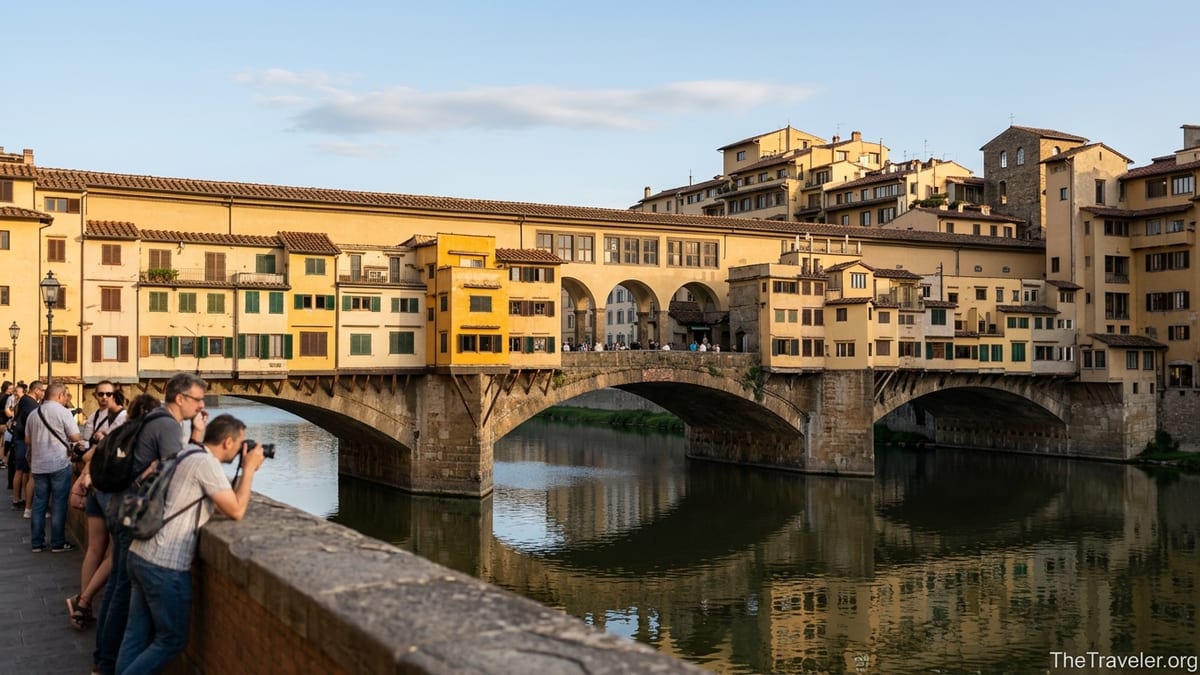
A Medieval Bridge That Refused to Disappear
Florence has had a crossing at the narrow bend of the Arno where Ponte Vecchio now stands since Roman times, but the stone bridge visitors see today dates to around 1345. Built as a three-arched structure in local stone, it was engineered to withstand the river’s violent winter floods that repeatedly destroyed earlier wooden bridges. When you lean over the parapet and look at the chunky stone piers splitting the river’s current, you are seeing a piece of fourteenth-century infrastructure still doing the job it was designed for.
Its survival is not accidental. The bridge occupies a strategic position connecting the historic civic heart around Palazzo Vecchio with the Oltrarno district. In practical terms, this meant constant use and constant maintenance. Even today, city workers routinely cordon off small sections of the pavement to inspect stones and drainage after heavy rain. Visitors who pass early in the morning may see utility vans parked awkwardly beside jewelry shop shutters, a reminder that this postcard view is also a functioning urban bridge.
Most remarkably, Ponte Vecchio was the only bridge in Florence not blown up by retreating German forces in August 1944. While every other crossing was destroyed to slow the Allied advance, this bridge was spared, reportedly on direct orders influenced by its historical and artistic value. Instead, buildings at either end were demolished to block access. That narrow escape gives today’s travelers the rare experience of standing on essentially the same medieval structure that merchants, dukes and soldiers have used for nearly seven hundred years.
Because of this continuity, walking across Ponte Vecchio is less like visiting a monument and more like joining a continuous stream that never really stopped. The view upriver to the simple stone arches of Ponte Santa Trinita and downriver toward modern bridges shows at a glance how unusual it is for a city to retain such a complete medieval crossing at its center.
From Butchers’ Stalls to the “Bridge of Gold”
The crowded little houses perched along the sides of Ponte Vecchio originally housed humble workshops. In the Middle Ages they were occupied by butchers, tanners and other trades that produced noise and waste best kept outside the city’s inner streets. Their scraps went straight into the Arno. By the late sixteenth century, this was no longer acceptable for the Medici, who had turned Florence into a polished ducal capital. In 1593, Grand Duke Ferdinando I issued a decree that expelled the butchers and reserved the shops on the bridge for goldsmiths and jewelers.
That decision reshaped the bridge’s identity. Today, nearly every doorway along the span belongs to a jewelry, gold or silver shop, making Ponte Vecchio something like a small, tightly packed luxury arcade in the open air. The Associazione Ponte Vecchio, a local merchants’ group, notes that this specialization has continued unbroken since the late 1500s, and some family businesses trace their roots back generations on the bridge. You can still sense this lineage when you see a grandfatherly workshop owner in a white coat leaning over a tiny anvil behind a glass display of modern pieces.
Prices vary widely. A simple silver charm or small pair of earrings might cost around 40 to 80 euros in one of the less ostentatious shops. At the other end of the scale, a handcrafted 18-karat gold necklace with diamonds in a historic boutique can easily run into the several thousands. Visitors swapping stories on travel forums frequently mention seeing similar-looking chains in Rome or Milan at noticeably lower prices, a reminder that the bridge’s location commands a premium. Locals often go instead to less scenic streets around Piazza Santa Croce when they want everyday gold jewelry without the Ponte Vecchio mark-up.
Despite that, the magnetism of buying something here is hard to deny. Some long-established houses, such as Dante Cardini or Fratelli Piccini, emphasize Florentine handwork and offer made-to-measure pieces, engraving and private terrace views over the river for customers marking engagements or anniversaries. Stepping into such a boutique is as much about the atmosphere as the purchase: creaking wooden floors, heavy safes, velvet-lined display cases and, through the back window, the Arno sliding past beneath the casement.
The Medici’s Secret Walkway Above the Crowd
Look up as you cross Ponte Vecchio and you will notice a continuous band of small rectangular windows and plastered wall running above the shop roofs. This is the Vasari Corridor, the elevated passage the Medici family used to move between their government offices in Palazzo Vecchio and their residence in Palazzo Pitti. Commissioned by Duke Cosimo I and designed by Giorgio Vasari, it was completed in 1565 in about five months, an astonishingly short time for a structure that winds for over 700 meters through and over the city’s core.
The corridor slips out of the Uffizi complex, crosses the Lungarno, runs along the north bank of the river and then crosses directly over Ponte Vecchio before ducking across rooftops in Oltrarno to reach the Pitti Palace. On the bridge, it slightly kinks around the medieval Torre dei Mannelli at the southeast corner because that family refused to let their tower be demolished. For observant travelers, this small bend is a telling detail: Florence’s powerful rulers could pierce walls and span rivers, but even they sometimes had to negotiate with local interests.
For centuries the corridor was closed to the public or accessible only on restricted tours. After an extended restoration, it reopened in December 2024 with a simplified interior that reflects its original function as a protected walkway rather than an exhibition hall. Visitors now typically access it on timed guided routes using a combined ticket with the Uffizi. The experience is quietly dramatic: narrow stone floors, low ceilings, and a sequence of windows framing the Arno, Ponte Vecchio’s roofline and the terracotta sea of Florence beyond.
Seen from inside the Vasari Corridor, Ponte Vecchio’s status as more than just a pretty bridge becomes obvious. It is literally the hinge of a power route, the place where the Medici stitched together their administrative and domestic worlds. Modern travelers often book corridor visits as a way to escape street-level crowds, but they come away with a sharper sense of how closely politics, architecture and everyday life intertwined here.
Views, Light and the Rhythm of a Florentine Day
Part of what keeps Ponte Vecchio iconic is the way it shapes and captures light on the Arno. Early in the morning, when jewelry shop shutters are still down and delivery vans are unloading, the bridge can feel almost quiet. Photographers and joggers claim this hour as their own, framing the empty cobbles through the arches of nearby Ponte Santa Trinita or standing mid-span to watch pale light crawl down the river toward the Cascine Park.
The atmosphere shifts dramatically by late morning. Tour groups spill onto the bridge from both ends, guides raising colored umbrellas near the small central widening to explain the history in three languages at once. By mid-afternoon in peak season, the pavement can be shoulder-to-shoulder, and crossing from one side to the other may take ten minutes. Street musicians choose the slightly wider central section, playing everything from classical violin to Italian pop songs, their sound bouncing off the shop fronts and the water below.
Sunset remains the most sought-after moment. The classic postcard shot is actually taken from Ponte Santa Trinita, looking back toward Ponte Vecchio as the low sun lights up its ochre facades and the small boxy shops cast reflections on the river. Travelers often time dinner reservations in nearby Oltrarno for 7:30 or 8:00 p.m., then walk over Santa Trinita around 6:30 p.m. in warm months to watch the sky change. On a clear May evening, you might see amateur photographers with smartphones shoulder-to-shoulder with visitors using tripods and full-frame cameras, all waiting for that slice of peach-colored light along the horizon.
Even after dark, the bridge does not entirely sleep. Many shops close around 7:30 or 8:00 p.m., pulling down heavy wooden shutters that turn their facades into a line of sculpted “treasure chests.” A handful of businesses – gelato counters tucked into corners, a wine bar on the Oltrarno side – keep serving passersby later. Couples linger along the parapets, and local teenagers sometimes cut across the bridge on scooters, weaving carefully around the last of the day’s visitors. The scene can feel surprisingly local once the big day-trip buses have gone.
Where the Bridge Meets Everyday Florentine Life
Although Ponte Vecchio attracts millions of visitors each year, it is still woven into the daily routines of Florentines. Office workers from the Uffizi area use it as a commute route to apartments or studios in Oltrarno, especially in winter when crossing a windy, more exposed bridge farther downstream feels less appealing. If you stand at one end around 8:30 on a weekday morning, you will see a distinct stream of locals dodging suitcase wheels and selfie sticks with practiced agility.
The bridge also acts as a narrow stage for local events. During Florence’s annual marathon each November, runners cross the Arno on Ponte Vecchio, the sound of thousands of shoes briefly drowning out the usual hum of conversations and camera shutters. On certain public holidays, city authorities decorate the parapets with flags, or a brass band might pause in the middle of the bridge to play a short set before moving on. For residents, these occasions cement the sense that Ponte Vecchio belongs to the city as a living space, not just to visitors as a photo opportunity.
Commercially, the concentration of high-end jewelry has created a micro-economy. Many shops are family-run, but others belong to larger groups that manage multiple storefronts under different names. Staff speak several languages, and you will often see sales associates greet visitors in English, Spanish or Mandarin before switching to rapid-fire Italian with colleagues. Tourist demand has brought both prosperity and tension. Local consumer associations periodically remind buyers to check for hallmarks and clear receipts, and stories circulate online of visitors who paid premium prices only to later discover similar pieces elsewhere for considerably less.
At the same time, there is a quiet network of trust between some shops and returning customers. Travelers who bought engagement rings on the bridge ten or twenty years ago sometimes return to have them resized or polished, or to choose a new piece to mark an anniversary. Jewelers keep detailed handwritten ledgers, and it is not uncommon to hear a proprietor recall, with some pride, “Your parents came here in 2004 and sat in that same chair.” Moments like this reveal a more intimate layer of the bridge beneath the constant churn of casual shoppers.
Planning Your Visit: Practical Tips on Crowds, Costs and Scams
To experience Ponte Vecchio at its best, timing matters. For quieter moments and softer light, aim for early morning before 9:00 a.m. or later in the evening after most day-trippers have left. Midday in high season often means slow-moving crowds and difficulty even reaching the parapet for a river view. If you want the classic sunset shot, consider walking over to Ponte Santa Trinita about 45 minutes before official sunset time and looking back toward Ponte Vecchio rather than trying to photograph it from on the bridge itself.
When it comes to shopping, go in with realistic expectations about price. Location and heritage add a substantial premium. A plain 18-karat gold band that might cost roughly 250 to 350 euros in a less famous Florentine jeweler can be significantly more expensive on the bridge. For elaborate pieces with diamonds or colored stones, it is common to see tags in the four-figure range. If your main goal is a fine piece of Italian gold at the best possible value, locals will often suggest browsing jewelry streets off Piazza Santa Croce or around the Duomo instead and saving Ponte Vecchio for window-shopping.
If you do decide to buy on the bridge, treat it like any major jewelry purchase back home. Ask clearly about the gold’s karat, whether stones are natural or lab-created and if the shop provides an international certificate for diamonds or high-value gems. In Italy, genuine gold pieces should carry a hallmark indicating purity, typically 750 for 18-karat. You have every right to ask to see it. Ensure your receipt lists the materials and karat, not just a vague description. Travelers have shared experiences online of spending over a thousand dollars on items that later showed quality issues or inconsistent documentation, and in those cases detailed paperwork can make a crucial difference if you need to dispute the charge.
Finally, keep an eye on your belongings as you would in any crowded tourist area. Pickpocketing is not rampant, but the combination of narrow space and heavy distraction makes Ponte Vecchio an easy hunting ground for opportunists. Use a cross-body bag that closes securely, keep phones and wallets out of back pockets, and step to the side if you need to stop to take photos so others can pass. With a bit of awareness, you can enjoy the bridge’s atmosphere without unnecessary stress.
The Takeaway
Ponte Vecchio remains one of Italy’s most iconic landmarks because it compresses so much of Florence’s story into a single, compact place. Its medieval arches speak to a city that once depended on the river as a lifeline. The transformation from butchers’ stalls to goldsmiths’ boutiques reflects the Medici’s drive to reshape Florence’s image from rough mercantile hub to refined ducal capital. The Vasari Corridor above hints at political intrigue and the constant need for safety. The crowds, street musicians and hurried office workers of today show that this is not a frozen museum piece but a bridge still used as a bridge.
For travelers, the real magic lies in approaching Ponte Vecchio as more than just a box to tick off a list of sights. Stand on the opposite bank at sunrise or sunset and watch how its mismatched facades catch the light. Step into a small jeweler’s shop and ask about the family history before you ask about prices. Notice the bend of the Vasari Corridor around the stubborn tower on its corner and imagine the negotiations it represents. In doing so, you will experience the bridge not simply as a backdrop for photos, but as a layered, living symbol of Florence itself.
FAQ
Q1. Why is Ponte Vecchio considered so special compared with other bridges in Italy?
Ponte Vecchio combines rare medieval architecture, continuous use since the 1300s, a unique row of historic shop-houses and the Medici’s Vasari Corridor into one compact landmark.
Q2. Is it worth buying jewelry directly on Ponte Vecchio?
It can be meaningful if you value the setting and tradition, but prices often reflect the famous location, so many visitors browse here and compare with shops elsewhere in Florence before deciding.
Q3. When is the best time of day to visit Ponte Vecchio to avoid heavy crowds?
Early morning before about 9:00 a.m. and late evening after most tour groups leave offer the quietest experience and gentler light for photos.
Q4. Where can I get the best photos of Ponte Vecchio itself?
The classic view is from Ponte Santa Trinita looking back toward Ponte Vecchio at sunset, when the bridge’s warm facades and shop fronts reflect in the Arno.
Q5. Can I visit the Vasari Corridor that runs over Ponte Vecchio?
Yes, access is via timed, ticketed visits organized through the Uffizi complex, typically as part of a guided route that crosses above the bridge and continues to the Pitti side.
Q6. Are the jewelry shops on Ponte Vecchio all family-run artisans?
Many are long-standing family businesses, but some belong to larger groups; you will find both traditional workshops and more modern boutiques sharing the same stretch.
Q7. How expensive is jewelry on Ponte Vecchio compared with other areas of Florence?
Jewelry on the bridge generally costs more than similar pieces in less touristed neighborhoods, reflecting both the historic address and the high demand from visitors.
Q8. Is Ponte Vecchio open at night, and is it safe to walk across?
The bridge is open 24 hours a day; while most shops close in the evening, it remains a well-lit, commonly used crossing and is generally considered safe with normal city precautions.
Q9. Did Ponte Vecchio really survive World War II when other bridges were destroyed?
Yes, it was the only major Florence bridge not blown up by retreating German forces in 1944, reportedly spared because of its historical and artistic significance.
Q10. How long should I plan to spend at Ponte Vecchio during a Florence visit?
Allow at least 30 to 45 minutes to walk across, explore the side streets and enjoy river views, longer if you plan to shop or photograph the bridge from neighboring crossings.