


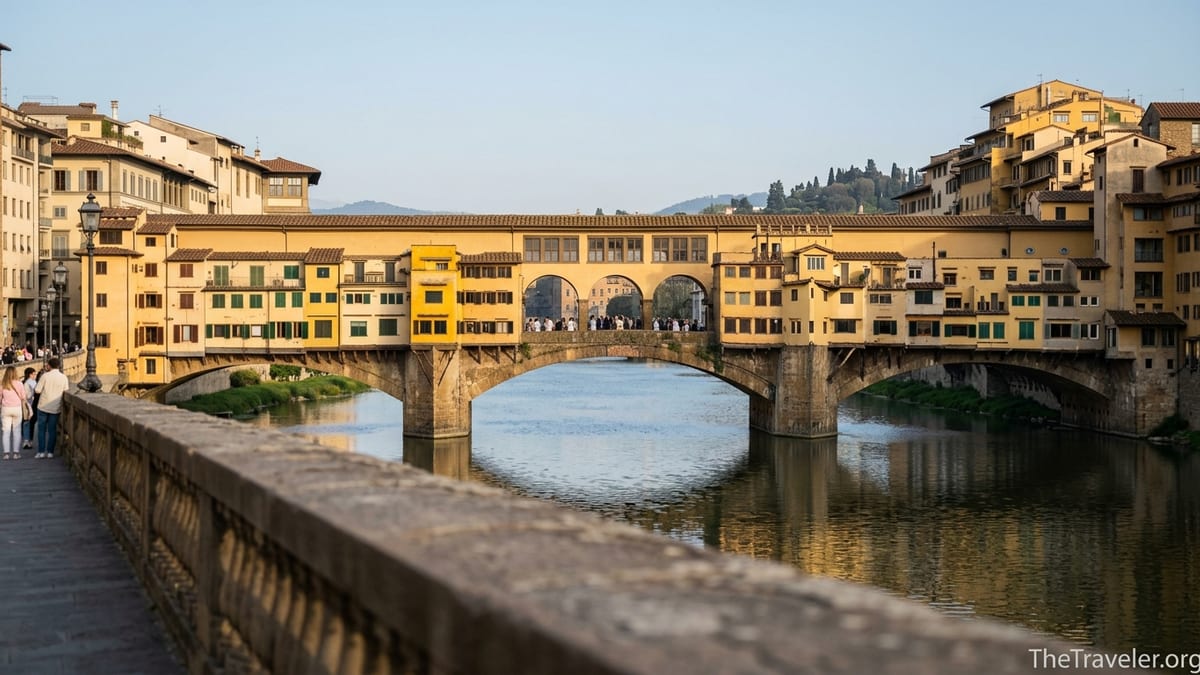
Ponte Vecchio is one of those places that looks effortless in photos: a jewel box of golden shopfronts hanging over the Arno, musicians playing, the river glowing at sunset. In reality, many travelers arrive on the bridge and feel overwhelmed, underwhelmed, or even ripped off. The problem is rarely the bridge itself. It is the small but costly mistakes people make when planning their visit. Here is how to experience Ponte Vecchio the way Florentines wish every visitor would.
Get the latest updates straight to your inbox!
Arriving at the Wrong Time of Day
The single biggest mistake visitors make is treating Ponte Vecchio as an anytime sight. In peak season, between roughly 10 am and 4 pm, the bridge can feel like a moving wall of people. Tour groups, day-trippers from cruise ships and school groups converge at once, and what should be a five-minute stroll can take twenty minutes of shuffling. Photography is frustrating, conversations are drowned out, and the romantic atmosphere disappears into the crowd.
Recent visitor guides and local tourism advice consistently recommend early morning or later in the evening as the sweet spots. Around 7 to 9 am, the light over the Arno is soft, shops are just starting to open, and you can actually stop at the stone balustrade without being elbowed aside. Late evening after about 8 pm, once most jewelry shutters are down, the bridge feels calmer again, with reflections of the ocher buildings rippling in the river and buskers playing for small, relaxed groups rather than packed crowds.
A common scenario: travelers staying near Santa Maria Novella station wander down to the river after breakfast and reach Ponte Vecchio around 11 am simply because it fits the day’s loop between the Duomo and the Oltrarno. They end up stuck in the densest crush of the day, get jostled by selfie sticks, and leave after ten minutes saying the bridge is “too touristy.” Planning your route the other way around, with an intentional early or late visit, turns the same landmark into one of the trip’s highlights.
Time of year matters too. Spring and early autumn usually bring gentler weather and slightly thinner crowds than July and August, when midday sun on the stone can be harsh and temperatures regularly climb high enough that standing in the open center of the bridge is uncomfortable. If you must visit at midday, at least cross quickly and enjoy your photos from a quieter vantage point like Ponte Santa Trinita instead.
Expecting Ponte Vecchio to Be a Bargain Jewelry Market
Another common mistake is arriving on Ponte Vecchio with the mindset of a flea market or outlet hunt. The bridge is lined with goldsmiths and jewelers for historic reasons, but today it is one of the most premium retail addresses in Florence. Rents are high and the clientele is largely international, so visitors are often surprised to see delicate 18-karat gold bracelets in the window with four-figure price tags, or simple charm necklaces that cost far more than similar-looking pieces in less famous streets.
Travelers regularly report buying a ring or pendant on the bridge, only to find nearly identical designs in shops around Piazza Santa Croce or in less central jewelry districts for noticeably less. That does not mean every purchase on Ponte Vecchio is a bad one; some long-established family workshops on the bridge still produce quality Florentine-style goldwork and one-of-a-kind pieces. But if you are sensitive to price, the mistake is using the bridge as your first and only reference point for jewelry shopping.
A more realistic strategy is to treat Ponte Vecchio as a showroom and inspiration. Note which styles you like, take mental or written notes of weights and prices, and then compare in a couple of other reputable jewelry streets in the historic center. Many visitors end up returning to the bridge to buy a particular piece after comparing, which is a far more confident purchase than impulsively handing over a credit card in the first glowing shop you step into.
If you do decide to buy, ask direct, concrete questions about karat, weight and origin, and request a formal receipt that clearly describes the item. Italian consumer law gives you protections, but they are easier to enforce when the paperwork is precise. Avoid assuming that every shop is a tiny artisan studio; several are essentially luxury boutiques aimed at tourists, and prices reflect that.
Ignoring Pickpockets and Street Hassles
The romantic narrowness of Ponte Vecchio is also what makes it a favorite working zone for pickpockets. Local safety advisories consistently flag the bridge and the streets immediately around it as classic hot spots, especially during the daytime peak when it becomes difficult to keep a clear bubble of space around yourself. Thieves work in pairs or small groups, using abrupt stops, sudden photo ops or minor jostles to create distraction.
A typical scenario looks like this: one person in front of you slows down suddenly to take a photo, the crowd behind compresses, and another person brushes against your side or back for a second longer than normal. A phone half-sticking out of a pocket or a wallet in an open tote is gone before you have even stepped back. Many victims only notice once they are off the bridge, when they reach for a card to pay for gelato in the Oltrarno and realise it has vanished.
The mistake is not in visiting Ponte Vecchio, but in assuming that because Florence feels safe overall, you can treat this bottleneck like a quiet neighborhood street. In practice, you should walk it the same way you would walk a major tourist crossing in any big European city: bag closed and in front, phone zipped away when not in use, wallet in a front or inside pocket, and no valuables in outer backpack pockets. If someone presses a bracelet, rose or sketch into your hands and then demands money, simply place it back in their hands or on a nearby surface and walk away without engaging.
Evening can feel calmer, but the same common-sense rules apply. Late at night, the bridge itself is usually quiet, and the bigger risk tends to be walking alone through near-empty streets after bars close. Most local universities and study-abroad programs in Florence specifically advise students to move in pairs at night, keep to well-lit main routes along the river, and use taxis if they feel uncomfortable walking back across town after midnight.
Seeing Only the Bridge and Skipping the Views
Many travelers make the mistake of treating Ponte Vecchio purely as a crossing point, without ever stepping back to see how beautifully it sits in the wider river landscape. The classic postcard view of the bridge is not from on top of it at all, but from Ponte Santa Trinita upstream, where you can see the three low arches, the jumble of ocher and mustard shopfronts, and the reflections stretching along the Arno.
A common pattern is that visitors walk from the Uffizi toward Palazzo Pitti, cross Ponte Vecchio in the thick of the crowd, take a quick selfie by the central balustrade, and keep going into the Oltrarno. Only later, when they see other travelers’ photos, do they realise they never actually saw the bridge at a distance. With a few extra minutes, they could have walked one bridge upstream or downstream and enjoyed not just better photos, but also a deeper sense of Florence’s riverside geometry.
The most rewarding approach is to build a simple loop. For example, walk from the Duomo or Piazza della Signoria down to the Arno and first cross at Ponte Santa Trinita, pausing in the middle for that wide view back toward Ponte Vecchio. After exploring a bit of the Oltrarno, return via Ponte Vecchio itself. Alternatively, if crowds on the bridge feel overwhelming, stay on the riverbank paths and photograph the bridge from the lungarni, where the water, sky and buildings all fit comfortably into a wide-angle frame.
Do not forget to look up when you are actually on the bridge. Above the jewelry shops runs the Vasari Corridor, the elevated passageway once used by the Medici family to move between Palazzo Vecchio and Palazzo Pitti. Its line of small windows and plastered exterior is easy to overlook if you are focused only on shop windows, but pausing to spot it adds a layer of history to what might otherwise feel like just another busy shopping street.
Treating Ponte Vecchio as a Quick Shopping Mall Stop
Because the bridge is packed with storefronts, many visitors default into a shopping-mall mindset: march across, glance into a few windows, mentally note the prices, and move on. In doing so, they miss the slower, more layered experience of Ponte Vecchio as both a working commercial street and a historic social space. Unlike a modern mall, the walkway is irregular, with worn stone underfoot, low doorways and tiny back rooms where jewelers repair pieces at old workbenches.
One mistake is to dip into the first shop you see just to say you bought something “on Ponte Vecchio.” Staff in the most prominent, gleaming boutiques at the northern entrance are used to fast, low-engagement sales and can sometimes feel brisk or transactional. If you simply slow down and explore a bit, you may find quieter workshops toward the southern end of the bridge where the owners are more inclined to talk about their craft, show you work in progress or explain the difference between Florentine engraving and other techniques.
A better way to approach the bridge is to separate your time into two short passes. On the first, perhaps in the morning, focus on the physical experience of crossing: lean on the railing to look down at the Arno, watch a rowing club slide under the arches, listen to a street musician set up in one of the wider bays. On the second, perhaps later that day, focus on the shops themselves if that interests you, stepping into just one or two that genuinely catch your eye rather than mechanically visiting every door.
Outside of jewelry, many small souvenirs on display are generic items that can be found throughout the historic center, sometimes for less elsewhere. If you want something distinctly Florentine but cannot afford gold, consider small silver pieces, cufflinks, or pendants featuring the city’s fleur-de-lis emblem, and again compare a couple of shops before you buy. The goal is to come away with something that feels personally meaningful, not just a purchase made under pressure because of the crowd behind you.
Forgetting Practical Comforts and Local Rules
Visitors often underestimate how physically tiring a simple bridge crossing can be when you combine uneven stone, heat, crowds and several hours of sightseeing on either side. Another frequent mistake is arriving in brand-new shoes or sandals with slick soles, only to find that the slightly sloping, sometimes polished stones underfoot become slippery when it has rained. Comfortable footwear with some grip is not just a hiking concern in Tuscany’s countryside; it genuinely matters on Ponte Vecchio as well.
Because the bridge itself is a public thoroughfare open 24 hours, there are no turnstiles, cafés or restrooms directly on it. Travelers who arrive in the middle of a hot afternoon carrying large shopping bags or wearing heavy jackets often find themselves overheating in the crush with nowhere to duck inside except high-end jewelry shops. Planning a brief break in a café on either side of the bridge before or after your visit can make the whole experience calmer and more enjoyable.
Local regulations in Florence’s UNESCO-listed center can also surprise visitors. Eating take-away meals or sitting with picnics directly on monuments or fragile stonework is increasingly discouraged and can lead to fines in certain marked areas. While Ponte Vecchio’s low walls are tempting places to perch with a slice of takeaway pizza, it is more considerate to finish food before you enter the tightest part of the bridge or to find a proper bench along the riverbanks. The same goes for open containers of alcohol at night, which draw more police attention in these sensitive historic zones.
Finally, photography etiquette is worth considering. It is absolutely acceptable to take pictures along the bridge and of the views, but some jewelry shops are wary of close-up shots of their displays, and staff may politely ask you to refrain or step back. Respecting those requests, and being aware of privacy when photographing musicians or other visitors at close range, helps keep the atmosphere relaxed for everyone.
Rushing Past the Oltrarno and Nearby Streets
Another mistake is treating Ponte Vecchio as nothing more than the fastest connection between the “real” sights of Florence on the north bank. In doing so, many travelers rush straight from the Uffizi area across the bridge to Palazzo Pitti and the Boboli Gardens, then promptly loop back, barely glancing at the Oltrarno’s side streets. Yet for many locals and long-term visitors, the neighborhoods just beyond the southern end of Ponte Vecchio are where Florence’s daily life still feels most authentic.
It is common to see first-time visitors cross the bridge, take a quick look at the exterior of Palazzo Pitti, and then double back to shop along Via de’ Tornabuoni. They miss atmospheric lanes like Via Santo Spirito or Borgo San Jacopo, where you can still find small artisan workshops, wine bars and bakeries that serve as neighborhood anchors rather than pure tourist pipelines. Spending even an extra hour wandering a few blocks into this area turns Ponte Vecchio from an isolated photo stop into the gateway for a richer neighborhood experience.
A practical way to correct this is to plan a meal or a coffee stop in the Oltrarno instead of near the Duomo on the same day that you visit Ponte Vecchio. For instance, you might cross the bridge in the early evening, linger for sunset photos from the riverbank, then continue a short distance into the Santo Spirito area for dinner on a quieter piazza. This way the bridge becomes part of a coherent evening rather than a box to tick on a checklist of monuments.
Conversely, if you are staying on the Oltrarno side, resist the urge to use Ponte Vecchio nonstop as your default route into the historic center. Mixing it up with other bridges like Ponte alla Carraia or Ponte alle Grazie not only eases the crowding slightly but also gives you different visual angles on the river and skyline, which can be just as memorable.
The Takeaway
Most disappointments on Ponte Vecchio stem from a handful of avoidable missteps: arriving in the worst heat and crowd of the day, treating the bridge as a bargain jewelry market, ignoring basic pickpocket awareness, or rushing across without ever stepping back for the views or into the surrounding streets. Correct those, and the very same place transforms from a stressful bottleneck into a highlight of Florence.
Plan your visit deliberately in early morning or later evening, approach the jewelry with clear eyes and no rush to buy, keep your belongings secure, and take time to admire the bridge both from its deck and from the neighboring bridges and riverbanks. Use Ponte Vecchio as a gateway into the Oltrarno rather than a dead end, and it will reward you with exactly what drew you to Florence in the first place: history layered with daily life, beauty that reveals itself when you slow down, and the feeling of walking through a city that still lives on the same streets it has used for centuries.
FAQ
Q1. What is the best time of day to visit Ponte Vecchio to avoid crowds?
The calmest times are generally early morning between about 7 and 9 am, or later in the evening after around 8 pm, when tour groups have thinned and the light over the Arno is softer.
Q2. Is it safe to walk across Ponte Vecchio at night?
The bridge itself is usually calm and feels safe in the evening, but you should use the same precautions you would in any busy European city: stay aware of your surroundings, avoid walking completely alone very late at night, and stick to well-lit routes back to your accommodation.
Q3. Are the jewelry shops on Ponte Vecchio a good place to buy gold?
The shops are known for quality pieces and historic craftsmanship, but prices are often higher than in less famous streets. Many travelers use the bridge to see styles and then compare prices with reputable jewelers elsewhere in the historic center before deciding where to buy.
Q4. What are the typical opening hours of shops on Ponte Vecchio?
Most jewelry shops follow standard Italian retail hours, opening roughly mid-morning and closing around early evening, often with reduced hours or closures on Sundays. The exact schedule can vary by shop and season.
Q5. Can cars or taxis drive over Ponte Vecchio?
No. Ponte Vecchio is a pedestrian-only bridge, so you will always cross it on foot. Taxis and private cars drop passengers on streets nearby, and from there it is a short walk to the bridge.
Q6. Is it true that pickpocketing is common on Ponte Vecchio?
Yes, pickpocketing is more common where crowds are dense, and Ponte Vecchio is one of Florence’s most crowded spots. Keeping bags closed and in front of you, and avoiding phones or wallets in back pockets, significantly reduces your risk.
Q7. Does Ponte Vecchio ever close to the public?
The bridge itself is a public thoroughfare and is open 24 hours a day under normal circumstances. However, the individual shops close in the evening, so after that time you will find only shuttered storefronts and the open walkway.
Q8. Where can I get the best photos of Ponte Vecchio?
For a full view of the bridge, walk to Ponte Santa Trinita upstream or to riverbank paths along the Arno. On the bridge itself, the small openings along the balustrade in the center provide classic views of the river and city.
Q9. Are there toilets or cafés directly on the bridge?
No, there are no public restrooms or cafés on Ponte Vecchio itself. Plan to use facilities in nearby bars, restaurants or museums on either side of the river before or after crossing.
Q10. Is visiting Ponte Vecchio worth it if I am not interested in shopping?
Yes. Even if you never step into a jewelry shop, the bridge offers historic architecture, Arno views, street music and an important sense of how Florence’s two riverbanks connect. Many visitors enjoy it most when they focus on the views and atmosphere rather than on shopping.