


The first time I stepped onto Florence’s Ponte Vecchio, I expected a pretty bridge lined with jewelry shops. What I did not expect was that a simple walk across its worn stones would reorder how I understood the city’s entire history. In the crush of tourists and gold displays, it is easy to miss that this narrow crossing over the Arno is a kind of open-air archive. If you know what to look for, each stretch of the bridge marks a shift in Florence itself, from medieval marketplace to Medici power play to wartime survival and modern tourism.
Get the latest updates straight to your inbox!
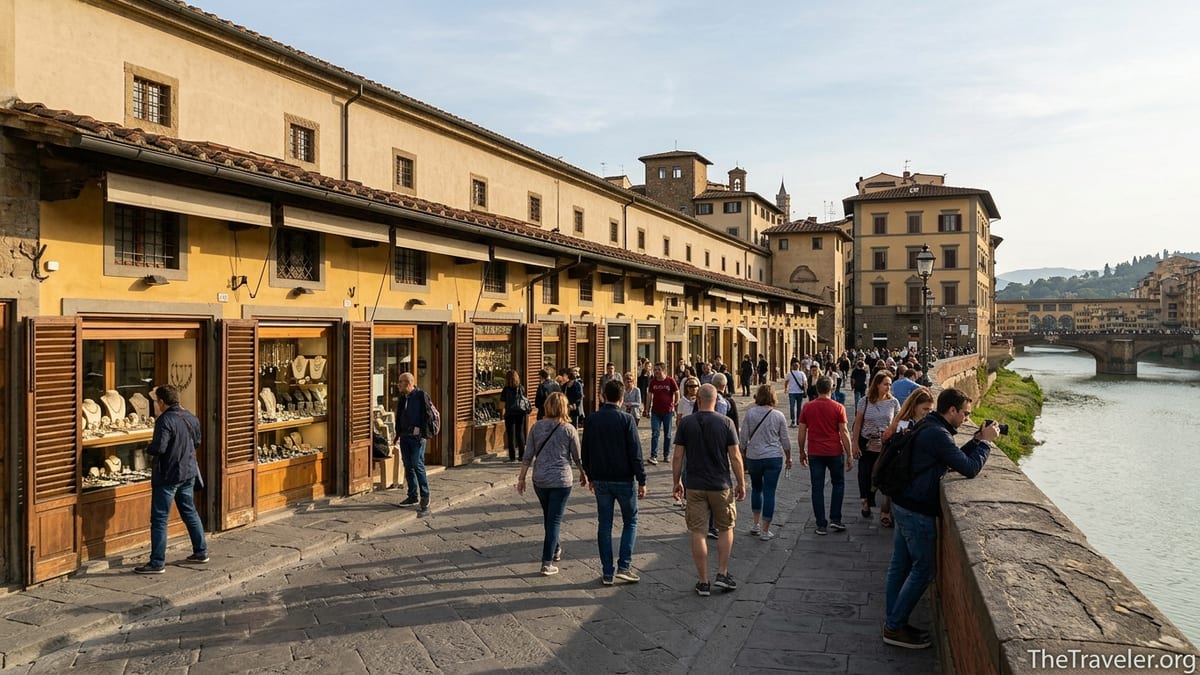
Arriving on the Bridge: First Impressions and Hidden Layers
The modern visitor usually reaches Ponte Vecchio by following the spine of central Florence: past the Palazzo Vecchio and the Uffizi, downhill toward the river. The approach is unassuming. One moment you are on an ordinary stone street, the next you are entering what feels like a tiny, crowded village hovering above the Arno. Silver bracelets and gold chains glitter in the windows, and selfie sticks poke the sky. It takes a moment to realize that the jewelry and the crowds are just the surface of something far older.
Architecturally, Ponte Vecchio is a three-arch stone bridge whose current form dates to the mid‑14th century, after floods destroyed earlier wooden crossings. Today it is hard to see the arches from the center because the bridge is walled in by two continuous rows of shops, a design common to medieval European bridges but now almost extinct. From street level, especially if you enter from the Uffizi side, the bridge feels less like infrastructure and more like an improbably narrow shopping street that happens to sag slightly in the middle.
What transforms this first impression is the realization that everything you see is layered onto survival. The bridge has outlived catastrophic floods and, remarkably, the systematic destruction of Florence’s other river crossings near the end of the Second World War. German forces demolished every other bridge in the city except Ponte Vecchio, blowing up the buildings at each end instead and leaving this one stone span standing. Local guides still recount the story that even Hitler, who visited Florence before the war, was taken by the bridge’s beauty and allegedly ordered it spared. Whether or not the legend is literally true, the fact remains that the bridge you are walking today is the same physical structure that spanned the Arno in 1944 while the rest of the riverbanks lay in rubble.
That realization changes the sensation of stepping onto the pavement. It is no longer just a pretty place to browse engagement rings. It is the last intact witness to some of Florence’s darkest and most turbulent nights. Every jostle from a tour group, every flash of a camera, happens on stones that somehow slipped through the logic of war.
Where Butchers Once Stood: Smells, Status and a Medici Makeover
Most travelers encounter Ponte Vecchio as the jewelry bridge. Opening hours and price tags confirm it. Many shops display 18-karat gold necklaces and rings that can easily reach several hundred euros or more, and window cards list certifications that reassure buyers about the purity of the metal. But for centuries this was not a place of luxury. In the Middle Ages, the bridge hosted butchers, fishmongers and tanners, trades defined not by glitter but by smell.
If you pause halfway across and lean on the stone parapet facing upstream, it becomes easier to imagine why. Before strict environmental controls, bridges were practical vantage points to dump waste into the water below and let the current carry it away. In a city where space inside the walls was precious, Ponte Vecchio doubled as a conduit for animal parts and fish offal, with runoff sluicing directly into the Arno. Contemporary accounts describe the stench as overpowering on warm days.
The turning point came in the 16th century, when the Medici family shifted their main residence across the river to the Pitti Palace. With the ruling dynasty now commuting back and forth each day, the smells of the bridge were no longer acceptable. Grand Duke Ferdinando I de’ Medici ordered the removal of the meat and fish stalls and reserved the bridge’s premises for goldsmiths and jewelers, a deliberate upgrade of both scent and status. Many of today’s shops still belong to families tied to that original wave of artisans, and you can see their names inscribed on the little wooden shutters that fold down to seal each boutique at night.
Knowing this while you walk changes how you read each glint of gold. Instead of seeing a random tourist-oriented marketplace, you are witnessing a 16th‑century urban policy decision still in force. The transformation from butcher bridge to jewelry bridge was not a natural evolution. It was a top‑down redesign of city life, stamped in gold and polished through centuries of practice.
The Vasari Corridor Overhead: A Private Highway of Power
Look up along the eastern side of Ponte Vecchio and you will notice a long, enclosed walkway running above the shops, punctured by small, square windows. This is the Vasari Corridor, built in 1564–1565 by the architect and painter Giorgio Vasari at the order of Cosimo I de’ Medici. Its purpose was nakedly political: to link the Medici’s working headquarters at the Palazzo Vecchio and Uffizi with their residence at the Pitti Palace without requiring the family to mingle with crowds or risk assassination on the open streets.
The corridor snakes almost a kilometer across the city, slipping along the top edge of the Uffizi, crossing the Arno on Ponte Vecchio, threading behind church facades and above private houses in the Oltrarno before diving into the Pitti complex. From the bridge, it looks like an oddly placed upper floor; from inside, it was a secure and exclusive passageway. Historical records describe how the meat market was pushed off the bridge to the newly built Loggia del Pesce near Piazza della Repubblica, specifically to keep unpleasant smells away from the Medici’s new route.
Until recently, the Vasari Corridor was largely closed to casual visitors, accessible only on limited tours. After a long restoration, scheduled reopening has been phased in so that more travelers can walk this same elevated route, viewing both the Arno and the crowds on Ponte Vecchio through small windows. Ticketed access is controlled, and prices are noticeably higher than a standard museum entry, reflecting the corridor’s delicate condition and limited capacity. Even if you do not go inside, simply knowing it is there recasts the scene below. The jumble of tourists and hawkers turns into a kind of moving stage for an absent audience of princes and courtiers.
As you look up from the jewelry windows and spot the corridor’s stone arches, Florence’s history becomes stratified: commoners and merchants at street level; rulers gliding above, eyes level with terracotta rooflines, insulated from the noise. The bridge becomes an anatomy lesson in power, with layers that are still visible in the masonry.
Reading the Bridge Like a Timeline
Walking from the north bank, near the Uffizi, toward the artisan quarter of the Oltrarno, you can read Ponte Vecchio almost like a linear timeline. The tightly packed jewelry shops, with their outward-jutting wooden cases, evoke the Medici decision to elevate the trades. The overhead corridor marks the consolidation of ducal authority in the late Renaissance. Halfway across, the central series of arches opens to a wider little piazzetta where buskers play guitars and couples stop for photos. This gap, with its low stone wall, offers the classic postcard view of the Arno framed by upstream and downstream bridges.
To the east, you see Ponte alle Grazie, rebuilt in concrete and stone after the war to resemble a simplified version of its medieval ancestor. To the west stand other modern crossings, all younger than Ponte Vecchio. Knowing that every other bridge you can see from your vantage point was reduced to rubble in 1944 and then painstakingly reconstructed lends a strange weight to the quiet chitchat around you. Somewhere under the music and chatter is the memory of soldiers planting explosives in the narrow streets at each end of this bridge and local residents waking to find their city sliced in two.
Floods left their marks as well. The devastating Arno flood of November 1966, which inundated churches and museums, battered Ponte Vecchio with floating cars, tree trunks and debris. Contemporary photographs show the arches nearly swallowed by brown water. Today you can still find, along nearby streets, plaques indicating the height the waters reached, sometimes well above head level. When you glance over the parapet and see the water glittering far below on a calm day, it takes an extra act of imagination to picture it snarling just beneath your feet.
This layering of catastrophe and continuity redefines the bridge from a romantic background for engagement photos to an active timeline of what Florence chose to rebuild and what it managed to preserve intact. For many travelers, that shift is the moment Ponte Vecchio stops being merely picturesque and becomes a key to reading the whole city.
Everyday Life on an Extraordinary Bridge
Despite the weight of history, Ponte Vecchio is still a workplace and a piece of everyday infrastructure. If you arrive early, around 8 a.m. on a weekday outside high season, you may see shopkeepers raising their wooden shutters, sweeping doorways and quietly chatting with neighbors as delivery staff maneuver small carts of goods through the narrow channel left between displays. Prices in the cases range from modest silver earrings at more approachable amounts to elaborate gold necklaces that can run into several thousand euros, aimed at serious buyers who may have arranged appointments in advance.
Locals tend to traverse the bridge quickly, using it as a pedestrian shortcut between the banking district near Via Tornabuoni and the artisan workshops of the Oltrarno. Many avoid the densest crowds by diverting to Ponte Santa Trinita upstream, which offers its own beautiful perspective back toward Ponte Vecchio’s jumble of shopfronts. Yet even hardened Florentines slow their pace when an evening sky streaks pink above the tiled roofs, or when floodlights switch on and the whole structure glows gold against the river’s darkening surface.
For travelers, it helps to time your visit with a specific purpose in mind. A midday crossing in July will be hot, loud and packed, with tour groups following raised umbrellas and guides explaining, in multiple languages, the story of the Medici and the spared bridge. A winter evening visit after rain will be quieter, with reflections of the jewelry windows shivering in puddles on the stone. Both are authentic experiences, but they offer different ways of sensing how life continues to flow across this ancient spine.
Real-world choices underscore that continuity. You might buy a simple silver ring here, paying a little more than you would in a generic high-street shop elsewhere, in exchange for the experience of negotiating with a family-run jeweler whose ancestors once served dukes. Or you might simply pause to listen to a busker play an Italian pop classic while you watch rowers glide under the arches below. In either case, daily life and deep history intermingle in a way that is hard to separate.
Understanding Florence Through the Bridge
What makes Ponte Vecchio so revealing is that it condenses Florence’s broader story into a single walkable line. The city’s identity as a commercial crossroads is there in the bridge’s original role as a market for meat and fish, serving neighborhoods on both banks of the Arno. Its era as a ducal capital is inscribed in the Vasari Corridor and the strategic removal of “low” trades to make way for goldsmiths more fitting to a princely commute. The traumas of modern conflict are visible in the reconstructed silhouettes of the neighboring bridges and in the almost miraculous survival of this one.
Even the tension between preservation and tourism comes into focus on the bridge. City authorities periodically debate how to manage the flow of visitors, discourage unauthorized street vendors and protect both the structure and the small businesses that operate on it. Shop rents along the bridge are thought to be among the highest per square meter in Florence, a fact that pushes tenants toward high-margin items like fine jewelry and premium souvenirs. When you see a bracelet priced well above what you expected, you are not just encountering a tourist markup; you are glimpsing the economic pressure of maintaining a medieval monument in a 21st‑century property market.
For a traveler, absorbing this context changes how you relate to the rest of the city. When you visit the Uffizi and see portraits of Medici rulers, you can imagine them slipping into a private corridor behind the gallery walls to cross the river above ordinary citizens. When you stand in Santa Croce or San Lorenzo and read about the 1966 flood, you can recall how high the water must have surged around the bridge’s arches. Ponte Vecchio becomes less an isolated highlight and more a connective thread that ties different neighborhoods, eras and social classes together.
By the time you step off the southern end into the Oltrarno, with its quieter piazzas, artisan workshops and family-run trattorias, you may find you are reading Florence differently. Street names, tower silhouettes and flood markers become clues rather than mere background. Your understanding of the city’s history is no longer confined to museums and guidebooks; it has been built under your feet while you walked.
The Takeaway
Many travelers treat Ponte Vecchio as a compulsory stop, a place to tick off a photograph before moving on to the next sight. Yet giving yourself time to really walk the bridge, to look up at the Vasari Corridor, down at the water and along the serried ranks of shopfronts, can transform it into one of the most revealing experiences in Florence.
The bridge gathers into a single span the city’s shifts from medieval practicality to Renaissance power, from wartime vulnerability to postwar reconstruction and today’s balancing act between heritage and mass tourism. Every jewelry window sits where a butcher once gutted animals; every romantic sunset view is framed by a structure that survived both explosives and floods. When you cross with this awareness, the crowds around you cease to be an annoyance and become fellow actors in a centuries-long story of how Florence chooses to present itself to the world.
In the end, walking across Ponte Vecchio changed how I understood Florence not because it offered the city’s most beautiful view, but because it showed how much of the city’s soul is compressed into a single, constantly used piece of stone. It is here that politics turned into architecture, that destruction turned into legend, and that everyday errands still pass through a corridor of history. The next time you find yourself approaching the Arno, consider slowing your pace. The bridge will carry you across the river either way, but if you let it, it will also carry you deeper into Florence’s past.
FAQ
Q1. Why is Ponte Vecchio considered so historically important?
Ponte Vecchio concentrates centuries of Florence’s history in one place, from its medieval market origins and Medici-era transformations to its survival of wartime destruction and major floods.
Q2. Was Ponte Vecchio really the only bridge in Florence spared during World War II?
Yes, during the German retreat in 1944 all other bridges in central Florence were destroyed, while Ponte Vecchio was left standing and nearby buildings were demolished instead.
Q3. Why are there so many jewelry shops on the bridge?
In the late 16th century the Medici rulers expelled butchers and fishmongers from the bridge and reserved the premises for goldsmiths and jewelers, a tradition that continues today.
Q4. Can visitors walk inside the Vasari Corridor above the bridge?
Access to the Vasari Corridor has historically been restricted, but after restoration it has been gradually reopening through controlled, ticketed visits managed with the Uffizi complex.
Q5. What is the best time of day to walk across Ponte Vecchio?
Early morning and late evening are usually less crowded, offering a calmer experience and softer light on the river compared with the peak midday rush.
Q6. Is it affordable to buy jewelry on Ponte Vecchio?
Prices vary widely, but rents and prestige mean costs are generally higher than in ordinary shops, especially for gold; more modest silver pieces can be comparatively accessible.
Q7. How long does it take to walk across the bridge?
The bridge itself is short and can be crossed in a few minutes, but lingering to explore the shops, views and details can easily turn it into a half‑hour or longer visit.
Q8. Does Ponte Vecchio still serve a practical role for locals?
Yes, despite the tourists it remains a functional pedestrian crossing between the historic center and the Oltrarno, used daily by residents commuting on foot.
Q9. Are there good photo spots near Ponte Vecchio?
Many photographers prefer to shoot the bridge itself from neighboring crossings such as Ponte Santa Trinita, which offers a full view of its arches and shopfronts.
Q10. How did the 1966 Arno flood affect Ponte Vecchio?
The 1966 flood sent debris and high water surging against the arches, causing damage but not collapse; the bridge survived, and nearby buildings and streets bear high‑water markers today.