


Antibes is spoiled for choice when it comes to beaches, but two names come up again and again when travelers compare notes over an evening pastis: Plage du Ponteil and Plage de la Gravette. Both are sandy, both are central, and both have loyal local followings. Yet they deliver very different moods and practical experiences. If you only have a day or two on the Côte d’Azur, which Antibes beach is likely to leave the better impression on you and your travel companions?
Get the latest updates straight to your inbox!
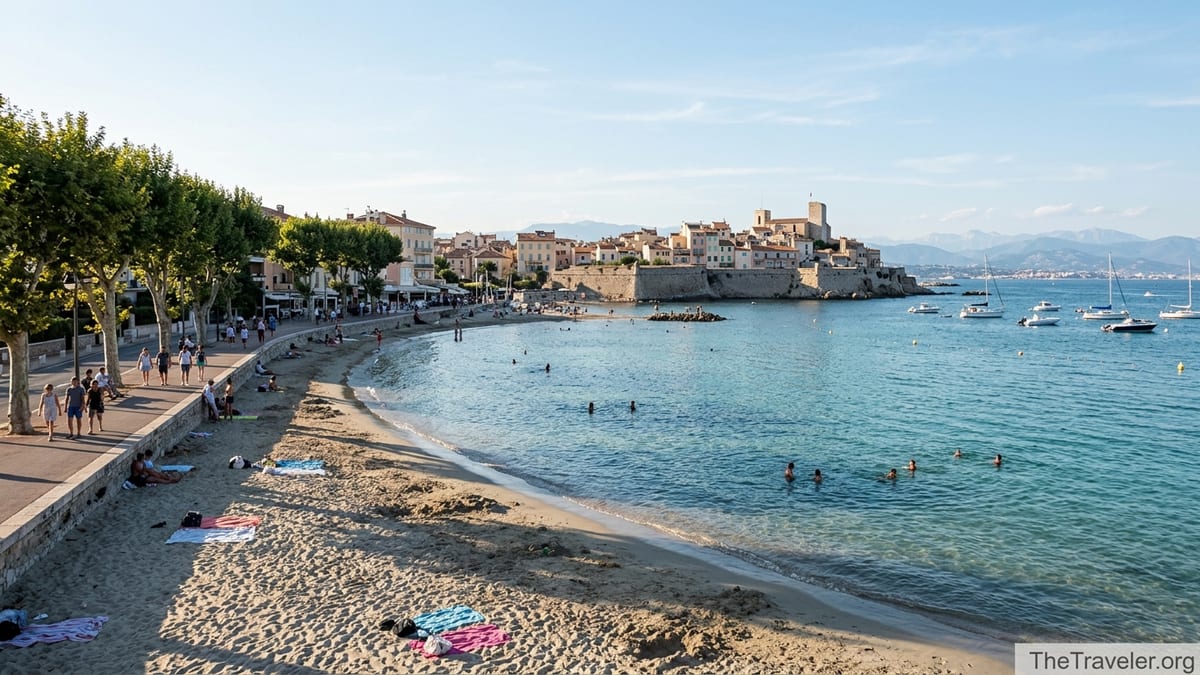
Setting the Scene: Two Very Different Antibes Beaches
Plage de la Gravette sits right below the medieval ramparts of Old Antibes, tucked between the fortified walls and Port Vauban. It is a compact horseshoe cove, sheltered by a breakwater that keeps the water calm and shallow for a long way out. From your towel you look back at stone ramparts and tiled roofs, or out toward Cap d’Antibes and the boats sliding into the harbor. It feels like a city beach in the best sense: steps from the old town market and cafés, yet surprisingly cut off from street noise.
Plage du Ponteil, by contrast, stretches out along Boulevard James Wyllie, a long ribbon of pale sand facing the bay and the distant Alps. Locals often say this is “their” everyday beach, a place to jog the promenade at sunrise, bring the kids after school, or meet friends for an evening swim. Behind the sand, a tree‑lined promenade with benches runs the length of the beach, giving it a relaxed neighborhood feel that is very different from Gravette’s walled cove atmosphere.
Geographically, Gravette is your obvious choice if you are staying inside the old town and want a quick dip between sightseeing stops. Ponteil lies a pleasant 10 to 15 minute walk south of the ramparts, effectively bridging Old Antibes and the Cap d’Antibes peninsula. Many visitors naturally use both, but first‑timers often end up preferring one over the other depending on whether they want a historic city cove or a broader, more open bay.
The key impression you take away from each beach is set from the moment you arrive. At Gravette you step through stone walls or down from the port side with the town at your back. At Ponteil you descend from a waterfront road lined with mansions and gardens, with Cap d’Antibes curving away in front of you. Both feel unmistakably Mediterranean, yet the mood could not be more different.
Access, Parking, and Ease of Getting There
If convenience is your top priority, especially without a car, Plage de la Gravette is hard to beat. From the Marché Provençal in Old Antibes, you can be spreading your towel on the sand in under five minutes. You simply follow the narrow streets toward the sea, pass through a gap in the ramparts beside Port Vauban, and the entire cove opens below. This makes it ideal for cruise passengers or day‑trippers who only have a few hours in town and do not want to spend time walking along the coast.
Parking for Gravette tends to revolve around Port Vauban. The multi‑level Vauban car park sits just outside the old walls and usually offers spaces in the shoulder seasons. In July and August, drivers often report paying around 2 to 3 euros per hour in the busiest daytime slots, and spots can fill by late morning. On a typical August Thursday, for example, arriving at 9:30 a.m. may give you a choice of shaded spaces on an upper level, while showing up after lunch could mean circling or opting for a more distant lot and a 10‑minute walk in the sun.
Ponteil offers a different access profile. The beach runs alongside a long strip of roadside and small car parks that locals know well. The dedicated Parking du Ponteil, just behind the sand, is particularly sought after in summer. Local guides in 2026 note that the blue‑zone spaces here and on nearby streets often fill as early as 8:30 a.m. in peak season, especially on weekends, and stays may be time‑limited, so you need to keep an eye on the parking disc or meter. Arriving by 8:00 a.m. in July almost feels like joining a quiet club of regulars carrying baguettes and beach umbrellas.
Without a car, reaching Ponteil is still straightforward. From the old town, you can stroll along the seafront via Plage de la Salis, or cut through town and rejoin the waterfront near the promenade, in about 15 minutes at an easy pace. Buses serving Cap d’Antibes also pass nearby, but most visitors find the walk scenic and enjoyable. For families with strollers, the promenade and gentle slopes give Ponteil a slight edge in comfort, whereas Gravette’s access involves ramps or steps through the ramparts that can feel a bit narrower and more crowded at busy times.
Sand, Water, and Swimming Conditions
Both Plage du Ponteil and Plage de la Gravette stand out on a coast better known for its pebbles. Gravette’s beach is a mix of fine sand and small white gravel, giving the water an almost luminous turquoise quality on sunny days. The cove is shallow for a long distance, and the breakwater shields it from waves and most wind. Parents often appreciate that children can wade and paddle near the shore without encountering sudden drop‑offs, although the rocky base near the far end can surprise taller swimmers with the occasional scraped knee if they venture too close to the barrier.
Ponteil’s sand feels softer underfoot than Gravette’s in many areas, especially in the center of the beach. The seabed slopes more gradually than many Riviera spots, and the bay remains relatively calm thanks to its orientation and offshore protection. On a typical August afternoon you will see stand‑up paddleboards gliding past, teenagers diving from small inflatables, and older swimmers following the buoys parallel to shore to get in a proper workout. Water sports here are relatively low‑key compared with the more adrenaline‑driven beaches of Juan‑les‑Pins, but kayak or paddleboard rentals occasionally appear in high season.
Water quality has been a point of discussion for Gravette in the past because of its position near the port and the enclosed nature of the cove. In recent years local reports note clear improvements after infrastructure upgrades, and regular monitoring in summer helps reassure bathers. Even so, on very busy days after heavy rain, some locals will choose Ponteil or nearby Salis instead, feeling more comfortable with the more open water circulation in the bay. If you are particularly sensitive or traveling with young children, it can be worth checking local beach information panels each morning for the latest bathing recommendations.
From a purely sensory standpoint, Gravette impresses with its clear, glassy shallows; Ponteil wins with its broader horizons and, on clear days, long views up the coast toward Nice and the distant Alpine ridges. If your idea of a memorable swim is floating in an amphitheater of stone walls and bobbing boats, Gravette will stay in your memory. If you prefer to feel part of a wide, open bay, Ponteil is likely to leave the stronger impression.
Atmosphere, Crowds, and Overall Vibe
Plage de la Gravette pulses with the energy of Old Antibes. In July and August it fills quickly with a tight blend of local teenagers, families based in the old town, and visiting travelers who have wandered down from the market. Towels are close together, and by midday you may find yourself chatting with the group next to you about restaurant tips or the best gelato stand in the old streets above. The surrounding stone walls trap the heat, so in the height of the afternoon it can feel like a sun‑soaked bowl.
In shoulder seasons, Gravette’s mood transforms. On a mild day in late May or early October you might share the sand with only a handful of locals, some reading in the shade of the ramparts while others swim slow laps across the cove. The proximity to the old town means you can easily nip up for an espresso or a fresh socca slice, then wander back down for another dip. This makes Gravette particularly atmospheric for travelers visiting outside school holidays.
Ponteil tends to feel less enclosed and more residential. The crowd skews strongly local, with many Antiboise families returning to the same stretch of sand year after year. In the late afternoon, office workers join parents and children for a quick sea swim before dinner. The promenade behind the beach becomes a social stage, with joggers, dog walkers, and grandparents pushing strollers. In August it is certainly busy, but because the beach is long rather than deep, you can usually walk a little further along to find a slightly quieter patch, especially toward the Salis end.
The atmosphere at Ponteil after sunset is one of its secret charms. While Gravette tends to empty out as the old town evening restaurant rush begins, Ponteil’s promenade stays active with locals strolling under the plane trees, often pausing on the benches to watch the last light fade over the bay. If a beach that feels folded into daily local life appeals to you, Ponteil is likely to resonate more deeply than Gravette’s more tourist‑centric cove.
Facilities, Food Options, and Comfort on the Sand
Both beaches provide basic facilities in summer, including lifeguards during peak months and freshwater showers. At Gravette, the simple showers and a public toilet area just inside the walls help keep things practical for families. The beach is entirely public, with no private clubs, so you will need to bring your own umbrella or rent basic equipment from seasonal vendors when available. Because space is limited, shade can be at a premium in mid‑afternoon, although the ramparts cast a welcome shadow late in the day as the sun drops behind the rooftops.
Ponteil also offers showers and seasonal lifeguard stations, along with the advantage of a longer promenade where you can retreat to benches under trees if you need a break from the sand. An important distinction is the presence of a private beach club, Royal Beach, at one end of Ponteil. For travelers who like a bit more comfort, renting a sun lounger and parasol here for the day typically costs in the rough range you would expect on the Côte d’Azur, with prices varying by row and season. The club atmosphere is more low‑key than some of the famous “see and be seen” spots in Cannes or Juan‑les‑Pins, but you still get table service, cocktails, and a more cushioned experience of the bay.
Food options differ subtly between the two beaches. Gravette lends itself perfectly to picnics. Many visitors stop by a boulangerie for baguette sandwiches or gather olives, cheese, and fruit from the Provençal market before heading down. At the back of the beach there is often a kiosk selling cold drinks, snacks, and ice creams, but serious dining means walking back up into the old town, where you can choose between harbor‑view terraces, small bistros in the lanes, or family‑run crêperies.
At Ponteil, the immediate surroundings include a handful of snack stands and cafés within a few minutes’ walk, as well as the Royal Beach restaurant offering full meals right by the water, from salads and grilled fish to more indulgent desserts. Because the promenade links seamlessly toward Salis and Cap d’Antibes, you can easily turn a beach day into a longer coastal stroll, stopping at another café or beach bar along the way. If your comfort checklist includes ready access to shaded seating, sit‑down meals, and the option of private‑club amenities, Ponteil again has the edge.
Best Beach for Families, Couples, and Active Travelers
Families with small children often gravitate to Plage de la Gravette for its bathtub‑like conditions. The shallow, protected water encourages even hesitant swimmers to splash far from shore, and the enclosed cove makes it easy to keep an eye on kids. Being close to the old town means you can retreat quickly to your apartment or hotel for naps or a change of clothes. A typical family day might involve a morning at the market, a few hours building sandcastles at Gravette, lunch at a nearby pizzeria, then an afternoon exploring the Picasso Museum overlooking the sea.
Ponteil also works well for families, particularly those with slightly older children who want space to throw a ball, practice paddleboarding, or swim longer distances. The sand is kinder on bare feet, and the wider beach allows more room for beach games without disturbing neighbors. Many Antibes residents see Ponteil as the natural progression as their children grow, starting at Gravette when they are toddlers and migrating gradually to Ponteil and Salis for more freedom and activity.
Couples might choose differently depending on the mood they seek. Gravette can feel wonderfully intimate at the edges of the day, especially at sunrise or on a calm October afternoon when the crowds have thinned. Sitting with your back against the ramparts as fishing boats slip in and out of the port is undeniably romantic. Ponteil, meanwhile, offers sunset walks, long sea views, and the option to continue along the coastal path toward Cap d’Antibes, pausing at viewpoints over small coves like l’Olivette or the Garoupe area.
Active travelers who like to mix beach time with jogging or longer swims tend to favor Ponteil. The promenade provides a flat running route connecting the town center to Salis and beyond, and the series of buoys make it easier to judge distances for open‑water training. That said, Gravette’s calm water can be a reassuring environment for beginner swimmers or those testing out snorkeling gear for the first time before heading to rockier coves.
Which Beach Leaves the Better Overall Impression?
When travelers compare Plage du Ponteil and Plage de la Gravette after a few days in Antibes, patterns emerge. Many remember Gravette as the place where they first slipped into the Mediterranean after wandering the old streets, the moment when the city and the sea suddenly came together. The image that lingers is often that of stone ramparts towering behind a curve of sand, with children paddling in clear shallows and port masts framing the horizon. The compactness of the cove concentrates the experience into a single, memorable postcard.
Ponteil, on the other hand, tends to leave a broader, slower‑burn impression. Visitors recall multiple visits stitched together: an early‑morning coffee on a bench watching swimmers, an afternoon siesta on the sand, an evening stroll with an ice cream while the sky turns pink. Because the beach is integrated into local daily life, it often becomes part of the rhythm of a stay rather than a single standout moment. For many, that cumulative familiarity is what makes Ponteil the beach they daydream about when they think of Antibes months later.
If pressed to choose which beach leaves the better impression overall, Ponteil often edges ahead for longer‑stay visitors and those who value space, views, and a lived‑in local feel. Gravette, though, arguably makes the more dramatic first impression, especially for short‑stay travelers or cruise passengers for whom Antibes is a brief chapter in a wider Riviera itinerary. The best strategy, if your schedule allows, is to let each beach do what it does best: visit Gravette for a few evocative hours tied directly to Old Antibes, and use Ponteil as your recurring, everyday sea escape.
Ultimately, your own priorities will decide the winner. If you imagine a sheltered, city‑cove dip surrounded by ancient walls, Gravette is your beach. If you picture a long sweep of sand under a promenade where you can return day after day, Ponteil is likely to leave the stronger and more enduring impression.
FAQ
Q1. Which beach is better for young children, Plage du Ponteil or Plage de la Gravette?
Plage de la Gravette is often considered better for very young children thanks to its shallow, sheltered cove and calm water, while Ponteil suits families with kids who want more space to play and swim.
Q2. Is the water cleaner at Plage de la Gravette or Plage du Ponteil?
Both beaches are regularly monitored in summer and generally offer good bathing conditions, but some locals prefer Ponteil after heavy rain because its more open bay can feel better flushed than Gravette’s enclosed cove.
Q3. Which beach is less crowded in peak summer?
Ponteil usually feels less cramped because it is longer and more spread out, even when busy, whereas Gravette’s small cove can become very dense by late morning in July and August.
Q4. Can I rent sun loungers and umbrellas at these beaches?
Plage du Ponteil has a private beach club, Royal Beach, where you can rent loungers and umbrellas, while Plage de la Gravette is entirely public so you generally bring your own gear or use simple seasonal rentals when available.
Q5. Which beach is closer to Antibes Old Town?
Plage de la Gravette is directly below the old town ramparts and only a few minutes’ walk from the market area, whereas Plage du Ponteil is about a 10 to 15 minute walk along the seafront or through town.
Q6. How early should I arrive to find parking in summer?
For both beaches in July and August, aim to arrive before 9:00 a.m., and closer to 8:00 a.m. for Ponteil’s small car parks and blue‑zone spaces, which can fill very quickly on sunny days.
Q7. Are there restaurants directly on the sand?
At Ponteil, the Royal Beach club operates a seafront restaurant with full meals and drinks, while Gravette relies mainly on a simple kiosk for snacks and nearby old‑town restaurants a short walk away.
Q8. Which beach is better for sunset?
Plage du Ponteil generally offers a more rewarding sunset experience, with a long promenade and open views across the bay, while Gravette tends to fall into the shadow of the ramparts earlier in the evening.
Q9. Is there shade available on either beach?
Neither beach has extensive natural shade on the sand, but Gravette benefits from shadow cast by the ramparts late in the day and Ponteil offers shaded benches and trees along the promenade just behind the beach.
Q10. If I only have time for one beach in Antibes, which should I choose?
Choose Plage de la Gravette if you want a quick, dramatic dip tied closely to the old town, and Plage du Ponteil if you prefer a more spacious, local‑feeling beach where you can linger and return.