


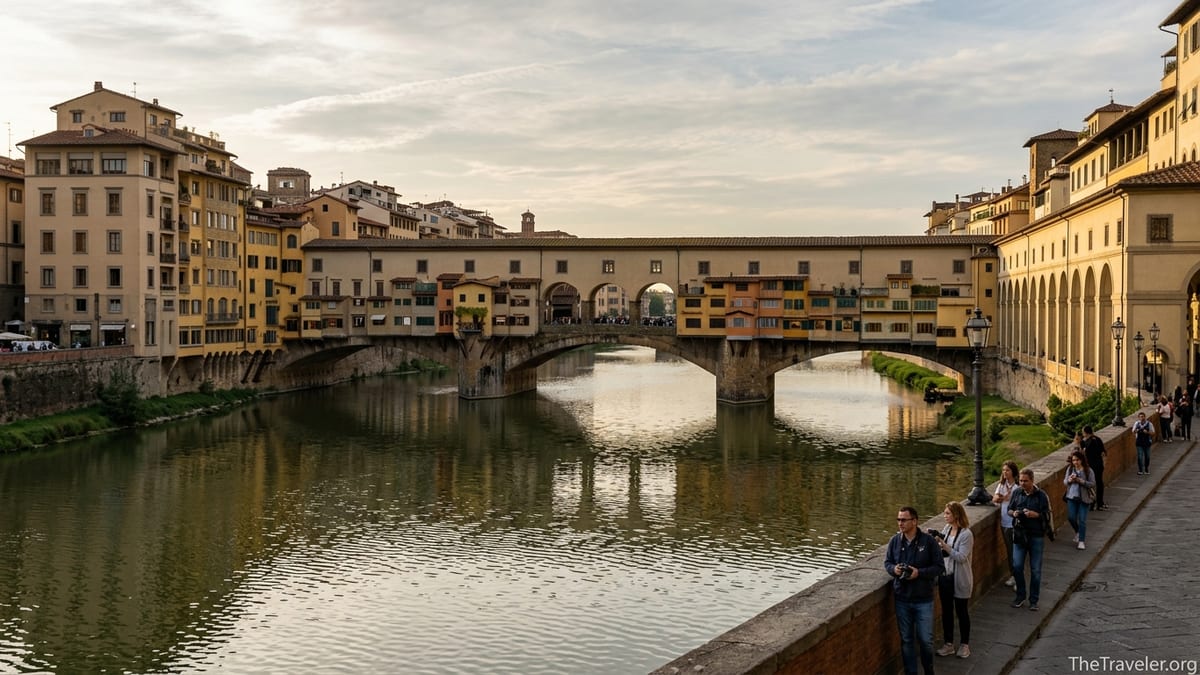
Ponte Vecchio is one of those places in Florence that looks almost unreal the first time you see it: a medieval bridge packed with tiny jewelry shops, ochre facades hanging over the Arno, and a constant flow of people crossing between the historic center and the Oltrarno. For a first-time visitor, it can be both magical and overwhelming. This guide explains what you are actually looking at, how to time your visit, where to stand for the best views, and how to weave Ponte Vecchio smoothly into your Florence plans.
Get the latest updates straight to your inbox!
Why Ponte Vecchio Matters
Ponte Vecchio, literally the “Old Bridge,” is Florence’s most famous crossing over the Arno River and the only bridge in the city not blown up during the German retreat in 1944. Today it functions as both a practical pedestrian route and an open-air gallery of gold and jewelry shops, with crowds of visitors streaming across almost all day and night.
The bridge’s trademark look comes from the small box-like buildings that cling to its sides. In medieval Europe it was common to build shops on bridges, but most of those structures disappeared over time. In Florence, the tradition survived. When you walk across Ponte Vecchio you are effectively walking through a narrow commercial street suspended above the water rather than an open bridge.
For a first-time visitor, this is not just a photogenic landmark. It is also a shortcut between two key parts of the city: the Uffizi and Piazza della Signoria area on the north bank, and the artisan-filled Oltrarno quarter and Palazzo Pitti on the south bank. Even if you did not plan to “visit” the bridge as a sight, you would probably cross it several times a day just moving between neighborhoods.
Because of its symbolic importance and central position, Ponte Vecchio is almost never quiet in peak season. Understanding when and how to see it can make the difference between inching through a solid wall of tour groups and enjoying a calm early morning walk with space to breathe and take photos.
A Short History You Can Actually Use
The first bridge on this spot dates back to Roman times, when Florence was a small settlement on the Via Cassia. Over the centuries wooden and stone versions were repeatedly destroyed by floods, including a major one in the 14th century. The current stone structure, with its three elegant segmental arches, largely dates from the 1340s, when Florentines rebuilt it in a sturdier form that has survived ever since.
Originally, the shops on Ponte Vecchio were occupied by butchers, tanners, and other trades that generated strong smells and waste, which conveniently fell into the river below. In the 16th century, when the Medici family built the elevated Vasari Corridor to walk from the government palace (Palazzo Vecchio) to their new residence (Palazzo Pitti), they no longer wanted to cross above a row of slaughterhouses. In 1593, Grand Duke Ferdinando I ordered that only goldsmiths and jewelers could have shops on the bridge, creating the refined commercial character visitors see today.
During the Second World War, every other bridge in central Florence was destroyed. Ponte Vecchio itself was spared, although the surrounding buildings on both banks were demolished to block passage. When you read that it is the “only surviving historic bridge in Florence,” this is what people mean. Standing in the center of the span, you are literally on a rare fragment of the city’s medieval infrastructure that avoided the fate of many similar bridges in Europe.
For travelers, these historical layers have practical implications. The Vasari Corridor still runs invisibly above the shop roofs, and new guided itineraries periodically open parts of it to visitors. Notices or scaffolding near the bridge may relate to ongoing work to stabilize or reopen sections of this elevated passage, so if you see construction, it is more than routine maintenance: it is part of Florence’s effort to preserve and repurpose this historic connector.
What It Is Like to Visit Today
In day-to-day terms, Ponte Vecchio is a public pedestrian bridge that is free to cross at any time of day or night. There are no turnstiles and no tickets required, which can be surprising if you are used to paying to enter famous monuments elsewhere in Europe. The catch is crowding. From around 10:00 in the morning until early evening, particularly between April and October, the bridge can be densely packed with tour groups, school trips, and cruise ship excursions.
The shops that line both sides of the bridge are almost all jewelry stores, many selling 18-karat gold, silver, and gemstones. Displays in the windows show necklaces and bracelets that can easily run into the hundreds or thousands of euros, but there are also smaller silver pieces and charm-style pendants at lower prices. Some travelers come intending to buy engagement rings or anniversary gifts here; others simply window-shop and enjoy the old wooden shutters and brass fixtures that give the storefronts a vintage feel.
There are occasionally small stands or street musicians along the central section of the bridge where the buildings open up and you can look out over the water. This is where many visitors instinctively stop, so movement slows. If you are crossing with luggage or you dislike dense crowds, it can be more comfortable to stay closer to one side wall and keep walking until you reach a less congested spot to pause.
In the evening, after the jewelry shops close, their heavy shutters fold down and the bridge’s character changes. The storefronts look more like old wooden trunks and the atmosphere becomes less commercial and more historic. Around this time you will see couples strolling after dinner, amateur photographers with tripods, and occasionally local teenagers cutting across between neighborhoods.
Best Time of Day and Season to Go
For a first-time visitor, timing is everything. The quietest and most atmospheric moments on Ponte Vecchio are typically early in the morning and later in the evening. Around sunrise, roughly between 6:00 and 8:00 depending on the month, the light turns the stone paving and facades a soft gold before the shops open. You might share the bridge with a handful of photographers, joggers, and locals heading to work rather than wall-to-wall tour groups.
Evenings, especially after 8:00 or 9:00 in summer when the day-trippers have left and the shutters on the jewelry shops are closed, can be another excellent window. You gain a sense of the medieval structure and can enjoy the lights of the city reflected in the Arno. Street lighting is bright enough for a comfortable walk but soft enough that reflections on the water remain visible in photos taken with a modern smartphone.
By contrast, late morning to mid-afternoon is the most crowded period. On a typical May or September weekday, coach tours and organized groups often reach the bridge between 10:00 and 15:00 as part of Uffizi and historic-center itineraries. In July and August, heat adds another layer of difficulty; the bridge’s narrow central section can feel stuffy when packed with people, and you will likely find it more pleasant to plan your photo stop for cooler hours.
Seasonally, spring and early autumn usually strike the best balance between decent weather and manageable visitor numbers. From roughly April to June and again from September to October, temperatures tend to be mild and evenings comfortable for staying out late on the riverfront. Winter can be atmospheric, with occasional mist over the water and Christmas lights reflected in the Arno, but some jewelry shops may shorten hours or close on certain days, so do not be surprised if not every storefront is open.
How to Get There and Navigate the Area
If you arrive in Florence by train at Santa Maria Novella station, Ponte Vecchio is an easy walk. Many local guides estimate it as about 15 to 20 minutes on foot, depending on your pace and how often you stop for photos or window-shopping. A typical pedestrian route runs via Via Panzani and Via de’ Cerretani toward the Duomo, then continues along Via Roma and Via dei Calzaiuoli to Piazza della Signoria before turning toward the Uffizi and the river. From there, you simply follow signs or crowds to Ponte Vecchio.
With luggage, the walk is still feasible for many visitors because the distance is only around 1 to 1.5 kilometers, but the paving stones can be uneven. Rolling a large suitcase over cobbles in summer heat can be tiring, so some travelers choose to take a taxi from the station instead. The ride is short, usually under fifteen minutes barring traffic, with metered fares that often fall into a modest range given the distance. Taxis cannot drive onto the bridge itself, but they can drop you close by on either bank, for example near Via de’ Guicciardini on the Oltrarno side.
Once at the river, orientation is simple. On the north bank, the bridge meets the area just downstream from the Uffizi Gallery. On the south bank, it leads into Borgo San Jacopo and Via de’ Guicciardini, which in turn bring you to Piazza Pitti and the Boboli Gardens. Street signs marked “Ponte Vecchio” and “Pitti” or “Uffizi” make it easy to choose a direction, and most pedestrian routes ignore car traffic entirely because much of the surrounding area is limited-traffic or pedestrian priority.
Driving directly to Ponte Vecchio is generally not recommended for visitors unfamiliar with Florence. The historic center is covered by a restricted traffic zone with monitored access times, and fines for entering without permission can be significant. If you are staying in a hotel that offers parking in or near the center, check with your accommodation in advance for up-to-date instructions on registered access routes rather than trying to rely on navigation apps alone.
Finding the Best Views and Photo Spots
One of the ironies of Ponte Vecchio is that you cannot actually see its iconic profile while you are standing on it. From the bridge itself, the view is of the Arno and other crossings, particularly Ponte Santa Trinita to the west and Ponte alle Grazie to the east. The classic postcard image of Ponte Vecchio as a cluster of houses and shops over the river is taken from the outside, usually from nearby bridges or riverbanks.
For many travelers, the single best vantage point is Ponte Santa Trinita, the elegant Renaissance bridge just a short walk west along the river. From its central point you can look back toward Ponte Vecchio and capture the full span with the hills in the background, especially beautiful at sunset when the ochre and cream facades catch the warm light. Because Ponte Santa Trinita is slightly curved and less busy, you can usually find space along the balustrade for photos without too much jostling.
Another excellent perspective comes from the south bank of the river along Lungarno Torrigiani and Lungarno degli Acciaiuoli. Walking these streets in the late afternoon or evening provides side-on views of Ponte Vecchio with reflections in the water. Photographers often stop at slight bends in the river where they can frame the bridge along with the Uffizi and the line of the Vasari Corridor running above its roofs.
If you are comfortable with a small uphill walk, combining Ponte Vecchio with a sunset trip to Piazzale Michelangelo can be particularly rewarding. A common pattern is to cross the bridge in late afternoon, wander through the Oltrarno toward the riverside ramps, and then climb up to the terrace in time for evening light. From the viewpoint, you can see Ponte Vecchio as part of the larger cityscape, sitting among domes and towers with the Arno curving through the frame.
Shopping, Safety, and Practical Tips
Shopping on Ponte Vecchio is first and foremost about jewelry. You will find gold necklaces, bracelets, rings, earrings, and watches displayed in carefully lit windows, along with silver and other precious materials. Many shops highlight pieces made of 18-karat gold, and some display price tags next to the items, which helps with quick comparison. If you are considering a significant purchase, it is reasonable to ask about certification, guarantees, and any possibility of tax refund paperwork for non-EU residents.
Prices here are often higher than in less prominent streets of Florence, partly because of the bridge’s prestige and high rents. Some visitors treat Ponte Vecchio as a place to choose a single statement item to commemorate a major event, while doing more everyday shopping in nearby streets where the same level of overhead is not built into the cost. If you simply want a small token, look for silver pieces or more modest gold pendants in the windows rather than the largest showpieces.
In terms of safety, violent crime against visitors remains rare, but pickpocketing can occur in any crowded tourist area. Wearing a cross-body bag that closes securely, keeping phones and wallets out of back pockets, and avoiding placing bags on the ground while taking photos are simple measures that go a long way. If someone “accidentally” bumps you while another person simultaneously tries to distract you with flyers or trinkets, treat it as a warning sign and move calmly away.
Weather is another practical factor. The bridge is open to the elements, and while there is some shelter under the shop overhangs, you will still feel rain and wind. In summer, midday sun can be intense, with limited shade in the central open section. A hat, sunscreen, and a bottle of water can make even a short crossing more pleasant. In winter, the stone can feel noticeably cold underfoot; comfortable footwear with decent grip is helpful on damp days when surfaces may be slick.
The Takeaway
For a first-time visitor to Florence, Ponte Vecchio is more than a quick photo stop. It is a working piece of the city where commerce, history, and daily life intersect above the Arno. Understanding that you are walking through a centuries-old trading street, rebuilt after floods, spared in war, and still lined with jewelers because of a Medici decree, adds depth to what might otherwise feel like a crowded passageway.
If you time your visit for early morning or later evening, approach via a simple walk from Santa Maria Novella or the Duomo area, and use nearby bridges and riverbanks for your wide shots, you will experience the bridge at its best. Combine this with realistic expectations about crowds and prices, a bit of care with your belongings, and a willingness to wander into the streets on either side, and Ponte Vecchio becomes not just a box to tick, but a memorable part of how you understand Florence.
FAQ
Q1. Do I need a ticket to visit Ponte Vecchio?
There is no ticket needed to walk across Ponte Vecchio. It is a public pedestrian bridge open 24 hours a day, so you can cross as often as you like without paying an entrance fee.
Q2. What are the opening hours of the jewelry shops on Ponte Vecchio?
Shop hours vary by business, but many jewelry stores typically open around late morning and close in the early evening. In high season you can expect most to be open during the main tourist hours of roughly 10:00 to 19:00, with some reducing hours or closing on Sundays or in winter.
Q3. When is the best time of day to avoid crowds on Ponte Vecchio?
The quietest times are usually early in the morning around sunrise and later in the evening after most day visitors and tour groups have left. Midday and mid-afternoon tend to be the most crowded, especially in spring, summer, and early autumn.
Q4. How far is Ponte Vecchio from Santa Maria Novella train station?
The walk from Santa Maria Novella station to Ponte Vecchio is roughly 15 to 20 minutes for most visitors. The route passes through the historic center, so it is straightforward and scenic, though paving can be uneven in places.
Q5. Is it safe to walk on Ponte Vecchio at night?
In normal conditions, walking on Ponte Vecchio in the evening is generally considered safe, with a steady flow of people until fairly late. As with any city, it is sensible to stay aware of your surroundings, keep valuables secure, and follow local advice from your hotel if there are particular events or disruptions.
Q6. Can cars or buses cross Ponte Vecchio?
No, Ponte Vecchio is reserved for pedestrians. Motor vehicles cannot cross the bridge, which helps preserve its structure and historic atmosphere. Taxis or private cars can drop you nearby on either bank, from where it is a short walk to the bridge itself.
Q7. Where can I get the best photos of Ponte Vecchio?
Some of the best photo vantage points are from nearby bridges such as Ponte Santa Trinita, and from the riverbanks on both the north and south sides of the Arno. From these spots you can capture the full profile of Ponte Vecchio with its overhanging shops and the reflections in the water, particularly attractive at sunrise or sunset.
Q8. Are prices for jewelry on Ponte Vecchio negotiable?
Practices differ by shop. Some jewelers may be open to limited negotiation, especially on high-value pieces, while others maintain fixed prices. It is acceptable to ask politely if a price is flexible or if there are comparable options in a lower range, and you should feel no pressure to buy if you are only browsing.
Q9. Is Ponte Vecchio accessible for visitors with limited mobility?
Ponte Vecchio is relatively short and flat, and there are no steps on the bridge itself, which helps with accessibility. However, surrounding streets may have uneven stone surfaces, and the density of crowds at busy times can make navigation slower for visitors using wheelchairs or mobility aids, so early or late visits are often more comfortable.
Q10. What other sights can I combine with a visit to Ponte Vecchio?
Ponte Vecchio sits between several major attractions. On the north side you are just steps from the Uffizi Gallery and Piazza della Signoria, while on the south side you quickly reach the Oltrarno quarter, Palazzo Pitti, and the Boboli Gardens. Many visitors naturally combine a walk across the bridge with time in these nearby areas on the same day.