


Co-branded airline credit cards promise upgrades, free bags, and “VIP” treatment, but they are not one-size-fits-all tools. The United Quest℠ Card from Chase is a good example: it can be extremely rewarding in the right hands, yet surprisingly expensive and inflexible if you do not fly United in a very specific way. Before you click “apply,” it is worth slowing down and asking whether this card really fits your travel patterns right now, instead of blindly assuming every premium airline card is a win.
Get the latest updates straight to your inbox!
The United Quest Card in Plain Language
The United Quest Card is a mid-tier co-branded card issued by Chase for United Airlines flyers. It sits in the lineup above the no-fee United Gateway Card and the lower-fee United Explorer Card, but below the high-end United Club Infinite Card. As of mid-2026, it typically charges a mid-hundreds annual fee and targets travelers who fly United often enough to care about checked bags, mileage earning, and travel protections, but do not need full lounge access. On paper, that sounds like a wide audience, which is why so many travelers assume it must be an obvious choice.
Key benefits include a generous welcome bonus that has often hovered in the 70,000 to 90,000-mile range, elevated earning on United purchases, a statement credit that effectively rebates miles on award flights, and credits that offset certain United fees. According to the current Chase description, cardholders can earn 4 miles per dollar on United purchases, on top of the miles they already earn as MileagePlus members, plus elevated categories like travel, dining, and select streaming services. There are also travel protections such as trip cancellation coverage and primary rental car collision coverage on eligible rentals, which can be valuable on their own.
United has also layered in a few niche perks. For example, the card includes a yearly rebate of miles on award redemptions up to a capped amount and annual credit toward United purchases such as seat assignments, extra bags, or inflight purchases. On the surface, these details give the impression that the card “pays for itself” quickly if you take a couple of trips. That assumption, however, depends on how, when, and where you actually fly, and how much you spend on United versus other airlines.
None of these features are inherently bad. The problem is that the marketing headline often oversimplifies the real trade-offs. United’s own site focuses on “earn miles faster” and “enjoy flexible award options,” but it is much quieter about what happens when your travel pattern changes, you stop flying United regularly, or you primarily buy the cheapest basic economy tickets that do not play nicely with certain card perks. That is where getting the card blindly can become an expensive mistake.
The Real Value of “Free” Checked Bags After United’s Fee Hikes
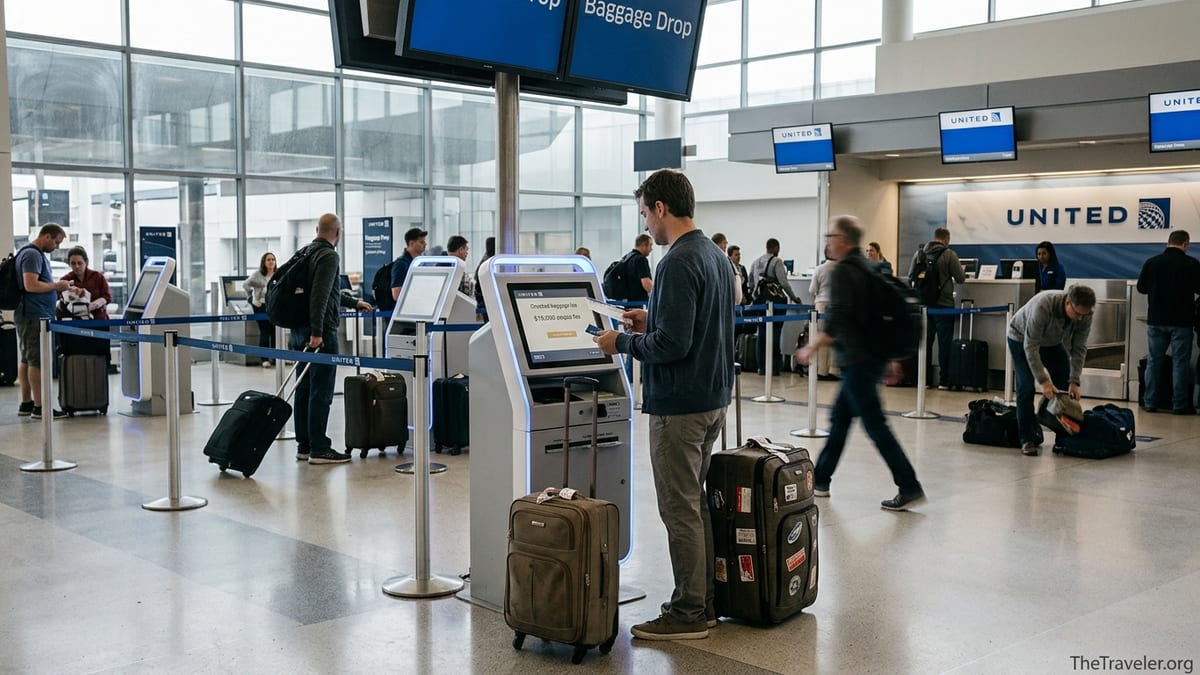
One of the most heavily advertised reasons to get a United co-branded card is the free checked bag benefit. This used to be relatively straightforward: base checked-bag fees were modest, and avoiding them clearly saved money. In 2026, the math is sharper. United has raised checked bag fees on many routes in response to higher fuel costs. Recent reporting from outlets such as the Associated Press noted that the first checked bag on many United itineraries within the United States, Canada, Mexico, and parts of Latin America climbed to about 45 dollars one-way, with a second bag around 55 dollars on many standard economy tickets. Over a simple round-trip, one checked bag can now add roughly 90 dollars per person to your travel costs before you even leave home.
In that context, a free first and second checked bag for you and a companion on United-operated flights, when available on certain United cards and fares, sounds extremely valuable. If you and your partner fly from Denver to Orlando twice a year with a checked suitcase each, that could be four legs of flying. At roughly 45 dollars per checked bag each way, you are looking at about 360 dollars per year in potential saved fees if every segment qualifies and you would have paid those fees out of pocket. That is real money, and for a heavy United flyer, it could more than cover a typical annual fee on a mid-tier card.
The catch is that the bag benefit is not universal. You only get the free bags on eligible United- or United Express-operated flights, you usually have to pay with the card or at least have it attached to your MileagePlus profile, and the benefit does not override every fare restriction. For example, United’s basic economy fares are notorious for offering no full-size carry-on on many domestic and short-haul international routes and charging the highest bag fees. While some co-branded cards can still grant a free first checked bag even on those discounted tickets, basic economy remains a risky place to assume anything. Several recent traveler reports described confusion where an online display showed a free bag, only for airport staff or the app to attempt to charge standard or even higher fees until the situation was manually corrected.
There is also the simple question of frequency. If you only take one United round-trip a year and normally travel with a carry-on backpack, the bag feature might never meaningfully offset the annual fee. Paying a mid-hundreds fee for “just in case” free bags does not make sense for a traveler who spends most of their time in the car, on trains, or on other airlines like Southwest that still allow two checked bags for free. Yet many people apply for the Quest-level card specifically because they are anxious about baggage fees, even though a cheaper card or no card at all might leave them better off given their habits.
When the Annual Fee Outruns Your Actual United Travel
The biggest quiet risk in signing up for the United Quest Card without much thought is that the annual fee keeps hitting your account long after your travel pattern changes. During the first year, with a large welcome bonus and maybe a couple of well-timed trips, the card can feel generous. You might redeem 80,000 miles for a round-trip United Polaris business-class seat from Newark to London during an off-peak sale and feel thrilled. The award rebate embedded in the Quest card might give you back a chunk of those miles, effectively lowering the cost of that redemption.
Fast forward to the second or third year, though, and life often looks different. Maybe you take a new job and now fly American out of Dallas rather than United out of Chicago. Perhaps your kids’ schedules mean you drive more and fly less. In that scenario, your United spend collapses from several thousand dollars per year in flights to a single holiday trip every other year. The card still charges the annual fee, but your ability to use the free bags, award rebates, and United-specific credits plummets.
For example, suppose you originally justified the card based on an annual summer trip from San Francisco to Maui where family members each checked a 50-pound suitcase. When you held the card and met the terms, the free bag benefit might have saved your family 180 dollars in round-trip bag fees. Two years later you are mostly taking short-haul road trips in California and the occasional Southwest hop to San Diego. You no longer check bags on United at all, and the only United purchase you made this year was a 220-dollar economy ticket to visit relatives once. In that case, the card’s core airline benefit is essentially wasted.
This problem is worsened by how airline co-branded cards encourage you to consolidate loyalty. United’s marketing suggests you will “earn miles faster in the air and on the ground,” with 10 total miles per dollar possible on some United fares when stacking MileagePlus and card earnings. That sounds impressive, but it only helps if you consistently choose United even when other airlines offer better schedules, prices, or routes. If you fall into the habit of paying more for a United flight just to “use your card benefits,” you might end up spending hundreds of extra dollars per year that quietly erase the value of miles and free bags.
Complex Rules, Partner Gotchas, and Basic Economy Traps
Another reason not to get the United Quest Card blindly is the sheer complexity of how United’s rules interact with different fares and partners. In 2026, United has rolled out a more tiered fee structure not just for checked baggage but also for certain seat assignments and change fees on discounted tickets. At the same time, the airline increasingly pushes basic economy as the first pricing option. Basic economy has tighter carry-on rules, fewer options to change or upgrade, and can charge full checked bag fees even on long-haul routes where standard economy still includes a free bag.
Consider a traveler booking a cheap basic economy ticket from Newark to Dublin. On a standard economy fare on many transatlantic routes, the first checked bag might be included in the fare. On certain basic economy tickets, though, that bag suddenly costs extra. A United co-branded card might still confer some savings, but those details vary by route, marketing carrier, and operating airline. A traveler who assumes their card automatically unlocks the same baggage rules they enjoyed on a previous trip could arrive at the airport and discover a triple-digit bill for a single suitcase, particularly on more complex itineraries involving a partner like Lufthansa or TAP where the “marketing carrier” rules the baggage policy.
The same sort of nuance shows up with partner flights. The United Quest Card’s bag and boarding benefits primarily apply to flights that are both marketed and operated by United or United Express. If you book a codeshare where the first segment is actually flown by a partner airline, the baggage policy is often governed by that marketing or operating carrier for your first leg. There have been real-world examples where travelers on United-numbered tickets with partner-operated first segments were quoted confusing fees, ranging from 200 dollars for a “third” bag to 400 dollars for certain combinations of first and second checked bags on complicated itineraries.
When you take those edge cases into account, it becomes clear that relying on a card to “simplify” your travel experience is not always realistic. You still need to check United’s baggage calculator for each trip, verify whether your fare includes a free checked bag, and read the fine print about basic economy restrictions. If you are the type of traveler who rarely has time or patience for this kind of homework, banking on the Quest card to clean everything up automatically is a recipe for frustration and unexpected charges.
Opportunity Cost: Flexible Bank Points vs Locked-In Airline Miles
Another reason to hesitate before grabbing the United Quest Card is opportunity cost. Every new credit card you open uses a slot in your wallet and often takes up some of your available credit and attention. If you are not deeply committed to United specifically, you might be better served by a flexible points card that earns transferable points you can move into multiple airline and hotel programs as your plans evolve.
Imagine you spend 1,500 dollars a month on travel and dining between work and leisure, plus another 1,500 dollars on general purchases. With a United Quest Card, you might earn 3 miles per dollar on travel and dining and 1 mile per dollar on other purchases. If you put everything on the card, that would generate around 6,000 United miles per month, or 72,000 miles per year, not counting any extra from United flights. Those miles are only directly useful within the United MileagePlus ecosystem and its partners. If United’s award chart for your favorite routes worsens or you move to a city where American or Delta dominates, your stash of United miles becomes less flexible.
By contrast, a flexible travel card from a major bank might earn 2 or 3 points per dollar on travel and dining and 1 to 1.5 points on everyday purchases, with the ability to transfer those points to multiple airlines, including United in some cases, or redeem through bank travel portals. Those points can be steered to United when it makes sense, but they are not locked there. If a future trip to Tokyo prices better on ANA through a different partner network, or a flight to Paris is cheaper in Air France miles, you can pivot. When you sign up blindly for a co-branded card like Quest, you signal that you are comfortable putting most of your eggs in one airline basket for several years.
There is also the simple arithmetic of redemptions. In recent years, dynamic award pricing has meant that a domestic round-trip in economy that once cost 25,000 miles might now price at 35,000 or more during peak periods. A 70,000-mile welcome bonus that once reliably covered two round-trips may now only cover a single trip if you are bound to crowded holiday dates. If you had earned that same spending power in flexible points, you might have been able to book with a competing airline, choose off-peak dates, or even purchase a deeply discounted cash ticket through a bank portal instead. None of this means the Quest card is bad, but it does mean the cost of committing to one airline program is higher than it appears at first glance.
Who Actually Wins With the United Quest Card
Despite all the reasons to be cautious, the United Quest Card can be an excellent fit for a certain kind of traveler. If you live near a United hub like Newark, Houston, San Francisco, or Denver and you regularly fly United or United Express several times a year, the combination of bag benefits, accelerated mile earning, and travel protections can absolutely justify the annual fee. A consultant who flies from Newark to Chicago twice a month, almost always checks a suitcase, and frequently redeems miles on domestic and short-haul international trips will likely extract substantial value from the card.
For example, consider a traveler based in San Francisco who flies United to visit family in Chicago, Honolulu, and Mexico City every year. Between three or four round-trips, they might check a bag on most flights, purchase extras like preferred seats, and occasionally book a last-minute ticket that costs more than they would like. With the Quest card, free checked bags on eligible fares could easily save a few hundred dollars per year. The annual United statement credit could be used on paid seat assignments or in-flight food and drinks. The award rebate might come into play when they redeem miles for a spring break trip to Cancun, giving back a slice of their mileage outlay.
Crucially, this traveler has predictable United-heavy patterns. They know they will fly United multiple times per year, they regularly check bags, and they value MileagePlus miles enough to redeem them for premium cabins when deals appear. For them, carefully running the numbers against the annual fee, and comparing Quest to the cheaper Explorer card and the pricier Club Infinite card, can lead to a clear yes or no decision.
The key distinction is that these travelers are making a conscious choice based on real data. They can point to last year’s travel: three United round-trips with two checked bags on each, plus a 50,000-mile award redemption they plan to repeat. Without the card, they estimate paying around 300 to 400 dollars in bag fees alone, plus missing out on elevated earning and protections. With the card, they can reasonably expect to come out ahead. That is very different from the casual flyer who keeps saying “I might travel more this year” and treats the Quest card as motivation, only to end up taking a single domestic trip on another airline.
The Takeaway
Airline cards like the United Quest Card are often marketed as simple solutions: pay an annual fee, never worry about bags, and enjoy faster mileage earning. In 2026, when checked bag fees on United have climbed and basic economy rules have grown more restrictive, those cards can indeed be powerful tools. But they are also sharper instruments than many travelers realize. Used without a clear plan, the Quest card’s annual fee can quietly exceed the value you receive, especially if your flying is irregular, mostly on other airlines, or limited to a single carry-on bag.
The right way to approach this card is not to apply blindly because a flight attendant walked down the aisle waving an 80,000-mile offer or because a banner ad promised free luggage. Instead, pull up your last year or two of travel, estimate how often you actually fly United, how many checked bags you typically bring, and how frequently you redeem miles for United or Star Alliance flights. Compare that against the cheaper United Explorer Card and at least one flexible bank card. If the math and your real habits clearly favor the Quest card, then it can be a smart, deliberate choice. If not, it is better to walk away and keep your travel budget focused on actual trips, not speculative perks.
FAQ
Q1. Is the United Quest Card worth it if I only fly United once a year?
For most travelers, no. If you only take one United round-trip annually and usually bring a carry-on, the value of free checked bags and award rebates is unlikely to exceed the annual fee.
Q2. Do I get free checked bags on every United ticket with the Quest card?
Not on every ticket. The benefit typically applies to eligible United- and United Express-operated flights on qualifying fares, and you may need the card linked to your MileagePlus account and used for the purchase. Always verify your specific baggage allowance before travel.
Q3. How did United’s recent baggage fee increases change the math on this card?
Higher bag fees make the potential savings from card-based bag benefits larger for frequent United flyers who check luggage often. At the same time, they make mistakes or misunderstandings about which fares qualify more expensive, so blindly assuming coverage can backfire.
Q4. What happens if I switch my loyalty from United to another airline?
If you move to a city dominated by a different carrier or your employer changes preferred airlines, the United-specific perks on the Quest card may become hard to use. In that case, you might be left paying the annual fee without getting enough value in return.
Q5. Are flexible bank travel cards better than airline cards like United Quest?
They can be, especially if you do not have a strong preference for a single airline. Flexible bank cards earn points that can be transferred to multiple partners or used for different types of travel, which can be more useful if your plans or preferred airlines change over time.
Q6. Does the Quest card help with United basic economy restrictions?
It can help in some areas, such as free checked bags on certain basic economy tickets, but it does not erase every restriction. Basic economy still has tighter rules for changes, upgrades, and carry-on allowances, so you cannot rely on the card to make it behave like regular economy.
Q7. How important are the Quest card’s travel protections?
They can be valuable, particularly primary rental car coverage and trip cancellation or interruption benefits. If you rent cars frequently or book expensive trips that might be disrupted, those protections are worth factoring into your value calculation.
Q8. Should I downgrade or cancel the Quest card if I am not flying much?
If your United travel has dropped and you are not using the card’s perks, downgrading to a lower-fee United card or switching to a flexible travel card can make sense. Just remember that closing a long-held card can affect your credit history, so evaluate your broader credit profile first.
Q9. How can I estimate whether the Quest card will pay for itself?
Look at your past 12 to 24 months of United flights, count how many checked bags you paid for, and estimate what those would cost at current fees. Add any likely award redemptions, seat fees, or inflight purchases you would cover with the card’s credits, then subtract the annual fee. If the result is clearly positive and repeatable, the card may be worthwhile.
Q10. Is the United Explorer Card a better starting point than the Quest card?
For many moderate United flyers, the Explorer Card’s lower annual fee and solid bag and boarding perks are a better fit. It can make sense to start there, learn how often you truly benefit from United-specific perks, and only upgrade to the Quest tier if your United travel and redemptions clearly justify the higher cost.