


A few minutes into a guided kayak tour, most travelers notice the same thing: the motorboat traffic fades away, the shoreline creeps closer, and suddenly the world feels bigger, wilder, and quieter. Around the globe, from Puerto Rico’s glowing bioluminescent bays to the flooded slot canyons of Lake Powell and the towering cliffs of Milford Sound, kayaks slip into places that larger boats physically, legally, and environmentally cannot go. For travelers who want to trade crowds and engine noise for close-up encounters with nature, understanding what makes kayaks so versatile can change the way you plan your next trip.
Get the latest updates straight to your inbox!
How Kayaks Physically Go Where Boats Cannot Follow
The simplest reason kayak tours reveal “hidden” places is practical: kayaks are small, human powered, and incredibly shallow in the water. Many sit-on-top touring kayaks only need about 15 to 20 centimeters of depth to float with a paddler aboard. That means they can cross sandbars, skim over reef flats at high tide, and ease into mangrove channels or canyon narrows that would leave a motorboat aground. On a bioluminescent bay tour in Vieques, Puerto Rico, for example, guides routinely lead groups through mangrove channels just a few feet deep before they emerge into Mosquito Bay itself, a protected lagoon famous as the brightest bioluminescent bay in the Caribbean.
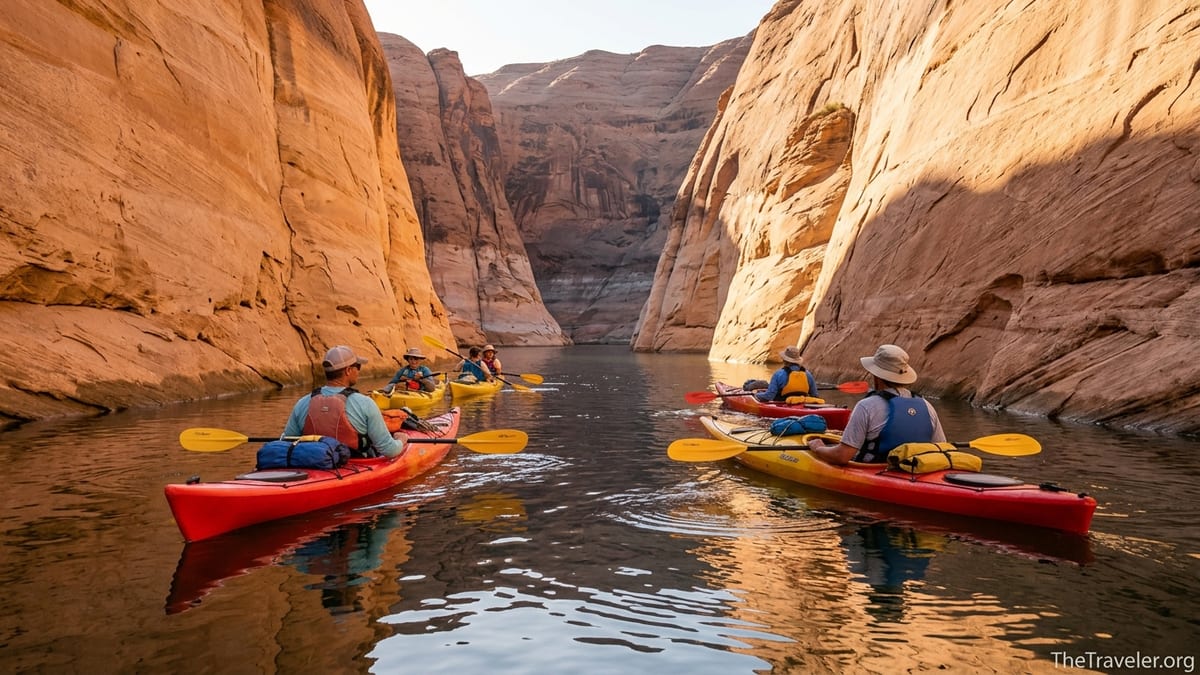
Hull shape also matters. Sea kayaks and touring kayaks are long and narrow, which lets them thread through gaps just wider than a person’s shoulders. In Lake Powell’s flooded side canyons, such as the water arm of Antelope Canyon reached from Antelope Point Marina, motorboats must stop when the sandstone walls pinch in and the passage becomes too narrow or too shallow for their draft. Kayakers, by contrast, can keep going until the canyon becomes a rock corridor only a few meters across, then beach their craft and continue on foot along the dry section of slot canyon above.
Motorboats are further limited by maneuverability. A 20-foot powerboat needs room to swing its bow and turn under power. A tandem kayak can pivot almost in place with a few corrective strokes. In practice, this means guides can nudge a group into tight spaces: beneath overhanging limestone ledges in Thailand, along the base of glaciers in Alaska where icebergs create a maze, or into recesses at the foot of New Zealand’s Stirling Falls in Milford Sound where only a handful of paddlers fit at a time. The smaller the craft, the more of the coastline you can explore.
Noise is another physical factor. Even when allowed, larger boats bring engine vibration and prop wash that can disturb wildlife and stir up sediment. Kayaks move almost silently. In Milford Sound, operators like Rosco’s Milford Kayaks run small-group tours that paddle close to seal colonies and waterfalls while minimizing disturbance. Travelers often remark that they could hear waterfalls and bird calls that were completely drowned out when they traveled the same route on a scenic cruise earlier in the day.
Regulations That Favor Muscle Power Over Motors
Beyond simple physics, laws and park regulations quietly give kayakers access to places that motors cannot go. Many of the world’s most sensitive marine and freshwater habitats are zoned so that only non-motorized craft are allowed past a certain line. The bioluminescent bay at Puerto Mosquito on Vieques is a clear example. It sits inside the Vieques Bioluminescent Bay Natural Reserve, and local rules strictly limit access to permitted operators using kayaks or low-impact electric craft. You cannot simply rent a speedboat and roar in after dark. For most visitors, the only way to experience the glowing water up close is to join a guided kayak tour that slips through the mangroves into the bay.
National parks often draw similar boundaries. In Salt River Bay National Historical Park on St. Croix, which also shelters a bioluminescent lagoon, nighttime visitation is limited and commercial tours are tightly controlled to protect the organisms that create the light. Guides shepherd small flotillas of kayaks into the mangrove-lined bay, where depth and conservation rules make motorized access impractical or illegal. Travelers who arrive expecting a crowded “boat show” are frequently surprised to find a handful of kayaks spread out on inky, quiet water instead.
In other destinations, regulations shape access indirectly. On Lake Powell, changing water levels and tribal land rules have gradually narrowed where commercial motor tours can operate near Antelope Canyon. Kayak tour companies, using lightweight craft launched from Antelope Point Marina or nearby ramps, can still legally access a long, winding arm of the canyon that lies below the famous dry slot portions visited on Navajo Nation land. Typical half-day kayak and hike outings from outfitters in Page combine about 6 to 10 kilometers of paddling with a short walk into the narrowing canyon, spending time in sections completely off-limits to large sightseeing boats.
New Zealand’s Milford Sound provides another regulatory contrast. Large cruise vessels follow set routes and timing windows negotiated with the national park authorities. Sea kayak tours, by comparison, operate on tighter group sizes and different schedules, often launching early in the morning to avoid peak boat traffic. While they still respect strict conservation rules about landings and wildlife approach distances, their ability to hug the shoreline and nose into quiet coves effectively creates an “inner” Milford Sound that only paddlers ever see.
Iconic Places Where Kayaks Unlock Hidden Angles
Nowhere is the contrast between kayaks and larger boats more dramatic than in bioluminescent bays. In Vieques, multiple licensed operators run small-group kayak tours in Mosquito Bay, often using clear-bottom boats so guests can watch each paddle stroke ignite an electric blue swirl beneath them. Because the bay is shallow, surrounded by mangroves, and protected from most light pollution, the experience from a kayak is immersive: travelers trail their hands in the water, watch fish streak away as glowing arrows, and see the hull of their boat outlined in light. Motorboats, where permitted, must keep distance to minimize wake and light, and passengers seldom get as close to the water or mangrove roots.
In Arizona, travelers comparing classic Upper and Lower Antelope Canyon hikes with kayak-based tours into the flooded lower sections often comment that the paddling route feels more tranquil and free-form. A typical guided trip from a company in Page might cost around 120 to 160 US dollars per person for a half-day Antelope Canyon kayak and hike combination, including equipment and a guide. After launching from Antelope Point and paddling across open water, groups enter the canyon’s no-wake zone and continue into narrows where motorboats pull back. The final stretch is usually reserved for human-powered craft; here, sandstone walls rise close on either side, reflecting golden light onto the water while paddlers drift in single file.
Milford Sound in New Zealand is another destination where kayaks provide access to angles cruise passengers simply do not get. Full-day sea kayak excursions led by established outfitters typically cost the equivalent of 250 to 300 US dollars and include all gear, a dry bag, and sometimes a snack. Groups paddle from Deepwater Basin toward Stirling Falls, weaving close to rock walls streaked with waterfalls. Because kayaks draw so little water, guides can slide them over shallow rock shelves into tiny inlets where seals haul out. On calm days, paddlers may “raft up” near the base of Stirling Falls, feeling fine spray on their faces, while larger ships must keep a wider safety distance.
Even in urban or heavily developed regions, kayaks reveal hidden perspectives. In coastal Croatia, for example, sunset sea kayak tours around Dubrovnik’s city walls let travelers explore sea caves and narrow rock channels beneath the fortifications. Rental motorboats and cruise tenders must stay well offshore, both for safety and to respect designated navigation routes. Paddlers, wearing helmets and headlamps in some cases, can slip into caverns that would be unsafe for any vessel with an engine or a deep hull.
Wildlife Encounters at Water Level
One of the biggest reasons travelers choose kayak tours instead of boat excursions is wildlife. Kayaks sit low and move quietly, which dramatically changes how close you can get to animals without stressing them. In Milford Sound, the dark surface layer of freshwater that floats above denser seawater creates a unique ecosystem where deep-water species like black coral live much closer to the surface than usual. From a kayak, you can look down into the green water along vertical rock walls and sometimes see dense invertebrate communities just below the surface, particularly near underwater observatories and protected sections of the fiord.
In bioluminescent bays, the wildlife encounter is microscopic yet unmistakable. The light in Mosquito Bay, Vieques, for instance, comes from dinoflagellates that flash when disturbed by movement. From a high-deck motorboat, you might catch streaks of light in the wake. Sitting in a kayak, your paddle blades trigger luminous cascades just centimeters from your hands. Fish darting away from the hull leave glowing trails that guests can trace for several meters. Because most tours operate with strict group size limits and no-swimming rules to protect the organisms, the viewing experience stays intimate and relatively low impact.
Mangrove ecosystems reward this kind of slow, close-up travel. Around Puerto Rico and the US Virgin Islands, dusk and nighttime kayak tours into mangrove channels regularly reveal sleeping birds in overhanging branches, needlefish gliding in the shallows, and upside-down jellyfish on the bottom. These are all easy to miss from a higher, faster boat. Guides frequently pause in near-total darkness and simply have everyone float quietly, listening to insect calls and distant surf. Many travelers later describe these still moments as the highlight of the trip, even beyond the glow of bioluminescence itself.
Beyond the tropics, cold-water destinations also favor kayaks for wildlife watching. Along Alaska’s Inside Passage, for example, outfitters use sea kayaks launched from small expedition ships to explore coves too ice-choked or shallow for the mothership. Paddlers can approach ice floes where harbor seals rest, maintaining prescribed distances while still feeling close. The absence of engine noise makes it easier to hear blows from whales surfacing nearby or the crackle of melting ice along the shoreline.
Environmental Footprints and Why Operators Choose Kayaks
Many of the places where boats cannot go are off-limits precisely because they are fragile. Managers of places like Puerto Mosquito on Vieques and Salt River Bay on St. Croix walk a tightrope: they want visitors to experience these rare ecosystems so that people will value and protect them, but they must prevent the very visitation from damaging what makes them special. Kayaks, with no propellers, fuel, or exhaust, tend to be one of the least intrusive ways to let people in. A guide can teach guests to avoid clanging paddles on mangrove roots or scraping the bottom in shallow seagrass, reducing physical disturbance.
Capacity is another reason tours lean toward kayaks. Operators can strictly control how many seats they sell each night, literally counting available kayaks. In Mosquito Bay, for instance, only a limited number of licensed companies can run tours, and they are often required to stick to caps designed to protect the dinoflagellate populations. It is far easier to monitor and manage a handful of two-person kayaks than a fleet of large motorboats. For travelers, this often translates into smaller groups and a quieter experience, even in a popular destination.
Fuel use and emissions also factor into the equation. While day cruises powered by modern engines can be relatively efficient for the number of passengers they carry, they still burn fossil fuel with every mile. Human-powered kayaks eliminate that footprint entirely for the on-water portion of the tour. In some bioluminescent bays, authorities have explicitly preferred or required non-motorized access after noticing that prop wash and sediment disturbance coincided with declines in water clarity and brightness in earlier years.
For local communities, kayak-based tourism can align better with long-term conservation goals. A small, community-owned outfitter operating evening kayak tours might rely on a couple of guides, a van, and a trailer of boats. The overhead is lower than running large vessels, and the environmental impact is easier to manage. This model has flourished in places like Vieques, where a network of local companies offers slightly different takes on the bioluminescent bay experience, from traditional tandem kayaks to transparent hulls that showcase the glow beneath your feet.
What Travelers Actually Experience on a Kayak Tour
When you book a kayak tour in one of these special environments, the difference from a standard boat trip begins long before you touch the water. In Vieques, for a Mosquito Bay excursion, most companies ask guests to arrive at a meeting point near sunset. After a safety briefing and gear fitting, everyone boards a shuttle van that drives to a simple, darkened launch area near the bay. There are no bright marina lights or big-ticket developments here by design. Guests often wade a short distance into the water to climb into their tandem kayaks before forming a “train” to paddle through shallow mangrove channels toward the main lagoon.
On Lake Powell, the logistics feel different but equally distinct from a boat cruise. At Antelope Point or Wahweap, outfitters fit each guest with a paddle, life jacket, and often a dry bag for a camera or snack. After a technique demonstration on shore, the group launches from a sloping beach and paddles across open water, sharing space with larger boats only until they reach the canyon mouth. Once they enter the tall sandstone walls of Antelope Canyon’s flooded arm, boat noise drops and the scale shifts. Sunlight reflects in narrow bands from the rock, and even novice paddlers quickly adjust to the rhythm of gliding and drifting between the walls.
Sea kayak trips in Milford Sound add weather to the equation. Fiordland is one of the wettest inhabited places on Earth, and paddlers are routinely outfitted with spray skirts, waterproof jackets, and sometimes neoprene gear. Tours commonly begin early, when the fjord is still quiet. As the group passes beneath towering cliff faces streaked with temporary waterfalls after rain, the sheer verticality hits home in a way that can be hard to appreciate from an enclosed cruise deck. Guides may lead the group into a small, calm cove, ask everyone to lay paddles across the deck, and simply float in silence to listen to the soundscape of dripping water, distant surf, and occasional bird calls.
In all these cases, the common thread is intimacy. Kayak tours lack the on-board bar, loudspeaker commentary, and climate control of larger vessels. Instead, they provide a more sensory, slower-paced experience, where wind, spray, darkness, or the glow of plankton are not filtered by glass or metal. For many travelers, that trade-off is precisely the point.
Choosing Between a Boat Trip and a Kayak Tour
Travelers deciding between a standard boat excursion and a kayak tour should think in concrete terms about what they want to see and how close they want to be to it. If your priority at Lake Powell is covering as much ground as possible in one day, a high-speed scenic boat tour may be more practical. If your dream is gliding deep into Antelope Canyon’s narrowing rock corridors and landing on quiet beaches, a 3 to 5 hour kayak tour is likely the better match, provided you are comfortable paddling at an easy pace for several kilometers.
Comfort and accessibility also matter. Kayak tours in places like Mosquito Bay and Milford Sound typically require travelers to sit low, sometimes with damp legs, for one to three hours. People with limited mobility or back issues may find it challenging to get in and out of low-slung boats or to maintain a paddling position. For that reason, some destinations complement kayak options with small electric boat tours or glass-bottom skiffs. These alternatives still respect no-swimming and low-impact rules, while offering a more stable platform and regular seating for those who need it.
Weather and timing can tip the balance as well. Bioluminescent bay tours are highly dependent on darkness and water conditions. Guides often recommend traveling near a new moon for the brightest effect and may reschedule during heavy rain or strong wind. In a kayak, rougher conditions are more noticeable than on a larger vessel, and guests must be ready for splashes and the possibility of a damp ride. In colder climates like New Zealand, travelers should be prepared for rapidly changing conditions, even in summer, and follow outfitter packing lists closely.
Budget is another practical consideration. While prices vary, kayak tours in iconic environments often cost a bit more per person than high-capacity boat cruises, largely because group sizes are smaller and guiding is more hands-on. In Puerto Rico, for example, a nighttime bioluminescent kayak tour in Vieques or Fajardo might run from roughly 60 to 100 US dollars per person, compared to less for a short daytime harbor cruise in a busy resort area. Many travelers who have tried both styles consider the added cost worthwhile for the quieter, more immersive experience.
The Takeaway
The magic of kayak tours is not just about adventure; it is about access. Thanks to their shallow draft, nimble handling, and low environmental impact, kayaks can slip into slots, mangroves, coves, and canyons where bigger boats are either physically unable or formally forbidden to go. For travelers, that translates into experiences that feel more like discovery than sightseeing: drifting through a tunnel of mangrove roots toward a glowing bay, gliding between sandstone walls as they close in around you, or floating at the base of a waterfall with spray on your face and no engine in earshot.
As destinations continue to balance tourism with conservation, the spaces reserved for muscle-powered travel are likely to grow more important, not less. Whether you are planning a bioluminescent bay visit in Puerto Rico, a Lake Powell canyon adventure, or a coastal paddle beneath New Zealand’s cliffs, choosing a kayak tour is often the surest way to see the parts of a place that most visitors, watching from the deck of a larger boat, never even realize are there.
FAQ
Q1. Do I need kayaking experience to join a guided kayak tour?
Most entry-level kayak tours in popular destinations are designed for beginners. Guides provide basic instruction on paddling and steering before you launch, and they typically choose sheltered routes with minimal currents and waves. If you can sit upright for an hour or two and are comfortable around water while wearing a life jacket, you can usually participate. Let the operator know in advance if you have concerns about fitness or mobility so they can advise you on whether a particular tour is appropriate.
Q2. How physically demanding are kayak tours compared with boat trips?
Kayak tours require more active participation than sitting on a motorboat, but most are paced at a relaxed, conversational level. A typical bioluminescent bay paddle in Puerto Rico might cover 2 to 4 kilometers over about two hours, with frequent stops to rest and look around. Lake or fiord tours, such as in Antelope Canyon or Milford Sound, may involve 6 to 10 kilometers of paddling over half a day. If you can comfortably walk several kilometers on land, you will likely manage the paddling with occasional breaks.
Q3. Are kayak tours safe for children and older travelers?
Many outfitters welcome families and seniors, often using stable tandem kayaks that pair a child with an adult or a less experienced paddler with a stronger one. Age minimums vary by destination and operator, commonly starting around six to eight years old for calm-water trips. Older travelers should consider their balance, flexibility, and ability to sit low to the water. If getting in and out of a kayak seems difficult, ask about alternatives such as stable sit-on-top designs, wider recreational kayaks, or companion electric boat tours that visit similar areas.
Q4. What should I wear and bring on a kayak tour?
Plan for clothing that can get wet and dries quickly. Lightweight synthetic layers, a windbreaker or rain shell, and secure sandals or water shoes work well in warm climates. In colder places like New Zealand’s Fiordland, follow the outfitter’s list, which may include fleece, hats, and gloves. Essential items usually include a refillable water bottle, insect repellent, and a small dry bag for a phone or camera if the operator does not provide one. For nighttime bioluminescent tours, guides often ask guests to avoid bright headlamps and phone flashes so everyone’s eyes can adjust to the dark.
Q5. Why are swimming and independent access often restricted in bioluminescent bays?
Bioluminescent bays are delicate ecosystems where the organisms that create the glow can be harmed by sunscreen, insect repellent, heavy sediment disturbance, and excessive noise or light. To protect them, authorities frequently ban swimming, limit the number of nightly visitors, and require that access be through licensed operators who follow strict guidelines. This is why you cannot usually drive yourself to a launch point and paddle in alone after dark. Joining a guided kayak tour not only complies with regulations but also supports the long-term health of the bay.
Q6. How do weather and moon phases affect kayak tours in places like Mosquito Bay?
Moonlight and cloud cover have a huge impact on how bright bioluminescence appears. Tours often book up fastest around the new moon, when the sky is darkest and the glow is most dramatic. On very bright full-moon nights, guides may still operate but manage expectations, sometimes using tarps or mangrove shade to help guests see the effect. Wind, heavy rain, or rough seas can lead operators to modify routes or cancel trips for safety, especially for kayaks. Travelers should build flexibility into their plans and pay close attention to operator updates.
Q7. Can I bring a camera on a kayak tour, especially at night?
Many travelers bring phones or compact cameras on kayak tours, but water exposure and low light are real challenges. During daytime paddles in places like Antelope Canyon or Milford Sound, a waterproof case or dry bag is usually sufficient. At night in a bioluminescent bay, capturing the glow requires long exposures and very steady support, which is difficult from a moving kayak. Guides often advise guests to focus on the live experience and accept that photos may not do it justice. Some operators take their own images and make them available to guests afterward.
Q8. How do kayak tours compare in price to standard boat excursions?
Prices vary by country and season, but kayak tours usually cost a bit more per person than high-capacity boat trips because group sizes are smaller and guiding is more intensive. In Puerto Rico, for example, a guided bioluminescent bay kayak tour might cost around 60 to 100 US dollars per person, while shorter daytime harbor cruises can be cheaper. In places like Milford Sound, full-day kayak experiences can be among the higher-priced activities in the region, reflecting both logistics and limited capacity. Many travelers find the extra cost worthwhile for the quieter, closer-to-nature experience.
Q9. What if I am nervous about capsizing or cannot swim well?
Reputable kayak tour operators require all guests to wear properly fitted life jackets and choose routes appropriate to the group’s skill level. On calm, sheltered waters, the risk of capsizing is low, especially with stable tandem kayaks. You do not need to be a strong swimmer, but you should be comfortable wearing a life jacket and listening closely to safety instructions. If you are particularly anxious, let your guide know at booking time; they may suggest the most sheltered tour option or, in some destinations, recommend an electric boat excursion instead.
Q10. How can I tell if a kayak operator is responsible and environmentally conscious?
Look for small group sizes, clear safety briefings, and explicit environmental guidelines, such as no-touch rules for wildlife and mangroves or restrictions on sunscreen types. In sensitive places like bioluminescent bays and national marine parks, check whether the company mentions permits or certification from local authorities. Reviews that praise guides for their natural history knowledge and low-impact practices are also a good sign. Choosing these operators not only improves your experience but also helps ensure that the hidden places kayaks can reach remain unspoiled for future travelers.