


Many travelers sign up for a kayak tour with a single expectation in mind: sweeping views worthy of a postcard or social feed. Yet when they return to the dock, what they talk about most rarely matches the photos on their phones. Instead of just the backdrop, it is the quiet coves, close wildlife encounters, conversations with guides and the feel of the water itself that linger longest. Around the world, from Alaska to Florida and Puerto Rico, kayak operators are hearing the same thing. People may book for the views, but they leave loving something else entirely.
Get the latest updates straight to your inbox!
The Real Reason Kayak Tours Stick in Your Memory
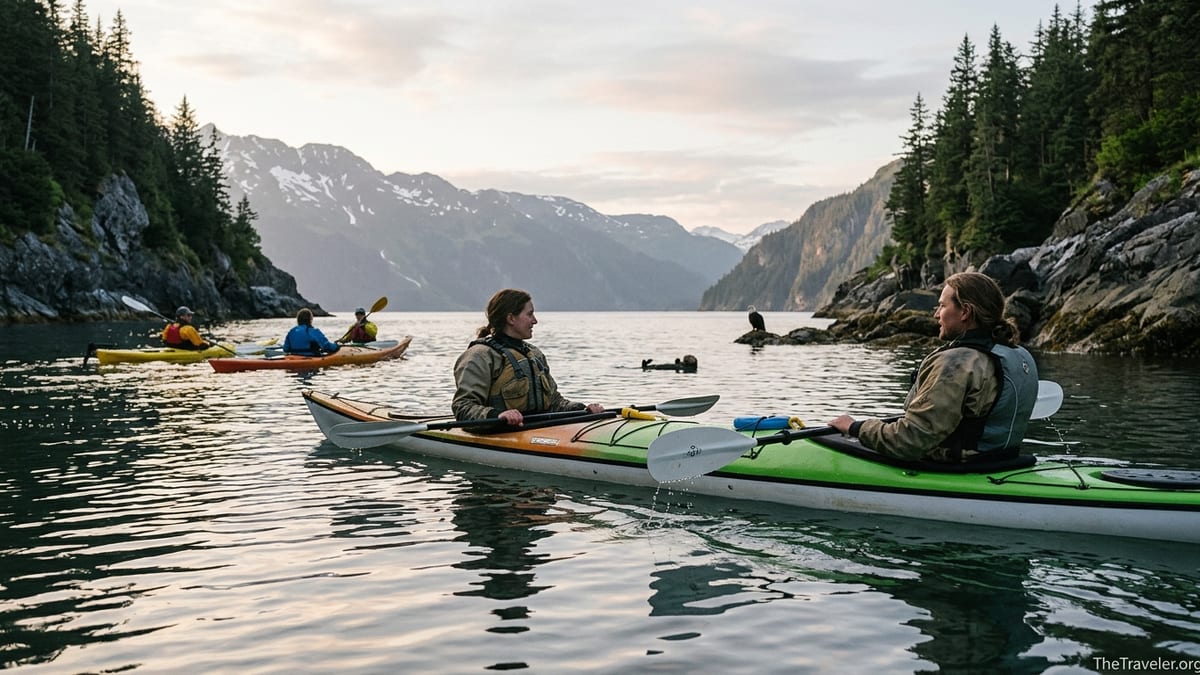
Ask a guide in any popular paddling destination what guests rave about after a tour, and the reply is surprisingly consistent. Scenery draws people in, but subtle, hard-to-capture sensations are what stand out. On sea kayaking trips in Alaska’s Kenai Fjords and Prince William Sound, for example, visitors often arrive focused on glacier vistas and towering cliffs. Yet in many trip reports, what they describe afterward is the near-total silence once the boat shuttle pulls away, the drip of paddles, the calls of seabirds and the soft exhale of a distant whale rather than the view framed in front of them.
This shift from spectacle to feeling is a pattern outfitters quietly build into their itineraries. In Whittier, a common half-day tour begins with a fast boat ride into Prince William Sound, then slows to a few miles of relaxed paddling along the shoreline. Guests do see glaciers and icebergs, but reviews repeatedly talk about the calm water in hidden coves and the sense of remoteness on a body of water ringed by the Chugach Mountains, rather than listing every peak by name.
Even short excursions show the same effect. In Ketchikan, Alaska, small-group trips to Orca Cove are sold on dramatic coastal scenery and the chance of whales and harbor seals. Many guests later say the highlight was drifting quietly beside rainforest islands while their guide pointed out starfish on the rocks and ravens in the trees. The smoked salmon snacks and hot drinks on the mothership at the end of the paddle often receive nearly as many compliments as the views themselves.
Scenery may be the reason travelers pull out a credit card, but the lasting appeal of a kayak tour is more personal. It is the rare combination of physical engagement, sensory detail and unhurried time that is increasingly difficult to find in more crowded adventure activities.
The Unexpected Intimacy of Wildlife Encounters
Wildlife shows up prominently in kayak marketing, and guests certainly hope to spot dolphins, manatees or sea otters. Still, many paddlers underestimate how different it feels to meet those animals from water level. In Alaska’s coastal towns such as Seward and Sitka, travelers can choose between large-boat wildlife cruises and kayak excursions that cover only a few miles. The boats reach more distant glaciers, but reviews of sea kayaking often emphasize how close sea otters float by, how bald eagles watch from the treeline and how salmon leap so close to the bow that spray hits the paddler.
In one commonly recommended day trip from Whittier into Shotgun Cove, guests sometimes find themselves edging into an inlet while pink salmon jump within arm’s length of the kayak. Some come expecting a long-distance workout; instead they remember fish breaking the surface and the eerie quiet once the outboard motor fade. Even when sightings are modest, being low in the water magnifies each one. A single harbor porpoise that might barely register from a ship’s deck can feel like a private show when you are at eye level.
The effect is just as strong in warmer climates. On Florida’s Space Coast, clear kayak bioluminescence tours near Cocoa Beach and Titusville are advertised with glowing water and night photography. Guests do see the famous light show in good conditions, but recent reviews also talk at length about shadowy silhouettes of manatees surfacing beside plastic hulls, the puff of dolphins exhaling in the dark and the darting wake of fish outlined by bioluminescence. Guests often report that seeing a manatee lift its snout within a few meters of their boat was more moving than the brightness of the glow.
This intimacy has a practical side. Because kayaks move quietly and stay close to shore, guides can pause and wait rather than chase wildlife. In Crystal River, central Florida, some kayak guides who specialize in manatee-watching time their departures for early morning, when boat traffic is low and the animals are less stressed. Guests may only see three or four manatees, but with fewer engines around, they are more likely to witness them feeding or slowly cruising, rather than simply surfacing between wakes.
Guides, Stories and the Human Connection on the Water
For many travelers, the unexpected highlight of a kayak tour is not the landscape but the person in the guide seat. In Ketchikan, an independent operator running small six-person groups frequently earns praise for local guides who grew up in southeast Alaska. Reviews talk about how they share stories of salmon runs, Indigenous history and everyday life in a town that sees large cruise ships every summer. Guests often mention realizing they learned more about contemporary Alaska over three hours in a kayak than they did on several bus-based shore excursions.
Elsewhere in Alaska, such as Seward and Homer, full-day or multi-day paddling trips combine guiding with informal education. Outfitters provide gear and instruction, but what travelers remember are small human details: an impromptu beach lesson on how to identify puffins and murres, or a guide casually explaining how to read tide tables while making coffee on a portable stove. These moments are rarely advertised in brochures yet appear repeatedly in post-trip testimonials.
Night tours highlight the same pattern. In Puerto Rico’s bioluminescent bays, for instance, visitors often arrive determined to see the brightest possible glow. Recent traveler accounts from Fajardo and Vieques note that the intensity of the bioluminescence can vary. Some paddlers describe conditions as subtle rather than spectacular, yet still recommend the tour because of the atmosphere created by guides. A calm voice navigating tight mangrove tunnels, patient explanations of the organisms responsible for the light and frank talk about conservation all feature heavily in positive feedback, even when the water is not as luminous as promotional images suggest.
In Florida’s Indian River Lagoon, some operators have begun posting nightly updates that rate glow conditions and wildlife sightings. Guests sometimes mention that these candid briefings, combined with guides willing to adjust expectations, made them trust the experience more. The value of a strong guide becomes clear when things do not go perfectly: when clouds obscure the stars, when a breeze raises small waves, or when mosquitoes are heavier than expected. Travelers who feel taken care of by their guide usually finish the evening with positive memories regardless.
The Quiet Magic of Simple Moments: Sound, Rhythm and Routine
Kayak tours are marketed with dramatic images: icebergs, rainforest cliffs, glowing waters. Yet some of the deepest impressions come from routine, almost mundane moments. On half-day jaunts out of Seward into Resurrection Bay, for example, outfitters such as Sunny Cove Kayaking often incorporate stretches of unhurried paddling where conversation drops and only the rhythmic dip of paddles breaks the silence. Guests commonly describe a sense of calm during those intervals that is difficult to capture on camera.
For urban travelers used to constant background noise, the sudden quiet on the water can be striking. Even near populated areas, a few hundred meters of mangrove or forested shoreline can mute traffic and harbor sounds. On Florida’s Space Coast, several bioluminescent tours depart just an hour from Orlando, yet guests report that as soon as they glide into narrow channels, city life feels distant. Fireflies on shore, owls calling and the occasional splash of fish combine into a soundtrack that many remember more vividly than any single view.
Small comforts also take on outsized importance. After paddling through light rain in coastal Alaska, warm drinks and a dry layer on the support boat feel almost luxurious. Some Orca Cove trips in Ketchikan serve locally caught smoked salmon, which guests mention nearly as often as they mention whales. On overnight kayak-camping trips in the Inside Passage, travelers who spend only moderate time in the kayak sometimes recall with equal fondness the ritual of setting up camp, sharing a simple meal and watching evening light linger over the water.
These low-key rituals are part of why many paddlers say their favorite portion of a tour was not at the most dramatic viewpoint but in an in-between space: a gravel beach used for rest stops, a shaded mangrove tunnel connecting two lagoons, or a quiet cove where the group drifted for several minutes without paddling. Such pauses give shape to the day and let travelers feel, however briefly, as if they have stepped out of their normal pace of life.
Choosing the Right Kayak Tour for More Than Just the Views
Recognizing that the intangibles matter as much as the scenery can help travelers choose better tours. In Alaska, for example, many first-time visitors focus on maximizing glacier exposure. They look for itineraries that promise multiple tidewater glaciers, long distances and extensive boat shuttles. Yet outfitters quietly suggest that guests interested in a richer experience might consider shorter paddling distances and more time exploring specific coves. Trips out of Seward that combine a boat ride with moderate paddling near one glacier, plus time ashore on a beach or island, routinely earn high satisfaction scores even when conditions make the ice less photogenic.
Travelers booking bioluminescent tours in Florida or Puerto Rico can apply similar thinking. Rather than choosing solely based on promotional photos of glowing kayaks, it is worth reading recent reviews that mention group size, guide quality and the balance between paddling and drifting. Some operators cap groups around ten to twelve people per launch and emphasize naturalist commentary. Others focus on a faster pace and more time covering distance, which can be less appealing for visitors primarily seeking atmosphere.
Price is another practical signal. In many destinations, kayak tours cluster within a range, but the cheapest option is not always the best value. In Ketchikan, for instance, independent kayak operators not partnered with cruise lines may cost roughly the same as ship-sponsored excursions yet offer smaller groups and more time on the water because they skip bus transfers. Similarly, on Puerto Rico’s main island, some tours bundle transportation from San Juan into the fee. Solo travelers may appreciate the convenience, but those already renting a car might prefer smaller local outfits that depart closer to the mangrove channels.
As with any outdoor activity, conditions are variable. Operators in bioluminescent areas routinely note that glow intensity can shift with rainfall, moon phase and water quality. Glacier views in Alaska can be muted by fog or low clouds. Travelers who choose companies that communicate these realities openly, rather than promising guaranteed spectacle, are more likely to finish their tour satisfied even when nature is less than dramatic.
How to Prepare So You Can Enjoy the “Something Else”
The more basic logistics you handle in advance, the easier it is to notice the quieter rewards of a kayak tour. The fundamentals start with clothing. In cold-water destinations like Alaska, layered synthetic or wool garments, a warm hat and gloves make it easier to appreciate the sounds and sensations around you instead of fixating on cold fingers. Many outfitters provide waterproof jackets, spray skirts and rubber boots, but arriving with a base layer that can get damp without causing a chill is essential.
In warm, buggy environments such as Florida’s lagoons or Puerto Rico’s mangrove bays, light long sleeves, quick-drying shorts and a neck gaiter can reduce mosquito annoyance. Recent traveler accounts from Titusville and other bioluminescent hotspots mention that even strong insect repellent is not foolproof. Covering skin physically and accepting that a few bites are part of the experience can help keep expectations realistic. Guides often carry extra, milder repellents for guests who react badly to high-DEET formulas.
Fitness expectations should be equally pragmatic. Most commercial kayak tours are designed for beginners, with paddling distances that average only a few miles and guides who manage pace carefully. That said, guests who rarely exercise may find a headwind or outgoing tide more tiring than expected. Letting the operator know about any mobility concerns before booking allows them to recommend shorter, more sheltered routes, such as protected bays instead of open coastlines.
Finally, building margin around the tour in your schedule gives you space to enjoy the afterglow. In cruise ports like Ketchikan and Sitka, many travelers rush from one excursion to another. Those who set aside an hour after returning to simply wander the harbor, sip a coffee or watch fishing boats unload often say that this unscheduled time helped the impressions from the water settle in. Similarly, after a late-night bioluminescence tour near Orlando, staying locally instead of driving long distances back to a hotel can make the evening feel less hurried and more reflective.
The Takeaway
Kayak tours have become a staple of modern travel itineraries, from Alaska’s fjords to Florida’s lagoons and Puerto Rico’s bioluminescent bays. They are marketed with sweeping views and, increasingly, dramatic night photography. Yet when travelers describe what moved them most, they rarely talk only about the view. They talk about quiet strokes in a glassy cove, a sea otter rolling on its back beside the bow, a guide who wove personal stories into a safety briefing, or the simple comfort of hot soup after paddling in the rain.
Understanding this gap between expectation and reality can help would-be paddlers choose better experiences. Looking beyond the headline scenery and paying attention to group size, guide expertise, route design and candid communication about conditions increases the likelihood of coming home with the kind of memories that do not need a camera to endure. Most people may still book kayak tours for the views, but those who leave loving the subtle, human and sensory elements of the journey often find themselves planning their next paddle long before the first set of photos is uploaded.
FAQ
Q1. Are guided kayak tours suitable for beginners with no experience?
Most commercial kayak tours are designed with first-timers in mind. Operators typically provide a short on-shore lesson, stable double kayaks and a relaxed pace, and they choose routes in protected coves or bays rather than exposed open water.
Q2. How physically demanding is a typical half-day kayak tour?
On a standard three to four hour outing, actual paddling time is often closer to 90 minutes to two hours, with breaks for wildlife viewing and rest. Mild fitness is helpful, but most reasonably active adults can manage the distance with guidance and occasional pauses.
Q3. What should I wear for a cold-water kayak trip in places like Alaska?
Wear layered synthetic or wool clothing, including a base layer that can get damp, a warm hat and gloves. Outfitters commonly supply waterproof jackets, spray skirts and sometimes rubber boots, but you are responsible for staying warm under that shell.
Q4. How can I reduce mosquito and insect issues on warm-weather or night tours?
Lightweight long sleeves, quick-drying pants or shorts, and a buff or neck gaiter provide physical protection. Use insect repellent as recommended by your guide, and understand that some bites are likely in mangrove or lagoon environments, especially during still, humid evenings.
Q5. Will I definitely see wildlife such as dolphins, manatees or whales?
No operator can guarantee wildlife, as sightings depend on season, time of day and luck. However, wildlife-rich areas like Alaska’s coastal fjords, Florida’s lagoons and Puerto Rico’s bays offer good chances of encounters, especially when guides choose routes based on recent activity.
Q6. How do I choose between a large-boat wildlife cruise and a kayak tour?
Boat cruises cover more distance and often reach more dramatic viewpoints with greater comfort. Kayak tours offer slower travel, quieter conditions and closer-to-the-water encounters. If intimacy with the environment matters more to you than range, a kayak is often the better choice.
Q7. What if the weather is poor or conditions are not as advertised?
Reputable operators monitor forecasts and will cancel if conditions are unsafe, offering rebooking or refunds when possible. When tours proceed in light rain, fog or lower bioluminescence, guides focus on atmosphere, safety and interpretation so guests still have a worthwhile experience.
Q8. Are clear kayaks worth the extra cost for bioluminescent tours?
Clear kayaks can make it easier to see subtle glow beneath the hull, especially in darker conditions, but they are not essential to enjoy the tour. The overall atmosphere, guide quality and group size usually influence satisfaction more than hull material alone.
Q9. How important is group size when booking a kayak tour?
Smaller groups typically allow more flexibility, quieter stops and easier interaction with guides. Many travelers report that tours capped around eight to twelve paddlers feel more personal than larger departures, even when the route and scenery are similar.
Q10. What can I do to get more than just good photos from a kayak tour?
Arrive prepared with suitable clothing and realistic expectations, choose an operator that emphasizes interpretation and small groups, and give yourself unhurried time before and after the tour. Focusing less on capturing every view and more on the sounds, stories and sensations often leads to deeper memories.