


I did not expect a kayak to rattle me more than a long-haul flight or a mountain road at night. Yet on a cool summer evening in Washington State, standing on a wooden dock with a paddle in my hands, I seriously considered backing out of my first guided kayak tour. Two hours later, gliding across dark water lit by flecks of bioluminescence, that same tour had become the defining memory of the entire trip.
Get the latest updates straight to your inbox!
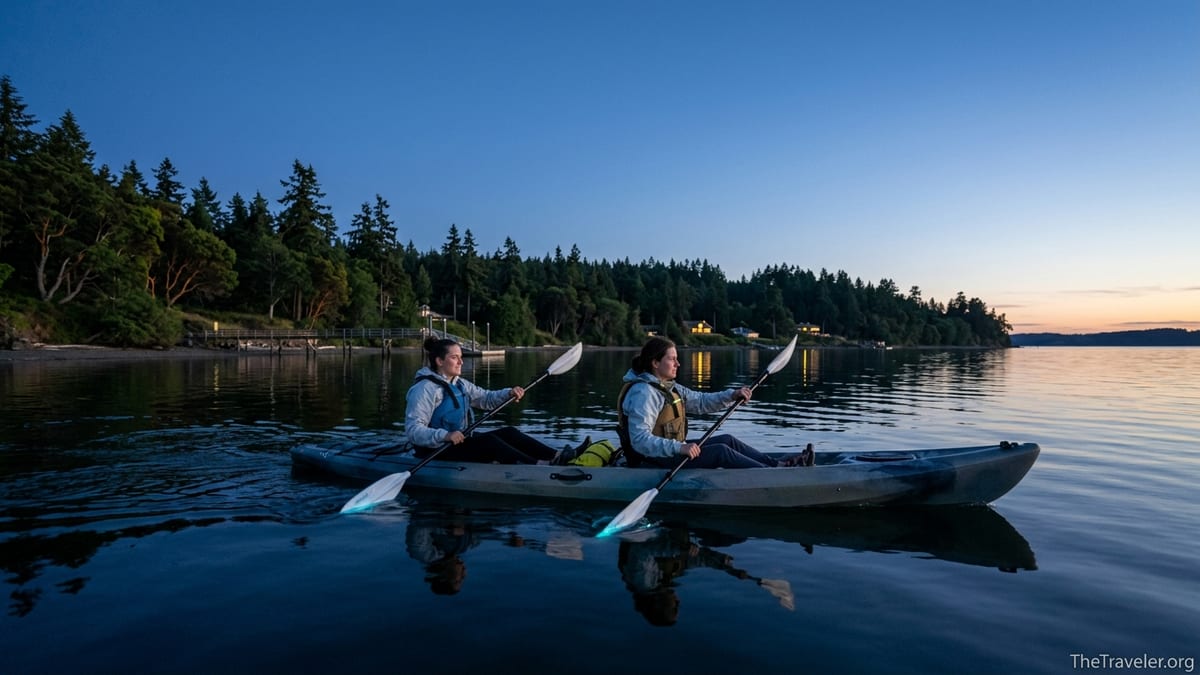
Why My First Kayak Tour Felt So Intimidating
The idea of kayaking had always sounded simple: sit, paddle, float. The reality, when I arrived at the waterfront in Port Gamble on Washington’s Kitsap Peninsula, felt much more complicated. The rental shed at Olympic Outdoor Center was buzzing with energy, boats stacked along the beach, guides adjusting spray skirts and life jackets for people who looked far more relaxed than I felt. When I signed in for the evening bioluminescence tour, my hands were already damp and not from the sea air.
The brochure had called it “beginner friendly,” with stable sit-on-top tandem kayaks and a mellow 2 to 2.5 hour route across Port Gamble Bay. The outfitter emphasized that many guests had never paddled before and that capsizes were rare, especially in their wide, double kayaks designed for stability. Still, as I watched another group launch, I fixated on every small wobble of their boats, imagining myself upside down in the bay.
Those nerves are common. Outfitters from Alaska to British Columbia and the Pacific Northwest report that many first-time kayakers arrive with the same questions: Will I tip over, what if I cannot swim well, and what happens if I freeze the moment the kayak moves. Guides are used to reading that body language: the tense shoulders, the forced jokes, the hesitation at the shoreline. The important thing to know is that a good operator builds the tour around those very fears rather than dismissing them.
What reassured me first was not the boat itself but the people. Our lead guide greeted each guest by name, explained that this particular tour was designed for cautious beginners, and pointed out that the water that evening was calm, with almost no wind. Knowing that this was a deliberate choice, not a lucky coincidence, made my anxiety feel less like a liability and more like something that was expected and planned for.
How a Proper Briefing Turned Fear Into Familiarity
The turning point came before we ever touched the water. On the gravel beach, our guide lined up a row of bright kayaks and walked us through a detailed safety and skills briefing. It covered how to adjust the foot pegs so our knees were slightly bent, how to hold the paddle loosely instead of in a white-knuckled grip, and how to steer a tandem kayak using gentle, coordinated strokes rather than brute force. We practiced forward strokes and turns on dry land, laughing as we mimed paddling while sitting on overturned boats.
Many reputable operators structure their tours this way. In Seward, Alaska, for instance, Sunny Cove Kayaking gives first-timers an on-land orientation that covers everything from fitting a life jacket to understanding how stable their 18-foot double kayaks really are. In British Columbia’s Gulf Islands, beginner-focused companies introduce basic paddle strokes and explain in plain language what to do if a boat does tip. The goal is not to turn guests into experts but to make sure nothing on the water feels entirely new.
Our guide was honest about the risks, which oddly made me feel calmer. He explained that while capsizes on calm summer nights were rare, they did carry spare paddles, radios, and towlines, and they had a clear, practiced plan for getting someone back into a kayak quickly if needed. He pointed out the nearest sheltered coves and talked through the route. It felt more like being walked through an airline safety briefing by someone who genuinely expected everything to go smoothly but knew what to do if it did not.
Guides on well-run tours also watch subtle cues. I noticed ours gently positioning the most nervous paddlers closer to him on the water and pairing inexperienced guests with more confident partners in the tandems. When one couple quietly admitted they were uneasy swimmers, he placed them in a kayak closest to his own and reassured them that properly fitted life jackets were non-negotiable and that we would be staying near shore in protected water.
Stepping Into the Kayak: The Jitters of the First Ten Minutes
For all the talking, the true test came when we stepped ankle-deep into the water and sat down in the boats. The first contact with the kayak felt wobbly, like standing on a bus as it pulls out of a station. Getting in and out is often the most unnerving part of a first tour. Guides know this and typically brace the boat at the bow or stern, asking you to sit down quickly in the center of the seat and keep your weight low. It looks clumsy from the dock but immediately feels more solid once you are seated.
The tandem setup helped. Sitting in the front, I could focus entirely on paddle rhythm while my partner in the back mirrored my strokes and added steering corrections. Many beginner tours in places as varied as Dubrovnik, Croatia, and Oahu, Hawaii, favor doubles for this reason. They are longer, wider, and harder to unintentionally flip than narrow solo touring kayaks. For anyone who is apprehensive, asking specifically for a tandem can make the first few minutes on the water feel far less precarious.
Those first ten minutes are often the hardest. On our Port Gamble tour the guide warned us that our brains would take a little while to trust that the slight side-to-side rocking did not mean we were about to tip. He kept the pace slow, letting everyone acclimate. We paddled only a short distance away from the beach, then paused to regroup, shake out tense shoulders, and adjust foot pegs. By the time we crossed the small bay toward the opposite tree-lined shore, my focus had shifted from staying upright to simply keeping my paddle in the water.
What surprised me most was how quickly the technique became intuitive. Kayak specialists often say that beginners usually find a comfortable rhythm within 15 to 20 minutes when conditions are gentle. That matched my experience: once I realized that gentle, consistent strokes worked better than panicked, powerful ones, the motion became almost meditative. The boat moved more efficiently when I stopped fighting it.
When Anxiety Quietly Slips Into Awe
Somewhere past the first point of land, my attention stopped circling around what might go wrong and started to widen to what was actually happening around me. The shoreline, which had seemed like a security blanket, receded into a dusky silhouette of Douglas firs and Madrona trees. Harbor seals surfaced at a distance, their heads briefly visible before sliding under again. The water around the boat darkened as the last light left the western sky.
Every memorable kayak tour has a threshold moment like this, when the activity stops feeling like an ordeal to survive and becomes a doorway into something quieter and more immersive. On sunset tours off Dubrovnik’s limestone cliffs, that shift often happens as the city walls turn golden and the sounds of traffic fade into a distant murmur. In calmer corners of Puget Sound, it arrives when paddlers realize they can hear the exhale of a seal or the wingbeat of a cormorant more clearly than their own worries.
On this particular night in Washington, that threshold was marked by light in the water. As our guide asked us to dip our paddles gently just off a pocket beach, the dark surface came alive with microscopic sparks. Bioluminescent plankton, disturbed by each stroke, left pale, silvery trails tracing the blades. When we let our hands hang over the edge, tiny flares of light floated off our fingers. The same strokes I had practiced anxiously an hour earlier were now creating temporary constellations at my fingertips.
This is why first-time guests often step off the beach at the end of a tour grinning in disbelief. What had been intimidating at the dock becomes a deeply sensory experience: the feel of cool salt water, the creak of the hull, the glow of a city skyline across a bay, or the unexpected appearance of a sea star just below the surface. My earlier fear had not disappeared so much as melted into a more expansive awareness. By the time we turned back toward the warm lights of the marina, I was no longer counting minutes until shore.
Choosing the Right Beginner-Friendly Kayak Tour
The single biggest factor in whether a first kayak outing feels terrifying or transformative is not your natural athletic ability. It is the match between the tour and your actual comfort level. In practical terms, that means choosing a route, operator, and time of day that are genuinely beginner friendly instead of simply booking whatever looks pretty in photos.
Look for tours that clearly state they welcome first-timers and that their gear and route are tailored to them. Olympic Outdoor Center in Washington, for example, describes its Port Gamble bioluminescence tour as suitable for all experience levels, using stable double sit-on-top kayaks, with a safety briefing and basic instruction included in the price. In Seward, companies running half day paddles in protected coves emphasize mellow seas and calm conditions rather than long crossings. In urban areas like Nashville, operators on mellow rivers such as the Cumberland often combine short guided segments with clear pre-trip coaching.
Price can be a clue, though not a guarantee. Cheaper, high-volume tours in popular coastal cities might pack large groups into single kayaks with minimal land-based instruction. Higher priced operations often limit group size, invest in better gear, and include more thorough briefings. It is worth reading recent guest reviews that mention guides by name and note how they handled nervous paddlers, unexpected wind, or a brief capsize. Positive comments about patient coaching and clear safety talk are more valuable than praise for simply paddling far or fast.
Location also matters. If you have never kayaked before, starting in sheltered water like a small bay, calm lake, or slow river is far more forgiving than unprotected coastline or surf zones. Many experienced sea kayakers advise first-timers to avoid tackling open ocean or complex tidal areas on their own, and instead to book guided sessions in gentler environments first. Once you understand how your body reacts on flat water, you can build up to more challenging conditions.
Realistic Expectations: How Hard Is a First Kayak Tour, Really
From the shore, kayaking can look effortless. The truth is more nuanced. A well-chosen beginner tour should feel physically manageable for an average adult with basic fitness, but that does not mean it is entirely easy. Expect a steady, repetitive upper body workout, a bit like a long walk for your shoulders and core rather than a sprint for your heart.
Most beginner-friendly tours last 1.5 to 3 hours on the water, with frequent pauses. In Port Gamble we paddled at a relaxed pace for roughly 45 minutes before our first longer break, then drifted quietly in darker water to focus on the bioluminescent display, using only small corrective strokes. In other destinations, such as short harbor routes in Japan’s Zushi area or coastal loops near Dubrovnik, guides break up the distance with swim stops or beach landings.
It is reasonable to feel tired arms or a sore lower back by the end of your first outing. That fatigue is less about difficulty and more about unfamiliar movement and posture. Guides often suggest small adjustments that make a big difference: sitting upright rather than slouching, relaxing your grip on the paddle, and engaging your torso in each stroke instead of pulling only with your arms. Once I started rotating from my waist, the effort dropped noticeably, and the kayak moved more smoothly.
What often feels hardest is not the paddling itself but managing anxiety, especially for people who are not strong swimmers or who have had a bad experience on a boat. Knowing that reputable outfitters require life jackets, monitor conditions closely, and cancel or reroute trips when wind and waves rise above a safe threshold can help you make peace with that nervousness. On my tour, hearing the guide calmly mention that they had postponed two previous nights because of wind actually increased my trust in their judgment.
Practical Tips So Your First Kayak Becomes a Trip Highlight
By the time we slid back onto the beach in Port Gamble, my earlier dread felt distant. What turned the experience into the highlight of the trip, though, was not just the glow in the water. It was how prepared and supported I felt. A handful of practical choices before and during the tour made that possible and are worth repeating for any first-time paddler.
Booking a guided tour rather than a self-guided rental made a huge difference. Having a trained leader choose the route, set the pace, and quietly watch the group allowed me to focus on the experience instead of wind forecasts and tide charts. This is particularly important in regions like the Pacific Northwest, where currents can change quickly and sheltered coves can be deceptively close to more exposed stretches of water.
Clothing mattered more than I expected. Our outfitter recommended synthetic or wool layers, a lightweight windbreaker, and shoes that could get wet, like sandals with heel straps or old running shoes. When a bit of spray came over the bow, I was grateful not to be wearing cotton jeans or heavy sneakers that would have stayed soggy. On cooler evenings, some guests wore light neoprene tops or borrowed splash jackets; in warmer climates, sun-protective shirts and broad-brimmed hats are equally crucial.
Finally, going in with a realistic mindset helped. I decided that my goal was not to look skilled, but simply to stay curious and communicate. I told the guide at the start that I was nervous and asked to be placed near the center of the group. During the paddle I mentioned when my hands felt tired and gladly accepted small corrections to my stroke. That willingness to admit what I did not know opened the door to the kind of coaching that turned an intimidating activity into something I now actively seek out when planning trips.
The Takeaway
Standing on a dock before your first kayak tour, it is easy to imagine all the ways things might go wrong. Water is unfamiliar. Boats wobble. Weather changes. Yet with the right guide, route, and expectations, that same tour can become the most vivid memory of a journey, the experience you talk about long after hotel names and restaurant menus have blurred.
My first guided paddle in Washington began with a tight grip on the paddle and a quiet calculation of how embarrassing it would be to walk away. It ended with my hands trailing through bioluminescent water, the hull moving steadily beneath me, and the quiet conviction that I wanted more evenings like this in my life. The fear did not vanish; it simply had something more compelling to share space with.
If kayaking intimidates you, consider that as a sign not to avoid it entirely but to approach it thoughtfully. Choose an operator that welcomes beginners, ask questions about safety and route choices, and be honest about your nerves. In many destinations, from calm bays of the Pacific Northwest to sheltered coves in warmer seas, outfitters build their entire season around helping first-timers move from apprehension to awe.
You may step into the kayak with shaking hands. Yet you might step out of it with a new benchmark for what counts as the highlight of a trip.
FAQ
Q1. Do I need prior experience to join a guided kayak tour?
Most beginner-focused tours are designed for people with no previous kayaking experience. Operators typically include a land-based safety talk and basic paddle instruction before you launch and choose calm, sheltered routes that suit nervous first-timers.
Q2. What if I am not a strong swimmer?
Many first-time kayakers are weak or hesitant swimmers. Reputable outfitters require properly fitted life jackets, stay close to shore on beginner tours, and train guides to assist quickly if someone ends up in the water. It is important to tell your guide about your comfort level so they can keep you closer and offer extra support.
Q3. How likely is it that my kayak will tip over?
On calm, beginner-oriented tours using wide recreational or tandem sit-on-top kayaks, unintentional capsizes are uncommon, though never impossible. Most happen when someone makes a sudden movement the guide has cautioned against, such as leaning too far over the side or trying to stand up.
Q4. What should I wear on my first kayak tour?
Dress for getting splashed, not for staying perfectly dry. Quick-drying synthetic or wool layers, a light windbreaker, and shoes that can get wet are ideal. Avoid heavy cotton like jeans and thick hoodies, which stay cold and damp. In sunny climates, add a hat, sunglasses, and sunscreen; in cooler places, consider a thin insulating layer or splash jacket.
Q5. How do I choose a safe, beginner-friendly operator?
Look for companies that clearly state their tours are suitable for first-timers, mention pre-trip safety briefings, and describe using stable kayaks such as tandems or sit-on-tops. Recent reviews that praise guides for patience, clear instruction, and good judgment about weather are more important than claims about covering long distances.
Q6. Will I be sore after my first time kayaking?
It is normal to feel some fatigue in your shoulders, arms, or lower back, especially if you are not used to the paddling motion. Most beginner tours move at a relaxed pace with built-in breaks. Good posture, a light grip on the paddle, and engaging your torso instead of just your arms can reduce soreness.
Q7. Can children or older travelers safely join a kayak tour?
Many outfitters welcome families and older adults on beginner tours, often placing children or less confident paddlers in tandem kayaks with a stronger partner. The key is choosing calm conditions, shorter outings, and operators who are comfortable adjusting the route and pace for a mixed-ability group.
Q8. What happens if the weather changes during the tour?
Responsible guides monitor forecasts and water conditions closely. They may cancel, postpone, or alter the route if wind or waves exceed safe limits for beginners. On the water, they can turn back early, move into more sheltered areas, or raft boats together to keep the group stable and comfortable.
Q9. How much does a beginner kayak tour usually cost?
Prices vary by region, but many guided beginner tours in North America fall into a moderate range that typically includes gear, instruction, and guiding. Higher-end operators may charge more for smaller groups, more experienced guides, or special experiences such as bioluminescence or wildlife-focused outings.
Q10. How can I manage anxiety just before launching?
Arrive a bit early to avoid rushing, tell your guide you are nervous, and focus on small steps: getting fitted for your life jacket, learning the paddle stroke on land, and practicing breathing slowly. Remember that the first ten minutes usually feel the most intense, and that most beginners report feeling significantly calmer once they are paddling steadily in calm water.