


Stand on the waterfront at Liberty State Park in Jersey City and it quickly becomes clear that this is no ordinary patch of green. The park itself offers sweeping lawns, a two mile promenade, and front row views of the Statue of Liberty and the Manhattan skyline. But what truly sets Liberty State Park apart is everything that surrounds it: historic rail terminals, working marinas, science museums, ferries to two of America’s most important landmarks, and rapidly evolving neighborhoods that make a simple park day feel like a full city break.
Get the latest updates straight to your inbox!
Gateway to the Statue of Liberty and Ellis Island
For many travelers, Liberty State Park is the most relaxed and efficient way to reach the Statue of Liberty and Ellis Island. Ferries depart from the historic Central Railroad of New Jersey Terminal inside the park, operated by Statue City Cruises, the official National Park Service concessioner. In practical terms this means you can buy a single ticket that covers the ferry ride plus access to Liberty Island, the Statue of Liberty Museum, Ellis Island, and the Ellis Island National Museum of Immigration, without ever battling the heavier security lines common in lower Manhattan.
From the Jersey side, the experience feels surprisingly calm. On a typical summer morning, visitors arriving for a 9:00 or 10:00 a.m. departure often report clearing security in 15 to 30 minutes, compared with significantly longer waits at Battery Park during peak travel months. A family driving in from suburban New Jersey might park near the terminal or at one of the park lots, walk five to ten minutes along the waterfront, and be boarding their ferry within an hour of leaving home. It is a straightforward, car friendly alternative to the more complicated transit tangle of southern Manhattan.
Another advantage of departing from Liberty State Park is the route itself. Ferries from New Jersey typically stop at Ellis Island first, then continue to Liberty Island, which can be helpful for travelers who want to devote unhurried time to the Ellis Island museum before tackling the Statue. Onboard, the views are classic harbor panoramas: the towers of Jersey City behind you, the Verrazzano Narrows Bridge in the distance, and the Statue drawing closer with every wave. For many visitors, the ferry ride alone feels like a Hudson River sightseeing cruise folded into the price of an admission ticket.
Travelers should be aware of ongoing improvements around the Liberty State Park ferry facilities. New Jersey transportation officials have launched a multi year project to upgrade the ferry terminal, reflecting the fact that millions of people now use this route each year. During construction there may be temporary detours or fenced off areas near the dock, but ferry operations continue, and most visitors experience only minor changes such as shifted queue lines or adjusted boarding ramps.
A Waterfront Park Framed by Skyline and History
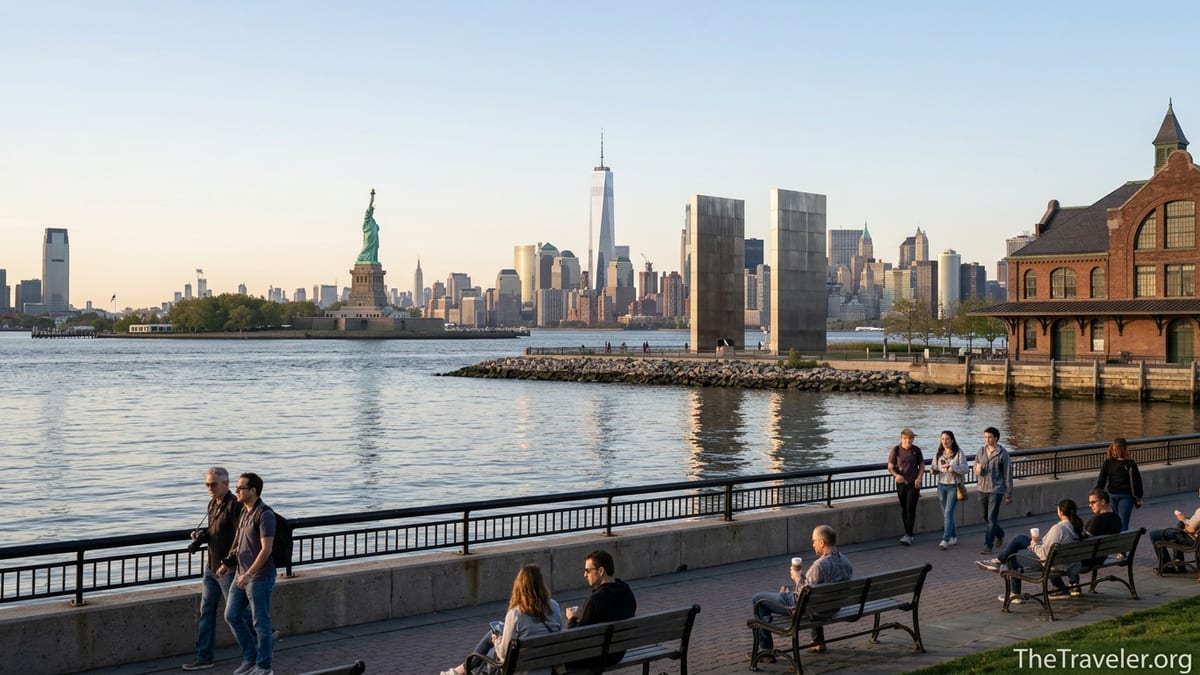
Even if you never step onto a ferry, Liberty State Park is a destination in its own right thanks to its setting directly on the Hudson River. The park’s two mile Liberty Walk promenade runs along the water, linking playgrounds, picnic lawns, and viewpoints in a continuous ribbon. On clear days you can see the Statue of Liberty to the south, Ellis Island almost directly ahead, and the full sweep of lower Manhattan to the east, with One World Trade Center sharply fixed on the horizon.
At the northern end of the park, the Central Railroad of New Jersey Terminal rises like a red brick cathedral to the age of rail. Once a major passenger gateway for immigrants moving westward after passing through Ellis Island, the terminal today functions as a museum space and a striking backdrop for photos. Inside, exhibits and historical signage help you imagine the days when thousands of new Americans boarded trains from these platforms bound for Chicago, St. Louis, and beyond.
Near the terminal, the Hudson River Waterfront Walkway continues beyond the park boundary into downtown Jersey City. Travelers can technically walk or bike from Liberty State Park all the way up the river through several waterfront neighborhoods, passing residential towers, office buildings, small parklets, and public art installations. An evening stroll here might include grabbing a coffee from a kiosk near the marina, then ambling north as the sun sets and the Manhattan skyline slowly lights up across the water.
This blend of nature, history, and urban energy is what makes Liberty State Park feel like more than just a city park. You might spend the morning birdwatching around the restored wetlands of Communipaw Cove, the afternoon wandering through the terminal and waterfront, and the evening eating dinner in a nearby neighborhood without ever getting into a car again.
Memorials, Museums, and Quiet Corners of Reflection
Liberty State Park also surrounds visitors with some of the region’s most powerful memorials. The New Jersey Empty Sky 9/11 Memorial stands just north of the CRRNJ Terminal, two parallel brushed steel walls aligned toward the site of the former Twin Towers. Tall, reflective surfaces capture the changing sky and skyline, while the names of the 749 New Jersey residents who lost their lives in the 2001 attacks are etched along the sides. Even on busy weekends, this area tends to feel contemplative; travelers often pause here after a day of sightseeing to let the experience sink in before they head back to the city.
On the western side of the park, away from the waterfront crowds, Liberty Science Center offers a completely different kind of immersion. This large, hands on science museum is especially popular with families, featuring interactive exhibits on everything from skyscraper engineering to animal habitats. It also houses an enormous domed theater that frequently shows nature documentaries and space films. For visitors planning a full day in the area, a common pattern is to visit the Statue of Liberty and Ellis Island from Liberty State Park in the morning, have a simple lunch at the park or in nearby Jersey City, then spend the late afternoon exploring Liberty Science Center’s exhibits indoors.
Scattered throughout the park are other small historical and interpretive signs that point to episodes many travelers have never heard of, such as the 1916 Black Tom explosion. At what is now the southeastern corner of the park, munitions destined for Allied forces in World War I detonated in a blast so powerful it shattered windows in Manhattan and damaged the Statue of Liberty. Today, casual visitors might jog or bike past this spot without realizing its past, but travelers who linger over the plaques come away with a sense of how the harbor has long been a stage for global events.
These memorials and museums give Liberty State Park a narrative depth that surprises many first time visitors. Instead of the quick photo stop they expected, travelers often find themselves spending hours exploring, reflecting, and connecting the modern skyline views with the history beneath their feet.
Marinas, Ferries, and Everyday Harbor Life
Adding another dimension to the park experience is Liberty Landing Marina, a substantial working marina tucked along the northern shore. Walking past its rows of sailboats and motor yachts, you get a glimpse of New York Harbor’s everyday life: crews hosing down decks, charter captains prepping for sunset cruises, and local residents commuting by water taxi. It is a side of the harbor that many tourists in Manhattan never see.
From the same general area, travelers can board the Liberty Landing Ferry, a commuter oriented service that runs across the Hudson to the Battery Park City Ferry Terminal in lower Manhattan. While schedules and prices vary over time, the ride is typically less than 15 minutes and provides yet another superb angle on the skyline. A visitor staying in Jersey City might, for example, spend the morning picnicking in Liberty State Park, then hop the ferry to Brookfield Place in Manhattan for an afternoon of shopping and dining, returning to the park by water as the city lights come on.
The presence of these ferries, together with private sightseeing boats and charter yachts that dock at Liberty Landing, creates a low constant hum of maritime activity around the park. On a sunny weekend you might see a Statue City Cruises ferry pulling away loaded with tourists, a sleek private sailboat heading down toward the Narrows, a smaller shuttle boat zipping residents to Paulus Hook, and a water taxi passing by on its way to midtown, all within the span of a few minutes.
Because so many of these services are aimed at daily commuters as well as tourists, they tend to run reliably year round, giving travelers flexibility in how they plan their time. If you miss the ferry you were aiming for, chances are another option will appear not long after, and even a short wait on the dock feels pleasant with the skyline directly ahead.
Surrounding Neighborhoods: From Paulus Hook to Bergen Lafayette
Part of what makes Liberty State Park feel larger than its boundaries is the way it connects to several distinct Jersey City neighborhoods. To the north and northwest, residential districts such as Paulus Hook, downtown Jersey City, and Liberty Harbor extend the waterfront experience with tree lined blocks, restaurants, and cafes. A traveler might finish a long walk on the Liberty Walk promenade, exit near the marina, and find themselves within ten to fifteen minutes on a lively street in Paulus Hook choosing between a classic pizzeria, a sleek cocktail bar, and a family friendly brunch spot.
Paulus Hook in particular has transformed over the past two decades into one of Jersey City’s most sought after addresses, helped along by the Hudson Bergen Light Rail, investments in Liberty State Park, and the expansion of ferry connections to lower Manhattan. Real estate in the area tends to command higher prices than in many surrounding neighborhoods, but for visitors this translates into a compact district where you can find well maintained brownstones, boutique fitness studios, and a dense collection of small restaurants. In the evening, the streets around Morris Street and Washington Street often feel like a mini restaurant row, with outdoor tables filling up in warm weather.
On the inland side of the park, the Bergen Lafayette neighborhood is becoming increasingly important to Liberty State Park’s story. Once more industrial and overlooked, it now borders the park’s western edge and is cited in plans to improve access to green space and active recreation facilities for local residents. Small cafes, neighborhood bakeries, and corner bars have appeared along Communipaw Avenue and nearby streets, creating options for travelers who prefer quieter, more local oriented spots over the more polished waterfront.
Because Jersey City’s waterfront is compact, it is feasible for a reasonably active visitor to explore several neighborhoods on foot or by bike in the same day. A possible route could take you from the light rail station at Liberty State Park through the park’s interior, along the Hudson River promenade, into Paulus Hook for lunch, and back through Bergen Lafayette toward one of its local coffee shops, all without ever needing a car or subway ride.
Practical Ways to Use the Park as Your Trip Hub
Beyond its scenery, Liberty State Park functions as a practical hub for exploring both New Jersey and New York City. For drivers, a key advantage is parking. While availability and fees shift over time, there are generally several large lots near Liberty Science Center, the western entrances, and the light rail station. Many New Jersey residents use the Liberty State Park Light Rail Park and Ride to leave their car for the day, ride the Hudson Bergen Light Rail into Jersey City or Hoboken, and connect to PATH trains into Manhattan. Travelers following the same pattern can combine a Statue visit, an afternoon in lower Manhattan, and an evening walk in Hoboken’s bar and restaurant scene without moving their vehicle more than once.
Visitors coming from Manhattan have multiple options. One common route is to take the PATH train from the World Trade Center to Exchange Place or Grove Street in Jersey City, then connect to the Hudson Bergen Light Rail toward Liberty State Park station. From the station it is roughly a 15 to 20 minute walk through the park to the waterfront and ferry terminal, or on certain days a seasonal park shuttle can shorten the distance. This approach is especially appealing for budget conscious travelers, as PATH and light rail fares are typically lower than many tourist focused water taxis or private cruises.
Those staying in Jersey City hotels often find that Liberty State Park becomes their de facto backyard. Properties clustered around the waterfront and downtown can be within a short ride of the park via light rail, rideshare, or even rental bikes. It is not unusual for business travelers with evening free time to slip down to the park after meetings, bring a takeaway dinner from a local restaurant, and eat at one of the picnic tables while watching ferries shuttle back and forth in the harbor.
Seasonality influences how you experience the park as a hub. In summer, early morning and late afternoon are the most comfortable times for long walks and Statue visits, with mid day best reserved for Liberty Science Center, shaded lawns, or nearby indoor restaurants. In winter, crisp clear air often brings the sharpest skyline views, and on quieter weekdays you may feel like you have entire stretches of the promenade to yourself, broken only by the occasional jogger or dog walker.
Ongoing Revitalization and What It Means for Travelers
Liberty State Park is in the midst of a long term revitalization effort that aims to balance conservation, recreation, and access for surrounding communities. State level plans envision new athletic fields, community spaces, improved entrances, and restored natural areas across parts of the park that were once rail yards or brownfield sites. For travelers, this means that areas which were previously off limits or rough around the edges are gradually being reimagined as trails, meadows, and sports facilities.
At the same time, these changes bring intermittent construction and evolving layouts, especially near key nodes such as the ferry terminal, waterfront jetties, and interior roadways. A visitor returning after several years away might notice new plantings along Liberty Walk, additional signage around the Richard J. Sullivan Natural Area, or revised traffic patterns near parking lots. Checking current park maps and advisories before a visit is wise, but the overall trend is toward more ways to experience the space rather than fewer.
Revitalization also reinforces the park’s role as a kind of outdoor living room for Jersey City residents. Community advocates have pushed for facilities that serve local youth sports, neighborhood gatherings, and environmental education as much as they serve tourists heading to the Statue of Liberty. For visitors, this can make a weekend afternoon in the park feel lively in an authentic way: kids playing soccer on a new field, families hosting birthday parties under picnic shelters, and local joggers sharing the path with out of town photographers hunting for the perfect skyline shot.
Crucially, the improvements have not changed Liberty State Park’s fundamental character as a largely open, green space in one of America’s densest metropolitan regions. Despite being framed by luxury towers in downtown Jersey City and financial skyscrapers in lower Manhattan, the park itself still offers long, unobstructed views and plenty of room to breathe. That contrast, between vast openness and urban intensity, is part of what leaves such a strong impression on first time visitors.
The Takeaway
Seen on a map, Liberty State Park looks like a straightforward green peninsula jutting into New York Harbor. Walk it in person and a more complex picture emerges. This is where ferries depart quietly for two of the country’s most significant monuments, where a historic rail terminal tells the next chapter of the immigrant story, where a 9/11 memorial aligns you with a changed skyline, and where a hands on science center turns a rainy day into an educational detour.
Just beyond the park boundary, working marinas, commuter ferries, and evolving neighborhoods extend the experience in every direction. You can step off a boat from Liberty Island and be eating waterfront seafood in Jersey City within minutes, or ride a commuter ferry from the marina to Manhattan’s office towers, turning a sightseeing day into a city hopping mini adventure. The park is both destination and crossroads.
For travelers who are willing to look past the obvious postcard shot of the Statue of Liberty, Liberty State Park reveals itself as much more than a viewing platform. It is a nexus where history, daily life, transportation, and neighborhood change all intersect. Plan even a single day here and you will likely leave with more than just skyline photos. You will carry a sense of how this corner of New Jersey fits into the wider story of New York Harbor and the people who continue to pass through it.
FAQ
Q1. Is it better to visit the Statue of Liberty from Liberty State Park or from Manhattan?
Both work well, but Liberty State Park usually offers smaller crowds, easier parking, and a calmer overall experience, while Manhattan is more convenient if you are already staying in lower Manhattan.
Q2. Do ferries from Liberty State Park go to both the Statue of Liberty and Ellis Island?
Yes. Official Statue City Cruises ferries from Liberty State Park typically stop at Ellis Island first and then continue to Liberty Island, and your ticket covers both stops.
Q3. How much time should I plan for a visit that includes Liberty State Park and the islands?
Most travelers should allow at least half a day, around five to six hours, to include ferry travel, security screening, time on Ellis Island, time at the Statue, and a short walk in the park.
Q4. Can I reach Liberty State Park by public transit from New York City?
Yes. A common route is to take the PATH train to Jersey City, transfer to the Hudson Bergen Light Rail toward Liberty State Park station, then walk or take a seasonal park shuttle to the waterfront.
Q5. Is Liberty State Park a good place for families with children?
Very much so. Families combine playgrounds and open lawns with hands on exhibits at Liberty Science Center, and older kids often enjoy the ferry ride and Ellis Island museum.
Q6. Are there food and drink options in or near Liberty State Park?
There are seasonal vendors and limited options within the park, plus additional cafes, restaurants, and bars in nearby neighborhoods like Paulus Hook, downtown Jersey City, and Bergen Lafayette.
Q7. Can I bike around Liberty State Park and the surrounding area?
Yes. The park has paved paths suitable for bikes, and experienced cyclists often link the park to the Hudson River Waterfront Walkway and nearby Jersey City streets for longer rides.
Q8. Is Liberty State Park worth visiting if I am not planning to take the ferry?
Yes. Many visitors come solely for the waterfront views, the Empty Sky Memorial, the historic rail terminal, picnics, jogging, or simply a quiet break from the city.
Q9. What is the best time of day to visit for views and photography?
Early morning and late afternoon into sunset are ideal, when the light is softer and the skyline and Statue of Liberty are beautifully illuminated.
Q10. Are there ongoing construction or revitalization projects that affect visits?
Yes, the park and ferry areas are undergoing phased improvements, so you may encounter temporary detours or fenced off sections, but the main attractions and views remain accessible.