


The first time I stepped out of the car at Liberty State Park in Jersey City, the wind off Upper New York Bay smelled faintly of salt and river mud. Ahead of me, Lady Liberty rose from the water as if she were just across a narrow street, and behind me the red-brick bulk of the old train terminal anchored the shoreline. Within minutes I understood why people do not just visit this place once. They come back, bringing kids, kayaks, picnic blankets, even out-of-town relatives, looking for another version of the same moment I was having right then: a sweeping view of New York Harbor that somehow feels both monumental and personal.
Get the latest updates straight to your inbox!
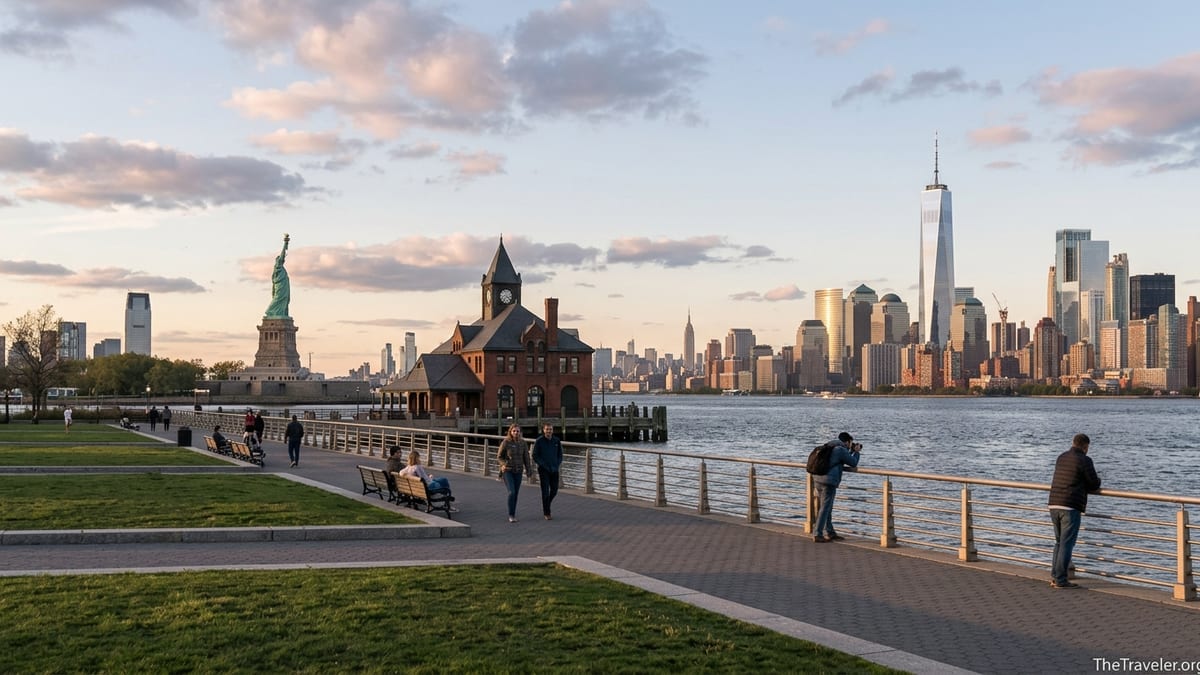
The First Glimpse Across the Water
Most people arrive at Liberty State Park expecting a good view. What I was not prepared for was the feeling of standing almost eye-level with the Statue of Liberty, with no skyscrapers in the way. From the promenade near the Central Railroad of New Jersey Terminal, Liberty Island sits roughly half a mile across the channel, close enough that you can watch the sunlight slide along the statue’s copper folds as the clouds move. On a clear afternoon you see the torch blaze gold, ferries carving white wakes between Jersey City, Ellis Island and Manhattan.
Turn slightly north and the entire lower Manhattan skyline fills your field of vision: One World Trade Center tapering into the sky, the glass towers of Battery Park City, the Brooklyn and Manhattan Bridges shimmering in the distance. This is the scene that lures wedding photographers, drone hobbyists and families in matching souvenir sweatshirts. It is also the view that convinces locals to keep returning. I met a Jersey City resident who told me he comes two or three evenings a week just to walk the waterfront after work, saying it is “the cheapest therapy in the metro area.”
What makes that first glimpse powerful is the space around you. Unlike the crowded sidewalks of Battery Park on the New York side, Liberty State Park opens wide. There is room to lean on the railing, set up a tripod, or simply stand still without someone brushing past your backpack. On a weekday morning in late spring, I counted more Canada geese than tour groups. Yet even with the quiet, the harbor feels busy: tugboats muscling barges upriver, helicopters drifting toward heliports, ferries shuttling commuters and visitors between states.
It is that balance of drama and breathing room that hits you in the first five minutes, and it sets the tone for everything else that follows in the park.
Stepping Into History at the Old Train Terminal
Walk inland a few steps and you leave the glassy skyline for a different kind of monument. The Central Railroad of New Jersey Terminal, a red-brick, Romanesque-style building finished in 1889, once funneled millions of immigrants from Ellis Island onto trains heading west. Today its clock tower, dormer windows and long iron train shed are preserved as part of the park, and standing in front of it you can almost hear the echo of steam whistles and station announcements.
Inside the terminal, interpretive displays describe how, in the early 20th century, this spot was one of several great waterfront rail hubs on the New Jersey side of the Hudson. Passenger cars lined up on the tracks behind the terminal while ferries met arriving trains at the front, sending people toward Manhattan or farther along the coast. Looking out through the tall arched windows at Ellis Island, you realize that for many families this was their first view of the American mainland after processing. Today school groups pause here as guides point out how the story ties together: ship to island, island to station, station to the rest of the country.
Even without a tour, the building pulls you in. Couples pose for engagement photos under the iron canopy where tracks once stretched. Joggers cut through the plaza under the station clock as if it is still a commuter shortcut. During special events like outdoor markets or festivals, food trucks line the approaches, their modern graphics contrasting with the century-old brickwork. The mix of old and new makes each visit a little different; one weekend you might find a heritage event with vintage rail cars, another weekend a local arts fair filling the concourse.
For a traveler, the practical payoff of the terminal is also significant. It serves as the departure point for Statue City Cruises ferries to Ellis Island and Liberty Island, turning the park into one of the easiest and most relaxed ways to start a Statue of Liberty visit from the New Jersey side.
Ferries, Skylines and the All-Day Harbor Experience
No matter how many photos you take from the shore, at some point the ferries will tempt you. From Liberty State Park, Statue City Cruises runs boats that loop between the park, Liberty Island and Ellis Island. On my visit, a standard reserve ticket purchased ahead of time cost in the mid 20-dollar range for adults, with lower fares for children and seniors, including access to both islands and the return ride. Prices can vary slightly by season and ticket type, so checking current options before you go is essential.
Boarding at Liberty State Park feels calmer than boarding in lower Manhattan. The security screening process is the same federal procedure used on both sides of the river, but the lines here are often shorter, particularly on weekday mornings or outside peak summer weekends. Families with strollers and visitors who prefer less crowding often choose this departure point for that reason. Once you clear security, you step onto a multi-level ferry where you can sit inside or on open-air decks. As the boat pulls away, the park’s green lawns recede behind the rust-red train shed, and Manhattan’s towers slide across your peripheral vision.
The trip itself can be treated as a harbor tour. Many travelers ride all the way to Liberty Island first, then onward to Ellis Island, spending an hour or more at each stop. Others with less time stay aboard for a shorter loop, photographing the statue’s profile from the deck and watching container ships in the nearby channels. If you start your day from New Jersey and end it in New York, you can continue into downtown Manhattan on foot after returning via Liberty Landing Ferry, which connects the park’s marina area with Battery Park City in around ten minutes, operating more frequently on weekdays than weekends and with separate fares typically in the single digits each way.
What keeps people coming back is not just the ferries themselves but the ability to build different days around them. One Saturday might be a full immigration history deep dive, combining Ellis Island exhibits with a walk through the old train terminal. Another afternoon might be nothing more than a harbor cruise followed by a simple bench picnic back on shore, letting kids watch the boats while planes queue above Newark Liberty International Airport in the distance.
Big Meadows, Quiet Trails and Everyday Escapes
It is easy to think of Liberty State Park only as a gateway to something else: the Statue of Liberty, Ellis Island, downtown Manhattan. Spend more time here, and you realize it is also a destination in its own right. The park covers more than 1,200 acres of former rail yards and shoreline, which means there is room for wide fields, shaded picnic groves and quieter corners where the city feels far away even though the skyline remains in sight.
Families tend to gravitate to the large lawns near the terminal and along the waterfront, where you will see birthday balloons tied to picnic tables and kids kicking soccer balls with the World Trade Center in the background. Barbecues sizzle at designated grills in the group picnic areas, which require advance permits but do not carry a per-use fee beyond that reservation. On summer weekends, these spots can fill early, so regulars bring foldable wagons loaded with coolers, charcoal bags and folding chairs, arriving by mid-morning to claim a table. Parking in the main lots near the waterfront is typically paid by the day or by the hour, but the cost remains modest compared to Manhattan garages, making it realistic for families to linger.
If your idea of a perfect park day is quieter, follow the paths south toward Caven Point. Here the scenery shifts to salt marshes, tidal flats and narrow boardwalks where interpretive signs describe migrating birds and native plants. The city never completely disappears, but the mood softens. I passed a local bringing his camera on a dawn walk to photograph egrets hunting in the shallows, and a pair of runners using the flat, paved loops for training laps before work. For many Jersey City and Bayonne residents, this is their quick weekday reset: a 30- or 40-minute walk under open sky that does not require leaving town.
Regular programming reinforces that sense of local routine. The park periodically hosts guided nature walks and summer kayak eco-tours that launch from the south side near the park office, typically charging a modest fee per person that is closer to the cost of a casual restaurant meal than a commercial tour. Reservations for these small group excursions often fill quickly, especially on warm weekends, and repeat participants told me they sign up every season to watch how the marsh changes throughout the year.
How to Reach the Park and Get Around Once You Are There
Part of Liberty State Park’s appeal is that it feels tucked away, yet it is thoroughly connected to the region. If you are arriving from Manhattan without a car, one of the most straightforward options is to take the PATH train to Exchange Place or Grove Street in Jersey City, connect to the Hudson Bergen Light Rail, and ride to the Liberty State Park station. From there, a level walk of roughly 20 to 25 minutes along park roads and paths brings you to the waterfront, the old terminal and the ferry departure area. There is currently no official park shuttle on this route, so comfortable walking shoes matter.
Drivers from New Jersey and beyond typically follow the New Jersey Turnpike to Exit 14B, which drops you within a few minutes of the park entrances. Signs point toward lots near the Liberty Science Center, the east end of Freedom Way and the waterfront. The Liberty Science Center lot, which often charges a flat daily rate comparable to a couple of New York subway fares, is a common choice for families combining a museum visit with time in the park. When that fills, overflow parking sometimes uses the nearby light rail station lot, a short walk away. Because availability and prices can change seasonally or for special events, it is wise to check park advisories or call ahead if you are planning around a specific time.
Once inside the park, navigation is simple. A long, paved path traces the waterfront from north to south, suitable for strollers, wheelchairs and bikes. Cyclists often ride from downtown Jersey City, following local streets into the park and then looping along the harbor-facing promenade. Bike share systems occasionally extend near the edges of the park, but availability is not guaranteed, so visitors who care most about cycling usually bring their own. For travelers staying in Manhattan, Liberty Landing Ferry can be a practical way to arrive directly at the park’s marina during weekday commutes, though its weekend schedule is lighter and it operates separately from the Statue of Liberty ferries.
However you arrive, give yourself more time than you think you need. It is easy to underestimate the size of the park when you are looking at a map from a hotel room, but walking from the light rail station to the terminal, then out to Caven Point and back, can add up to several unhurried miles.
Where Locals Linger: Cafes, Picnics and Sunset Rituals
Unlike some urban parks that feel ringed with restaurants, Liberty State Park offers a simpler, almost minimalist set of amenities, which in turn shapes how people use it. Near the marina and Liberty House Restaurant, you can find sit-down dining with white-tablecloth harbor views, popular for weddings and special occasions. But for most everyday visits, locals come self-sufficient, bringing coolers, thermoses of coffee and trays of empanadas or dumplings picked up from neighborhood spots in Jersey City before they arrive.
On a recent Sunday, I watched a multigenerational family from Journal Square set up a long folding table under a tree with aluminum trays of homemade biryani and grilled chicken. A few yards away, a group of friends in cycling jerseys leaned bikes against the railing and shared paper cups of iced coffee from a nearby cafe in Paulus Hook. They all had different rituals, but when I asked why they chose this park over closer neighborhood playgrounds or waterfronts, they gave similar answers: the openness, the view, the feeling of being on a mini-vacation without leaving town.
As late afternoon slides into evening, the park shifts again. People who work in Manhattan sometimes time their return so they can watch sunset from Liberty State Park before heading home. Tripods sprout along the railing as amateur photographers chase the classic shot: the sky turning pink behind the Statue of Liberty while office lights flicker on in the Financial District. Others keep it simpler, sitting on the grass with takeout pizza boxes from downtown Jersey City, letting kids roll down the slight slopes as ferries trace white lines across the darkening water.
The lack of heavy commercial development inside the park is deliberate. It keeps the focus on the harbor itself, rather than on shopping or nightlife. Visitors looking for more dining or bar options simply walk or drive back into Jersey City afterward, where entire restaurant rows in neighborhoods like Downtown and the Powerhouse Arts District wait a short ride away.
Planning Your Visit: Seasons, Weather and Crowd Patterns
Although Liberty State Park is open year-round, the experience changes significantly with the seasons. Late spring and early autumn are arguably the sweet spots: mild temperatures, relatively low humidity and a softer quality of light that flatters both skyline photos and long walks. On a clear October afternoon, for example, you might wear a light jacket while watching migrating birds skim over the marshes, then stay comfortably through sunset without the intense summer heat radiating off the pavement.
Summer brings its own rewards and complications. Long daylight hours, school holidays and warm evenings make June through August the busiest period for family picnics, weekend festivals and Statue of Liberty visits. Parking lots near the waterfront can fill by late morning on prime Saturdays, and ferry lines lengthen from mid-morning through early afternoon. Locals who know the rhythm often arrive early, enjoy the park until midday, then retreat to indoor attractions like Liberty Science Center or nearby cafes during the hottest hours before returning in the evening.
Winter, by contrast, belongs to those who appreciate a more austere harbor. On cold, clear days, the air can be startlingly crisp, sharpening the outlines of skyscrapers across the Hudson. Fewer visitors mean you may walk long stretches of the promenade without passing anyone but dog walkers in heavy coats. Some ferry services may operate on reduced schedules in the coldest months, and wind off the bay can make temperatures feel several degrees lower than in sheltered city streets, so planning layers and checking current operating hours becomes crucial.
Regardless of season, weather can shift quickly on the water. A sunny forecast in Jersey City does not always guarantee perfect visibility; haze and humidity sometimes soften the view of midtown Manhattan by afternoon. If your main goal is photography, starting early in the day or timing your visit for golden hour just before sunset usually offers the best mix of light and clarity.
The Takeaway
When I think back to that first moment at Liberty State Park, what I remember most is not just the postcard-perfect view of the Statue of Liberty or the geometry of lower Manhattan’s skyline. It is the feeling that the harbor belonged, at least for a while, to the people quietly moving through the park: kids on scooters racing along the promenade, grandparents sitting on folding chairs near the picnic groves, commuters stepping off a ferry with briefcases in hand. The park gathers all of these lives and sets them against one of the most recognizable backdrops on earth.
That is why people keep returning. There are always new reasons to come back: a different season, a visiting relative who has never seen the statue up close, a spontaneous decision to watch fireworks over the water, a morning run that turns into a meditative loop under changing skies. Yet the core experience remains the same. Liberty State Park offers a rare mix of urban energy and open space, history and everyday routine, big-ticket sights and small, personal rituals.
If you give yourself more than a quick stop on the way to a ferry, you may find that what stays with you is not just the crossing to Liberty Island, but the walk back through the park afterward, when the harbor quiets and the lights come up across the river. That is the moment many travelers realize they will be back.
FAQ
Q1. Is Liberty State Park worth visiting if I am not taking the Statue of Liberty ferry?
Yes. Even without the ferry, the park offers some of the best unobstructed views of the Statue of Liberty and Manhattan, plus large picnic areas, walking and biking paths, marshland trails near Caven Point and the historic Central Railroad of New Jersey Terminal to explore.
Q2. How do I get to Liberty State Park from Manhattan on public transportation?
A common route is to take the PATH train from Manhattan to Exchange Place or Grove Street in Jersey City, transfer to the Hudson Bergen Light Rail and ride to Liberty State Park station. From there it is roughly a 20 to 25 minute flat walk through the park to the waterfront and ferry area.
Q3. Is there parking at Liberty State Park and how much does it cost?
Yes. There are parking lots near the Liberty Science Center, along Freedom Way and near the waterfront. Fees are generally modest compared to Manhattan garages and may be charged by the day or hour, with exact rates and availability varying by lot, day of the week and special events.
Q4. Are there food options inside Liberty State Park?
Food options inside the park are limited. There is restaurant dining near the marina and event spaces, and occasionally food trucks during festivals, but many visitors bring their own picnics or pick up takeout in Jersey City neighborhoods before arriving.
Q5. Can I bike in Liberty State Park?
Yes. Biking is popular on the paved paths that run along the waterfront and through the interior of the park. Riders often pedal in from nearby Jersey City or Bayonne. There may be occasional bike share availability near the park’s edges, but it is best to bring your own bicycle if cycling is a priority.
Q6. What is the best time of day to visit Liberty State Park for views and photos?
Early morning and late afternoon into sunset typically provide the best light and fewer crowds. Golden hour before sunset often gives particularly striking views of the Statue of Liberty and Manhattan skyline, with softer colors and reflections on the water.
Q7. Are there restrooms and basic facilities in the park?
Yes. Restroom facilities are available near major gathering points such as the historic train terminal, some picnic areas and by certain parking lots. Drinking fountains and benches are scattered along the promenade, but it is wise to carry your own water, especially on hot days.
Q8. Is Liberty State Park suitable for young children and strollers?
Very much so. The park’s wide, mostly level paths are stroller friendly, and there is ample open space for children to run and play. Families should plan for the walking distance between the light rail station, parking areas and waterfront, and pack snacks, water and sun protection during warmer months.
Q9. Do I need a ticket to enter Liberty State Park?
No. Entry to Liberty State Park itself is free. Costs apply only to services such as parking in certain lots, ferry tickets to Liberty Island and Ellis Island, and paid activities like special tours or programs.
Q10. How much time should I plan for a visit to Liberty State Park?
If you are only walking the promenade and taking photos, two to three hours can be enough. If you add ferry trips to Liberty Island and Ellis Island, visits to the museum exhibits there and time to explore the park’s trails and picnic areas, plan on most of a day.