


Travelers landing in New York City often focus on Manhattan’s big-ticket names: Times Square, Central Park, the High Line, the Brooklyn Bridge. Yet just across the Hudson River in Jersey City, Liberty State Park quietly offers many of the same headline experiences visitors crave: knockout skyline views, direct access to the Statue of Liberty and Ellis Island, meaningful history, and space to breathe. All without an admission fee. As New Jersey invests in a sweeping revitalization plan leading up to the park’s 50th anniversary, the question becomes unavoidable: can Liberty State Park claim the title of the best free attraction near Manhattan?
Get the latest updates straight to your inbox!
A Waterfront Park With a Billion-Dollar View
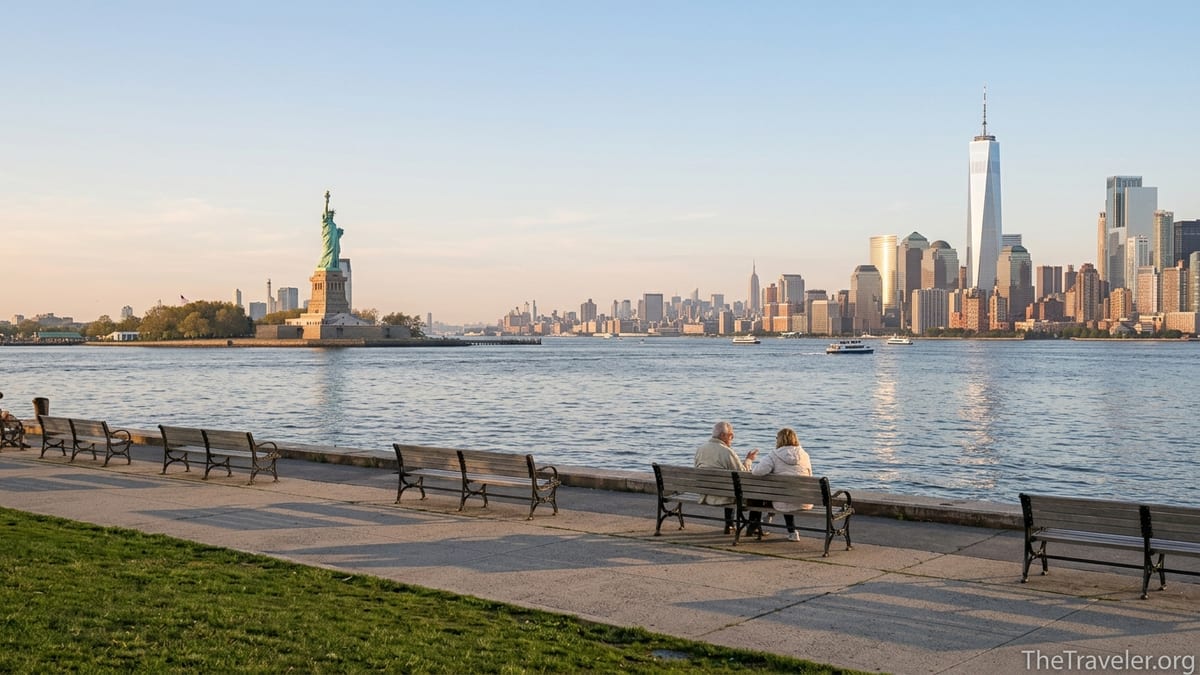
Liberty State Park sits directly opposite Lower Manhattan on New York Harbor, and its biggest selling point is immediately obvious: the view. Stand along the Hudson River Waterfront Walkway by the historic train terminal and you are looking straight at the Statue of Liberty, Ellis Island, and the glass-and-steel skyline of the Financial District. On clear days, you can trace the curve of the harbor past One World Trade Center, the ferry wakes cutting through the water, and aircraft banking over the city. For many visitors, this panorama alone would justify the trip.
Unlike busy Manhattan promenades where joggers, bikes, and tourists constantly compete for space, Liberty State Park’s riverfront tends to feel calmer, especially on weekday mornings or outside peak summer weekends. There is room to stop and actually linger over the view, to set up a tripod for a long-exposure night shot of the skyline lights, or to let kids wander without the fear of stepping into a bike lane. Photographers often favor the park’s open lawns and piers at golden hour, when the sun sets behind Jersey City and the towers of Lower Manhattan glow in soft side light.
Crucially for budget-conscious travelers, none of this costs anything. There is no gate fee to enter Liberty State Park and no ticket needed to stroll the waterfront or sit on a bench facing the harbor. Compare that with paid observation decks in Manhattan, where a family of four can easily spend over 150 dollars for timed admission and elevator rides to the top of a skyscraper. In Liberty State Park, that skyline becomes a free backdrop for a picnic or a sunset walk.
The setting also changes character throughout the day in ways that reward repeat visits. Early mornings often bring a hush over the Hudson, with joggers tracing the path as ferries begin their first crosses from New Jersey to New York. By late afternoon, the lawn by the Empty Sky Memorial fills with locals on blankets, and when the sun slips behind the Palisades, Manhattan’s windows ignite one by one. For night owls, the park is one of the best low-cost spots in the region to watch the Tribute in Light on the September 11 anniversary or to catch fireworks displays over the harbor in early July.
Gateway to the Statue of Liberty and Ellis Island
One of Liberty State Park’s most powerful advantages over other free attractions near Manhattan is its role as a gateway to Liberty Island and Ellis Island. The official concessioner for Statue of Liberty and Ellis Island ferries operates a major departure point directly from the park’s historic Central Railroad of New Jersey Terminal. From here, passengers clear airport-style security in a modern ferry building and then board boats that stop first at Liberty Island, then Ellis Island, before returning to New Jersey.
For visitors staying in Manhattan, it can seem counterintuitive to cross into New Jersey just to catch the ferry. Yet many travelers find that the Liberty State Park departure offers a calmer, more efficient experience than the heavily trafficked Battery Park dock at the southern tip of Manhattan. Security lines from the New Jersey side are often noticeably shorter, especially in peak season, which can trim waiting times and reduce the sense of crowding that sometimes overwhelms first-time visitors. Day-trippers who value a more relaxed launch point and a park setting before and after the trip often consider the extra transit worth the effort.
The boat ticket itself is not free, of course, but the staging area in the park is. That makes Liberty State Park a smart compromise for travelers torn between budget constraints and a desire to “do the Statue properly.” Even if you ultimately decide to skip the islands, you can still walk the waterfront and frame close views of the statue across the water, without paying a cent. For those who do book, many seasoned visitors recommend early-morning departures from Liberty State Park, pairing the first boats of the day with a midmorning picnic back on shore while the crowds swell at the New York docks.
Logistically, the park connects well to the broader region. The Hudson-Bergen Light Rail stops near the park’s western edge, and several bus routes feed the surrounding Jersey City neighborhoods. Drivers will find multiple parking lots scattered throughout the park, generally charging modest day rates compared to Manhattan garages. When you factor in the cost of time spent waiting in longer security lines in Manhattan, Liberty State Park’s role as a more tranquil launchpad for one of the country’s most iconic sites strengthens its case as a top-value attraction.
History in Brick, Steel, and Sky
Liberty State Park is not just a pretty stretch of waterfront. It is layered with stories that connect New Jersey and New York to national history. The anchor is the red-brick Central Railroad of New Jersey Terminal, a grand late 19th century building where immigrants who had just processed through Ellis Island boarded trains bound for destinations across the United States. Today, its restored façade, clock tower, and soaring interior halls serve less as a transportation hub and more as a visual and emotional focal point.
Standing on the terminal’s platform and looking toward Ellis Island, it is easy to imagine the journey: ships nudging into the harbor, passengers stepping onto the island for inspection, then crossing the water once more to Liberty State Park’s shoreline. Panels inside and around the terminal trace this story in photos and text, yet what resonates most for many visitors is simply the sense of space. Unlike the more compressed urban context of Lower Manhattan, the terminal at Liberty State Park rises against a backdrop of open sky and water, reinforcing the idea of arrival and possibility that defined so many immigrant experiences.
The park’s industrial past is also visible in more subtle ways. Rusted rails embedded in the ground near the terminal hint at the sprawling rail yards that once occupied this peninsula. Archaeological work and environmental cleanup transformed what had become a neglected brownfield into lawns, wetlands, and trails beginning in the late 1970s. As New Jersey advances a new master plan, that transformation continues, with restoration of the historic train shed and upgrades to public spaces designed to make the terminal area even more welcoming for events, markets, and cultural programming in the coming years.
Beyond the built environment, Liberty State Park’s position in the harbor has put it in the foreground of national moments. After the attacks of September 11, 2001, the park became a key staging area for emergency operations and later a place of remembrance. Today, its combination of historic architecture, open skies, and direct sightlines to both the former World Trade Center site and the Statue of Liberty gives the park a gravitas that many visitors do not expect from “just” a local green space.
Empty Sky and a Landscape of Reflection
Many travelers arrive at Liberty State Park for the skyline and the Statue, then find themselves most moved by a work of public art: the Empty Sky memorial. This state 9/11 memorial consists of two parallel stainless-steel walls, each more than 200 feet long, set along a grassy axis that points directly toward Lower Manhattan. As you walk between the walls, the names of New Jersey residents who died in the attacks are etched at eye level, while the polished surfaces reflect your image, the sky above, and the distant towers across the water.
The design deliberately frames the gap in the Manhattan skyline where the Twin Towers once stood. At certain angles, especially near sunset, the walls catch the warm light and mirror the harbor in a way that can be quietly overwhelming. Visitors often report that the memorial feels more intimate than some downtown Manhattan sites, in part because Liberty State Park is less crowded and because the open lawns give people space to sit with their thoughts. On the anniversary of the attacks and during the annual Tribute in Light, the memorial becomes a focal point for remembrance ceremonies and personal pilgrimages.
Empty Sky alone would be a worthwhile reason to detour to Liberty State Park, particularly for travelers interested in how different communities remember shared tragedies. Yet the memorial is just one of many contemplative pockets in the park. Benches along the waterfront invite you to watch the ferries trace their routes, while quieter inland paths lead through meadows and newly restored natural areas where city noise recedes. In a region where so many public spaces constantly buzz with activity, the ability to shift from a global icon like the Statue of Liberty to pockets of quiet reflection within a few minutes’ walk is a rare luxury.
For families, this balance matters. Adults might spend time at the memorial while children play at nearby playgrounds or open fields, and multigenerational groups can choose their own pace. Couples on a tight Manhattan schedule might pair a ferry trip with a sunset stroll through the memorial axis before returning to the city for dinner. In each case, the park’s combination of emotional weight and physical openness sets it apart from more compressed free attractions like the High Line or Bryant Park.
Everyday Recreation, Picnics, and Local Life
Beyond iconic views and memorials, Liberty State Park functions day-to-day as Jersey City’s backyard. On any given weekend from spring through fall, you are as likely to see birthday parties under the picnic shelters and families grilling near the southern lawns as you are tour groups heading to the ferry. Soccer games, kite flyers, pickup cricket matches, and casual dog walkers all share the same broad fields, giving visitors a sense of how locals actually use the waterfront.
This local energy is part of what makes the park such a compelling free attraction. Travelers can grab inexpensive takeout from nearby Jersey City neighborhoods or pack groceries from a Manhattan supermarket, then claim a table with harbor views for an afternoon feast. The park’s layout, with long, open lawns broken up by clusters of trees and shelters, means you can usually find a spot that feels neither isolated nor crowded. Compared to Central Park’s busier meadows, where groups jostle for space on warm weekends, Liberty State Park often feels more relaxed and less choreographed.
Runners and cyclists value the park for its relatively flat, uninterrupted paths, ideal for longer workouts with scenery. Parents appreciate the playgrounds and the ability to let kids ride scooters or small bikes without constantly dodging heavy traffic. Birdwatchers find their own reasons to return, especially near the Richard J. Sullivan Natural Area and the western edges of the park, where wetlands and restored habitats attract migratory species. None of these activities require more than transit fare and perhaps a small parking fee, rare in a metro area where even basic recreation often comes with a price tag.
Events further enrich the calendar. Festivals, charity runs, and outdoor concerts periodically take over sections of the park, using the skyline as a ready-made stage backdrop. While some events charge participation fees, simply being in the park during a race or music festival can add a festive layer to an otherwise quiet visit. Travelers who prefer solitude can aim for weekday mornings or cooler months, when the park feels almost like a private waterfront garden at the edge of one of the world’s busiest cities.
Getting There, Costs, and Practical Tips
For all its charms, Liberty State Park is not quite as effortless to reach as many Manhattan attractions, and this is often what keeps it off standard visitor itineraries. From Midtown Manhattan, one common route is to ride the PATH train to Jersey City’s Exchange Place or Grove Street stations, then transfer to the Hudson-Bergen Light Rail toward the Liberty State Park stop. From there, it is roughly a 15 to 20 minute walk through the park’s western side to the waterfront and the historic terminal. Alternatively, some visitors opt for ride-hailing services or taxis directly from Manhattan or downtown Jersey City, particularly if traveling with luggage or young children.
Driving is straightforward compared with threading a car into Manhattan. Access roads off the New Jersey Turnpike and local highways lead to multiple park entrances, with parking lots near the Liberty Science Center, the ferry terminal, and along Audrey Zapp Drive. Parking fees are typically modest compared to Manhattan garages, and because the park is spread out, spaces tend to be easier to find outside major event days. For travelers staying at hotels in Jersey City’s waterfront districts, a short taxi or app-based ride can bring you to the park in under ten minutes, often for the price of a couple of subway swipes.
Inside the park, costs are almost entirely optional. There is no entrance fee and no requirement to join tours. You can spend a day walking, photographing, and picnicking for little more than the cost of getting there. Paid extras cluster around specific attractions: ferry tickets to the Statue of Liberty and Ellis Island, admission to Liberty Science Center (which sits at the park’s edge and offers a separate slate of interactive exhibits and film domes), and occasional event fees for special programming. Travelers comparing options might find that a half day in Liberty State Park plus a self-guided stroll through Jersey City’s historic downtown delivers as much or more value than a packed Manhattan schedule of tickets and lines.
Weather and timing also matter. On windy winter days, the waterfront can feel exposed, with the harbor funneling cold air straight across the open lawns. Summer weekends bring more visitors, though the park’s scale usually absorbs crowds better than Manhattan’s more compact green spaces. Shoulder seasons like late April, May, September, and early October are particularly rewarding, with comfortable temperatures and clear skies that flatter both skyline and statue views. Whenever you go, bring layers, sunscreen, and water; once you are along the waterfront, concessions can be spaced farther apart than in city parks stocked with vendors on every corner.
How It Stacks Up Against Other Free NYC-Area Icons
To decide whether Liberty State Park can claim the title of the best free attraction near Manhattan, it helps to compare it with the heavyweights. Central Park offers sheer variety: formal gardens, lakes, performance venues, playgrounds, and centuries of cultural associations. The High Line delivers designer landscaping and an elevated urban perspective. The Brooklyn Bridge and its riverfront parks give you postcard views with every step. Each of these is free to enter and easily folded into a typical New York itinerary.
Liberty State Park’s advantage lies in what it combines in one place. It offers a direct relationship with three national symbols at once: the Statue of Liberty, Ellis Island, and the Lower Manhattan skyline. It pairs that with a solemn state memorial, a major historic rail terminal, and open recreational fields large enough to stretch out without feeling hemmed in by crowds. Few, if any, other free sites in the region manage that mix of national history, everyday local life, and wide-angle harbor scenery.
Where the park falls behind is convenience. First-time visitors may be reluctant to master PATH and light rail transfers or to cross into New Jersey on short trips. Some will decide that a free Staten Island Ferry ride from Manhattan, which also passes close to the Statue of Liberty and requires no extra planning beyond subway fare, provides enough of a harbor experience for their needs. Others may prioritize the buzz of Manhattan’s core over the calmer atmosphere across the river.
Yet for travelers who value space, views, and a sense of escape from Midtown intensity, Liberty State Park often proves to be a highlight rather than a detour. It is especially strong for repeat visitors who have already checked off Manhattan’s classics and now seek something that feels both grand and local. As New Jersey’s ongoing revitalization projects bring new athletic fields, upgraded waterfront amenities, and restored historic structures online through the mid-2020s, the park’s appeal is likely to grow, not shrink.
The Takeaway
So can Liberty State Park in Jersey City be the best free attraction near Manhattan? For many types of travelers, the answer leans strongly toward yes. The park offers one of the region’s most expansive harbor views, a front-row seat to the Statue of Liberty and Ellis Island, and a powerful 9/11 memorial, all wrapped in a landscape that invites both quiet reflection and everyday play.
It will not replace Central Park’s cultural density or the High Line’s urban drama, and it demands a bit more logistical effort than hopping on a Midtown subway. But for those willing to cross the Hudson, Liberty State Park delivers a rare combination: national-history landmarks, neighborhood park warmth, and skyline theater, with no admission fee at the gate. As investment in new facilities and restorations continues around its 50th anniversary, this slice of Jersey waterfront looks more and more like the New York area’s most undervalued free experience.
FAQ
Q1. Is Liberty State Park really free to enter?
Yes. There is no admission fee to enter Liberty State Park or use its basic amenities like paths, lawns, and picnic areas. You only pay for extras such as parking, ferry tickets to the Statue of Liberty and Ellis Island, or admission to nearby Liberty Science Center.
Q2. How do I get to Liberty State Park from Manhattan without a car?
The most common route is to take the PATH train from Manhattan to Jersey City, then transfer to the Hudson-Bergen Light Rail toward the Liberty State Park stop and walk into the park. Many visitors also use ride-hailing services or taxis directly from Lower Manhattan or downtown Jersey City for a faster, though more expensive, option.
Q3. Is it better to take the Statue of Liberty ferry from Liberty State Park or from Battery Park in Manhattan?
Both departure points use the same official ferry operator and reach Liberty Island and Ellis Island. Battery Park is more convenient if you are staying in Manhattan, but lines there are often longer, especially in peak season. Liberty State Park usually offers a calmer atmosphere and shorter security queues, which some travelers prefer even if it requires extra transit from New York.
Q4. Can I see the Statue of Liberty clearly from Liberty State Park without buying a ferry ticket?
Yes. From the waterfront near the historic rail terminal and along the Hudson River Walkway, you get strong, unobstructed views of the Statue of Liberty across the water. While you will be farther away than on Liberty Island itself, many visitors are satisfied with photos and memories from the park’s shoreline alone.
Q5. What are the must-see spots inside Liberty State Park?
Most visitors prioritize the Central Railroad of New Jersey Terminal, the Empty Sky 9/11 Memorial, and the main waterfront promenade facing Lower Manhattan, Liberty Island, and Ellis Island. Those with extra time can explore inland lawns, picnic areas, playgrounds, and the paths near the park’s restored natural areas for quieter walks and birdwatching.
Q6. Is Liberty State Park safe for visitors, including solo travelers and families?
In general, Liberty State Park is considered safe during daylight hours and is frequently used by local families, runners, and tour groups. As with any large urban park, it is wise to stay aware of your surroundings, keep valuables secure, and avoid poorly lit, isolated areas late at night, especially if you are alone.
Q7. Are there food and restrooms available in the park?
Yes. Restrooms are located near key areas such as the historic terminal and popular picnic zones, and seasonal concessions or nearby restaurants serve snacks and light meals, particularly along the waterfront and near the marina. Many visitors still choose to bring their own food or pick up takeout from Jersey City and use the park’s picnic tables and lawns.
Q8. How much time should I plan for a visit to Liberty State Park?
If you are only walking the waterfront, visiting the Empty Sky memorial, and taking photos of the skyline and Statue of Liberty, two to three hours is usually enough. If you add a ferry trip to Liberty Island and Ellis Island, plus a picnic or a visit to Liberty Science Center, you can easily fill most of a day.
Q9. Is Liberty State Park a good alternative if I am short on time in New York City?
If your schedule is very tight, you might choose closer free experiences like the High Line or Brooklyn Bridge. But if you can spare half a day and especially if seeing the Statue of Liberty matters to you, combining Liberty State Park’s waterfront with a ferry ride can be an efficient way to experience the harbor, skyline, and key landmarks in one loop.
Q10. What should I bring with me for a comfortable visit?
Plan for the weather. In most seasons, comfortable walking shoes, layers, sunscreen, water, and perhaps a hat are recommended, as the waterfront can be sunny and breezy. In cooler months, extra warmth is essential along the exposed harbor. A picnic blanket, small tripod, or binoculars can also enhance your time in the park without adding much cost.