


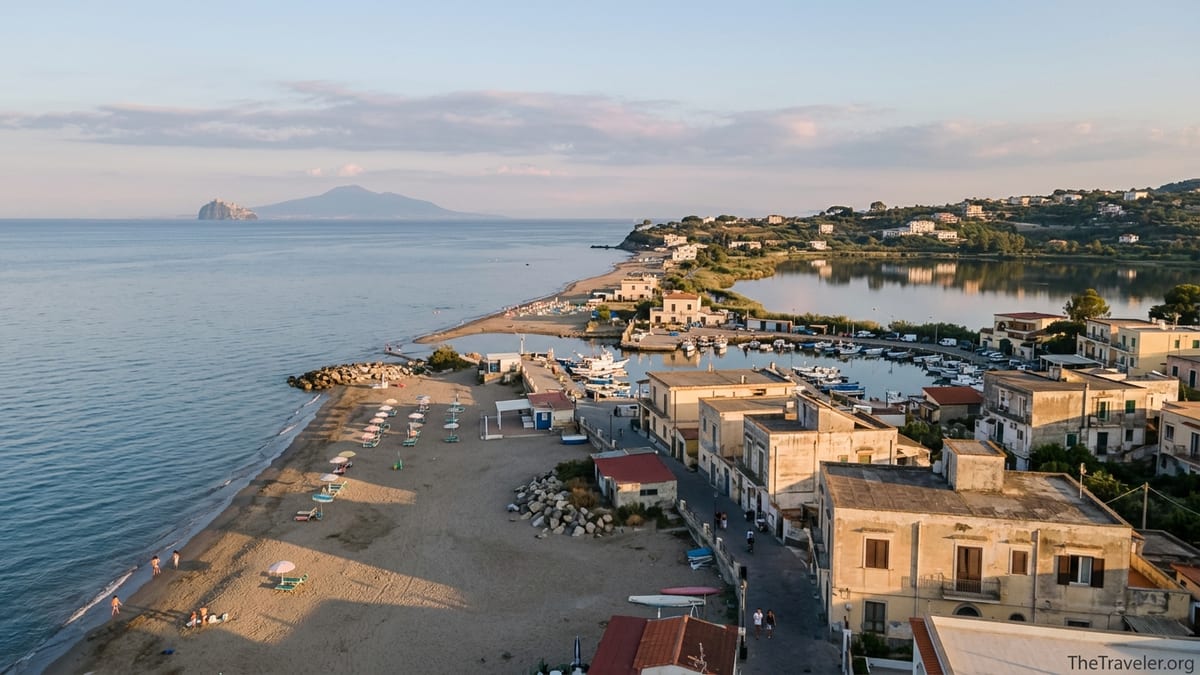
Ask Neapolitans where they slip away for a quiet day by the sea and many will name the same place, almost in a whisper: Bacoli. Curving around a series of volcanic lakes and sandy crescents at the western edge of the Gulf of Naples, this low-rise town is where locals go when the Amalfi Coast feels too crowded, and when they want Roman history, lazy swims and seafood lunches all within a few minutes’ drive of the city.
Get the latest updates straight to your inbox!
The Coastal Town Neapolitans Keep for Themselves
Bacoli sits about 15 kilometers west of central Naples, in the heart of the Campi Flegrei, or Phlegraean Fields, a volcanic area dotted with craters, fumaroles and thermal springs. Despite this dramatic setting, the town itself feels disarmingly everyday. Apartment blocks look out over fishing harbors, nonnas carry shopping bags past Roman walls, and schoolchildren walk home along streets perfumed with jasmine and sea salt.
Locals love that Bacoli is both connected and separate. From Naples, many simply jump on a Cumana suburban train to Torregaveta, then continue by bus or on foot along the coastal road, arriving in under an hour door to door. Others drive along the ring road towards Pozzuoli and Baia. Once they arrive, the pace shifts: traffic slows, conversations lengthen, and a swim before lunch suddenly feels not like a treat but a basic right.
Compared with the Amalfi Coast or Capri, Bacoli is still largely a weekend and summer retreat for residents of the wider Naples area rather than an international hotspot. Beach clubs cater to families who return year after year, restaurants know regulars by name, and many apartments are second homes passed down through generations. Visitors who come with curiosity and respect quickly discover that they are stepping into someone’s cherished backyard, not a stage set built for tourism.
This “for us first” mentality is part of Bacoli’s charm. Prices, while rising, are generally anchored to a local market: a mid-range seafood lunch might run 25 to 35 euro per person including a carafe of house wine, while an espresso on the waterfront is usually around 1.50 euro. The mood is relaxed rather than exclusive, and many stretches of sand remain free-access, used daily by residents for early-morning swims and late-afternoon strolls.
Beaches Locals Actually Use: Miseno, Miliscola and Schiacchetiello
For many Neapolitans, “going to Bacoli” is synonymous with a day on the sand. The long curve of Spiaggia di Miseno is one of the area’s best loved strands, a broad sweep of pale sand facing Capri and the islands of Ischia and Procida. Families arrive early in summer with cool bags and plastic toys, setting up under rows of rented umbrellas at long-running lidos, while teenagers gather at informal beach bars that turn up the music as the afternoon goes on.
Next door, the equally popular Spiaggia di Miliscola offers another arc of fine sand, backed by a mix of paid lidos and free sections. Locals like Miliscola for its easy logistics: buses stop close to the shore, and paid beach clubs usually offer packages that include a sunbed, umbrella, changing rooms and showers for roughly 20 to 30 euro per person on peak summer weekends, often less in June and September. Many residents buy seasonal passes, using the beach almost like their communal garden from May to late September.
Those who prefer privacy slip away to Schiacchetiello, a tiny rocky cove facing the islet of Pennata, reached via a steep footpath that descends from the road near the ancient cistern of Piscina Mirabilis. Here the beach is a small strip of pebbles and natural rock platforms rather than wide sand, and there are no changing cabins or loudspeaker systems. Locals bring their own towels and small umbrellas, clamber down in sandals, and reward themselves with a swim in unusually clear, calm water that feels a world away from the packed lidos of Miseno.
Another local favorite is the stretch around Capo Miseno, where paths lead to viewpoints overlooking both the open sea and the calm waters of Lago Miseno. In the evenings, residents often combine a stroll along the waterfront promenade with a short paddle in the shallows, then stop for a gelato or paper cone of fried anchovies from stands that open only in season. The ritual is simple but deeply rooted in local life, and visitors who join in gently, without crowding or littering, are usually welcomed.
Roman Ruins in Everyday Life: From Piscina Mirabilis to Baia’s Underwater City
In Bacoli, Roman history is not kept at a polite distance behind fences. It appears unexpectedly at street corners and on hillsides, blending with the lived-in fabric of the town. One of the most impressive examples is the Piscina Mirabilis, a vast Roman cistern once linked to the naval base at nearby Misenum. Hidden beneath a residential street, it resembles an underground cathedral of stone pillars and vaulted ceilings, cool even in August. Locals recommend visiting in the late morning, when light filtering through the openings creates dramatic shafts across the reservoir floor.
Above and around Bacoli lie other fragments of the Roman world: the Cento Camerelle, a honeycomb of ancient chambers carved into the tufa rock, and the so-called Tomba di Agrippina, actually part of a small theater attached to a seaside villa. Many residents still refer to these sites in everyday directions. A friend may propose “Meet by Agrippina at sunset” instead of naming a bar, or suggest walking down from Piscina Mirabilis to the sea as if it were a single continuous park connecting past and present.
Just along the coast in Baia, within the municipality of Bacoli, the Archaeological Park of the Campi Flegrei brings together thermal baths, villas and temples built when this was the holiday playground of Rome’s elite. Terraced ruins descend toward the water, with views over the bay that have changed surprisingly little in two millennia. The site is part of a wider archaeological network whose combined ticket, valid for two days, typically costs under 10 euro and covers several locations around Campi Flegrei, making it accessible for repeat visits.
What especially captivates locals is the submerged continuation of Baia’s ruins offshore. Due to slow geological subsidence, a large portion of the ancient town now lies several meters under water in the protected Submerged Archaeological Park of Baia. Neapolitans with a taste for adventure book half-day snorkel or glass-bottom boat excursions from small operators based along the coast, often paying around 35 to 50 euro for a guided boat trip and closer to 70 to 90 euro for an introductory dive, depending on season and equipment rental. Swimming above mosaic floors and broken columns while schools of fish weave between them is one of those experiences many locals insist you “must do at least once.”
Quiet Lakes, Coastal Walks and Everyday Escapes
While summer weekends fill the main beaches, plenty of locals come to Bacoli in the shoulder seasons specifically for the quiet. The town is framed by two lagoons, Lago Miseno and Lago Fusaro, which create mirrors of water sheltered from the open sea. Around Lago Miseno, a lakeside walking and cycling path attracts joggers, dog walkers and parents pushing strollers, particularly in the golden hour before sunset when the sky softens and the silhouettes of fishing boats stand still on the water.
Lago Fusaro, slightly inland, has a more romantic, slightly melancholic air. On a small artificial island stands the Casina Vanvitelliana, an 18th century hunting and fishing lodge with curving lines and pale walls that seem to float on the lake. Many locals bring visitors here for quiet late-afternoon photos or to sit on benches along the shore. Admission to the interior of the Casina, when open for exhibitions or events, is usually a modest fee, while simply walking the banks of the lake remains free.
Beyond the lakes, short hikes climb the low volcanic hills around Bacoli, offering views that stitch together the entire Campi Flegrei region from Pozzuoli to the islands. Residents know the best times to walk are early morning in summer or throughout the day in late autumn and winter, when the air is crisp and the outlines of Capri and Ischia appear particularly sharp. The paths are not heavily signposted, so many first-time visitors arrange a local guide or join small walking groups that depart from town squares on weekends.
For everyday escapes, Neapolitans also rely on simple pocket-sized spaces: a bench facing the harbor at Baia, the terrace of a modest bar set just above Spiaggia Romana, or the shade of a pine tree in one of Bacoli’s small squares. The scale is human and the atmosphere unhurried. Quiet here is not imposed silence but a soft background of conversation, the clink of coffee cups and the slap of small waves against hulls.
Food, Wine and Waterside Aperitivo the Bacoli Way
Food is another reason locals are attached to Bacoli. The town leans heavily on seafood, with fishing boats landing just meters from many restaurant terraces. Typical menus feature dishes like spaghetti alle vongole made with clams from nearby waters, mixed fried fish served in generous platters to share, and pepata di cozze, a simple pot of mussels steamed with garlic and parsley. Prices tend to be lower than in the historic center of Naples, especially at family-run trattorias a block or two back from the water.
At lunchtime, workers from Naples sometimes drive out for a quick break, capitalizing on the proximity and the relative ease of parking, especially outside high summer. They might order a fixed-price menu including a pasta dish, main course and side, often available for around 20 to 25 euro on weekdays, then sip an espresso before heading back to the city. On weekends, extended families gather around large tables, children running between courses to look at the water while grandparents linger over dessert.
Aperitivo has its own local rhythm. Around Baia’s small marina and along the waterfront in Bacoli, bars set out tables a few steps from the sea. From about 6 or 7 in the evening in summer, groups of friends arrive for spritzes or local Campi Flegrei white wines, produced on volcanic slopes a short drive inland. A glass of wine with a small plate of snacks often costs in the region of 6 to 8 euro, more if the bar faces directly onto the harbor views at sunset. The dress code skews relaxed: sundresses and sandals, linen shirts, and occasionally flip-flops straight from the sand.
Throughout the year, small bakeries and pasticcerie in Bacoli’s center keep locals supplied with sfogliatelle, graffe doughnuts and seasonal sweets. Many residents advise arriving early in the day if you want the full choice of fresh pastries and savory snacks like frittatine di pasta before they sell out. Taking a paper bag of warm, fried treats down to a bench by the lake is as typical a Bacoli ritual as any sit-down restaurant meal.
Staying in Bacoli: A Local Base Near Naples
Although still less developed as an international destination than Sorrento or the Amalfi Coast, Bacoli has a growing mix of places to stay that appeal to travelers who want a quieter base within easy reach of Naples. Small hotels and guesthouses cluster around the Baia and Bacoli waterfronts, while many locals rent out apartments near Miseno and Miliscola during the summer season. Prices vary widely by date, but outside the peak of August, visitors can often find comfortable double rooms from around 80 to 120 euro per night, with higher rates for properties directly on the water or with panoramic terraces.
What sets Bacoli stays apart is the sense of living among residents rather than in a tourist enclave. You may wake to the sound of fishing boats leaving port, pop downstairs for coffee in a bar where you are quickly recognized after a couple of days, and share the evening passeggiata, or stroll, along the seafront. Apartment rentals, in particular, make it easy to shop at neighborhood fruit stands and fishmongers, cooking simple meals with local produce and freshly caught fish.
Transport connections back to Naples and the region are a key reason locals recommend Bacoli to friends visiting from elsewhere. Buses link the town with train stations at Torregaveta and Pozzuoli, where frequent services head into the city. By car, the drive to Naples can take roughly 40 to 60 minutes depending on traffic, placing Bacoli within commuting distance for some residents. Ferries to the islands of Ischia and Procida depart from nearby ports such as Pozzuoli, letting travelers combine a stay in Bacoli with day trips across the bay.
For travelers, the main adjustment is pacing. Bacoli does not run on a nonstop tourist timetable: some restaurants close one day a week even in summer, beach clubs operate primarily from late spring to early autumn, and different spots feel lively or quiet depending on local habits rather than visitor demand. Embracing this rhythm, rather than fighting it, is part of experiencing Bacoli the way locals do.
Practical Tips and Local Etiquette
Because Bacoli functions primarily as a local resort, a few practical pointers can make visits smoother. Summer weekends in July and August are busy, particularly on sunny Sundays when many Neapolitans drive out at once. Traffic can back up on the narrow approach roads and parking by the main beaches becomes competitive. Residents often advise arriving early, by around 9 in the morning, or choosing shoulder months like June and September for quieter days with still-warm water.
On the beaches, most stretches at Miseno and Miliscola are divided between stabilimenti, or equipped beach clubs, and spiagge libere, free public sections. Locals respect simple rules: they keep personal umbrellas and chairs out of paid areas, avoid blocking the waterline with tents or large set-ups, and take their rubbish home if bins are full. Noise is part of Italian beach life, but blasting personal speakers beside people seeking a quiet swim is generally frowned upon.
When visiting archaeological sites, comfortable footwear is important. Paths at places like Baia’s hillside ruins or the approach to Schiacchetiello can be uneven. Local guides and staff appreciate visitors who follow marked routes and avoid climbing on fragile walls. Entry charges for state-run sites in the area are relatively modest by European standards, and there are often reduced or free days for younger visitors, students or residents, so checking current conditions and opening hours before setting out is wise.
Finally, it is worth remembering that Bacoli sits within an active volcanic region. Small tremors and scientific monitoring occasionally make the news, but local life carries on with characteristic pragmatism. Visitors who stay informed through official channels and follow any guidance issued during their stay generally find that the main impact of the geology on their trip is positive: hot springs, fertile soil for vineyards, and a dramatic landscape unlike anywhere else on the Bay of Naples.
FAQ
Q1. Is Bacoli a good alternative to the Amalfi Coast for a beach holiday?
Bacoli offers long sandy beaches, good swimming and easy access to Naples with a more local, low-key atmosphere than the Amalfi Coast, making it ideal for quieter stays.
Q2. How do I get from Naples to Bacoli without a car?
Many travelers take the Cumana suburban train towards Torregaveta and then continue by local bus to Bacoli, or use regional buses from Naples that run via Pozzuoli and Baia.
Q3. When is the best time of year to visit Bacoli for good weather but fewer crowds?
June and September usually offer warm sea temperatures and plenty of sunshine with fewer local holidaymakers than in July and August, especially on weekdays.
Q4. Are the beaches in Bacoli free or do I have to pay?
Both options exist. Miseno and Miliscola have paid beach clubs with services, as well as clearly marked free sections where you can use your own towel and umbrella.
Q5. Can I visit the underwater archaeological park in Baia if I am not a diver?
Yes. Glass-bottom boat tours and guided snorkeling trips allow non-divers to see submerged mosaics and ruins, while certified divers can join organized dives.
Q6. Is Bacoli suitable for families with children?
Locals often bring children to Bacoli because of its gently shelving sandy beaches, family-friendly restaurants and relatively short travel time from Naples.
Q7. How expensive is it to eat out in Bacoli compared with central Naples?
Prices vary, but many mid-range seafood trattorias in Bacoli are comparable to or slightly cheaper than popular areas in central Naples, especially for set menus.
Q8. Do I need to book accommodation in advance in Bacoli?
In peak summer and on August holiday weekends, advance booking is strongly recommended, while in shoulder seasons you may find more last-minute availability.
Q9. Is Bacoli a good base for exploring the wider Campi Flegrei area?
Yes. From Bacoli you can easily reach Pozzuoli, Cuma, the Campi Flegrei archaeological sites and ferry ports for day trips to islands such as Ischia and Procida.
Q10. Is it safe to visit Bacoli given the volcanic activity in Campi Flegrei?
The area is closely monitored by Italian authorities. Locals continue daily life, and visitors who follow official advice and stay informed typically experience no disruption.