


Tucked just beneath the medieval ramparts of Antibes’ old town, Plage de la Gravette is the kind of city beach locals quietly hope visitors will overlook. Sheltered from the open sea, framed by stone walls and Port Vauban’s sleek yachts, it offers calm, shallow water, soft sand, and some of the most atmospheric views on this stretch of the French Riviera. For many Antibois, this is the beach for everyday swims, after-work dips, and weekend picnics with a picture-book backdrop of the old town.
Get the latest updates straight to your inbox!
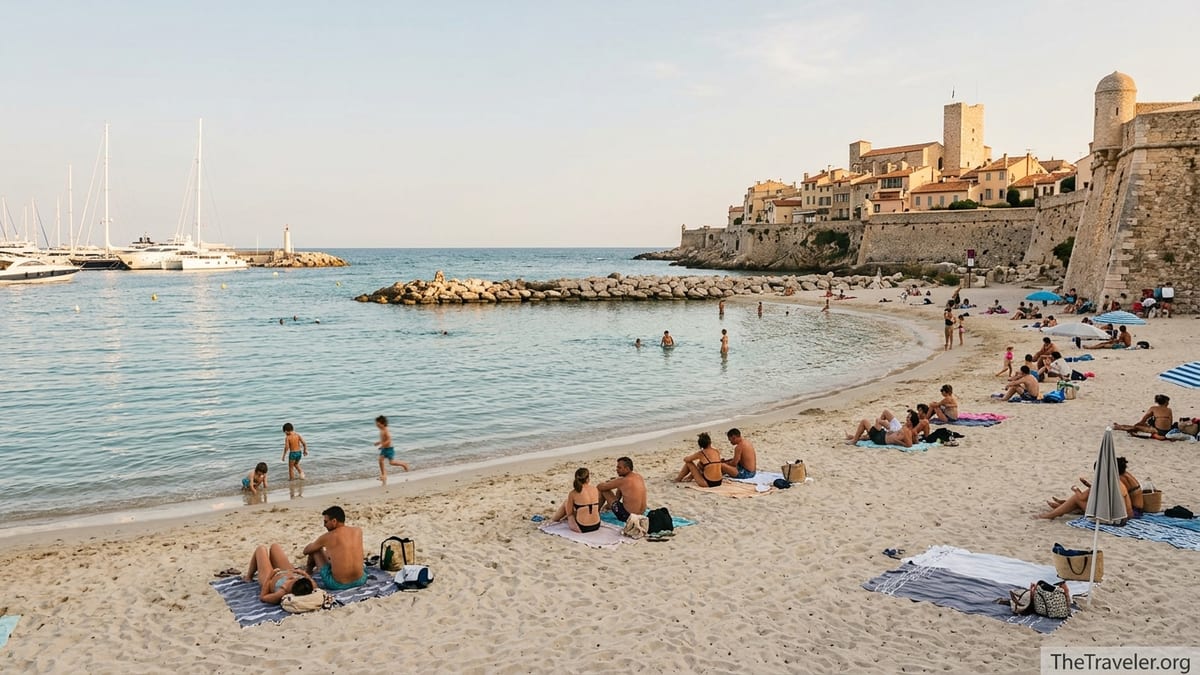
A Sheltered Cove Locals Treat Like Their Backyard
Plage de la Gravette sits in a natural horseshoe-shaped cove between the old town of Antibes and Port Vauban. Ancient stone ramparts wrap around the back of the beach, while a rocky breakwater partially closes the bay. This layout calms the swell and turns the shoreline into a protected, near-still pool that locals treat as an extension of their living room. Residents will tell you they come here “for a quick dip” on the way home from work or after a morning at the Marché Provençal food market a few streets away.
On a typical summer evening you might see an office worker in rolled-up chinos wading out for a five-minute swim before heading home, or an elderly couple in matching swim caps taking their daily laps along the buoys. Because the beach lies only about 10 minutes on foot from the Antibes train station, many locals who commute to nearby Nice or Cannes still manage to end their day with a swim here, often arriving with just a towel and a small canvas beach bag.
The setting feels surprisingly intimate given how central it is. Instead of a noisy seafront road, you enter Plage de la Gravette through a stone archway in the ramparts from Quai Henri Rambaud. Inside, you are immediately surrounded by sand, sea, and high ochre walls that mask much of the city behind you. It is easy to understand why this discreet cove attracts a loyal local crowd who often skip the more glamorous beaches on Cap d’Antibes in favor of this simple, convenient spot.
Because Gravette is fully public, there are no private clubs or cordoned-off stretches, something locals appreciate in a region where many prime waterfronts are reserved for paying sunbed guests. People bring their own towels and umbrellas, small coolers filled with fruit and baguette sandwiches, and sometimes a portable Bluetooth speaker for low-volume music. The atmosphere is relaxed and unpretentious, closer to a neighborhood park than a showpiece Riviera beach.
Calm, Shallow Water Perfect for Families
The biggest reason local families favor Plage de la Gravette is the water itself. Sheltered by the breakwater, the sea here is often glassy, with only the gentlest ripples reaching the shore. The seabed stays shallow for a considerable distance, which means small children can splash and play near the edge while adults stand ankle or knee-deep close by. Parents frequently describe it as a place where they worry a little less, compared with more exposed beaches along the coast.
In peak summer, lifeguards are typically on duty from around mid-June to mid-September, adding another layer of comfort for families. You will often see local children learning to swim between the buoys while grandparents watch from the sand, or teenagers practicing snorkeling a few meters out near the rocks. For younger kids, inflatable rings and foam noodles are a common sight, and the shallow gradient means many can stand even several meters from the shore.
The softness of the sand is another practical draw. Unlike many Riviera beaches that are made up of large pebbles, Gravette’s surface is fine sand mixed with light gravel, comfortable enough to walk on barefoot and ideal for sandcastle building. Visiting parents often remark how little gear they actually need here. Rather than renting loungers, they spread out simple cotton towels and let their children roam between the waterline and the ramparts, where the sand is firmer and good for ball games.
Facilities support this family-friendly use. There are beach showers and public toilets just inside the walls, and a snack kiosk at the back of the beach where locals buy cold drinks, fresh orange juice, and simple items like panini or ice cream. Prices at the kiosk are higher than a supermarket but still modest by Riviera standards, with many families mixing a picnic brought from home with a shared box of churros or a few popsicles as a treat.
Old Town Views That Feel Straight From a Postcard
Locals often say the real magic of Plage de la Gravette lies in what you see when you look up from your towel. To the right, the pale stone tower of the Picasso Museum rises above the old town ramparts, with a cluster of terracotta rooftops cascading behind it. To the left, the masts and superstructures of Port Vauban’s yachts stand in sharp contrast, a reminder that Antibes is both an old fishing port and a modern yachting hub.
This combination of historic skyline and maritime life is particularly striking in the late afternoon. As the sun sinks behind the hills toward Cannes, the facades of old Antibes shift from bright white to warm honey. Shadows deepen in the arches of the ramparts while the water inside the cove turns a deeper turquoise. Locals know that this golden hour produces some of the best photographs in town, and it is common to see residents strolling down after work with a small camera, snapping the museum tower and boats framed by swimmers in the foreground.
On certain weekends in early summer, events in Port Vauban, such as classic yacht gatherings, add even more character to the view. From the sand you might watch historic sailing boats leaving the harbor in the morning and returning late in the day, their tall masts silhouetted against the sky. Longtime residents often time their beach visits around these regattas, enjoying the spectacle from the comfort of a towel rather than from a crowded pier.
Even small day-to-day details contribute to the charm. Fishing boats occasionally chug past the opening of the bay at slow speed, and on clear winter days locals come to Gravette simply to sit on the rampart wall above the sand, looking out toward the snowy peaks of the Alpes-Maritimes in the distance. Few city beaches offer such a clear, layered view: medieval fortifications at your back, the lived-in old town to one side, and the wide sweep of the Mediterranean straight ahead.
Everyday Convenience: Markets, Parking, and Quick Swims
Another reason Plage de la Gravette figures so heavily in local routines is simple practicality. It sits only a few minutes’ walk from Antibes’ central Provencal market, narrow shopping lanes, and the cafés that ring Place Nationale. For many residents, a typical Saturday runs in a rhythm that feels almost choreographed: early stop at the market for vegetables, cheese, and olives, a coffee at a terrace nearby, then straight through the rampart archway with a straw bag of picnic supplies for a late-morning swim.
If you are staying elsewhere on the Riviera, Gravette is equally accessible. From Nice or Cannes, the regional train usually costs just a few euros and takes around 20 to 30 minutes to Antibes. From there, locals advise following the signs down Avenue de Verdun to Port Vauban and then along Quai Henri Rambaud, with the beach entrance clearly marked in the stone walls. The walk from the station to your towel can easily be under 15 minutes if you travel light.
For those who drive, the large underground car park at Port Vauban provides practical, if not cheap, parking a short walk from the beach. Daily summer rates can feel high, so many Antibois with cars choose late afternoon or evening swims instead of full beach days, cutting parking costs by staying only two or three hours. Another common strategy is to combine a morning swim with errands in town, making the most of one parking session to cover both.
The beach is also reasonably accessible for visitors with limited mobility. A gently sloping access route from the port side leads through the ramparts, and seasonal arrangements in recent years have aimed to improve access for wheelchair users, including assistance down to the water at designated times. Locals point out that while Gravette is not perfect in this regard, it is one of the more manageable options for people who struggle with steep paths or uneven rocky shorelines elsewhere.
How Locals Actually Use Plage de la Gravette
Spend a few hours at Plage de la Gravette and patterns of local life quickly emerge. Early mornings, especially outside of July and August, belong mainly to residents. You will see solo swimmers cutting smooth, quiet lines along the breakwater, dog walkers pausing on the ramparts to watch the light change, and a handful of retirees chatting in low voices while they dry off in the sun. This is the moment when Antibes feels most like a small town, and the beach like a neighborhood square.
By late morning and into the afternoon, families take over. Local parents arrive with compact folding strollers, sun tents, and a mix of supermarket snacks and homemade dishes. A typical set-up might be a simple cotton fouta spread on the sand, a mesh bag with swim toys, and a shared salad niçoise in a plastic container. Children run between the water and the foot of the ramparts, where informal games of beach volleyball or football sometimes spring up in the late afternoon when the sun dips and the sand cools.
Teenagers and young adults tend to cluster at the far ends of the bay. On quieter weekdays in June and September, you might see groups of local high school students arriving after class, headphones in, dropping their bags in a circle and alternately swimming and sunbathing while they chat. For adults who work in the nearby yacht harbor or in the old town’s restaurants and shops, Gravette often serves as a lunch-break escape: a 15-minute swim, a quick shower at the back of the beach, and then back to the shift.
Evenings, particularly in July and August, can have a slightly festive feel without tipping into party territory. Locals meet friends here for picnic dinners, spreading out simple feasts of bakery quiches, cherry tomatoes, melon, and bottles of chilled rosé or sparkling water. As the sky darkens, the lights of the old town flicker on above the ramparts and the mast lights in Port Vauban reflect on the water. For many Antibois, this is the moment when they feel most grateful to live where they do: swimming until sunset with centuries of history at their back.
Practical Tips to Experience Gravette Like a Local
To enjoy Plage de la Gravette the way locals do, timing is crucial. In peak summer, residents will often aim to arrive before 10 a.m. if they want a spot close to the water, or after 4 p.m. when families start to drift home for dinner and the sun becomes less intense. Midday in July and early August can be very busy, which is why many locals prefer to use that period for errands or lunch in the shade, returning to the beach when the light is softer.
Food-wise, locals usually avoid relying solely on the beach kiosk, which can have queues in high season. Instead, they pick up items at the nearby covered market and small supermarkets around Place de Gaulle. A typical budget-conscious picnic for two might include a baguette, a tub of hummus or tapenade, sliced cured ham, a punnet of cherry tomatoes, a small box of strawberries, and a bottle of water, totaling around 15 to 20 euros depending on where you shop. Add a couple of ice creams from the kiosk later in the afternoon, and you have a full beach day without the cost of a private beach club.
Sun protection is another area where local habits are worth copying. Because the ramparts block shade on the sand for much of the day, many residents bring their own compact umbrellas or small pop-up sun shelters, especially for children. Beach gear is easy to find in neighborhood shops just outside the old town, where you can buy a basic umbrella for a modest price. Locals also know that even on breezy days the reflected light from the pale sand and stone walls can be intense, so hats and light cover-ups are common.
Finally, consider following the local rhythm by pairing your beach time with other simple pleasures. A popular pattern is a morning swim at Gravette, lunch at a small bistro in the old town, then an afternoon visit to the Picasso Museum or a walk along the coastal path toward the Nomade sculpture overlooking Port Vauban. In the evening, many residents like to wander back toward the Esplanade du Pré des Pêcheurs, where seasonal fairground rides and a ferris wheel sometimes appear, providing a playful contrast to the tranquil water you left behind at the beach.
The Takeaway
Plage de la Gravette is not the largest or most luxurious beach on the French Riviera, and that is exactly why locals cherish it. Sheltered waters make it an everyday swimming hole for families and solo bathers alike. The setting beneath Antibes’ ramparts, with views over the old town and Port Vauban, gives even a short dip the feel of a holiday postcard. Its location steps from markets, cafés, and the train station means residents can weave a swim into the fabric of their day without planning or ceremony.
For travelers, understanding how locals use Gravette changes the experience. Instead of treating it as just another stop on a beach checklist, you can approach it as Antibes’ informal living room: a place where people from all walks of life gather to cool off, chat, and watch the light shift across the stone walls and the sea. Come early or late, bring simple food and minimal gear, and leave room in your schedule for unhurried swims and people-watching. In doing so, you will see why so many Antibois choose this modest cove over more famous stretches of coastline.
FAQ
Q1. Where exactly is Plage de la Gravette in Antibes?
Plage de la Gravette sits just below the old town ramparts of Antibes, between Port Vauban and the historic center, a short walk from the train station and the Marché Provençal.
Q2. Why do locals prefer Plage de la Gravette to other nearby beaches?
Locals love Gravette for its sheltered, shallow water, fully public access with no private clubs, and the convenience of being steps from the old town, shops, and markets.
Q3. Is the water really calmer here than on other Riviera beaches?
Yes, the cove is protected by a breakwater and surrounded by stone walls, so waves are usually gentle, making the water noticeably calmer than on more exposed stretches of coast.
Q4. Is Plage de la Gravette suitable for young children?
The gradual slope of the seabed, fine sand, and typically calm conditions make it very popular with families, especially when lifeguards are on duty in the main summer months.
Q5. Are there facilities like showers and toilets at the beach?
Yes, there are public showers along the back of the beach and toilets just inside the ramparts, as well as a seasonal kiosk selling drinks, snacks, and simple hot food.
Q6. How can I reach Plage de la Gravette without a car?
You can take the regional train to Antibes, then walk around 10 to 15 minutes through the old town toward Port Vauban and enter the beach via the archway in the ramparts on Quai Henri Rambaud.
Q7. When is the best time of day to visit to avoid crowds?
Locals often favor early mornings before 10 a.m. or late afternoons after 4 p.m., when the sun is softer, families begin to leave, and it is easier to find space on the sand.
Q8. Can I bring my own food and drinks to the beach?
Yes, Gravette is a public beach, so picnics are common. Many people pick up bread, cheese, fruit, and drinks from nearby markets and supermarkets before settling in on the sand.
Q9. Is the beach accessible for people with limited mobility?
Access is relatively gentle compared with many rocky Riviera beaches, and seasonal measures aim to assist visitors with reduced mobility, though conditions can vary and some areas remain sandy and uneven.
Q10. Are there good photo opportunities from Plage de la Gravette?
Yes, the views of Antibes’ old town tower, the ramparts, and Port Vauban’s yachts, especially at sunset, make Gravette one of the most photogenic spots in the city.