


Most beaches in Antibes demand a choice: historic walks in the old town or a day by the sea. Plage de la Gravette quietly sidesteps that decision. Hidden just beneath the medieval ramparts and a few minutes’ walk from the marché provençal, this compact city cove combines Riviera sea swimming with some of the most atmospheric views on the coast. Here is what truly sets Plage de la Gravette apart from other beaches in Antibes, and how to make the most of it on your next trip.
Get the latest updates straight to your inbox!
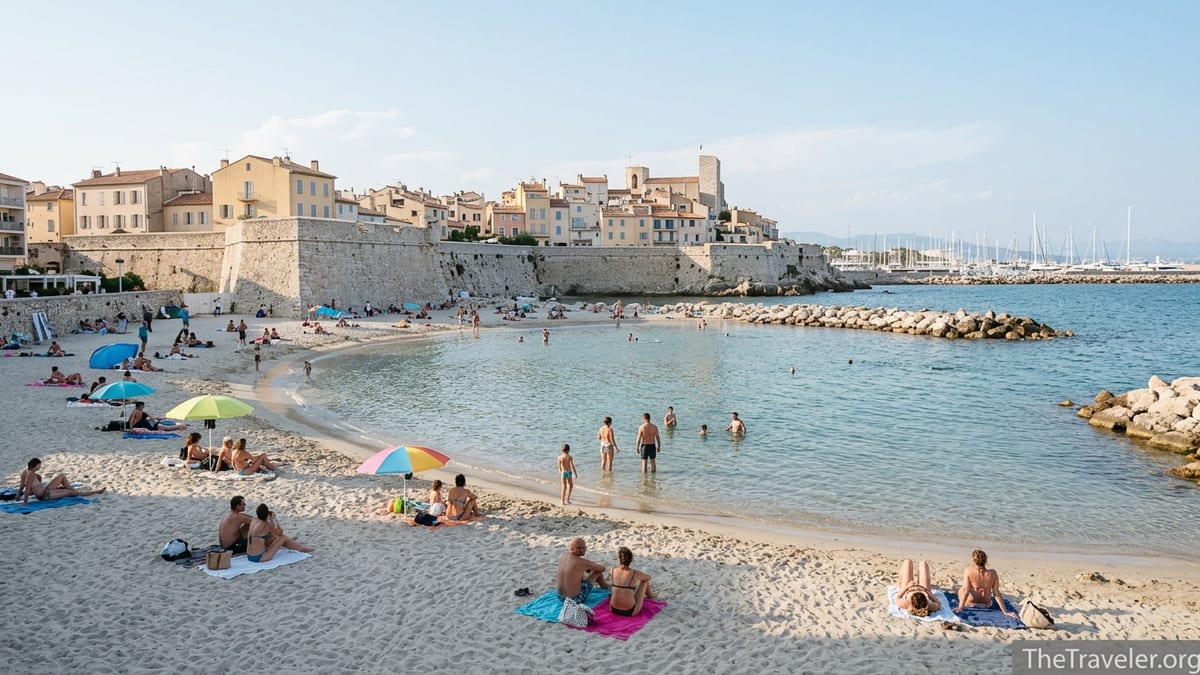
A Sandy City Cove Under Medieval Walls
Plage de la Gravette is the only beach in Antibes that feels like an extension of the old town rather than a separate destination. Walk past the fishing boats and yachts of Port Vauban, slip through an opening in the ramparts on Quai Henri Rambaud, and the sand appears almost at your feet, framed by stone walls and the ochre facades of Vieil Antibes above. Other local favorites such as Plage du Ponteil or Plage de la Salis require at least a short coastal stroll; La Gravette, by contrast, is a five to ten minute walk from the cathedral, the Picasso Museum or the covered market.
The setting is dramatically different from the long, open bays of Juan les Pins or the wild coves on Cap d’Antibes. At La Gravette, you look back toward massive defensive walls and the towers of the old town while still facing water that is Caribbean-clear on good days. Many visitors end up here in street clothes straight after a morning of shopping for socca and olives in the market, slipping back to their apartment or hotel later still in sight of the ramparts. That seamless blend of urban life and beach time is unusual even by Riviera standards.
The beach itself is a shallow horseshoe of mostly sand with some fine gravel mixed in, a softer underfoot experience than the rounded pebbles you find in nearby Nice or on parts of the Cap. Families spread out towels directly on the sand and children build castles just a few metres from the waterline. Because the bay is small and framed by stone on three sides, it retains an intimate, almost amphitheater feel that you will not find on the larger open beaches along Antibes’ 25 kilometers of coastline.
Public, Free and Unclaimed by Beach Clubs
One of the most distinctive features of Plage de la Gravette is that it is entirely public. On many French Riviera shores, from Cannes’ La Croisette to sections of Juan les Pins, some of the best sea frontage is taken up by private beach clubs that charge for loungers and control access to the sand. At La Gravette there are no rows of branded sunbeds, no entrance fees and no roped-off sections. Every square metre of sand is open to anyone who walks through the ramparts gate.
In practical terms, this gives the beach a different rhythm. Mornings often belong to locals and long-stay visitors who arrive early with parasols and small coolers, staking out space near the shoreline. Around midday, day trippers from Nice or Cannes wander in with just a towel, spontaneous swimsuits bought in town and a baguette sandwich from a nearby boulangerie. Unlike some private clubs where you commit to a full day’s lounger rental, La Gravette invites shorter, repeat visits: a 45-minute dip before lunch, a quick sunset swim after dinner or a brief cool-off with children between sightseeing stops.
The absence of commercial structures also preserves unbroken views. Look left and you see the curve of the breakwater and the superyachts of Port Vauban; look right and the stone walls and pastel houses of Vieil Antibes rise almost directly from the sand. Where Plage de la Salis and Ponteil are backed by roads and low apartment buildings, La Gravette is firmly anchored in the historic fabric of the town, with only a low snack kiosk and rampart-integrated facilities at the rear of the beach.
Exceptionally Sheltered, Shallow and Family Friendly
Parents often describe Plage de la Gravette as the easiest beach in Antibes for young children and less confident swimmers. The bay is enclosed by a man-made rocky breakwater, which keeps the water calm even on windy days when waves might be rolling onto La Salis or the more exposed beaches on Cap d’Antibes. The seabed slopes very gently; in summer you can usually walk tens of metres out while still standing chest-deep or shallower, which makes games of catch, paddle ball and simple floating feel safe.
Comparatively, some of the postcard-perfect coves around the Cap, like those near the Abri de l’Olivette, drop off more quickly and have rockier entries, which can be tricky for toddlers or anyone unstable on their feet. Juan les Pins does offer broad sandy stretches, but its open bay is more vulnerable to chop from boat traffic and wind. La Gravette’s semi-enclosed design keeps the water more like a gently rippling pool for much of the summer season.
From mid-June to around mid-September, the beach is usually supervised by lifeguards, similar to nearby Plage du Ponteil and Plage de la Salis. Their elevated stations overlook almost the entire crescent, so families can let older children swim within clearly watched boundaries. Public showers are placed along the back of the sand and toilets are built directly into the rampart wall just outside the entrance, avoiding the long walks or roadside crossings required at some other beaches. For many visiting families, these details, combined with the shallow water, make La Gravette the go-to option for a first swim on arrival in Antibes.
Old Town Access, Port Vauban Parking and Easy Logistics
Another way Plage de la Gravette stands out is in how easy it is to reach without a car. Antibes train station sits roughly one kilometre away. From there, you can either walk straight through town, following signs to the old port and ramparts, or take a short local bus ride that stops near Avenue de Verdun. Visitors staying in the old town often find themselves passing the access gate on Quai Henri Rambaud several times a day, using the beach almost like a neighborhood park.
For those driving in from Nice, Cannes or inland villages such as Valbonne or Grasse, parking can be a deciding factor between beaches. Here La Gravette has a distinct advantage over the wilder Cap d’Antibes coves or even Juan les Pins. The large Port Vauban car park sits only a few minutes’ walk from the sand, placing you closer to the old town and the beach than many lots serving Plage de la Salis or the Cap’s hidden inlets. While summer parking is never cheap on the Riviera, the convenience of stepping from multi-storey parking into the medieval port quarter and then directly onto a beach is rare along this coast.
Logistics on the sand are straightforward. Because La Gravette is compact, you are never far from your belongings, and it is easy to keep an eye on children moving between the water and your towel. A casual café kiosk behind the beach sells cold drinks, simple snacks and ice creams, so you do not need to leave the cove for refreshments. Many visitors, especially families and budget-conscious travelers, buy fruit, cheese and bread from the covered market in the morning, then picnic on the sand around midday before retreating to the shaded alleys of the old town during the hottest hours.
Compared to more spread-out stretches like Plage du Ponteil, where choosing a spot far from the access points can mean a long walk back to facilities or food, La Gravette’s small footprint makes spontaneous, low-effort beach time possible even for those on tight schedules or with limited mobility.
Atmosphere: Local, Lively and Less Glitzy
While Juan les Pins has a distinctly resort feel, with music from beach clubs and a promenade lined with bars, Plage de la Gravette feels more like a neighborhood beach that happens to sit in a major Riviera town. On a June weekday morning you may find local retirees doing gentle laps parallel to the breakwater, teenagers chatting on the rocks at the edges of the cove and families from nearby streets arriving with folding chairs and parasols they will carry back home on foot.
The crowd is mixed, from Antibois who have been coming here for decades to visiting couples staying in old town guesthouses. You are likely to hear French spoken more prominently than on some of the higher-profile resort beaches; English, Italian and Scandinavian languages trail behind. The dress code is simple: swimsuits, linen cover-ups, flip-flops picked up in one of the old town’s small boutiques. High heels and designer daywear are more likely to be seen on the private club terraces of La Garoupe or the chic decks of Plage Keller on Cap d’Antibes.
Even in July and August, when the sand can feel almost entirely covered by towels from late morning onward, the mood is more relaxed than glamorous. Street musicians occasionally play on the promenade above the walls, and in the evenings many visitors come for a dip before heading to casual bistros nearby. There are no DJ booths or bottle service, and the nightlife is found back in the lanes of Vieil Antibes rather than on the beach itself. If you like a lived-in, local atmosphere and do not mind close neighbors on the sand, La Gravette offers a distinct contrast to the more curated, club-heavy stretches elsewhere on the coast.
Comparing La Gravette with Other Antibes Beaches
To understand what makes Plage de la Gravette distinct, it helps to compare it directly with a few of Antibes’ other well-known beaches. Plage du Ponteil, a short walk south, is also sandy and public but stretches along an open bay with more traffic from small boats and a backdrop of residential buildings and parking. Its longer shoreline suits walkers and those who enjoy spreading out along a promenade, but it lacks La Gravette’s feeling of being tucked into the old town.
Continue along the coast and you reach Plage de la Salis, another popular family choice with fine sand and shallow water, framed by views of the Alps and the Cap. Salis feels more resort-like, backed by a road, gardens and a mix of residences and low-key restaurants. Cap d’Antibes coves such as La Garoupe or the Abri de l’Olivette, meanwhile, are dramatically beautiful, with pines leaning over turquoise water and narrow strips of sand or pebbles. They deliver a wilder or more exclusive ambience, often at the cost of easier access, parking and public facilities.
La Gravette’s closest counterpart in character might be the town beaches of smaller Riviera villages, but even there few sit so directly under centuries-old ramparts and steps away from major museums and markets. If your priority is a full beach day with space to stroll, rent chairs and linger over a multi-course lunch with your toes in the sand, Salis or a Cap beach club may suit you better. If what you want is to punctuate an Antibes city day with swims, or you are traveling with children and prefer not to manage long walks in the heat, La Gravette offers a uniquely compact, city-meets-sea experience.
Price expectations also differ. On Plage de la Gravette, you pay only for what you choose to buy from the kiosk or nearby shops; there are no mandatory lounger or umbrella rentals. By contrast, a pair of sunbeds and an umbrella at a private beach club on La Garoupe or in Juan les Pins can easily run to several dozen euros for a day in peak season, before food and drinks. For visitors looking to balance Riviera charms with a realistic budget, La Gravette can anchor several low-cost sea days within a larger Antibes stay.
The Takeaway
Plage de la Gravette is different from other Antibes beaches not because it is the largest or the most luxurious, but because it weaves the sea so neatly into the everyday life of the old town. Its sheltered, shallow bay makes swimming accessible to almost everyone, from small children to older travelers. Its fully public status and absence of beach clubs keep costs down and views open. Its location under medieval ramparts, steps from the market and port, turns a simple swim into part of the broader Antibes story.
If your ideal Riviera day alternates between cobbled streets and clear water, if you value easy logistics over see-and-be-seen glamour, or if you are traveling with a family and want a beach you can reach in minutes without a car, Plage de la Gravette is hard to beat. Treat it as your home base cove in Antibes, then explore Ponteil, Salis and the Cap d’Antibes for variety. You may find that, in spite of their beauty, it is La Gravette’s compact, lived-in charm that keeps drawing you back.
FAQ
Q1. Where exactly is Plage de la Gravette in Antibes?
Plage de la Gravette sits just outside Antibes’ old town ramparts, between Port Vauban and the historic center, with access through an opening in the walls on Quai Henri Rambaud.
Q2. How does La Gravette differ from Plage du Ponteil and Plage de la Salis?
La Gravette is smaller, fully enclosed by a breakwater and directly under the old town walls, while Ponteil and Salis are longer, more open bays backed by roads, gardens and residences.
Q3. Is Plage de la Gravette a good beach for children?
Yes, its gently sloping, shallow water and sheltered bay make it particularly suitable for children and less confident swimmers, especially in calm summer conditions.
Q4. Are there lifeguards on duty at Plage de la Gravette?
In most recent seasons, lifeguards have been present from around mid-June to mid-September during daytime hours, similar to other main public beaches in Antibes.
Q5. Do I have to pay to use Plage de la Gravette?
No, it is a fully public beach with free access. You only pay for any optional food, drinks or items you buy from nearby shops or the beach kiosk.
Q6. What facilities are available on the beach?
La Gravette offers freshwater showers, nearby public toilets integrated into the rampart wall, and a simple kiosk selling drinks and snacks behind the sand.
Q7. How can I get to Plage de la Gravette without a car?
You can walk from Antibes train station in about 15 to 20 minutes through the old town, or take a short local bus ride that drops you close to Port Vauban and the ramparts entrance.
Q8. Is the beach very crowded in summer?
In July and August, the sand fills up quickly, especially late morning and afternoon, so arriving earlier in the day or later toward evening helps secure a comfortable spot.
Q9. Can I buy food and drinks nearby or should I bring my own?
You can do both. Many visitors bring picnic supplies from the covered market and supplement them with cold drinks and snacks from the kiosk behind the beach.
Q10. Is Plage de la Gravette suitable outside the main summer season?
Yes, spring and early autumn can be ideal, with fewer crowds and still-pleasant sea temperatures, though lifeguard services and kiosk hours may be reduced or unavailable.