


Wedged between Antibes’ medieval ramparts and the superyachts of Port Vauban, Plage de la Gravette looks like the ideal French Riviera beach: soft sand, gently shelving turquoise water and postcard views of old stone walls. But is it actually worth dedicating one of your precious Côte d’Azur beach days to this compact urban cove, especially when you could head to bigger-name stretches like Garoupe, Salis or the beaches of Juan-les-Pins instead? This guide breaks down exactly what Gravette is like today, with on-the-ground details to help you decide if it fits your style of Riviera beach day.
Get the latest updates straight to your inbox!
Where Exactly Is Plage de la Gravette and What Does It Feel Like?
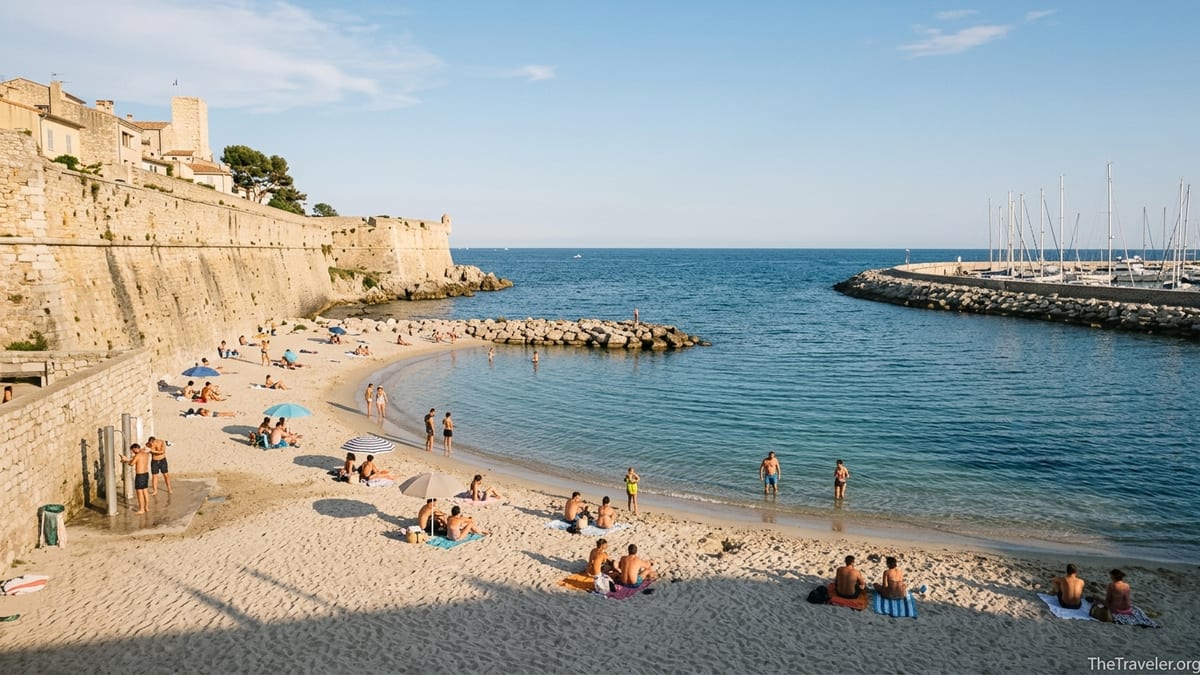
Plage de la Gravette sits at the very edge of Antibes old town, tucked behind the ramparts and right next to Port Vauban. Practically, that means you can walk there in about five minutes from the Marché Provençal or the Picasso Museum area, following the harborfront until you see a stone arch leading through the walls and down to the sand. For many visitors staying in or around Vieux Antibes, this is the closest and most convenient beach, with no hills to climb and no need for a bus or taxi.
The setting is surprisingly dramatic for such a small bay. On one side you have the tall honey-colored ramparts that glow at sunset; on the other, a curved breakwater and the forest of masts from the marina. Beyond the narrow opening of the bay, you can often see ferries and cruise ships out on the open water, while inside the cove the sea is usually flat and lake-like. The beach itself is a shallow horseshoe of pale sand and fine gravel, backed by a simple concrete promenade, public showers and a low snack kiosk in high season.
In terms of ambience, Gravette feels distinctly local, especially on summer evenings when families arrive after work with cool bags and beach toys. You will hear a mix of French, Italian and English, but the crowd is less polished than at paid beach clubs in Cannes or Saint-Jean-Cap-Ferrat. Expect people reading under umbrellas, teenagers playing beach volleyball near the back wall, and grandparents watching from the shade of the ramparts. It is very much an everyday city beach rather than a glamorous, loungers-and-bottle-service kind of scene.
The trade-off for that central, atmospheric setting is size. Gravette is not long; at busy times it can feel like everyone in Antibes has had the same idea. On a July afternoon the beach can be towel-to-towel from the waterline back to the wall. If you want space, you either arrive early, target shoulder season months like May, June or late September, or come later in the day when many day-trippers have left for dinner.
Water, Sand and Swimming Conditions
For many travelers, the main appeal of Plage de la Gravette is how gentle the swimming conditions are compared with the stony, quickly shelving beaches in nearby Nice. The bay is protected on all sides by a curved breakwater with only a narrow opening, which means waves are usually minimal, and the sea feels more like a large protected pool. In summer, the water close to shore stays shallow for several meters, making it particularly reassuring for cautious swimmers and children who want to wade rather than plunge straight into deep water.
The sand underfoot is a mix of fine sand and small pale pebbles. It is far more comfortable than the big rounded stones of Nice city beaches, but not as powder-soft as some Caribbean-style stretches. Close to the waterline you will feel some pebbles and a few larger rocks under your feet, so basic water shoes can help if you have sensitive soles. Regulars often spread their towels closer to the middle of the bay where the sand is deepest and the slope into the water is most gradual.
Water quality has been a concern in the past because of the beach’s position inside a small, sheltered cove next to a busy port. In recent years, however, local authorities have invested in improving wastewater management, and recent French bathing water reports classify Gravette as suitable for swimming in normal conditions. On calm, sunny days the water is typically clear and a bright aquamarine, with visibility good enough to see the sandy bottom and scattered rocks. After heavy rain, like anywhere on the Riviera, runoff can temporarily affect clarity, and local beach notice boards will indicate if swimming is not advised.
One important practical detail: lifeguards are normally on duty in peak season, typically from early July through the end of August, usually between late morning and early evening hours. During these months, a supervised swimming zone is marked by buoys. Outside that window you will not have surveillance, so families with young children should be extra cautious. There are no major currents inside the cove, but adults should still keep an eye on kids near the narrow entrance where small boats sometimes pass and the water depth increases.
Is Plage de la Gravette Good for Families?
For families with young children, Plage de la Gravette is one of the easiest French Riviera beaches to manage without stress. You can stroll there from a rental apartment in old Antibes in five to ten minutes, with no need to cross fast traffic or navigate steep steps. Strollers can roll along the harbor promenade and down the gentle ramp behind the walls, which is a major plus compared with many cliff-backed coves where you are negotiating long staircases or rocky paths.
Once you are on the sand, the cove’s shape really works in your favor. The protected bay stops waves from building, so toddlers can sit at the water’s edge and let tiny ripples lap around their feet. Older kids usually gravitate to the slightly deeper area toward the center, where they can still stand comfortably but have enough depth to float, practice snorkeling in shallow water or play with inflatable rings. The high rampart wall at the back of the beach creates a wide band of shade by mid-to-late afternoon, which is useful if you are trying to keep children out of the strongest midday sun.
Facilities are basic but family-friendly. You will find cold-water showers on the promenade, which are perfect for rinsing off sand before walking back through town, and simple public toilets close to the entrance. In high season a snack truck or kiosk often sells bottled water, sodas, ice creams and simple baguette sandwiches, so you can top up a picnic with a ham-and-cheese baguette or buy a treat without leaving the beach. That said, many families prefer to bring their own cooler bag, stocking up at the nearby covered market or the supermarket on Boulevard d’Aguillon before walking down.
The main drawback for families is crowding. On a sunny August afternoon, the density of towels can make it tricky for children to run around without treading on someone’s things. If you are traveling with toddlers who roam unpredictably or who do not like close quarters, you might prefer alternative sandy beaches like Plage du Ponteil or Plage de la Salis, both a 15 to 20 minute walk along the waterfront, where the sand stretches out more broadly and there is usually a bit more breathing room. For many visitors staying right in old Antibes, a practical strategy is to use Gravette for short morning or evening dips and head to those larger beaches for full-day outings.
Access, Parking and When to Come
If you are staying in Antibes without a car, access is one of Gravette’s biggest strengths. From Antibes train station it is roughly a 15-minute walk: you exit toward the port, follow signs to Port Vauban, then keep the harbor on your right until you reach the stone archway in the ramparts. Local buses also stop close to the harborfront, so if you are coming from suburbs or nearby villages, you can generally get within a short walk of the beach. Because it is right beside the historic center, Gravette works well as a break in a sightseeing day, for example after a visit to the Picasso Museum or a wander through the narrow streets of the old town.
Driving is more complicated, particularly in high season. The waterfront area around Port Vauban has a mix of large underground car parks and open-air spaces, but in July and August these can fill quickly, especially in the late morning when both beachgoers and yacht visitors arrive. Expect to pay typical Riviera city parking rates rather than symbolic fees, and give yourself extra time to circle for a space. Some visitors choose to park a bit further inland near the train station or on the edges of town and walk down, which can save both money and frustration when the port-side lots are full.
Timing can make or break your experience. In peak summer, arriving before 10 am gives you the best chance at finding parking and a comfortable patch of sand near the water. Early mornings are calmer, with mostly locals swimming laps and families with small children. Between mid-morning and late afternoon the beach slowly fills until it reaches its busiest around 3 pm. If you prefer softer light and fewer people, late afternoon into early evening is particularly pleasant: the sun swings around, casting the ramparts in warm gold, and many visitors head off to shower and find a terrace for dinner, leaving a bit more room along the shoreline.
Seasonality matters too. In May, June and late September, you may find that Gravette offers the best balance of warmth, manageable crowds and pleasant water temperatures, although the sea will naturally be cooler in May and early June. In winter, locals still come here for a quick plunge on sunny days, but you will likely want a wetsuit and there will be no beach services in operation. If your trip falls in spring or autumn, be aware that after big storms authorities sometimes move sand and carry out small maintenance works on beaches around Antibes, which can temporarily change the feel of the shoreline.
What You Will (and Will Not) Find on the Beach
Plage de la Gravette is a fully public beach. There are no private beach clubs, no rows of uniform sun loungers, and no waiters delivering mojitos to your towel. If your idea of a perfect French Riviera day involves rented sunbeds, table service and a long lunch on the sand, you will be better off at places like the private sections of Plage de la Garoupe on Cap d’Antibes or the beach clubs of Juan-les-Pins. At Gravette, you bring what you need and you share the sand with everyone else.
This simplicity has advantages. You can spread out a picnic from the old town market, complete with rotisserie chicken, olives and a fresh baguette, without worrying about outside food rules. You are free to move your towel to follow the shade, retreat closer to the rampart wall during the midday sun, or hug the waterline at quieter times. The absence of heavy infrastructure also keeps the view relatively uncluttered, with no giant billboards or towering restaurants spoiling the historic setting.
In terms of amenities, you can expect basic showers and public toilets, occasional beach-volleyball space at the back, and simple snack options in high season. There are no lockers or left-luggage facilities, so keep valuables to a minimum or travel with a dry bag you can keep near you while you swim. Wi-Fi may be available via city networks, but it is not something to rely on for work or streaming; Gravette is better suited to reading a paperback or watching boats slide in and out of the harbor than catching up on emails.
Immediately outside the ramparts, you are in one of the densest clusters of cafés and restaurants in Antibes. That means you can alternate beach time with a coffee on a shaded terrace along the harbor, or wander into the old town for a late lunch of socca, salad niçoise or a scoop of artisan ice cream. For many travelers, this mix of quick beach access and city comforts is precisely why Gravette earns a place on their itinerary, even if they also plan to visit more remote coves along the coast.
How Does Plage de la Gravette Compare to Other Riviera Beaches?
Deciding whether Gravette is worth your beach day means weighing it against other nearby options. Within Antibes itself, the main alternatives are Plage du Ponteil and Plage de la Salis, both stretching out along the coast toward Cap d’Antibes. These beaches are also sandy and shallow, but more elongated than Gravette. If you want room for long shoreline walks, paddleboarding or slightly less compressed crowds on a busy August day, Ponteil and Salis often feel more spacious. They also offer a mix of public sections and a few private concessions, which gives you the option to rent loungers if you wish.
Across the headland, the beach resorts of Juan-les-Pins offer a different atmosphere again. The sand is wide and level, and many sections are backed by a promenade of bars and restaurants with classic French Riviera sunbed setups. Families who want a mix of shallow water, easy snack access and paid loungers sometimes prefer Juan-les-Pins for all-day settling in. The trade-off is that you mostly lose the historic backdrop and harbor views that make Gravette so photogenic, and you will probably rely more on public transport or a car to get there.
Compare all of this with Nice, just a short train ride away, where most central beaches are made of large grey pebbles that are beautiful to look at but uncomfortable to lie on without a thick mattress. Travelers who have already tried sunbathing on Nice’s stones often find the sand at Gravette and the Antibes beaches a welcome relief. On the other end of the spectrum, more exclusive coves like those on Cap d’Antibes or Saint-Jean-Cap-Ferrat may offer clearer water and fewer people, but reaching them usually involves steep paths, limited public access, or relatively expensive beach clubs.
In that context, Plage de la Gravette stands out as a very accessible, low-cost, low-effort option with a strong sense of place. You sacrifice some space and seclusion, and you accept a simple setup without frills, in exchange for a quick dip under historic ramparts and the ability to blend beach time with wandering one of the Riviera’s most charming old towns. For many visitors, especially first-timers to Antibes, that combination makes it worth at least a half-day visit if not a full one.
The Takeaway
If your priority is a long, languid day reclining on a reserved sun lounger with full restaurant service, or if you crave remote coves with almost no one else around, Plage de la Gravette is unlikely to be your ideal French Riviera beach. Its small size, city-center location and fully public nature mean that crowds and a somewhat busy urban feel come with the territory, especially at the height of summer.
However, if you want a stress-free way to cool off between sightseeing in Antibes, a shallow, sheltered bay where children and less confident swimmers can enjoy the sea, and a beach where the backdrop is as interesting as the water, Gravette is absolutely worth a place on your shortlist. It excels as a practical, atmospheric “home base” beach: somewhere you can stroll to without much planning, enjoy for a couple of hours with a picnic or an ice cream, then trade sand for cobblestones and continue exploring the old town.
For many travelers, the smartest strategy is not to frame the choice as Gravette versus everywhere else, but Gravette plus at least one contrasting beach experience. Spend a relaxed morning here, then dedicate another day to the wider sands of Ponteil or Salis, or to a beach-club afternoon in Juan-les-Pins. Approached that way, Plage de la Gravette becomes a very worthwhile piece of a varied French Riviera beach itinerary, delivering exactly what it promises: simple pleasures, soft sand, calm water and classic Mediterranean views, all right at the doorstep of historic Antibes.
FAQ
Q1. Is Plage de la Gravette worth visiting if I only have one day in Antibes?
If you have just one day in Antibes and want both the old town and the sea, Plage de la Gravette is an excellent choice because it is only a short walk from the historic center and offers a quick, easy way to swim without leaving town.
Q2. Is the beach suitable for young children and non-swimmers?
Yes, the gently shelving sand, usually calm water and summer lifeguard presence make Gravette particularly suitable for young children and nervous swimmers, although adults should still supervise closely, especially near the deeper entrance to the bay.
Q3. Are there jellyfish or other hazards to worry about?
Like elsewhere on the French Riviera, jellyfish can occasionally appear in warm, calm periods, but this varies by day; it is wise to check the beach notice boards or ask locals, and to exit the water if you see a cluster of jellyfish drifting close to shore.
Q4. Can I rent sun loungers or umbrellas at Plage de la Gravette?
No, Gravette is entirely public and does not offer rented loungers or classic beach-club setups, so you should bring your own towels, a foldable beach mat or travel umbrella if you want shade and extra comfort.
Q5. How early should I arrive in summer to find space?
In July and August, aiming to arrive before about 10 am greatly improves your chances of finding parking nearby and claiming a comfortable spot on the sand, particularly if you want to be close to the waterline.
Q6. Are there food and drink options directly on the beach?
In high season a simple kiosk or truck usually sells basics such as bottled water, soft drinks, ice creams and sandwiches; for a wider choice of meals, cafés and restaurants in the adjacent old town are only a few minutes’ walk away.
Q7. What should I bring with me for a day at Gravette?
It is sensible to bring a beach towel or mat, sunscreen, a hat, water, snacks or a picnic, and optional items like water shoes for the occasional rocks underfoot and a small umbrella or pop-up shade, since there are no rental facilities.
Q8. How does Gravette compare in price to nearby private beaches?
Because Gravette is fully public, access is free, and your main costs are parking and whatever food and drinks you buy, making it noticeably cheaper than private beach clubs where sunbed packages can quickly add up.
Q9. Is the beach accessible for people with limited mobility?
Access is relatively gentle compared with many coves, with a short walk along the flat harborfront and a sloping entry to the sand, but conditions can vary and those with specific mobility needs should check the latest local information before visiting.
Q10. When is the best time of year to visit Plage de la Gravette?
Late spring and early autumn, roughly May, June and late September, often provide a good balance of pleasant temperatures, swimmable water and lighter crowds, while July and August offer the warmest seas but also the busiest beach conditions.