


Anacapri sits high above Capri town in every sense: geographically, culturally, and in the hearts of many locals who still see it as the last stronghold of everyday island life. While the famed Piazzetta below fills with designer bags and day-trippers, Anacapri moves at a slower pace, with grandmothers chatting on doorsteps, artisans glazing tiles in tiny workshops, and restaurant owners greeting regulars by name. For travelers willing to trade a bit of glamour for a lot more authenticity and calm, this quieter half of the island is where Capri still feels like a lived-in home rather than a stage set.
Get the latest updates straight to your inbox!
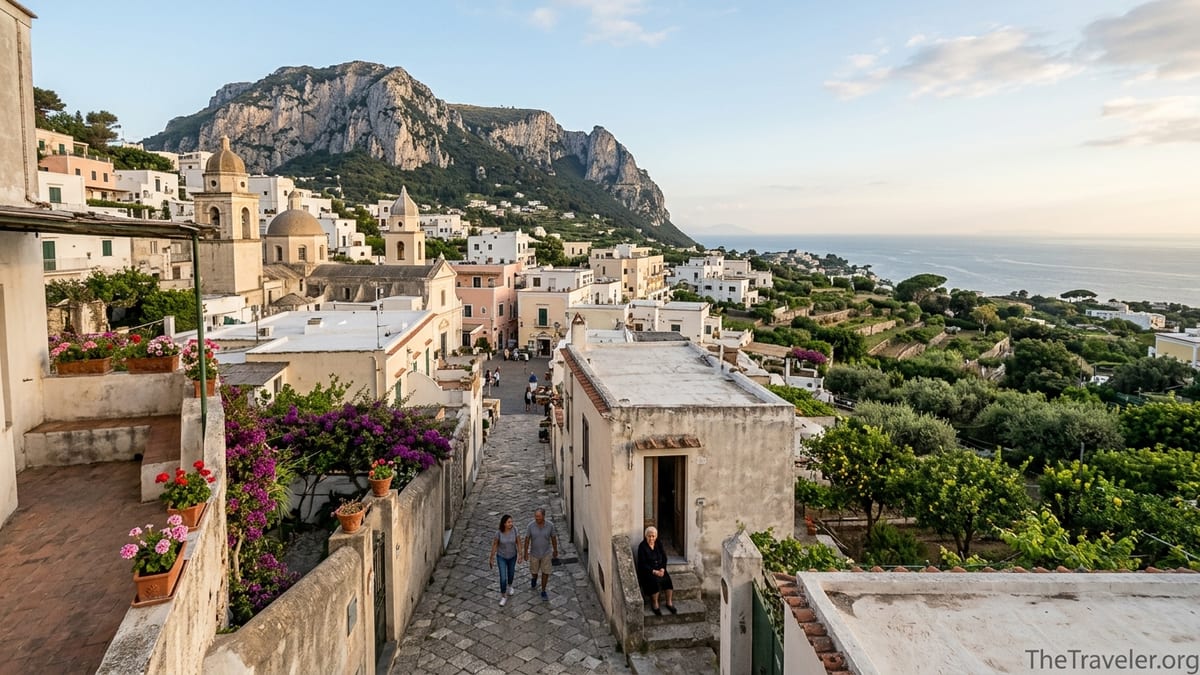
A Village Above the Glamour
Anacapri is one of the island’s two municipalities and occupies the upper, western side of Capri, spread across the slopes of Monte Solaro. It is literally “above Capri,” a name that reflects both its elevation and its atmosphere. Where Capri town wraps tightly around its showpiece Piazzetta and luxury boutiques, Anacapri opens out into wider streets, whitewashed lanes, and residential corners that locals actually use year-round.
Arriving from the port at Marina Grande, you feel the shift as the bus winds up the famous hairpin road. Down below, the crowds pour from hydrofoils and line up for the funicular; fifteen minutes later you are stepping off at Piazza Vittoria, where islanders gather at the newsstand and schoolkids cut across the square. The ambiance is still touristic in summer, but much closer to a working village than a resort stage.
This “upper village” identity matters deeply to residents. Longtime families here often work in hospitality and tourism like their peers in Capri town, but they live above the clamor, with gardens, lemon groves, and small apartment blocks tucked along pedestrian alleys. For them, Anacapri is the part of the island that still resembles the Capri their grandparents knew.
For visitors, that means a different rhythm. You still have cafés serving espresso and sfogliatelle in the morning, but you are likely to share the bar counter with a bus driver starting his shift or a local shopkeeper rather than a cruise passenger racing the clock. In the evening, when day-trippers stream back down to their boats, Anacapri unfurls into a serene, almost village-like calm.
Streets Where Island Life Still Happens
If Capri’s Piazzetta is the island’s open-air catwalk, Anacapri’s historic center is its living room. Around Piazza Diaz, along Via Giuseppe Orlandi and the web of alleys nearby, residents still run their daily errands: picking up bread from the panetteria, pausing for a chat beneath balconies draped with bougainvillea, or queueing at the post office. These are the streets where locals will tell you they “go to town,” and they mean Anacapri, not Capri.
Walk Via Giuseppe Orlandi in late afternoon and you might see a shopkeeper hosing down the pavement in front of a family-run ceramics store, while a neighbor wheels home groceries. There are souvenir shops, of course, but also practical places that most tourists overlook: a hardware store, a bar with its television tuned permanently to football, a tiny barber where the same clients have been coming for decades. The mix keeps the area grounded in everyday needs, not just visitor spending.
The lanes leading off the main street show an even softer side. Narrow vicoli open onto quiet courtyards, small shrines, and terraces with grapevines stretched overhead. On summer evenings, you might catch the smell of tomato sauce simmering or someone grilling fish on a hidden balcony. Compared with Capri town’s polished facades, Anacapri’s houses can feel more modest and weathered, but locals see that as part of the appeal: this is where life is lived, not just photographed.
For travelers, slowing down to match that pace is the key. Instead of ticking off sights, it is worth lingering on a bench in Piazza Vittoria, watching schoolchildren scatter or old friends swap island gossip. That ordinary scene is exactly what many residents are trying to protect from the pressures of mass tourism.
A Quieter Base for Exploring the Island
Many islanders and repeat visitors quietly recommend Anacapri as a base if you are staying more than a night. Accommodation ranges from small family-run B&Bs in the historic center to villas surrounded by vineyards along streets like Via Migliera and Via Vecchia del Faro. These stays often sit in pedestrian lanes where the loudest sound after dark is clinking cutlery and distant church bells.
A typical Anacapri guesthouse might offer three or four rooms in a converted family home, breakfast served on a terrace shaded by lemon trees, and owners who suggest which cousin runs a good boat tour or which bakery has the freshest torta caprese. Compared with Capri town, where many hotels orient themselves toward short high-end stays, Anacapri properties often aim at guests who value calm over constant buzz.
Practicalities reinforce the appeal. Public buses connect Anacapri to Marina Grande, Capri town, the Blue Grotto, and the Faro area throughout the day. A single ticket currently costs a few euros, with services running roughly every 15 to 20 minutes in high season. For most visitors this makes it easy to stay in the quieter upper village and descend for a few hours of shopping or a boat tour when desired, without needing a car or private driver.
Taxi prices from the port up to Anacapri tend to be higher than the bus but still manageable for those with luggage or mobility concerns, particularly if the fare is split between several travelers. Many locals still prefer the bus, not only for cost but because it is where they catch up on conversations and island news. Choosing the same mode of transport offers an easy moment of everyday contact.
Local Food Culture and Family Tables
One of the main reasons islanders favor Anacapri is food. While Capri town attracts headline-name restaurants, Anacapri quietly keeps many of the family kitchens alive. Here you are more likely to find menus written only in Italian, house wines from Campania served in carafes, and recipes that have barely changed in decades.
In the lanes near the center, spots like Il Solitario, set in a garden reached through a narrow alley, specialize in dishes that locals actually order: simple grilled fish, ravioli capresi filled with fresh caciotta cheese and marjoram, and rabbit stewed with herbs, a traditional countryside recipe. Portions are generous, the setting casual, and the atmosphere often feels more like a neighborhood gathering than a “destination” restaurant.
For something quick, residents know to stop at informal places such as Al Buco, a take-away in central Anacapri that turns out hot wood-fired pizza, crocché potato fritters, and baked pasta for workers heading home or families picnicking on the cliffs. Prices here are closer to what locals can afford everyday: a slice of pizza and a drink for roughly the cost of a coffee and pastry down in more fashionable corners of Capri.
Out toward the countryside, trattorie tucked along Via Migliera or near the lighthouse mix dramatic sea views with deeply local clientele. On summer evenings, you will see extended families gathering over bowls of mussels, plates of fried anchovies, and carafes of local white wine. Visitors who book these tables in advance are welcomed into that scene, but the tone remains firmly set by islanders, not by what looks best on social media.
Nature, Walks, and Views Without the Rush
Another reason locals cherish Anacapri is its access to quieter corners of the island’s landscape. Instead of queuing for limited spots on narrow viewpoints, residents tend to choose longer paths and less crowded overlooks that start right at their doorstep.
From Piazza Vittoria, the Monte Solaro chairlift glides up to the island’s highest point. Many day-trippers ride it for the iconic panorama of the Faraglioni rocks, but locals often time their visits for early morning or late afternoon, when the light softens and the summit cafe still has seats free. The ride itself takes around ten minutes each way, with chairs swinging gently over terraced gardens and small farms that show Anacapri’s agricultural roots.
Beneath the chairlift, walkers can follow mule tracks once used by farmers. Paths like Via Migliera lead west from the town center to cliff-edge viewpoints such as the Belvedere del Tuono, where the sea stretches out toward Ischia and the open Tyrrhenian. These routes pass sun-bleached walls, fig trees, and tiny vineyard plots that many families continue to cultivate part-time, more for tradition than for income.
Closer to the coastline, the Fortini path skirts a series of historic coastal forts around Anacapri’s western edge. While not a secret, it is still less busy than Capri’s more famous promenades, especially outside peak hours. You may see local hikers using it as an evening walk or families picnicking on exposed rocks, the sea breeze carrying the sound of small boats passing far below.
Culture and Heritage Beyond the Shop Windows
Locals who champion Anacapri often point not just to its quiet but to its cultural depth. The town hosts some of the island’s most meaningful historic sites, yet they are woven into the fabric of daily life rather than isolated behind ticket booths alone.
Villa San Michele, the former home of Swedish doctor and writer Axel Munthe, is a prime example. Perched near the top of the stairs above Piazza Vittoria, it combines landscaped gardens, classical fragments, and one of the island’s most evocative terraces. Many residents worked here or still do, and the villa’s concerts and exhibitions form part of Anacapri’s cultural calendar rather than a stand-alone tourist attraction.
A short walk away, the small Church of San Michele hides a remarkable 18th century majolica floor depicting the Garden of Eden. While visitors come for photos, parishioners use the church for actual worship and community events. On weekdays you might share the pews with an elderly resident praying quietly or a parent stopping in after school drop-off.
Elsewhere in the center, Casa Rossa, a distinctive red house built in the late 19th century, hosts exhibits on the island’s history and art. For local students, the building is a place to learn about their heritage; for travelers, it is a reminder that Capri’s story long predates its transformation into a luxury destination. Spending time in these institutions supports the same cultural fabric that residents are trying to maintain.
Reaching Anacapri and Moving Around Calmly
For many first-time visitors, the journey to Anacapri feels like a threshold between two different Capris. From Marina Grande, you can either take the funicular up to Capri town and change to a public bus, or board a bus directly from the port to Anacapri if services are running. The bus ride up the hairpin road takes around 20 to 25 minutes from the dock, less from Capri town itself.
Bus tickets are inexpensive by island standards and can be bought at ticket offices in Marina Grande, near Capri’s Piazzetta, and in Anacapri around Piazza della Pace. Most buses are compact minibuses built to navigate narrow curves, and they fill quickly in high season, which is one reason many locals prefer to travel early in the morning or later in the evening when the lines shrink.
Taxis, often the island’s distinctive open-top models, cost more but can be a practical option if you are arriving with luggage or limited mobility. Fares from the port up to Anacapri typically fall in a mid-range that is not trivial but can be reasonable split between three or four people. Locals advise agreeing the approximate price before departure and confirming that you will be dropped near the final stops in Anacapri, from where many accommodations offer short, complimentary walks or simple directions along pedestrian lanes.
Once in Anacapri, the town center is compact enough to explore entirely on foot. Distances to main sights such as Villa San Michele, the chairlift station, and the beginning of walking paths are measured in minutes rather than kilometers. For further excursions, such as down to the Blue Grotto or out to the Punta Carena lighthouse, dedicated bus routes allow you to reach the sea without needing a rental vehicle, something islanders themselves rarely use on these steep, narrow roads.
The Takeaway
Ask Capri residents where they escape the island’s busiest season and many will point you up the hill. Anacapri represents a version of Capri where children still ride their bikes through small squares, gardeners tend lemon trees instead of storefront flower displays, and restaurants cook foremost for neighbors rather than influencers. It is not untouched by tourism, and in high summer its streets and buses are undeniably busy, but the balance between visitor economy and everyday life is still more visible here than below.
For travelers, choosing Anacapri means accepting fewer shop windows and late-night venues in exchange for deeper contact with the island’s real rhythms. It is waking to church bells instead of nightclub bass, greeting the same barista each morning, and returning at dusk along a quiet lane scented with jasmine. The sights are still impressive, from Monte Solaro’s summit to cliff-edge walks and hidden chapels, but the lasting memory tends to be of the village itself and the people who keep it alive.
If you arrive with patience, curiosity, and respect for the fact that this is first and foremost a home, Anacapri can feel like being let in on a local secret: that Capri’s truest beauty lives not only in its famous views, but in the quieter, higher streets where the island still belongs to those who live there all year.
FAQ
Q1. Is Anacapri really quieter than Capri town?
Anacapri is generally much calmer, especially in the early morning and evening, though it still gets busy in peak summer daytime hours.
Q2. How long does it take to get from the port to Anacapri?
By public bus from Marina Grande it usually takes around 20 to 25 minutes, depending on traffic and how many people board at intermediate stops.
Q3. Is Anacapri a good place to stay without a car?
Yes. The center is walkable, and frequent buses link Anacapri with Capri town, the Blue Grotto area, and the lighthouse, so a car is unnecessary.
Q4. Are restaurants in Anacapri cheaper than in Capri town?
Prices vary, but many family-run trattorie, pizzerias, and take-away spots in Anacapri are aimed at locals and can be more affordable than some venues below.
Q5. What are the must-see sights in Anacapri?
Popular highlights include the Monte Solaro chairlift, Villa San Michele, the Church of San Michele, Casa Rossa, and cliff paths like Via Migliera.
Q6. Can I visit the Blue Grotto easily from Anacapri?
Yes. Buses run from Anacapri toward the Blue Grotto area, and many visitors combine that with a boat tour from the port for a different perspective.
Q7. Is Anacapri suitable for families with children?
It can be ideal, thanks to quieter streets, small squares where kids can move around more easily, and shorter walking distances between main sights.
Q8. Do I need to book restaurants and the chairlift in advance?
Restaurant reservations are advisable in high season evenings. The chairlift usually does not require advance booking, but going early helps avoid lines.
Q9. What is the best time of day to enjoy Anacapri like a local?
Early mornings and late evenings, when day-trippers are still arriving or have already left, are when the village feels most like itself.
Q10. Is Anacapri a good choice in the off-season?
Outside peak months it is very peaceful, with some hotels and restaurants closed, but for those seeking quiet and local life, that can be a major advantage.