


Landing in Oslo and stepping off the train into Oslo Central Station can feel overwhelming, especially on a first visit. The station, known locally as Oslo S, is Norway’s busiest transport hub, combining long distance trains, commuter lines, the airport express, local buses, trams, the metro and an attached food hall. With a little preparation, however, your arrival here can be smooth, safe and even enjoyable. This guide explains what to expect the moment you roll your suitcase onto the platform and how to make the most of Oslo S before you head into the city.
Get the latest updates straight to your inbox!
Understanding Oslo Central Station’s Layout
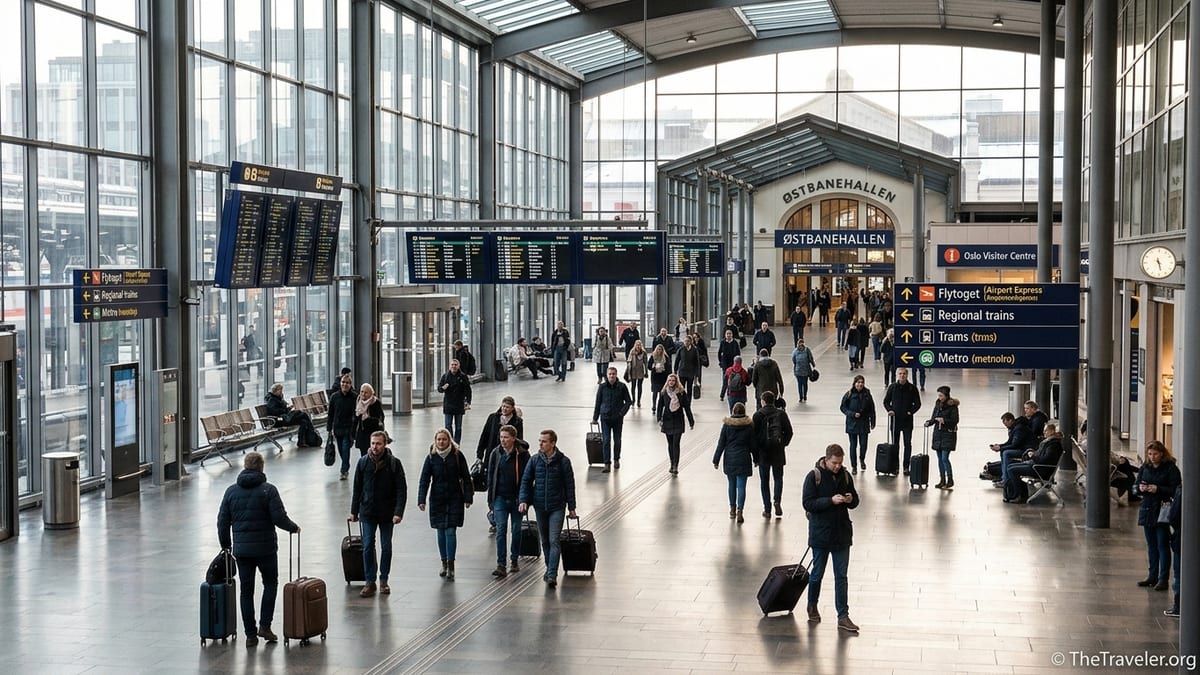
Oslo Central Station is large but compact enough to navigate on foot in a few minutes once you know the basic layout. The platforms are numbered, with long distance and regional trains typically using the higher numbers, and commuter and airport services using tracks closer to the main hall. Electronic departure and arrival boards hang above the concourse and at the ends of platforms, showing train numbers, departure times, track numbers and whether a train is on time or delayed. English is used alongside Norwegian, and staff at the information desk are used to helping visitors who are new to the system.
Arriving from Oslo Airport, most travelers step straight into the main concourse area after walking up from the platforms. Here you will find ticket machines, a small cluster of convenience kiosks, seating and clear signs pointing toward trams, buses, the metro and nearby streets such as Karl Johans gate. If you need a moment to get your bearings, stand to one side in the main hall rather than at the top of an escalator or in front of ticket machines, which can get busy during rush hours.
The station is really three areas joined together: the main station hall where most platforms are located, the dedicated airport express section, and Østbanehallen, the renovated former east station that now serves as a food hall and shopping arcade. All are under the umbrella name “Oslo S,” and you can walk between them indoors without going outside. This is useful in winter, when temperatures often sit below freezing and snow can make outdoor streets slippery.
Outside the station, Jernbanetorget square is the key landmark. From here you find the main tram and bus stops, one of the central metro entrances and easy walking routes to the Oslo Opera House, the Barcode business district and the central shopping streets. If you look up, the distinctive “Tiger” sculpture on the square and the glass roofline of the station help you reorient yourself if you pop outside and then need to find your way back in.
Arriving from Oslo Airport: Flytoget vs Regular Trains
Most international visitors first encounter Oslo Central Station when arriving from Oslo Airport Gardermoen. Two main train options run directly between the airport and Oslo S: Flytoget, the dedicated Airport Express Train, and regular Vy operated regional or commuter trains. Both use the same general platforms at the airport station beneath the arrivals hall and arrive at Oslo S in around 20 to 25 minutes, but they differ in price, frequency and included services.
Flytoget is designed for air passengers and advertises journey times of around 20 minutes between Gardermoen and Oslo S, with departures roughly every 10 minutes at peak times and slightly less often late at night and early morning. A one way adult ticket typically costs in the region of 198 Norwegian kroner when bought at the machine or through the Flytoget app. Trains have spacious luggage racks at carriage ends, overhead storage and clear displays in English. For travelers with tight connections, heavy luggage or a preference for a straightforward, English friendly service, Flytoget is often the least stressful option.
Regular regional and commuter trains operated by Vy also run between the airport and Oslo S, usually three times per hour, with journey times around 23 minutes. A standard one way adult ticket on these services is usually significantly cheaper than Flytoget, often around 109 to 130 kroner when booked through the Vy or Ruter apps or at the station. These trains are popular with locals and budget conscious visitors. The carriages are comfortable, but luggage space can feel more limited during busy periods, and announcements may prioritize Norwegian first, although signage inside the trains is easy to follow.
In practice, the choice often comes down to budget and timing. If you land late at night, have only hand luggage and spot an immediate Flytoget departure on the platform, paying extra might be worthwhile just to be on your way. If you land midday and are not in a rush, waiting a few extra minutes for a cheaper Vy service can save enough money to fund a simple lunch in Østbanehallen once you reach Oslo S. Either way, tickets are usually easiest to buy from the official apps or station machines as soon as you emerge into the arrivals area, so you are not fumbling for payment on the platform itself.
Tickets, Apps and How to Avoid Confusion
For first time visitors, a common source of confusion is the difference between train tickets sold by Flytoget, train tickets sold by Vy, and city public transport tickets sold by Ruter, the agency that oversees metro, tram, bus and some local rail. While all of these may move you along similar tracks, the tickets are not interchangeable. A Flytoget ticket is valid only on Flytoget services, while a Vy ticket between the airport and Oslo S is valid only on Vy operated trains for that specific journey.
If you plan to spend several days in Oslo and mainly use metro, tram and bus, a Ruter ticket can be a better starting point. For example, a Ruter ticket covering the airport zone to the central Zone 1 allows you to ride regular Vy trains from Gardermoen into the city and then transfer to city trams or the metro without buying a new ticket, as long as you board all transport within the validity period printed in the app. This is appealing if, for instance, you are staying in a neighborhood like Grünerløkka or Majorstuen, which are better reached by tram or metro after the train.
Downloading both the Vy and Ruter apps before you travel is highly recommended. With the Vy app, you can search “Oslo Lufthavn” to “Oslo S,” see the next departures, and purchase the ticket in a few taps using a bank card. The Ruter app lets you select your start and end zones, choose a single ticket or a longer pass, and stores the ticket on your phone so you simply show the QR code to inspectors if asked. Ticket machines at the airport and Oslo S itself mirror these options, but international visitors sometimes appreciate being able to pay in their home currency card within the app and avoid queuing at busy times.
Once you arrive at Oslo S, look out for ticket validation checks near certain platform exits, especially for Flytoget. If you used a digital ticket on your phone, keep the app open and screen brightness high in case you are asked to scan or display it. If you hold a paper ticket, do not throw it away until you are fully out of the station and onto the city street or into your connecting train. Inspectors in Norway are polite but firm, and traveling without a valid ticket can result in on the spot fines that are considerably higher than the original fare.
Services Inside the Station: Luggage, Money and Essentials
One of the first practical questions on arrival is what to do with luggage. Oslo Central Station offers self service lockers where you can store bags and suitcases for a few hours or overnight. These are usually located near the main concourse and along some of the side corridors leading toward Østbanehallen. Prices vary depending on locker size and duration, but as an example, you might pay the equivalent of roughly 80 to 120 kroner for a medium locker for 24 hours. Payment is typically by card only, and instructions are displayed in several languages.
The lockers are useful if, for instance, you are connecting between Oslo’s two airports and have a multi hour gap in the city. Some travelers arriving at Sandefjord Torp and flying out later from Gardermoen store large suitcases at Oslo S, then explore the nearby Opera House and waterfront with only a small daypack before returning to catch the airport train. The station is staffed and covered by cameras, but as in any large transport hub, keep valuables in a smaller bag that you keep with you rather than in storage.
For cash and banking needs, Oslo S and its immediate surroundings include ATMs and bank branches, though Norway is largely cashless and most visitors manage easily with a contactless card or mobile payments only. Convenience stores in the station, such as Narvesen or 7 Eleven branded kiosks, sell drinks, snacks, SIM cards and basic toiletries and accept major international cards. If you need a local SIM or eSIM to navigate maps and apps, staff at the Oslo Visitor Centre can also point you toward current options and providers.
Restrooms are available inside the station, though some are pay to enter, with turnstiles that accept coins or contactless payment. Keeping a small amount of Norwegian cash or a low value contactless card handy can smooth this. Showers are not standard in the main station, but some long distance travelers use nearby budget hotels for day rooms if they need to freshen up after an overnight train or bus. Seating in the main hall is limited relative to the number of passengers, so expect to share benches at busy times and consider using a café in Østbanehallen if you want a more relaxed place to sit with your bags.
Oslo Visitor Centre and Navigating the City From Oslo S
Inside Østbanehallen, directly connected to the station, you will find the Oslo Visitor Centre, the official tourist information point for the city. It typically operates daily with slightly shorter hours on weekends, opening from mid morning to late afternoon. Staff here speak excellent English and can provide free maps, guidance on public transport, recommendations for attractions and neighborhoods, and help with booking tours, Oslo Pass cards or last minute accommodation if you prefer face to face assistance.
For example, if you arrive at Oslo S around lunch time and want to understand whether an Oslo Pass will save you money, you can walk straight to the Visitor Centre and explain your rough itinerary, such as “two days, planning to visit the Viking Ship Museum’s successor at the Museum of the Viking Age, the National Museum and take a fjord cruise.” Staff will look at current prices and opening times and give you an honest assessment of whether a pass or pay as you go tickets make more sense. They can also point out which tram or bus to take from Jernbanetorget to reach your first hotel or museum stop.
From Oslo S itself, it is a short level walk to several key areas. The Oslo Opera House is about five to ten minutes on foot, reached by exiting toward the waterfront and following signs for “Operaen.” The main shopping street, Karl Johans gate, begins just across the square and leads gradually uphill toward the Royal Palace, passing the Stortinget parliament building and the National Theatre. Trams fan out from Jernbanetorget to residential and nightlife districts such as Grünerløkka, Tøyen and Majorstuen, while the metro from Jernbanetorget station under the square connects quickly to places like Holmenkollen and Sognsvann if you plan to hike or ski.
If you are jet lagged or arriving late in the evening, you may prefer to stay within a few minutes’ walk of the station. Several mid range chain hotels sit within one or two blocks of Oslo S, and this can make early morning departures or late night arrivals significantly easier. A typical traveler arriving on the last Flytoget after midnight in winter, for instance, can be in a nearby hotel lobby within five minutes without needing a taxi. In the morning, they can then stroll back into the station for a train to Bergen or Trondheim without worrying about rush hour traffic.
Food, Drinks and Waiting Comfortably
Østbanehallen, attached to the eastern side of the station, is a bright, glass roofed hall filled with cafés, casual restaurants and small shops. It is a popular place for both visitors and locals to pause for a coffee, lunch or early dinner before catching a train. You will find everything from Norwegian style bakeries selling cinnamon buns and open sandwiches to international chains offering pizza, burgers or sushi. Prices are relatively high by international standards, but you can still find a simple coffee and pastry for around 60 to 80 kroner if you choose carefully.
If you prefer to keep costs down, the convenience stores in the main station sell freshly made sandwiches, hot dogs, salads and basic groceries at a lower price point. Many travelers pick up a yogurt, fruit and sandwich here before boarding a long regional train north toward Lillehammer or Trondheim, where onboard catering might be limited. Remember that in Norway, tap water is safe to drink, so carrying an empty refillable bottle and filling it in station restrooms or at water fountains can save on bottled water purchases.
For those with longer layovers, cafés in Østbanehallen are generally happy for you to linger for an hour or two with a laptop or book as long as you buy something. Free Wi Fi is common, either provided by the venue or through the station’s general network, and power outlets are often available along walls or under seating. This makes the hall a pleasant place to catch up on messages, download maps or simply decompress after a long flight before heading to your accommodation.
Alcohol is tightly regulated in Norway, and you will not find late night bars in the station itself. Some sit down restaurants in Østbanehallen serve beer and wine with meals, typically at higher prices than many visitors are used to. If you want a more atmospheric evening drink, it is usually better to drop your bags at your hotel and then explore nearby neighborhoods like Grünerløkka or Aker Brygge, which offer a wider range of bars and waterfront terraces within a 20 to 25 minute walk or a short tram ride from Oslo S.
Safety, Security and Late Night Travel
Oslo is generally considered one of Europe’s safer capitals, and Oslo Central Station reflects this. The station is well lit, fitted with extensive CCTV cameras and patrolled by security staff and, at times, police, particularly during busy periods. Most travelers feel comfortable using the station early in the morning or late at night. That said, petty crime like pickpocketing and occasional aggressive begging can occur, especially in crowded areas near ticket machines or main entrances, so standard big city precautions apply.
Keep your passport, wallet and phone in zipped pockets or an interior compartment of your bag, and avoid leaving luggage unattended while you check departure boards or visit restrooms. If someone approaches you asking for signatures, donations or to check your tickets away from official barriers, it is fine to politely decline and walk toward a staffed information point instead. Official staff will wear uniforms and name badges and will not pressure you in unusual ways.
Late at night, the station continues to operate, but some side entrances and interior corridors may close earlier than the main hall. If you are catching one of the final trains out to the airport or to another city after midnight, follow the signs to the platform indicated on the departure board rather than relying on past experience, as occasional engineering works can shift trains to different tracks. Nearby streets can feel quiet in winter months after around 22:00, so many visitors choose accommodation close enough to walk quickly back from Oslo S without navigating deserted backstreets.
If you encounter any issues, from a lost wallet to feeling unwell, your first stop should be the station’s staffed information areas or security desks, where personnel can contact police, medical services or lost property offices as needed. In emergencies, the national emergency number 112 connects you to police, while 113 is for medical emergencies. English language service is standard, and operators are used to guiding non Norwegian speakers.
The Takeaway
For a first time visitor, arriving at Oslo Central Station does not need to be stressful. By understanding the station’s basic layout, the difference between Flytoget and regular Vy trains from the airport, and the role of apps like Vy and Ruter, you can move from airport arrivals to your hotel or onward train with confidence. The presence of the Oslo Visitor Centre, extensive food options in Østbanehallen and practical facilities like luggage lockers and ATMs means you can also use the station as a comfortable base for your first few hours in the city.
Think of Oslo S not just as a transit point, but as a starting line for exploring the Norwegian capital. From here, you can stroll to the Opera House, ride a tram to vibrant neighborhoods, or board trains that snake through forests and along fjords to the rest of the country. With reasonable attention to safety and a little advance planning on tickets, your arrival experience can set a calm, organized tone for the rest of your trip.
FAQ
Q1. How early should I arrive at Oslo Central Station before my train departure? For domestic and regional trains, arriving 15 to 20 minutes before departure is usually sufficient, allowing time to find your platform and board calmly. For popular holiday departures or if you need to buy tickets on arrival, aim for 30 minutes.
Q2. Is it better to take Flytoget or the regular Vy train from Oslo Airport to Oslo S? Flytoget is faster, more frequent and very straightforward, but costs more. Vy trains are a few minutes slower and can be busier, yet significantly cheaper. If you value convenience or travel late at night, Flytoget is attractive. If you prioritize budget and are not in a rush, Vy is often the better choice.
Q3. Can I use one ticket for both the airport train and Oslo trams or metro? A Flytoget ticket is only valid on Flytoget services. A Vy ticket from the airport to Oslo S is valid for that train journey only. However, if you buy a Ruter ticket covering the airport zone to central Oslo, it is valid on regular Vy trains and then on local buses, trams and the metro within its time limit.
Q4. Are there luggage lockers at Oslo Central Station? Yes. Self service lockers in various sizes are available inside the station, generally near the main hall and certain corridors. You pay by card and can store bags for several hours or overnight, which is useful if you want to explore the city during a long layover.
Q5. Is Oslo Central Station safe at night? The station is generally safe, well lit and monitored, and many people use it early in the morning and late at night. Normal big city precautions apply: keep valuables secure, stay in well populated areas, and use official staff or security if you need assistance.
Q6. Where can I get tourist information when I arrive at Oslo S? The Oslo Visitor Centre in Østbanehallen, attached to the station, offers maps, advice, ticket help and recommendations in several languages. It is open daily with slightly reduced hours on weekends and public holidays.
Q7. Do I need cash at Oslo Central Station or is card payment enough? Card payment is accepted almost everywhere in and around Oslo S, including ticket machines, cafés and convenience stores. Keeping a small amount of cash can be handy for some restrooms or older vending machines, but most visitors manage comfortably with cards or mobile payments only.
Q8. How do I connect from Oslo S to the metro, tram or bus network? Jernbanetorget square directly outside Oslo S is a major interchange for trams, buses and the metro. Clear signs inside the station point you toward exits for “T” (metro) and tram stops, and real time screens show which line is arriving next. A Ruter ticket on your phone covers these modes within its zones and validity.
Q9. Are there good food options inside the station? Yes. Østbanehallen offers a range of cafés and restaurants, from bakeries and coffee bars to casual sit down places. Convenience stores in the main hall sell sandwiches, snacks and drinks, which are useful if you are catching a train and prefer to eat onboard.
Q10. What should I do if I lose something on a train or at Oslo Central Station? Start by contacting the train operator’s lost property service, either Vy or Flytoget, depending on which train you used. For items lost in the station itself, speak to staff at the information desk or security points, who can direct you to the appropriate lost and found office or help you file a report.