


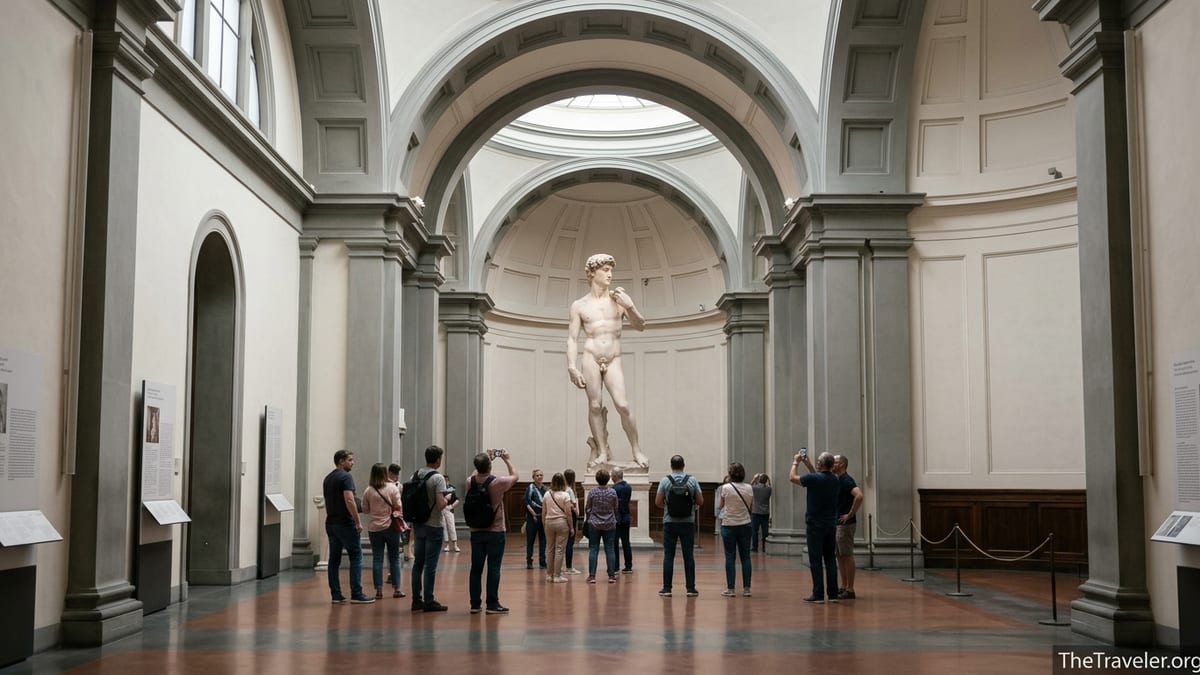
Travelers come to Florence for many reasons, but almost everyone leaves talking about the same encounter: the moment Michelangelo’s David appears at the end of the Accademia Gallery’s long, bright hall. Even in an age of high-resolution images and 3D scans, this five-meter-tall figure carved over 500 years ago still has the power to stop a busy museum crowd into complete silence. Understanding why David feels so extraordinary helps you appreciate not just a famous artwork, but a turning point in how people see the human body, heroism, and even the city of Florence itself.
Get the latest updates straight to your inbox!
From Rejected Marble Block to Renaissance Masterpiece
Part of what makes David so extraordinary is that he should not exist at all. The statue was carved between 1501 and 1504 from a single massive block of Carrara marble that had been left outdoors for decades, already roughly hacked into by other sculptors who gave up on it. Contemporary documents describe it dismissively as a damaged "man of marble" lying on its back in the courtyard of the Florence cathedral works yard, considered too flawed and too thin for such an ambitious figure.
When the 26-year-old Michelangelo was finally hired to attempt what others had abandoned, he accepted the challenge under tight conditions: a two-year contract and a workspace behind the cathedral. For a modern traveler used to seeing David in the enclosed, climate-controlled Accademia Gallery, it is hard to imagine that this global icon began as a problem lump of stone no one wanted, exposed to weather and considered nearly unusable. The very fact that it became an artwork of such harmony and power is one of the reasons art historians still describe David as a kind of miracle in marble.
The technical difficulties were real. The stone was tall but relatively shallow from front to back, which limited how far limbs could project. Michelangelo had to design the pose so that David’s arms and legs stayed mostly within the original block’s profile, while still conveying energy and life. Stand near the statue today and you can sense just how precisely the body fits within an invisible rectangular outline, proof of a sculptor planning every inch in three dimensions to overcome the marble’s limitations.
Even the decision to carve David from a single block matters. Many large Renaissance sculptures were assembled from multiple pieces of stone, but Michelangelo insisted on carving a unified figure. Travelers familiar with modern sculpture, which often welcomes seams and assemblage, may not realize how radical and risky this choice was in the early 1500s. One bad vein or mis-struck blow could have ruined years of work. The courage and confidence required simply to begin such a project contribute to David’s legendary status.
A Human Body That Redefined Heroism
Another reason David still impresses in person is the way Michelangelo uses the human body itself as the language of heroism. Rather than depict the familiar biblical scene of David standing over the severed head of Goliath, Michelangelo chose an earlier, more psychological moment. David is shown before the fight, tense and alert, sling over his shoulder, stone gripped in his right hand. There is no dramatic action, no enemy in sight, just concentrated resolve.
Walk slowly around the statue in the Accademia and that tension becomes physical. The left leg carries the weight, the right leg relaxes forward. The hips tilt one way, the shoulders counter-tilt the other, a pose art historians call contrapposto. Veins swell in the hands, the neck muscles tighten, the brow furrows. These details come alive at close range in a way that reproductions cannot match. From a few meters away, especially when the gallery is quieter early in the morning, you can see the subtle shift in the ribcage as David inhales, as if he is taking one last breath before the confrontation.
The body itself is deliberately idealized, echoing classical Greek sculpture while adding Michelangelo’s own fascination with anatomy. David is not a fragile boy but a young man in peak condition, with powerful legs, defined abdominal muscles, and a broad, twisting torso. Yet nothing feels exaggerated like a modern superhero figure; the proportions remain believable enough that visitors often comment that David looks like he might step down from his pedestal at any moment. That sense of potential movement is one of the sculpture’s quiet miracles.
In practical terms, this means travelers who rush past David for a quick photo from the front miss much of what makes it exceptional. The most revealing angles are often from the right side, where you can see the sling running down David’s back, and from behind, where the powerful structure of the shoulders and lower back becomes clear. Visitors who schedule a longer slot at the Accademia typically find themselves circling the statue three or four times, discovering new anatomical details from every vantage point.
Political Symbol and Civic Identity of Florence
David is not only a masterpiece of sculpture; it is also a symbol woven into the political story of Florence. Originally commissioned for a high buttress of the cathedral, the finished statue in 1504 impressed city officials so much that they decided it was too important to be hidden far above street level. Instead, they placed it at ground level in front of the Palazzo Vecchio, the seat of the Florentine government, in Piazza della Signoria.
Travelers who walk today through that square will see a marble copy of David standing where the original once stood, facing toward the south, symbolically turned toward potential enemies. In the early 1500s the figure of the young shepherd defeating the giant resonated strongly with republican Florence, which saw itself as a small but determined city-state standing up to larger powers, especially rival city-states and foreign monarchies. David’s calm confidence, his readiness without arrogance, came to embody the ideals the city wanted to project to the world.
The statue’s public life was dramatic. It survived lightning strikes, weather, and even acts of violence; in the 16th century it was damaged when political factions clashed in the square. In the 19th century, concerns about deterioration from exposure led to the decision to move the original indoors, a complex relocation that took place in the 1870s. Travelers today can follow this story physically: see the copy in Piazza della Signoria, then walk about 10 minutes north to the Accademia on Via Ricasoli to encounter the original in its carefully controlled museum setting.
For visitors interested in how art and politics intersect, this dual experience is valuable. Standing in the busy open-air square among modern protest banners or city events, then stepping into the quieter, focused atmosphere of the Tribuna del David inside the Accademia, you can feel how the same image has served both as an everyday civic emblem and as a revered artistic treasure.
Anatomical Detail, Scale, and Michelangelo’s “Eye”
On paper, David’s measurements are impressive enough: the statue stands more than 5 meters high and weighs over five tons. In person, though, the scale is both monumental and strangely intimate. The head and hands are slightly larger than strict human proportion, a choice scholars believe Michelangelo made because the figure was originally intended to be viewed from below. Travelers who look up from close range at the Accademia notice that the oversized hands, especially the right one holding the stone, become psychological anchors, emphasizing David’s will and action.
Michelangelo’s understanding of anatomy came from years of drawing and, according to historical sources, from direct study of the human body. He carved tendons, veins, and subtle muscle transitions into the marble with such sensitivity that modern medical specialists have studied David to discuss how closely the sculpture matches real physiology. Even details a casual visitor might not consciously register, such as the slight asymmetry of the eyes or the barely visible twist at the base of the neck, contribute to an uncanny sense of life.
Lighting in the Accademia is arranged to accentuate these sculpted forms. Natural light filters from above in the Tribuna, catching the smooth planes of the chest and thighs and the sharper edges of the knees and fingers. Travelers arriving when the gallery opens, often around 8:15 in the morning, will see softer, cooler light; those visiting in the afternoon may experience warmer tones streaming through the upper windows. Because the surface of the marble is finely finished but not glassy, it catches light in a way that brings out the smallest chisel marks when viewed from the side.
In a world where many famous artworks feel smaller than people expect when finally seen in person, David tends to have the opposite effect. Visitors who have seen countless photos on postcards, coffee mugs, and T-shirts often report surprise at how tall, solid, and present the figure is in the gallery. The long approach corridor lined with Michelangelo’s unfinished "Prisoners" sculptures heightens this effect. You move from rough, half-emerging figures to the fully realized David at the end, like walking through the sculptor’s process toward its most complete expression.
Enduring Preservation, Debate, and Global Influence
For a five-century-old sculpture carved in fragile stone, simply surviving intact is no small achievement. Cracks in the ankles and lower legs have long concerned conservators, especially given Florence’s seismic risk. Modern studies, including detailed structural analyses and 3D scans, have looked closely at how the statue might respond to vibrations. This has prompted measures to stabilize the base and closely monitor the marble, reminding visitors that this apparently indestructible icon is, in fact, vulnerable.
The statue has undergone careful cleanings and restorations, most notably in the early 2000s, which removed accumulated grime while preserving the character of the original surface. These interventions often spark debate in Italy about how much restoration is appropriate, illustrating how deeply the public feels about David. When you stand in front of the sculpture today, you are seeing not only Michelangelo’s work but also centuries of curatorial choices about lighting, environment, and conservation methods.
David’s influence extends far beyond Florence. Replicas in Florence itself, in Piazzale Michelangelo and Piazza della Signoria, allow visitors who cannot secure Accademia tickets to experience the silhouette and pose at full scale outdoors. Around the world, cast and marble copies appear in museums, universities, and even hotel lobbies. Travelers might encounter a full-size replica in a museum in London or a fiberglass version in a shopping center, each testifying to the sculpture’s broad cultural reach.
This ubiquity makes seeing the original even more striking. When you finally face the real David in the Accademia, the familiar outline resolves into a specific piece of stone with tiny irregularities, faint discolorations, and subtle tool marks that reproductions smooth over. The experience underlines why art historians and ordinary travelers alike insist that no photo, 3D print, or replica fully replaces standing in front of Michelangelo’s marble in Florence.
Experiencing David Today: Practical Advice for Travelers
For modern visitors, part of what makes David extraordinary is how central he has become to the experience of Florence. The Galleria dell’Accademia is a compact museum, but it ranks among the city’s busiest, with millions of visitors annually coming specifically to see this statue. Standard adult tickets in 2026 are around 20 euros for a timed-entry slot, purchased either on the official museum system or through authorized resellers that may bundle a guide or additional services into the price.
Because of high demand, especially from April through October, daytime slots often sell out days or even weeks ahead. Many travelers who arrive in Florence without a reservation find that only late-afternoon or early-evening times are still available, if at all. Booking as soon as you lock in your travel dates is wise, particularly if you want a quieter visit at opening time. For those who cannot find official tickets, small-group tours that include entrance to the Accademia can sometimes offer last-minute availability, though at a higher total cost, often in the 40 to 60 euro range including the ticket.
Inside the museum, expect a security check and a brief wait before entering the main gallery. Once in front of David, allow yourself more time than a quick photo stop. Travelers often find that 20 or 30 minutes spent simply observing from different angles transforms the visit from a checklist item into a memorable encounter. Sitting for a few minutes on the benches in the Tribuna lets you watch how light moves over the marble and how other visitors react, which can be as revealing as any guidebook description.
If the Accademia is fully booked during your stay, visiting the outdoor copy in Piazza della Signoria and the bronze version at Piazzale Michelangelo, reached by a short uphill walk or bus ride, still offers a meaningful experience. The view of Florence from the Piazzale, often at sunset, places David against the backdrop of the Duomo and the Arno River, connecting the statue’s form to the city whose identity it helped shape.
The Takeaway
Michelangelo’s David stands at the intersection of artistry, engineering, politics, and human emotion. It is extraordinary not only because of its technical perfection, but because of the odds it overcame: a flawed block of stone, ambitious scale, and a complex civic role in a turbulent city. For travelers, the statue rewards both quick admiration and long contemplation, revealing new layers with every circuit around its base.
To understand David is to understand something essential about Florence and about the Renaissance idea of human potential. The sculpture captures a moment of intense inward focus just before decisive action, carved into stone that was once considered unusable. When you stand beneath that steady gaze in the Accademia Gallery, you witness how vision, courage, and skill can turn a rejected material into one of the most compelling images in the history of art. It is this fusion of backstory, beauty, and lived experience that keeps Michelangelo’s David at the top of so many travelers’ lists and ensures that, century after century, the statue continues to feel astonishingly alive.
FAQ
Q1. Where can I see Michelangelo’s original David in Florence? The original statue is housed in the Galleria dell’Accademia on Via Ricasoli, a short walk north of Florence’s cathedral, not in the Uffizi Gallery.
Q2. How tall is Michelangelo’s David? David stands a little over 5 meters tall, roughly 17 feet, making it significantly larger than life-size and imposing when viewed at close range.
Q3. Why are the hands and head of David larger than expected? Michelangelo enlarged these areas because the statue was originally meant to be seen from far below, and the emphasis on hands and head reinforces David’s thought and action.
Q4. Do I need to book tickets in advance to see David? Advance booking is strongly recommended, especially in the high season, as timed-entry tickets can sell out days or weeks ahead for popular morning and midday slots.
Q5. How much time should I plan for a visit to the Accademia Gallery? Most travelers find that 60 to 90 minutes is enough to see David from multiple angles and explore the rest of the collection without rushing.
Q6. Is it possible to see David without paying an entrance fee? The original requires a paid ticket, but Florence has outdoor full-size copies in Piazza della Signoria and at Piazzale Michelangelo that you can view for free at any time.
Q7. Can I take photos of David inside the Accademia? Non-flash photography is generally allowed for personal use, but tripods, selfie sticks, and professional lighting equipment are not permitted in the galleries.
Q8. What is the best time of day to visit David? Early morning entry slots often provide a calmer experience with fewer crowds, while late-afternoon visits can be more crowded but still rewarding.
Q9. Why is Michelangelo’s David considered politically important? The statue became a symbol of the Florentine Republic, representing a small but determined city standing up to larger powers, much like David against Goliath.
Q10. What other Michelangelo works can I see near David? In the same museum you can see Michelangelo’s unfinished "Prisoners" sculptures, and a short walk away the Medici Chapels and parts of the Bargello Museum also house important works by him.