


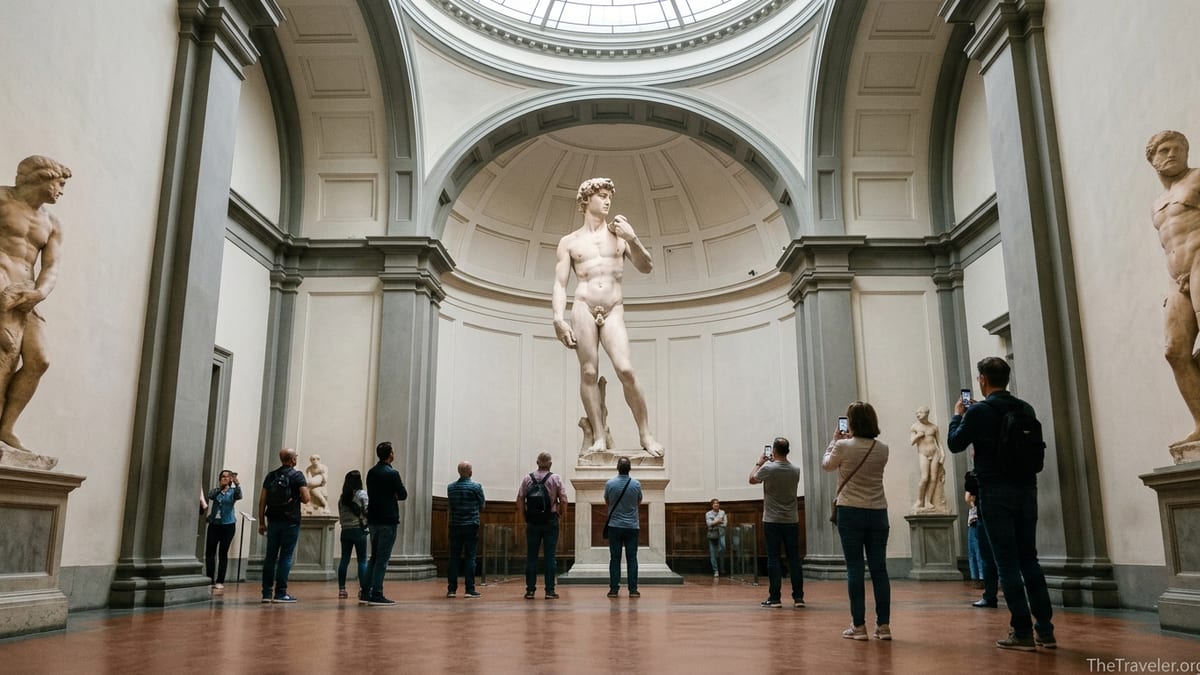
Every year, travelers pour into Florence’s Galleria dell’Accademia for a single encounter. They shuffle through security, file past musical instruments and unfinished statues, then walk into a high, bright hall and stop. At the far end, under a domed skylight, stands Michelangelo’s David. Even if you have seen it on postcards, coffee mugs or fridge magnets, the real sculpture is startling in person: taller than you expect, tenser than you remember, and more intensely present than any photograph suggests. Many Renaissance works are famous. Very few feel like a living person has walked into the room. David does. That quality is at the heart of what makes this statue different from every other Renaissance masterpiece.
Get the latest updates straight to your inbox!
A Giant Cut From a "Ruined" Block
One of the most concrete ways David stands apart begins long before today’s visitor steps into the Accademia. The statue was carved from a single block of Carrara marble that two earlier sculptors had already rejected as flawed and too thin. Historical records from Florence’s Cathedral Works Board show that this massive block, nicknamed the "giant," lay exposed in a courtyard for roughly 25 years, weathering and developing imperfections, before Michelangelo took it on in 1501. By Renaissance standards, this was not the ideal start for a monumental commission. Artists usually chose fresh, compact stone. Michelangelo accepted what others saw as a problem and turned it into an opportunity.
Standing in front of the statue today, you can see how tightly the figure fills the marble: from David’s outstretched left arm to the twist of his hips, there is almost no extra stone. Conservators at the Accademia have noted that this forced Michelangelo into unusual solutions, such as keeping the figure relatively flat from back to front and aligning the contrapposto pose along the block’s strongest axis. For modern travelers, that risk is not abstract. When you book a timed ticket to the Accademia and walk down the long corridor of unfinished "Prisoners" toward the bright niche, you are literally approaching a sculpture that should, by all logic, not exist in this form at all.
That improbable origin story sets David apart from many other Renaissance icons. Donatello’s bronze David in the Bargello Museum, for instance, was planned from the outset as a freestanding statue in a courtyard and cast in metal that could be controlled and reworked. Michelangelo, in contrast, had one fragile shot in stone more than five meters high. When travelers visit both museums, often on a combined ticket that local authorities have recently coordinated to help spread visitor numbers more evenly across Florence, they are able to feel that contrast not as textbook theory but as a physical experience: one David born from a carefully prepared plan, the other wrestled from a damaged monolith.
The scale also matters. David stands at about 5.17 meters, or just under 17 feet, without his pedestal. Travelers who have only seen reproductions frequently report a moment of shock walking into the gallery: the statue towers over the crowd, larger than many expect, yet every vein and tendon remains sharply defined. Scholars of sculpture often describe David as demonstrating absolute control over marble, but for a visitor, it can feel closer to a dare: Michelangelo took a compromised, weathered block and carved something so ambitious that the city had to rethink where to put it.
David Before the Battle: A Revolutionary Moment
Another decisive difference lies in what moment of the biblical story Michelangelo chose to depict. Earlier Renaissance artists tended to show David after his victory over Goliath, foot planted on the giant’s head, sword in hand, the drama already resolved. Donatello’s famous bronze David, which travelers see in the Bargello, and Verrocchio’s youthful David both follow that pattern. Michelangelo broke it. He chose to portray David just before the confrontation, sling over his shoulder, stone in hand, eyes fixed on the distant enemy.
If you stand slightly to the statue’s right and look up along the line of David’s gaze, you will notice the tension written into his body: the knitted brow, the slight parting of the lips, the cords in his neck. Guides at the Accademia often invite visitors to walk around the base and compare the calm, almost classical profile with the charged expression from the front-right angle. The story is suspended at its most uncertain instant. This moment-before approach is far more psychologically intense than the triumphant poses typical of earlier works, and it is one reason why many travelers describe the statue as feeling contemporary, even cinematic, despite its creation in the early 1500s.
That choice also shifts the meaning of the work. Florence at the time was a fragile republic surrounded by stronger powers, often likened to David facing larger political Goliaths. By depicting the hero before victory, Michelangelo aligned the statue with a city that had not yet won but was defiant nonetheless. Visitors who walk from the Accademia down to Piazza della Signoria, where a full-size outdoor replica now stands in front of Palazzo Vecchio, can see how the figure’s alert pose reads as a civic sentinel, not just a Bible character. It embodies vigilance rather than celebration, a nuance that distinguished it from other religious imagery of the day.
This pre-battle moment also affects how modern audiences relate to David on a personal level. Travelers often say they feel the statue captures the seconds before any big decision in life: an exam, a negotiation, a difficult conversation. Where many Renaissance masterpieces draw you into mythic time, David feels like the instant just before you act, frozen at human scale, even as the sculpture itself is monumental.
Human Anatomy Pushed to Its Limits
Renaissance artists were obsessed with the human body, but Michelangelo pushed that fascination to an extreme in David. The statue’s anatomy is hyper-observed, the product of years of studying live models and dissecting cadavers. When you approach the figure from the left, subtle details emerge: the flex of the abdominal muscles as David shifts his weight, the tendons atop the right hand clutching the sling, even the veins on the back of the left hand that seem to pulse with anticipation.
At the same time, the anatomy is deliberately distorted. Michelangelo enlarged David’s head and especially his right hand beyond normal proportion. Guides in Florence often point this out to visitors standing near the base: from eye level, the hand can look almost too big, the fingers thick and strong. Yet when you step back toward the middle of the hall, the distortions settle into balance. Scholars explain this as a correction for the statue’s original intended position, high on a cathedral buttress, where viewers would have looked up from the street. In that elevated context, a smaller head and hand would have read as weak. In person, the exaggerations give David a sense of latent power that photographs flatten out.
This blend of anatomical precision and calculated distortion is different from the approach of many contemporaries. Compare it, for example, to Leonardo da Vinci’s Last Supper in Milan, a masterpiece of psychological narrative and perspective but entirely two-dimensional. Standing in the Accademia, travelers can walk around Michelangelo’s figure, watching the contrapposto twist from multiple vantage points, something you simply cannot do with a wall fresco. Even among sculptures, few combine such technical virtuosity in carving with a sophisticated understanding of how viewers will move around the work. That is why local guides often warn against staying planted in the first crowded spot; circling the statue reveals a shifting sequence of anatomical and emotional readings that no single photograph captures.
Conservators who worked on the 2003–2004 cleaning of David also highlighted the extraordinary surface finish, from the ultra-smooth planes of the torso to the faint tool marks still visible in shadowed areas. Under the Accademia’s carefully calibrated lighting, travelers can see how Michelangelo adjusted the sheen of the marble so that muscles catch light more vividly while less important areas recede. Many Renaissance sculptures aim for idealized smoothness. David, in person, has a livelier skin, with tiny variations that create a convincing illusion of living flesh when the daylight from the dome shifts across it as the hours pass.
From Cathedral Roof to Political Lightning Rod
What truly sets David apart is how dramatically its meaning has shifted with each new location. The statue was originally commissioned by Florence’s Cathedral authorities as part of a series of large figures for the exterior of Santa Maria del Fiore. After Michelangelo finished carving in 1504, a committee of prominent citizens and artists, including Leonardo da Vinci and Sandro Botticelli, met to decide where to put it. They quickly realized that hauling more than six tons of marble onto the cathedral roof was not only dangerous but would hide much of its power. The group recommended a far more visible site: beside the entrance to the Palazzo Vecchio, Florence’s town hall.
When travelers today step into Piazza della Signoria and look at the replica David standing to the left of the Palazzo’s door, they are seeing the political version of the statue, the one that faced the square for nearly four centuries. In that civic context, David became a pointed symbol of the republic challenging its enemies, a visual argument about courage and self-governance. Historians note that the statue was even damaged during episodes of unrest, including a broken arm in the 16th century when rioters used the piazza as a stage for protests. Few Renaissance works moved so dramatically from religious commission to political emblem.
The journey continued in the 19th century. Concerned about weathering and structural cracks in the legs, city authorities moved the original indoors in the 1870s to the newly prepared Galleria dell’Accademia and later installed the marble copy in the piazza. For modern travelers, that means encountering David in at least two forms: the protected, museum-centered masterpiece under soft skylight and the outdoor version surrounded by buskers, demonstrations and the constant buzz of Florentine street life. Some visitors even make a third pilgrimage up to Piazzale Michelangelo across the Arno, where a bronze cast surveys the city from a panoramic terrace at sunset.
These layers of relocation give David a biography unlike that of most Renaissance artworks, which tend to remain anchored to original chapels, palaces or convents. The Uffizi’s Birth of Venus by Botticelli, for example, is viewed in a gallery but still feels tied to Medici villa culture and private devotion. David, by contrast, has been successively reinterpreted as cathedral decoration, republican manifesto, national symbol and global tourist magnet. Walking between the Accademia, Piazza della Signoria and Piazzale Michelangelo over the course of a day lets travelers trace that evolving identity with their own feet, something few other masterpieces invite so directly.
An Encounter Designed for Modern Travelers
While David was carved in the early 1500s, today’s experience of the sculpture is the result of very recent choices. The Accademia has become one of Florence’s most visited museums, and local tourism authorities periodically adjust ticketing and crowd management to protect the statue. Around busy periods such as spring and early autumn, standard timed-entry tickets bought in advance typically cost in the low to mid tens of euros, with small booking fees added by private resellers and official channels alike. In 2026, cultural officials in Florence introduced a coordinated pass allowing travelers to visit both the Accademia and the Bargello, encouraging visitors drawn by Michelangelo to also discover the earlier Renaissance bronzes of Donatello and others.
Inside the museum, the environment around David is carefully engineered. The Tribune, the domed hall where the statue stands, was designed in the 19th century to frame the sculpture along a central axis, but lighting and visitor flow have been updated more than once to ease congestion. On a typical busy day, you might start at the back of the hall, joining the semicircle of people taking photos, then slowly move closer as guides finish their talks and groups circulate out. Many independent travelers find that arriving either when doors open in the morning or in the last hour before closing gives a little more breathing space to let the scale and detail sink in.
This shaped encounter sets David apart from works like Leonardo’s Mona Lisa in Paris, where thick glass and a relatively narrow gallery create a more compressed, distant viewing condition. At the Accademia, you can walk almost right up to the base of the statue. The museums’ staff maintain a respectful distance buffer, but it is close enough that travelers often comment on the hairline chisel marks in the curls or the crystalline sparkle in the marble where the light hits sharply. The combination of protective measures and near-intimate access is unusual for such a famous artwork and contributes to that sense of standing in the same physical space as Michelangelo’s hand.
Even the debates around conservation become part of the experience. During the early 2000s cleaning, there was a public argument among curators and art historians about how aggressively to remove surface deposits. The final, relatively delicate wash left the statue lighter and more unified without stripping away all traces of age. Visitors who saw David before and after often report that the figure now reads as both ancient and surprisingly fresh, a balance that curators work hard to maintain in the face of millions of footsteps vibrating the floors every year.
A Global Icon That Still Feels Local
Most Renaissance masterpieces stay quietly inside their museums. David, by contrast, has become a global celebrity. Reproductions appear on everything from snow globes in airport shops to full-size replicas in art academies abroad. News stories occasionally flare up around its nudity, from school controversies in the United States to debates over how a 3D-printed David should be displayed at world expos. Yet when you finally stand in front of the original in Florence, the encounter feels surprisingly grounded and local.
Part of that comes from the immediate context. The Galleria dell’Accademia is not a giant encyclopedic museum; it is a relatively compact space built around a handful of key works. On a typical visit, travelers might first pass through the gallery of plaster casts and musical instruments, then turn a corner and see David drawing the entire crowd’s attention. The fact that the statue has never left Florence, surviving wars and floods while other treasures were looted or sold, reinforces its role as a civic talisman. Local guides sometimes refer to it as "il nostro ragazzo," our boy, indicating how strongly residents still identify with the figure.
Comparison with other must-see works helps clarify the difference. When visitors in Rome stand under the Sistine Chapel ceiling, also painted by Michelangelo, they are overwhelmed by biblical scenes and the sheer volume of imagery, but the experience is tightly controlled: hushed guards, time-limited entry, necks craned upward. David is a single, focused presence, encountered at eye level, where body language feels legible and immediate. In Venice, the Accademia’s Tempest by Giorgione fascinates with its mysterious symbolism, yet remains a painting on a wall. David occupies the same space you do. As you walk around it, other tourists become part of the composition, their scale constantly reminding you of the statue’s size and the vulnerability of the marble.
That coexistence of global fame and local rootedness may be David’s most contemporary quality. Travelers today come with smartphones and social media expectations, but many still end up pocketing their cameras for a few minutes just to look. The statue’s wear, hairline fractures and subtle discolorations remind you that this is not a digital image but a five-century-old piece of stone that has stood through Florence’s shifting fortunes. No other Renaissance work combines ubiquity in reproduction with such a specific, irreplaceable sense of place. To fully understand David, you have to go to Florence and stand in that particular room.
The Takeaway
Michelangelo’s David is different from other Renaissance masterpieces in ways that become clear only on the ground. It is a sculpture carved from a compromised block that others abandoned, pushed to a scale that still surprises modern travelers walking into the Accademia. It captures a uniquely tense moment before action rather than the usual triumphant aftermath, turning a biblical hero into a symbol of a fragile republic and, by extension, of any individual facing a daunting challenge.
Its anatomical daring, calculated distortions and refined surface finish make it feel alive as you walk around it, while its layered history of relocation from cathedral project to town square to museum has loaded it with meanings that go far beyond religious illustration. The way Florence manages and presents the statue today, through timed entry, carefully controlled lighting and a network of related sites such as Piazza della Signoria and Piazzale Michelangelo, turns a museum visit into a multi-stop exploration of civic identity.
For travelers, that means David is not just another box to tick on a crowded itinerary. It is a chance to experience how a single artwork can carry the weight of a city’s history, its politics, its pride and its ongoing debates about conservation and cultural values. In a world saturated with images, the original still has the power to stop you mid-step, pull you out of your schedule and hold you in a charged silence that feels anything but historical. That rare, almost physical encounter is what sets Michelangelo’s David apart from every other Renaissance masterpiece.
FAQ
Q1. Where can I see the original Michelangelo’s David?
The original David is housed in the Galleria dell’Accademia in Florence, Italy, in a domed hall known as the Tribune.
Q2. How tall is Michelangelo’s David?
The statue itself is about 5.17 meters tall, just under 17 feet, not including the pedestal it stands on in the museum.
Q3. Why was David moved indoors from Piazza della Signoria?
Authorities moved David indoors in the 19th century to protect it from weathering and structural damage, replacing it with a full-size marble replica in the square.
Q4. Do I need to book tickets in advance to see David?
Advance timed-entry tickets are strongly recommended, especially in peak seasons, to avoid long lines and ensure you can enter at a convenient time.
Q5. How is Michelangelo’s David different from Donatello’s David?
Donatello’s versions show David after defeating Goliath and are smaller and in bronze or marble, while Michelangelo’s David is much larger and depicts the hero before the battle.
Q6. How long did it take Michelangelo to carve David?
Archival records suggest Michelangelo worked on David for about two to three years, from 1501 to 1504, largely carving alone.
Q7. Was David always intended for the Accademia Gallery?
No. David was originally commissioned for Florence’s cathedral, then installed in Piazza della Signoria, and only later transferred to the Galleria dell’Accademia.
Q8. Is photography allowed in front of David?
As of recent visitor policies, non-flash photography is generally allowed, but tripods and professional lighting are not; always follow current on-site instructions.
Q9. Can I see other works by Michelangelo near David?
Yes. The same hall in the Accademia houses several of Michelangelo’s unfinished "Prisoners" statues, which show figures emerging from rough marble.
Q10. How crowded does the Accademia get, and when is the best time to visit?
The museum can be very crowded, especially late mornings and early afternoons; early opening hours or the last entry slots usually offer slightly calmer visits.