


I thought I knew the French Riviera before I ever set foot in Nice. In my mind it was a glossy reel of infinity pools in Saint-Tropez, superyachts in Monaco and a shoreline built for people who arrive by helicopter, not by tram. Then I walked across Nice from the airport tram stop to the far side of the port, tracing the city’s pavements for days. Step by step, the Riviera stopped being a postcard and became a place where people actually live. That walk changed how I saw the French Riviera completely.
Get the latest updates straight to your inbox!
From Runway to Pavement: Arriving in a Real City, Not a Resort
The shift began almost as soon as I stepped out of Nice Côte d’Azur Airport. Instead of heading straight for a taxi rank, I followed the signs for the tram. Line 2 runs from the terminals into the city in around 25 minutes, gliding past apartment blocks with laundry on the balconies and corner bakeries opening for the morning rush. A single public transport ticket is only a few euros, and suddenly the Riviera felt less like a gated playground and more like a place that welcomed ordinary budgets and everyday commutes.
Riding the tram into town is a gentle antidote to the Riviera myth. You share the carriage with people heading to work in uniforms, teenagers streaming music, an older couple with shopping trolleys. It is a reminder that for most residents, the Mediterranean is not a backdrop to a yacht party but the edge of their daily life. When I hopped off near Avenue Jean Médecin and started walking toward Place Masséna, I realized that Nice is first a city and only second a resort.
Nice’s center feels dense and urban, more Marseille than Monaco. Supermarkets sit next to North African snack bars; discount clothing chains face Belle Époque façades. On Rue Gioffredo I passed a tiny copy shop and a locksmith before the street opened suddenly into the theatrical red-and-cream arcades of Place Masséna. Within ten minutes of leaving the tram, the journey had already taken me from airport infrastructure to a square where children pedal rental go-karts and office workers cross under a row of surreal glowing statues.
That short walk from modern tramline to 19th-century plaza was my first clue that the Riviera, at least in Nice, is not a single polished experience sold to visitors. It is a patchwork of working neighborhoods, grand public spaces and scruffy corners that only really reveal themselves on foot.
Promenade des Anglais: Beyond the Instagram Fantasy
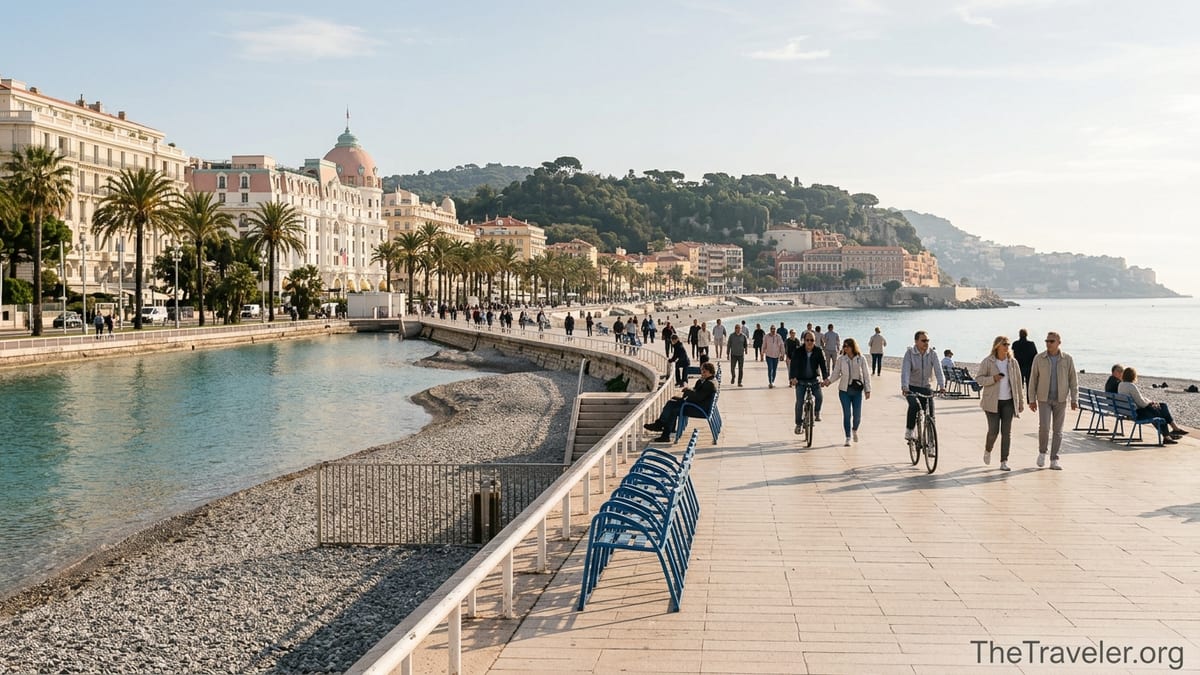
From Place Masséna I followed the flow of people down to the sea. The promenade that appears on a million postcards, the Promenade des Anglais, is a generous ribbon of pavement stretching for several kilometers along the curve of the Baie des Anges. In photos it often looks like a catwalk of white parasols and luxury hotels, and of course those are there. The domed Negresco hotel stands out in its sugary pink and white, and private beach clubs line the shore with neat rows of sun loungers charging from roughly 25 to 40 euros per day in high season for a mattress and umbrella.
But walk the Promenade instead of just posing on it, and another story emerges. At sunrise, when the Mediterranean is flat and silver, people jog past in sports club T-shirts, pushing prams or walking dogs. Retirees in windbreakers sit on the trademark blue chairs, filling thermoses with coffee poured from home. Cyclists on shared e-bikes ring bells at dreamy tourists stepping into the bike lane. The Riviera, in that early light, looks less like a luxury brochure and more like a seafront any coastal city might have, just with improbably blue water.
Continue west along the Promenade and you leave the cluster of grand hotels for residential blocks and smaller cafés set back from the beach. A takeaway espresso from a simple counter bar might cost around 1.50 to 2 euros, and you can drink it sitting on the public section of the pebble beach for free, watching planes taking off from the airport at the far end of the bay. The contrast with nearby private beach restaurants, where a glass of chilled rosé can easily cost 8 to 12 euros, is stark but instructive: Nice leaves it up to you which Riviera you want to participate in.
Walking, you also feel the weight of history here. The Promenade began in the 19th century as a path funded by British visitors, evolving into the city’s emblem and, more recently, the finishing straight of the 2024 Tour de France instead of the Champs-Élysées in Paris. Standing where cyclists once sprinted against a backdrop of palm trees, I understood that Nice is no longer a side character to the Riviera story; it has become one of its main stages.
Vieux Nice: A Working Old Town Behind the Postcards
Turn your back to the sea at the level of Cours Saleya and you slip into Vieux Nice, the old town pressed between the Promenade and the slope of Castle Hill. Seen from above it is a honeycomb of narrow streets, but at ground level it is more like entering another climate. The light softens, the air cools and the sounds change from traffic to murmur. Laundry hangs between pastel façades the color of apricots and faded terracotta. The restaurants catering to visitors share space with cobblers, key cutters and tiny grocery stores stacked with artichokes and lemons.
Cours Saleya itself is both a cliché and a revelation. In the morning, long rows of striped awnings shelter stalls piled high with seasonal produce, cut flowers and Provençal herbs. A small basket of olives from a local producer might cost 4 to 6 euros; a paper cone of socca, the chickpea pancake that is a Nice institution, about 3 to 4 euros from a counter bearing the “Cuisine Nissarde” label that identifies traditional addresses. Eating it hot with a plastic fork, leaning against a market pillar, I realized that the Riviera’s greatest luxury might be its simplest food.
Because I was walking, I also noticed the details that bus tours roll past: the bilingual street signs in French and Nissart, the local dialect; the baroque curls of church façades squeezed into tiny squares; a primary school whose playground looked directly onto a 17th-century bell tower. I wandered past a hole-in-the-wall wine bar where locals argued about football over glasses that cost about 4 euros each, then stumbled upon a contemporary art gallery hidden behind a plain wooden door. The old town is not preserved behind glass. It is lived in, layered and sometimes scruffy, with graffiti on 18th-century stone and electric scooters parked under carved lintels.
Of course there are tourist traps, particularly near the busiest lanes that serve identical laminated menus of “Niçoise specialties” at inflated prices. But walking lets you read the small signs: the black and gold “Cuisine Nissarde” plaques, the lunchtime crowds of office workers choosing one restaurant over another, the bakeries that still sell pan bagnat, the traditional tuna and vegetable sandwich, for around 6 to 8 euros. In these side streets the French Riviera stops being an idea and becomes a meal, a commute, a school run.
Climbing Castle Hill: Seeing the City as a Whole
At the eastern edge of the old town, a path leads up to the Colline du Château, or Castle Hill. You can take an elevator from near the seafront, but I opted for the staircase that curls up between stone walls and orange trees. The climb takes less than ten minutes, but each landing peels back another layer of the city. Halfway up there is a small terrace where a man sold cold drinks from a fridge plugged into an extension cable. Above that, the noise of scooters and traffic fades and is replaced by the sound of a waterfall that was engineered as part of the hill’s 19th-century landscaping.
At the top, where a military fortress once stood before it was destroyed by order of Louis XIV in the early 1700s, there is now a public park. Families picnic under pine trees, teenagers practice skateboard tricks, and visitors lean on the stone balustrade to stare at the curve of the Baie des Anges. From here you can see almost the whole route of that first long walk: the airport at one end of the bay, the symmetrical bulk of the Negresco, the white sweep of the Promenade, the terracotta roofs of Vieux Nice, and on the far side, the cranes and masts of Port Lympia.
Looking down from Castle Hill, what struck me was not the glamour but the compactness of the city. Nice is big enough to feel cosmopolitan yet small enough that you can cross much of it in under an hour on foot. From this vantage point the Riviera is not a necklace of disconnected resorts but a continuous inhabited coastline. Trains rattle in and out of the main station; local buses snake up into the hills behind town. What had felt, from the runway, like an exclusive destination started to look like a regional hub binding together the hinterland and the sea.
The park itself also hints at a different Riviera. There is a small playground, a café selling coffee for around 2.50 euros and scoops of ice cream for children, and an Orthodox cemetery where elaborate tombs tell the story of Russian visitors who came here long before the age of Instagram. This is not a curated viewpoint for tourists; it is a communal living room where you might see a grandmother knitting next to a couple in hiking gear and a group of local teenagers sharing a portable speaker.
Port Lympia and the New Riviera Energy
Descending the eastern side of Castle Hill brings you to Port Lympia, Nice’s working and leisure harbor. Compared to the mega-marinas of Antibes or Monaco, it feels almost modest at first: fishing boats and small yachts moored side by side, ferries docking for Corsica, and orange-and-cream apartment houses framing the water in a perfect horseshoe. But walk along the quays and you notice that this is one of the city’s most dynamic districts, pulsing with a new kind of Riviera energy.
The streets behind the port, particularly around Rue Bonaparte and Place du Pin, are sometimes described as a “Petit Marais,” a nod to the creative, LGBTQIA+ friendly ambiance that recalls Paris’s Marais. Independent wine bars pour natural wines by the glass for 6 to 8 euros, cafés double as design stores, and concept spaces such as Ramdam mix exhibitions, live music and a bar under one roof. On a summer evening the terraces here are full of locals rather than cruise passengers, and you are as likely to hear Niçois French and Italian as English.
At the water’s edge, traditional pointus fishing boats painted in blues and yellows bob next to sleek motor launches. The contrast encapsulates the modern Riviera: heritage and high design sharing the same slipway. A modest seafood platter on a port-side terrace can start around 25 euros, but if you wander a few blocks inland you will find pizzerias and bistros where a main course still costs between 14 and 18 euros. Walking gives you the freedom to step away from the immediate waterfront and its premium prices to explore a wider mix of options.
From the far side of the harbor, near the lighthouse, you can look back at Nice framed by water, with Castle Hill rising green above the old town and the curve of the Promenade stretching into the distance. Standing there, I realized my mental map of the French Riviera had been upside down: I had always pictured the sea as something you look out at from exclusive hotels. In Nice, many of the most memorable views are reversed. You look back from public spaces toward a city that belongs as much to its residents as to its visitors.
Everyday Riviera: Markets, Backstreets and Local Rituals
The more I walked, the more everyday rituals came into focus. On Boulevard Jean Jaurès, where the modern city meets the edge of the old town, office workers queued outside a boulangerie at 8.30 a.m. for still-warm croissants and pain au chocolat priced under 2 euros. A few streets inland, at Marché de la Libération, stalls sold ripe tomatoes and peaches by the kilo to locals pulling wheeled shopping bags, a world away from the souvenir-laden lanes near the seafront.
In residential neighborhoods north of the center, cafés set out simple metal tables on the pavement where regulars read newspapers and argue about local politics over tiny coffees. On Rue de France, one row back from the Promenade, laundromats sit beside Vietnamese canteens and small independent hotels where a double room in mid-season might be closer to 100 or 120 euros per night, a fraction of the rates at the seafront palaces. These streets are where you begin to meet the people who keep the Riviera running: cleaners heading to hotel shifts, chefs still in their whites grabbing a late drink, tram drivers swapping shifts.
Food in particular grounded my sense of place. In one weeklong stay I learned to tell the difference between a generic “Mediterranean” menu and one rooted in Nice. The latter appears in plates of pissaladière, an onion and anchovy tart sold in thin, oily slices for about 3 euros from bakery counters; barbajuans, fried pastries stuffed with chard and ricotta; or simple plat du jour lunches that might feature daube de boeuf, a slow-cooked beef stew. Many of the most characterful addresses are compact, cash-friendly spots with tightly written blackboard menus, not the glossy dining rooms I once associated with the Côte d’Azur.
Walking also revealed how the city negotiates tourism and real life. In high season, Cours Saleya’s terraces are full until late, and queues snake from gelato counters charging 3 to 4 euros a scoop. Yet two streets away, small courtyards fall silent by 10 p.m. as residents close shutters against the evening heat. A city that, from afar, seemed to exist purely for visitors turns out to protect a rhythm that belongs to itself: market mornings, beach afternoons, apéritif hour, and quiet interiors at night.
The Riviera Reframed: Nice as Gateway, Not Sideshow
By the time I had worn through one pair of sandals, my idea of the French Riviera had quietly rearranged itself. Walking showed me that Nice is not a cheaper annex to more famous neighbors like Cannes or Monaco. It is a gateway and a center in its own right. From the main train station, regional trains run along the coast to Ventimiglia in Italy, Cannes and beyond, often for under 10 euros per journey if you buy advance or off-peak tickets. But you could spend days in Nice alone and still feel you had only just started to understand the city.
The clichés of the Riviera are still here. You can, if you wish, rent a lounger on a private beach, order a 20-euro cocktail at a rooftop bar and watch luxury cars glide along the Promenade at sunset. Yet those scenes are just one layer. Underneath lies a city where people queue for the bus, complain about housing prices, shop for school supplies and meet friends for a 5-euro glass of wine. The myth of a purely gilded coastline dissolves once you wear out some shoe leather.
Nice also challenges the idea that the Mediterranean is only for summer. On a mild January afternoon I walked the seafront in a light jacket, passing swimmers who plunged into the water and then wrapped themselves in bathrobes, as if the beach were an outdoor extension of their bathroom. Cafés on Place Garibaldi were busy with people having hot chocolate and coffee rather than Aperol spritz. The Riviera, I realized, is not a season but a calendar year of shifting light and habits.
Most of all, walking made me see that what separates Nice from many resort towns is its refusal to be a stage set. It is messy in places, with construction sites, graffiti and traffic jams. Not every building is freshly painted; not every alleyway smells of lavender. But precisely in that mix of beauty and everyday grit, the French Riviera stopped feeling like a fantasy to consume and started feeling like a culture you could, briefly, join.
The Takeaway
Walking through Nice, from airport tram stop to Castle Hill viewpoints and portside bars, rewired my understanding of the French Riviera. The city revealed itself as a lived-in Mediterranean capital with a working harbor, schoolyards tucked behind baroque churches, tramlines full of commuters and markets that open long before tourists appear on the beach. The Riviera I discovered is less about exclusivity and more about coexistence: between luxury hotels and laundromats, rooftop cocktails and takeaway socca, cruise passengers and pensioners on park benches.
If your idea of the Côte d’Azur has been shaped by glossy magazine spreads, Nice is the place to challenge that image. Trade taxis for trams, seafront suites for backstreet guesthouses, and scheduled tours for a sturdy pair of shoes. Start at the airport, finish at the lighthouse beyond Port Lympia, and let the pavements in between redraw your mental map. By the time you leave, you may find, as I did, that the French Riviera has shifted from dream destination to somewhere far more interesting: a real place, with real lives unfolding in the sun.
FAQ
Q1. Is Nice walkable for first-time visitors?
Yes. The central areas of Nice, including the Promenade des Anglais, Old Town, Castle Hill and Port Lympia, are compact and easy to explore on foot, with most key sights within 20 to 30 minutes’ walk of each other.
Q2. How much should I budget per day for food in Nice?
For casual meals, allow roughly 25 to 40 euros per person per day. This covers a bakery breakfast, a simple lunch like pan bagnat or socca, and a bistro-style dinner without expensive wine.
Q3. Are the beaches in Nice free?
Most of the shoreline in Nice consists of public pebble beaches that are free to access. Private beach clubs charge for loungers and umbrellas, typically from about 25 to 40 euros per day in high season.
Q4. Do I need a car to explore Nice and the nearby Riviera towns?
No. Within Nice you can walk or use trams and buses, and regional trains connect the city with destinations like Cannes, Antibes and Menton, making car-free travel straightforward for most visitors.
Q5. When is the best time of year to walk around Nice?
Spring and autumn are ideal, with mild temperatures and fewer crowds. Early mornings and late afternoons in summer are pleasant for walking, but midday heat can be intense on exposed streets.
Q6. Is Castle Hill (Colline du Château) suitable for all fitness levels?
The hill involves stairs and slopes, but there is also a free elevator from near the seafront. Most visitors with average fitness can reach the viewpoints at a comfortable pace, taking breaks as needed.
Q7. Where can I find authentic Niçoise food in Nice?
Look for places bearing the “Cuisine Nissarde” label and focus on traditional dishes such as socca, pissaladière, pan bagnat and daube. Many are in and around Old Town and local markets.
Q8. Is Nice safe to walk at night?
Central areas like the Promenade des Anglais, Old Town and Port Lympia are generally busy and feel safe, though normal city precautions apply. Stick to well-lit streets and avoid poorly lit back alleys late at night.
Q9. How expensive is public transport compared to taxis in Nice?
Public transport tickets cost only a few euros per ride, while taxi fares from the airport to the center typically run to several tens of euros. Using trams and buses can significantly reduce overall costs.
Q10. Can I use Nice as a base to explore the rest of the French Riviera?
Yes. Nice is an excellent base, with frequent trains and buses to nearby coastal towns and hill villages. Many travelers spend several nights in Nice and do day trips to see more of the Riviera.