


You do not casually meet Michelangelo’s David. You queue for it, you plan around it, and in high season you may find yourself shoulder to shoulder with hundreds of people all craning for the same marble profile. For many visitors to Florence, the statue is a non‑negotiable bucket‑list item. Others leave wondering if the crush of bodies was worth twenty minutes in front of a single work of art. So is David still worth visiting, given how busy Florence has become, or is it time to skip it in favor of quieter corners of Tuscany?
Get the latest updates straight to your inbox!
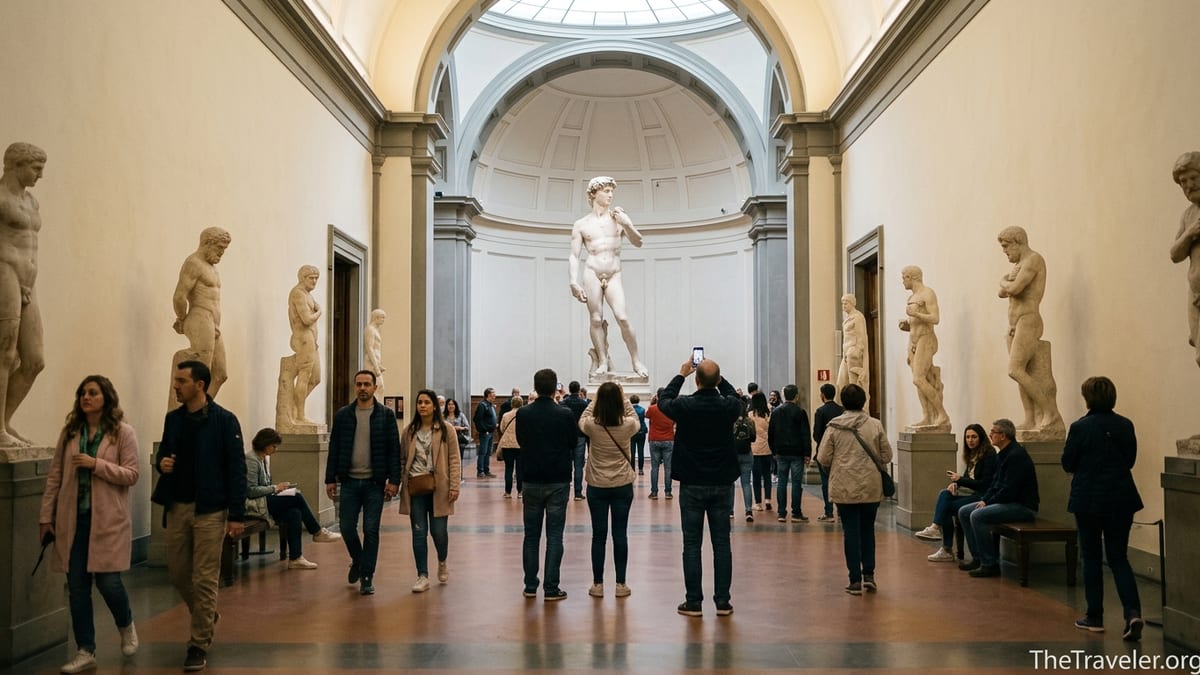
Why David Still Matters in an Age of Overtourism
Michelangelo carved David between 1501 and 1504 from a single block of Carrara marble that had been abandoned as unusable by other sculptors. Today the 5.17‑meter statue stands in the Galleria dell’Accademia in Florence, where it has been housed since the late nineteenth century. For many travelers this is not just another museum piece but a physical encounter with one of the most famous objects of the Renaissance, the kind of work that appears in school textbooks and documentaries long before anyone sets foot in Italy.
That star power explains a lot of the crowding. Florence has seen record tourism in recent years, and cultural icons like the Uffizi and the Accademia are on almost every first‑time itinerary. On a typical July day the narrow Via Ricasoli outside the museum can feel like a small airport terminal: tour groups assembling beneath folded umbrellas, ticket touts advertising “skip the line” passes, and independent travelers peering anxiously at their time slots. Inside, the Gallery of the Prisoners, which leads to David, often fills with a slow‑moving wave of visitors all gravitating toward the same sculpture at the end of the hall.
Yet many travelers who brace for the worst still come out moved. It is common to hear people say they were surprised by the statue’s scale, the tension in David’s body, or the way the chisel marks remain visible on the marble surface. In a world of digital replicas and Instagram images, the original can still land like a shock. That gap between expectation and experience is the main argument in favor of going: despite the crowds, the work itself has not diminished.
The question is not whether David is extraordinary. It is whether the trade‑offs involved in seeing it make sense for you, given your interests, budget, and tolerance for busy spaces. Framing the decision that way is more useful than assuming it is automatically essential or dismissing it as an overrated selfie backdrop.
Understanding the Crowds: What Visiting Really Feels Like
To decide if David is worth it, it helps to picture the visit as it actually unfolds. The Galleria dell’Accademia is a relatively small museum compared with the Uffizi. Most people come primarily to see David, then spend a shorter amount of time with the rest of the collection. In high season, this concentrates a lot of movement into a modest footprint. Expect a security check at the entrance, then a brief internal queue before you enter the main galleries.
In the long gallery that houses David, the densest cluster typically forms directly in front of the statue and at the base of the pedestal, where people queue informally for their “solo” photo. The edges of the space, and the benches along the sides, tend to be calmer. If you are sensitive to crowds, you can often carve out a more comfortable experience by stepping back toward the entrance of the hall or sitting on a side bench to observe the statue from a distance before edging closer for a final look.
The emotional atmosphere can vary dramatically by time of day. Mid‑morning and mid‑afternoon, especially on weekends and during summer or Easter holidays, the room can feel noisy and rushed: tour guides raising their voices over each other, phones held aloft, children weaving through the throng. In contrast, during the last hour of opening, the volume drops noticeably. On some evenings in the shoulder seasons, visitors report being able to stand near the back of the hall and contemplate David with only a handful of others nearby, the marble glowing softly under the dome’s diffuse light.
Crucially, the visit is usually short. Many independent travelers estimate spending 60 to 90 minutes in total inside the Accademia, with the bulk of that time around David and the adjacent galleries of Michelangelo’s unfinished “Prisoners” and the plaster casts. That brevity can be an advantage if you are scheduling tightly, but it can also make the line outside feel disproportionate if you arrive without a reservation and are facing a wait of an hour or more.
Tickets, Time Slots, and the Real Cost of Seeing David
Seeing David is not just a question of patience; it is also a financial decision. As of 2025, standard tickets for the Galleria dell’Accademia bought through the official channels typically fall in the low to mid‑teens in euros for adults, with modest seasonal variations and booking fees. Third‑party resellers offering “skip the line” or guided tours commonly charge a significant markup, sometimes bringing the total closer to the price of a good dinner in a mid‑range Florentine trattoria.
The more important “cost,” however, may be your time. In peak months like June, July, and early September, the official timed‑entry slots often sell out days in advance. Travelers who check the website a day or two before visiting frequently find their preferred times unavailable and turn instead to tour operators or ticket agencies, which may still have group allocations. That can mean higher prices in exchange for guaranteed access and a fixed schedule that might not align with your preferred rhythm of sightseeing.
Consider a real‑world scenario. A couple planning a three‑day stay in Florence in mid‑July finds that morning slots for the Accademia are sold out for their dates. Their options: pay more for a late‑afternoon guided tour that includes tickets, rearrange their day to accept an evening visit, or show up without reservations and hope that the walk‑up line moves quickly enough. The walk‑up approach may work in shoulder season, but in high summer it can turn into a multi‑hour wait outside on a hot street, which some travelers later describe as the least pleasant part of their trip.
When you evaluate whether David is “worth it,” weigh that combination of ticket price, potential markups, and opportunity cost. Time spent queuing in Via Ricasoli is time not spent lingering over a coffee on Piazza Santo Spirito, crossing the Arno to explore artisan workshops in the Oltrarno, or taking a late‑afternoon bus up to Fiesole for sunset views over the city. If your schedule in Florence is short, those trade‑offs become sharper.
Who Should Make David a Priority, and Who Might Skip It
Some travelers are almost guaranteed to find value in a visit to David, crowds or not. If you are deeply interested in Renaissance art, sculpture, or Michelangelo specifically, the Accademia is a cornerstone experience. Standing before the original reveals subtleties that no replica captures, from the slight asymmetry in David’s features to the delicate transitions of light across the marble surface. Art students, history buffs, and anyone who has studied the statue in school often describe the encounter as a highlight of their time in Italy.
Families with older children or teenagers can also find David compelling. The story behind the statue, rooted in the biblical David and Goliath but reimagined as a symbol of Florentine civic pride, is accessible and dramatic. A guided tour that lasts about ninety minutes and focuses on storytelling rather than theory can keep everyone engaged long enough to make the crowds feel secondary. Many operators in Florence now design small‑group visits with headsets, which allow guides to speak at a normal volume even in a busy hall.
On the other hand, some travelers are likely to come away underwhelmed. If museums are not normally part of your travel life and you mainly enjoy cities for food, nightlife, and relaxed wandering, a tightly scheduled indoor visit in a congested space may feel obligatory rather than exciting. Visitors with strong crowd anxiety, mobility issues, or sensitivity to noise sometimes find the main David hall especially challenging at peak times, even if they have timed tickets. In those cases, the existence of high‑quality outdoor replicas, including the full‑scale statue in Piazza della Signoria outside Palazzo Vecchio and another at Piazzale Michelangelo, becomes more relevant.
Florence also rewards depth over volume. Travelers on second or third visits sometimes choose to skip the Accademia entirely to spend more time in less publicized spaces: wandering the cloisters of Santa Croce, taking in the frescoes at Santa Maria Novella, or exploring the quieter Bardini Gardens above the Arno. If you have already seen David on a previous trip, it may be more enriching to pursue those alternatives rather than repeating the experience just because it feels obligatory.
Strategies to See David Without Losing Your Patience
If you decide the statue belongs on your Florence itinerary, a few practical steps can greatly improve the experience. First is timing. Early morning entry on weekdays, especially outside of major holidays, remains one of the best ways to reduce the worst crowding. Arriving at the museum twenty to thirty minutes before your timed slot gives you some buffer for security and check‑in, and being among the first in your wave of visitors allows you to get a relatively unobstructed view of David before the hall fills.
Late‑day slots can also be surprisingly calm. Travelers who have entered in the last hour before closing often find that the initial surge has passed and that groups are already thinning out. This can be particularly pleasant in the cooler months, when the early sunset and indoor lighting combine to create a softer, more introspective atmosphere in the gallery. The trade‑off is that you have less time overall inside the museum, so this strategy works best if your main goal is David and a quick circuit through the surrounding rooms.
Booking strategy matters too. Whenever possible, use the official booking channels rather than jumping to third‑party vendors at the first sign of scarcity. Tickets for mid‑week dates outside of July and August often remain available closer to the day than peak‑season weekends do, and last‑minute cancellations occasionally free up slots even in busy months. Checking the site repeatedly in the week before your visit can sometimes pay off with a reasonably priced official time slot that lets you avoid inflated reseller fees.
Inside the museum, adjust your expectations about how you will navigate the space. Instead of pushing immediately to the front for a close‑up photo, consider starting at the perimeter of the hall, circling slowly to take in different angles, and only then approaching the base for a final look. If a tour group clusters in one corner, step back and focus instead on the “Prisoners,” the unfinished figures that line the approach to David. These twisted, half‑emerged bodies offer powerful insight into Michelangelo’s working process and are often less crowded, allowing moments of quiet engagement even when the central statue is surrounded.
Alternatives and Complements: Experiencing David Beyond the Accademia
One of the strongest arguments in favor of skipping the Accademia, at least for some travelers, is the presence of high‑quality replicas of David in the open air. In Piazza della Signoria, a full‑scale copy stands in front of Palazzo Vecchio, roughly where the original once stood. While it lacks the subtle surface details of the marble masterwork inside the museum, it still conveys much of the statue’s scale and pose. Visitors who pause here early in the morning, before the day‑tripper crowds arrive, can study the figure against the stone backdrop of the medieval square with plenty of space to move around.
Another popular vantage point is Piazzale Michelangelo, the panoramic terrace on the south bank of the Arno. Here, a bronze David dominates the central platform, surrounded by views over the Duomo, Palazzo Vecchio, and the dense roofscape of Florence. Many travelers ride up by bus in the late afternoon, wander among the souvenir stalls, then watch the sunset with gelato in hand as musicians perform. The statue itself is less finely detailed than the original, but the combination of art, cityscape, and open sky creates a very different, more expansive experience.
For those who want depth rather than substitution, pairing the Accademia with other Michelangelo sites in Florence can create a coherent theme for a day. The Medici Chapels in the Basilica of San Lorenzo house his powerful tomb sculptures of the Medici dukes, while the Biblioteca Medicea Laurenziana incorporates his architectural designs. Visiting these spaces in the same trip as David offers a broader sense of his range and lets you distribute your “crowd energy” over multiple venues instead of concentrating all your expectations on a single crowded hall.
Ultimately, these alternatives do not replace the original, but they do broaden the spectrum of experiences available. If you decide that the cost of seeing David in person is simply too high for your circumstances, you can still connect with the statue’s image and context across the city in ways that feel less pressured and more aligned with your travel style.
The Takeaway
So is Michelangelo’s David worth visiting despite the crowds? For many travelers, the answer is still yes, provided you go in with open eyes and a realistic plan. The statue remains one of the most powerful encounters with Renaissance art anywhere in Europe, and for visitors who care deeply about sculpture, history, or the story of Florence itself, standing in that gallery can justify the logistics needed to get there.
At the same time, Florence is no longer a place where you can casually drop into the Accademia on a whim during peak season and expect a tranquil experience. Record visitor numbers have turned David into a test case for modern mass tourism, where limited space meets global demand. Ignoring that reality is a recipe for frustration. Acknowledging it, and shaping your itinerary accordingly, gives you a better chance of emerging from the museum feeling inspired rather than exhausted.
If your time in Florence is brief, your budget tight, or your patience for dense crowds low, it is entirely reasonable to prioritize other experiences. The city offers enough art, architecture, and street life to fill days without ever setting foot on Via Ricasoli. Seeing David is not a moral obligation; it is one of many possible ways to connect with Florence’s past and present.
In the end, the decision comes down to alignment between your expectations and the on‑the‑ground reality. If you choose to go, plan ahead, choose your time thoughtfully, and give yourself permission to step back from the center of the crowd and simply look. If you decide to skip it, enjoy the freedom that choice gives you to wander a little further and sink a little deeper into the city beyond its most famous marble icon.
FAQ
Q1. Do I really need to book tickets in advance to see Michelangelo’s David?
Yes, for most of the year you should plan to reserve timed‑entry tickets in advance. Same‑day tickets are sometimes available in the quieter winter months or on less busy weekdays, but in spring, summer, and early autumn many travelers report that popular morning and mid‑afternoon slots sell out days ahead. Booking early through official channels or reputable agencies reduces the risk of long walk‑up lines or missing out altogether.
Q2. How long should I plan to spend inside the Galleria dell’Accademia?
Most independent visitors spend about 60 to 90 minutes inside the museum. That typically includes time to walk through the introductory galleries, study Michelangelo’s unfinished “Prisoners,” sit or stand for an extended look at David from different angles, and then browse the plaster cast collection and paintings. If you join a guided tour, expect around 75 to 120 minutes depending on the pace and how many sections of the museum are covered.
Q3. What is the best time of day to avoid the biggest crowds at David?
Early morning and the last hour before closing are usually the least crowded times. First‑entry slots on weekdays tend to be calmer than mid‑morning, when tour groups arrive in force. Late‑day visits can also be pleasantly quiet as buses depart and day‑trippers head back to other cities. Weekends, public holidays, and peak summer dates are consistently busier, so choosing a shoulder‑season weekday and an early or late slot offers the best balance.
Q4. Is it worth paying extra for a “skip the line” or guided tour ticket?
It depends on your budget and appetite for logistics. A skip‑the‑line or guided ticket often costs significantly more than the standard admission bought directly, but it can save time and reduce stress, especially if standard time slots are sold out. Travelers who value context and storytelling often feel that a small‑group tour adds meaning to what they are seeing, turning a short museum stop into a deeper experience. If you are comfortable navigating on your own and can book standard timed tickets in advance, you may decide the extras are not necessary.
Q5. Will I still appreciate David if I have already seen the outdoor replicas in Florence?
Most travelers who visit both say yes. The outdoor replicas in Piazza della Signoria and at Piazzale Michelangelo give a strong sense of the statue’s scale and pose, but they lack the fine detail and subtle surface quality of Michelangelo’s original. Inside the Accademia, you can see the careful carving of muscles, veins, and expression up close, and the controlled lighting under the dome emphasizes the contrasts of light and shadow. If you have limited time or dislike crowds, the replicas are a good alternative, but the museum visit offers a more nuanced experience.
Q6. Is the Accademia manageable for travelers who dislike very crowded spaces?
It can be, with careful planning, but it depends on your personal comfort level. Choosing a less popular time slot, avoiding major holidays, and aiming for early morning or late afternoon all help. Inside, you can step back toward the entrance of the David hall or sit along the walls where the density is lower, then approach the statue briefly when there is a gap. That said, if you have severe crowd anxiety or sensory sensitivities, even these strategies might not be enough during peak periods, and you may find the outdoor replicas a more relaxed option.
Q7. Are children likely to enjoy a visit to see Michelangelo’s David?
Many older children and teenagers respond well to David, especially if the story behind the statue is explained in an engaging way. The idea of a young hero facing a giant, and the drama captured in David’s poised stance, can be compelling. Short, focused visits work best: plan no more than 60 to 75 minutes inside, consider a guide or audio guide that uses clear, accessible language, and be prepared with a plan for a snack or gelato stop afterwards. Very young children may lose interest quickly, so adjust expectations accordingly.
Q8. What should I wear and bring when visiting the Accademia?
Dress comfortably with respect for an indoor cultural site. There is no strict dress code like in some churches, but lightweight layers, comfortable walking shoes, and a small day bag are practical. In summer, a refillable water bottle is useful for the wait outside but may need to be emptied or put through security. Large backpacks, tripods, and bulky items are usually discouraged or subject to checks, so pack light. Photography is typically allowed without flash, but always follow current signage and staff guidance.
Q9. How does seeing David compare with visiting larger museums like the Uffizi?
The experiences are quite different. The Accademia is compact, and most people visit primarily for David and a handful of other highlights, making it a shorter, more focused stop. The Uffizi, in contrast, is a sprawling gallery filled with Renaissance masterworks by Botticelli, Leonardo, Raphael, and others, where a visit can easily last three to four hours. If you have limited museum stamina, you might pair David at the Accademia with a lighter afternoon, while dedicating a full morning or more to the Uffizi on a separate day.
Q10. If I decide to skip David, what are good alternative art experiences in Florence?
If you skip David, you can still immerse yourself in Florence’s art and history. Consider spending more time at the Uffizi, exploring the frescoes and cloisters of Santa Maria Novella or Santa Croce, or visiting the Medici Chapels in San Lorenzo to see other powerful Michelangelo sculptures. Crossing the Arno to the Oltrarno district opens up quieter churches, artisan workshops, and gardens like Bardini, where you can enjoy views over the city. These experiences offer a rich sense of Florence’s character without the concentrated crowds of the Accademia.