


I thought I knew medieval Tuscany before I set foot in Pisa. I pictured walled hill towns, stone towers over Siena, and vineyards rolling away toward a hazy horizon. Walking across the green lawn of Piazza dei Miracoli, with the white marble of the cathedral, baptistery, Leaning Tower and cemetery rising around me, I realized how incomplete that picture had been. Here, in a single walled square at the edge of the old city, Tuscany suddenly turned maritime, scientific and boldly outward-looking.
Get the latest updates straight to your inbox!
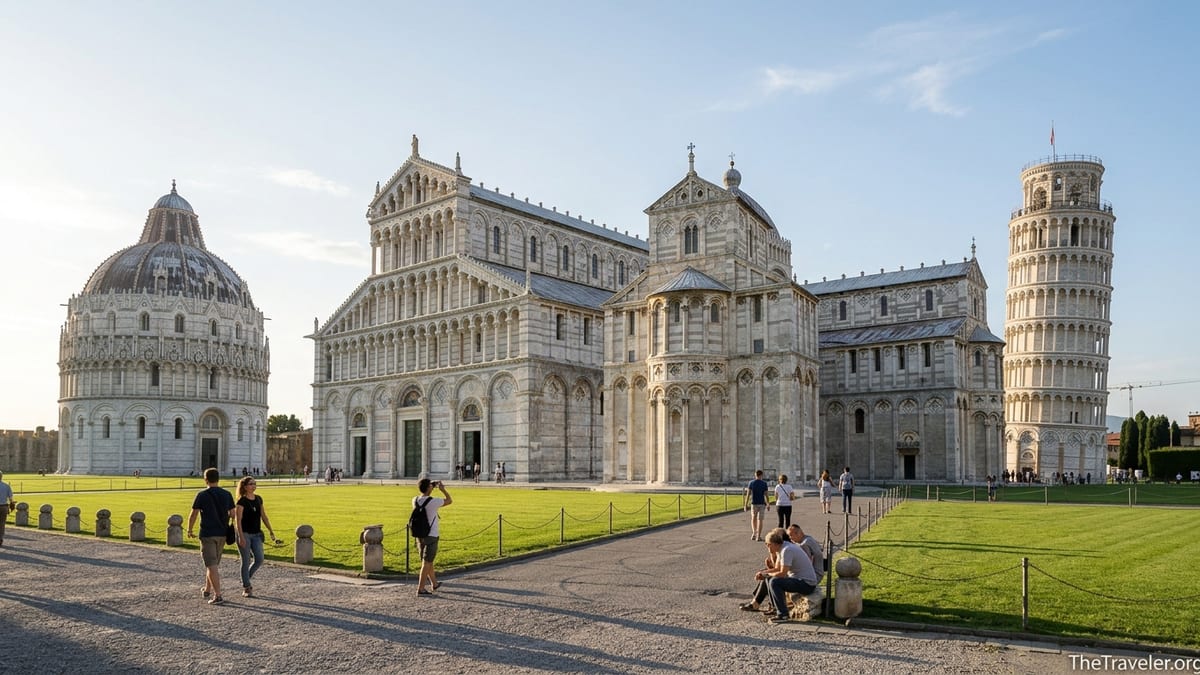
First Steps onto the “Meadow of Miracles”
The first surprise when you enter Piazza dei Miracoli is not the Leaning Tower. It is the grass. Instead of a paved urban piazza, you step into a bright green lawn ringed by glinting white marble. On a summer morning, when ticket booths open around 9 am, the marble of the Duomo and tower catches the low sun, while early visitors move quietly along the gravel paths. The scene feels more like a cloistered garden than a busy tourist site, despite the tour groups forming near the gates.
Most travelers reach the square by walking 15 to 20 minutes from Pisa Centrale station, passing student bars and small groceries where a cappuccino and pastry might cost about 3 to 4 euros. Turning a final corner on Via Santa Maria, the view suddenly opens and the tower appears behind the cathedral like a tilted exclamation point. This shift from ordinary streets to monumental space is jarring, in the best way. It immediately suggests that the medieval city that created this place was thinking on a scale that went far beyond local parish churches.
As you join the flow through the ticketed entrances, you quickly discover that the Leaning Tower is only one piece of a tightly choreographed ensemble. The Duomo stretches on a long east–west axis, the circular baptistery stands like a stone echo at its western end, and the Camposanto cemetery forms a solemn cloister along the northern edge. It is an arrangement that feels ceremonial and deliberate, and it becomes a key to rethinking what medieval Tuscany valued.
Meeting a Maritime, Not Just Rural, Tuscany
Most visitors arrive in Pisa straight from Florence, Siena or Lucca and carry that visual language in their heads: brick campaniles, crowded civic squares, and streets that spiral up hills. Pisa’s Piazza dei Miracoli tells a different story. The city’s wealth between the 11th and 13th centuries came from the sea. It was one of the Italian maritime republics, trading across the Mediterranean and clashing with Genoa and other rivals over shipping routes. Marble for the cathedral and tower arrived by boat up the Arno River from quarries near Carrara, a reminder that this inland meadow was connected to distant coasts and islands.
Standing near the baptistery, you can see this maritime identity carved into the stone itself. The Duomo’s façade mixes classical columns with Islamic-style arches and inlaid green and grey stone, echoing motifs found from North Africa to the eastern Mediterranean. Guides leading small groups for about 25 to 35 euros per person often point out these details, explaining how Pisan ships carried not only spices and textiles but also ideas. The result is a Tuscan Romanesque style that feels wider and more cosmopolitan than the brick Gothic of inland cities.
That realization shifts how you read Tuscany more broadly. A day in San Gimignano or Montepulciano shows you a countryside of wine estates and farmsteads; a morning in Pisa shows you shipyards, arsenals and counting houses superimposed over the modern city. When you look up at the Leaning Tower as a freestanding campanile, you begin to see it less as a photographic stunt and more as a bell that once regulated a port’s life of tides, labor shifts and religious rituals tied to seafaring.
Inside the Cathedral: A Different Kind of Medieval Splendor
Many travelers never make it inside the Duomo, assuming that the free cathedral entry included with most tower or monument tickets is optional. Stepping through the bronze doors, however, does more than add another church to your list. It fundamentally changes how you imagine medieval Tuscan religion and art. The interior is dark at first, with black-and-white striped columns marching down a long nave, and then gold catches your eye: a richly coffered ceiling, star-like and reflective, that feels more North African or Byzantine than typically Florentine.
If you have purchased a combined ticket that includes the cathedral, you can time your visit to avoid the crowds that form between late morning and mid-afternoon. On a recent spring weekday, the staff were letting people filter in after showing a 7 to 10 euro monument ticket at the entrance desk, while separate lines formed outside for those queuing only for the free access. Inside, you see the mosaic of Christ in Majesty in the apse, completed in the 14th century, and understand how long this square remained a living building site that spanned generations.
The pulpit, a richly carved cascade of stone supported by columns, invites you closer. Travelers who have seen Nicola Pisano’s work elsewhere in Tuscany recognize his influence here in the way classical drapery and crowded biblical scenes coexist. You begin to realize that medieval Pisa was not stylistically “behind” later Renaissance Florence; it was already experimenting with sculptural realism while remaining rooted in its Romanesque language. For many visitors, that alone reframes the timeline of Tuscan art they carry from guidebooks and museum visits.
The Baptistery and the Power of Sound
Walk out of the cathedral and around to the baptistery, and the mood changes again. From the outside, its double shell of white marble and darker stone bands looks almost like an armored drum. Construction began in the mid-12th century, and later Gothic additions ring the upper levels. Visiting the interior usually requires a separate monument ticket. As of 2026, several vendors offer combined packages where adding the baptistery and Camposanto to a cathedral visit brings the total to roughly 10 to 15 euros, depending on the operator and season.
Inside, the baptistery is spacious and surprisingly bare. The stone floor slopes gently, the central font sits like a geometric pool, and tiers of seats ring the circular walls. At designated times, often once an hour during busier months, a staff member demonstrates the famous acoustics. They sing a few pure tones that hang in the air and then fold over one another, producing chords that seem to come from the walls instead of the performer. Hearing those notes float under the domed roof feels less like a curiosity and more like a reminder that medieval builders understood sound and space in practical ways.
That five-minute acoustic demonstration can change how you imagine religious life here. Baptism in this echoing chamber, lit by living flame and filtered daylight, would have been a sensory event as much as a theological one. Travelers who usually glance quickly at fonts and move on often linger after the demonstration, looking up at the ribs of the dome and down at the worn steps. In that pause, the baptistery becomes a lens onto medieval Tuscan spirituality that goes beyond fresco cycles and marble altarpieces.
Climbing the Leaning Tower: Physics under Your Feet
Of course, most people still come to Pisa to climb the Leaning Tower. Reservations are strongly recommended, especially between April and October, since daily visitor numbers are capped. Timed tickets for the tower itself typically run around 20 euros for adults, while combined tickets that bundle the tower with the baptistery, Camposanto and cathedral can reach the high 20s. Tour operators sometimes add small surcharges, so booking directly with official or well-reviewed vendors is advisable if you are watching your budget.
The climb begins in a narrow stone stairwell that wraps around the hollow core. What changes your idea of medieval Tuscany here is not simply the tilt, though you feel it as soon as you step inside. On the leaning side, the marble treads are noticeably more worn, polished by centuries of feet unconsciously choosing the lower, easier path. As you rise, landings open small windows framing different angles of the cathedral roof and baptistery dome. This close relationship between structures reminds you that the tower was never meant to stand alone as a spectacle; it was a working bell tower integrated into a larger sacred complex.
At the top, you walk along the bell chamber and look down at the Piazza dei Miracoli from above. The geometry becomes clear: the cathedral’s long rectangle, the baptistery’s circle, the Camposanto’s cloister, and the tower itself tilted gently away from the cathedral. Guides often mention the late 20th-century stabilization project, when engineers removed soil and added counterweights to halt the tilt. Gazing at the horizon, you see the faint line of the Pisan hills and, on clear days, sense where the coast lies beyond them. The idea that a medieval Tuscan city was at once deeply religious, scientifically experimental and technically ambitious becomes hard to ignore.
Camposanto: Where Medieval Time Feels Tangible
If climbing the tower is about motion and sensation, visiting the Camposanto is about stillness and time. From the outside, this monumental cemetery looks like a long, plain wall. Step through its doors using the same combined monument ticket, and you enter a rectangular cloistered courtyard lined by Gothic arcades. Tall cypress trees rise from the central lawn, and light spills in sideways, creating alternating bands of brightness and shadow along the inner walkways.
For many travelers, this is the quietest part of the entire Piazza dei Miracoli. Tour buses rarely allocate enough time for a thorough visit, so you are likely to share the space with a handful of independent visitors and a few art students sketching battered tomb sculptures. Sections of the walls still preserve fragments of medieval fresco cycles, damaged by a bomb in the Second World War and by fire that followed. Conservation panels explain how some frescoes were detached and restored in nearby museums, while others remain where they are, delicate and dimly visible.
Here the idea of medieval Tuscany as a living, evolving culture rather than a frozen postcard really takes hold. The Camposanto contains Roman sarcophagi repurposed in the Middle Ages, elaborate family tombs from later centuries and anonymous burials. City elites, bishops and scholars share the same earth. Walking the cloister, you start to think of Tuscan history not as separate episodes labeled “Roman,” “medieval,” “Renaissance” and “modern,” but as layers compacted into a single site that keeps being reinterpreted.
Evenings, Practicalities and Seeing Beyond the Selfie
Recent seasons have seen extended evening openings in high summer, with the monuments staying open into the later evening hours from mid-June through August. On nights when the square is illuminated, the white marble glows softly while the lawns fall into shadow, and the atmosphere shifts from crowded attraction to contemplative space. Travelers who have already done their daytime visits often return after dinner, sometimes with a gelato from a nearby bar, to sit on a low wall and watch the tower recede into the dark blue sky.
Visiting at different times of day also changes how you navigate the practicalities. Morning slots before 10 am and late evening hours usually offer slightly shorter security lines and a quieter climb up the tower. Midday in July or August can be intensely hot on the exposed lawn, with temperatures easily into the high 80s Fahrenheit, so many travelers combine an early visit with a shaded lunch on a side street and then continue by regional train to Lucca or the Tuscan coast.
The more time you spend in the Piazza dei Miracoli, the more you notice visitors who only stay long enough to take the classic “holding up the tower” photo and then move on. There is nothing wrong with a playful shot, but when you have listened to a sung note reverberate in the baptistery, traced sculpted drapery in the cathedral or read the dates on weathered tombs in the Camposanto, the square’s meaning deepens. Medieval Tuscany stops being a distant abstraction and starts to feel like a set of human choices about art, science, belief and urban space, all negotiated in this one meadow.
The Takeaway
Walking through Pisa’s Piazza dei Miracoli changed how I saw medieval Tuscany because it compressed an entire worldview into a walkable rectangle. Instead of isolated monuments, you encounter a system: a cathedral aligned toward the east, a baptistery tuned to amplify the human voice, a bell tower that became an accidental experiment in soil mechanics, and a cemetery that gathers centuries into one cloister. Each piece speaks to a maritime republic that looked toward the sea while shaping a distinct religious and artistic identity on land.
For travelers, the square offers more than a checklist of sights. It is an invitation to reimagine Tuscany not solely as vineyards and hill towns, but as a region whose medieval heart once beat to the rhythm of waves, bells and liturgy. Allowing a full morning or even a day in Pisa, budgeting for combined tickets, and stepping beyond the lawn into each monument can turn what many treat as a quick photo stop into a profound encounter with a different side of the Middle Ages. When you leave, walking back down Via Santa Maria toward the station, the memory that lingers is not just of a leaning tower, but of an entire city that dared to build miracles in marble.
FAQ
Q1. How much time should I plan for Piazza dei Miracoli?
Most travelers should allow at least half a day, roughly four to five hours, to visit the cathedral, baptistery, Camposanto and climb the Leaning Tower without rushing.
Q2. Do I need to book tickets for the Leaning Tower of Pisa in advance?
Advance booking is highly recommended, especially from spring through early autumn, because tower entries are timed, numbers are limited and same-day slots often sell out.
Q3. Are there combined tickets for the monuments in Piazza dei Miracoli?
Yes, various combined tickets bundle the Leaning Tower, cathedral, baptistery, Camposanto and sometimes the site’s museums, typically at a lower total cost than separate purchases.
Q4. Is the cathedral really free to enter?
The cathedral itself usually offers free entry, but during busier times a free ticket is required, and most visitors access it using a paid monument or tower ticket that includes entry.
Q5. What is the best time of day to visit to avoid crowds and heat?
Early morning before 10 am and later evening openings in summer tend to be quieter and cooler than midday, when the lawn and marble surfaces can become very hot and crowded.
Q6. Can children climb the Leaning Tower of Pisa?
Children are allowed only above a certain age, usually around 8 years old, and must be accompanied by an adult; exact age and height rules are posted when you buy tickets.
Q7. Is Piazza dei Miracoli accessible for travelers with limited mobility?
The lawn, perimeter paths, cathedral and Camposanto have step-free areas or ramps, but the Leaning Tower involves a long, narrow stairway with no elevator and is not wheelchair accessible.
Q8. Are there evening visits or night lighting in the square?
In high season, the monuments often stay open into the evening on selected dates, and the square is illuminated, creating a calmer atmosphere than during peak daytime hours.
Q9. Can I sit or picnic on the grass inside Piazza dei Miracoli?
Rules about the lawn are enforced; authorities typically discourage picnicking and ask visitors not to step onto the grass except in designated areas, to protect the site.
Q10. Is Pisa worth more than a quick stop just to see the Leaning Tower?
Yes, spending several hours in the Piazza dei Miracoli and exploring nearby streets reveals a rich maritime and artistic heritage that many travelers miss on a brief photo stop.