


Piazza dei Miracoli in Pisa is one of those places that looks almost unreal when you first step onto the lawn. The Leaning Tower tilts dramatically, the white marble of the cathedral and baptistery glows in the sun, and visitors from all over the world are scattered across the grass lining up the classic “holding up the tower” photo. For a first time visitor it is thrilling, but also surprisingly confusing: which ticket should you buy, how early should you book, and what is actually worth going inside? This guide walks you through the square step by step with up to date, on the ground advice for visiting in 2026.
Get the latest updates straight to your inbox!
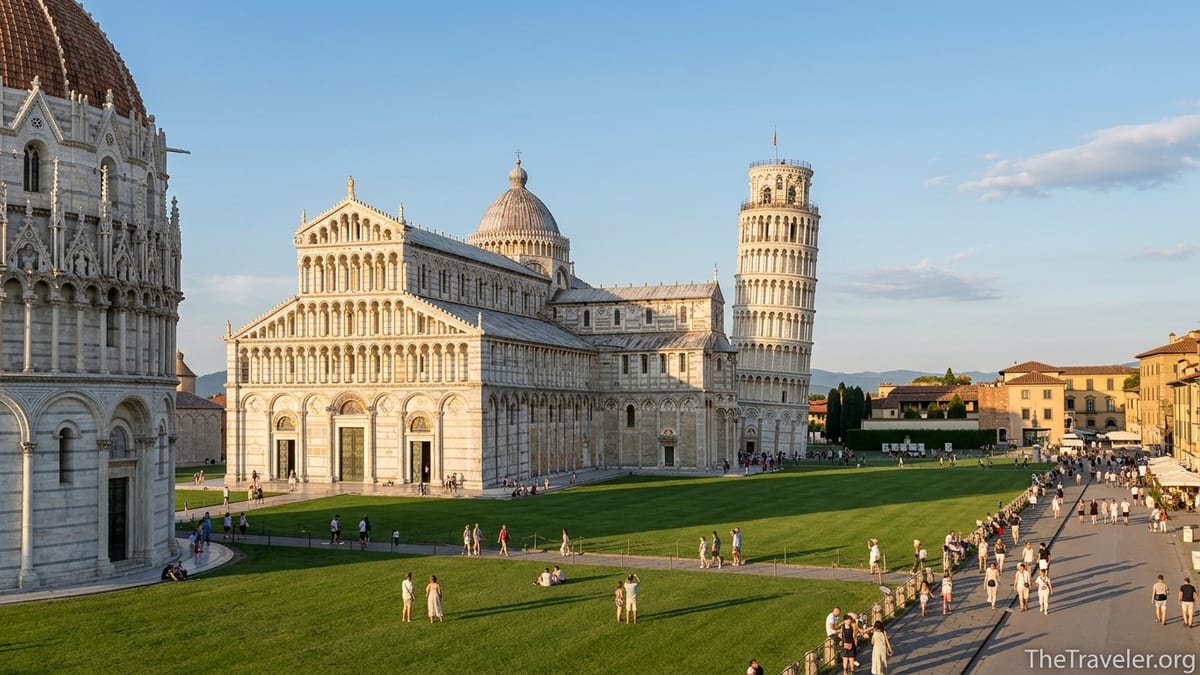
Understanding Piazza dei Miracoli
Piazza dei Miracoli, also known as Piazza del Duomo, is a walled complex on the northern edge of Pisa’s historic center. Inside the grassed square you will find four main monuments built between the 11th and 14th centuries: the Cathedral of Santa Maria Assunta, the famous Leaning Tower (the cathedral’s freestanding bell tower), the circular Baptistery of San Giovanni, and the cloistered cemetery called Camposanto Monumentale. Two museums complete the ensemble, the Museo dell’Opera del Duomo and the Museo delle Sinopie, which display original sculptures, artworks, and fresco drawings removed from the site.
The entire square is a UNESCO World Heritage Site and is often described as one of the finest groups of Romanesque and Gothic buildings in Europe. The tower gets most of the attention, but the cathedral interior, the baptistery acoustics, and the frescoes in the Camposanto are what often stick with visitors after the obligatory tower photo. A first time visit is most rewarding if you treat Piazza dei Miracoli as a small, walkable museum complex rather than just a quick stop for a selfie.
Access to the grassed piazza itself is free and open long hours, including into the evening when the monuments are beautifully illuminated. The paid monuments each have their own opening times and ticket rules, and in busy months such as June, July, and August the Tower operates on tightly controlled timed entry. This is why some basic planning before you arrive can save you both time and frustration once you are at the gates.
Tickets, Prices and What They Really Include
The ticket system in Piazza dei Miracoli is simpler than it first appears if you remember there are two layers. The first layer is the Leaning Tower ticket. As of mid 2026 an adult ticket to climb the Leaning Tower costs about 20 euros and gives you a 30 minute timed slot to climb the 294 spiral steps to the top. Everyone pays roughly the same standard price apart from young children, and tickets are strictly non refundable and non changeable if you buy the basic option. You must show an ID that matches the name on the ticket to enter, so do not buy a tower ticket for someone who might not come.
The second layer is the “Complete Visit” style ticket for the rest of the square. Current combined passes sold through official and authorized channels cluster the Cathedral, Baptistery, Camposanto, and the two museums. A typical complete pass without the Tower runs in the region of 15 to 20 euros per adult, while a combined Tower plus monuments pass sits around 27 euros, depending on the exact bundle and season. In practice, if you know you want to climb the Tower and also go inside at least two of the other monuments, the complete pass with Tower is usually the best value.
One detail that confuses many first timers is that entry to the Cathedral is free, but only if you pick up a timed free ticket from the ticket office and only on days when it is not already full with paid combination tickets. In high season the easiest way to guarantee Cathedral entry at a convenient time is indirectly, by buying any paid monument ticket which automatically grants access. If you simply walk up in the afternoon on a busy July day without any ticket, you may find that all the free Cathedral slots have already been allocated.
If you like flexibility, look carefully at cancellation rules. The official 20 euro Tower ticket is cheap but locked to a specific time. By contrast, many third party tickets cost a bit more, often 35 to 45 euros for a Tower plus guided visit, but come with free cancellation up to 24 hours before and instant delivery to your phone. For travelers coming from Florence or on tight train connections, paying a small premium for a flexible or refundable option can be cheaper than losing a non refundable slot because a train from Santa Maria Novella arrived late.
Opening Hours, Best Times and Evening Visits
Across the year, Piazza dei Miracoli follows fairly regular daytime hours, with monuments typically opening in the late morning and closing by late afternoon or early evening. In shoulder seasons like April and October tower climbs usually run from around 9 am to 6 or 7 pm, while the Cathedral, Baptistery, and Camposanto close a little earlier. Exact times change with daylight and religious services, so always check the schedule for your specific date when you book your tickets.
For summer 2026 there is a welcome change that first time visitors should know about. From mid June to the end of August the main monuments and museums, including the Leaning Tower, Cathedral, Baptistery, Camposanto, Museo dell’Opera del Duomo, and Museo delle Sinopie, are scheduled to stay open in the evening, with last entry around 10 pm. This extended opening transforms the feel of the square. After sunset the temperature drops, day trip buses leave, and you can walk around the lawn or step into the Camposanto cloister with a fraction of the daytime crowd.
In terms of crowd levels, the peak time in Piazza dei Miracoli is roughly between 10 am and 3 pm, especially when multiple cruise excursions arrive from Livorno. If you want quieter photos and shorter lines, aim to be on site for the first tower climbs around opening time or come in the early evening. Travelers staying overnight in Pisa can often enjoy the square almost peacefully around 8 or 9 pm, when most day trippers have already boarded trains back to Florence or the coast.
Weather also matters. On a hot July afternoon the white marble reflects the sun and the lawn offers little shade, making midday visits tiring, especially if you plan to climb the Tower. In that case it is more comfortable to visit the Baptistery and museums during the heat of the day and schedule your tower slot for early morning or after 6 pm when the stone steps are cooler and the light from the top is softer.
What to See: Tower, Cathedral, Baptistery, Camposanto and Museums
The Leaning Tower is the star attraction, and climbing it is a unique experience. Inside, the marble spiral staircase narrows as you ascend, and the lean is physically noticeable. On one side of the stairwell it feels oddly easier to climb, on the opposite side you feel yourself tilting backward. At the top you step out onto an open gallery with low stone walls and a clear view across the green piazza and the red tiled roofs of Pisa. Because climbs are limited to small groups every 30 minutes, the top never becomes so crowded that you cannot circle the gallery to take photos.
Just south of the tower sits the Cathedral of Santa Maria Assunta, the true centerpiece of the square. Its striped marble facade and bronze doors are impressive, but it is the interior that surprises many first timers. The nave is lined with tall columns, the ceiling is richly gilded, and the pulpit carved by Giovanni Pisano is one of the masterpieces of medieval sculpture in Italy. Entry requires observance of a dress code and some basic decorum, and at certain times of day you may see services in progress. Even a 20 minute walk through the interior helps put the tower into context, because you understand that the bell tower was only one part of a larger religious complex.
The circular Baptistery is slightly west of the Cathedral and has its own character. Inside, it is comparatively bare, with a central baptismal font and another finely carved pulpit. What makes it memorable for visitors are its acoustics. Several times an hour a staff member often steps into the center and sings a few notes, which echo and overlap in the space above, creating a simple but striking demonstration of how sound behaves in the dome. Many travelers consider this short acoustic display one of the highlights of their visit, especially if they arrive when the building is not packed.
On the north side of the square stretches the Camposanto Monumentale, a cloistered cemetery built along a long rectangle of white marble arcades. The grassy central courtyard is quiet and shaded, but the real interest lies in the frescoes and sarcophagi along the walls. Extensive restoration work over the last decades has brought back parts of the dramatic “Triumph of Death” and “Last Judgement” cycles, which were badly damaged in the Second World War. Compared with the busy tower area, the Camposanto feels unexpectedly peaceful, and many visitors who rush in thinking they will only spend 10 minutes end up staying far longer.
The museums are easy to skip but reward those with an interest in art and architecture. The Museo dell’Opera del Duomo, tucked behind the Cathedral, houses original statues and reliefs removed from the exterior to protect them from weathering, plus important metalwork and textiles. From its upper floors you also enjoy framed views back onto the tower and cathedral. The Museo delle Sinopie, housed in a former hospital along the south wall of the piazza, displays the red underdrawings of the Camposanto frescoes, which help you understand how these monumental scenes were planned. For a first visit, including at least one of the museums rounds out the experience without adding much time.
Dress Code, Safety and Practical Etiquette
Piazza dei Miracoli is both a major tourist site and an active religious complex, so a few basic rules apply. The Cathedral and Baptistery enforce a modest dress code similar to what you find in many Italian churches. Shoulders should be covered, and shorts or skirts should be roughly knee length. You do not need formal clothing, but very revealing beachwear or bare midriffs are likely to cause issues at the entrance. In summer, a light scarf or thin cotton shirt in your day bag is enough to meet the standard if you are otherwise dressed for the heat.
Security at the Tower is strict. Large backpacks, suitcases, camera tripods, and sometimes even handbags bigger than a small crossbody are not allowed on the climb. A staffed cloakroom near the base of the tower holds your larger items for free or for a small token fee, depending on the season, while you are inside. You pass through airport style metal detectors before entering the tower staircase, so allow a few extra minutes before your booked time slot. Arriving at the security gate only as your time slot opens and then having to check a bag is how some visitors end up missing their climb.
On the lawn, signs technically prohibit walking or sitting on the grass in certain areas, but rules change seasonally and are sometimes applied loosely. You will often see people relaxing or taking photos on the central grass outside the most sensitive zones, especially in late afternoon. Follow the guidance of on site staff and avoid climbing on fences, statues, or low walls. Police and security guards patrol the piazza, and while the overall atmosphere is relaxed, petty theft remains a possibility. Keep bags closed, camera straps around your wrist or neck, and wallets in front pockets rather than back pockets while you focus on photographs.
Finally, be prepared for persistent but generally polite souvenir sellers just outside the walled complex, especially along Via Santa Maria and the main coach drop off area. They sell miniature towers, magnets, hats, and bottled water. Prices are negotiable and almost always higher at first offer, so if you want a small souvenir it is fine to politely bargain, but if you are not interested a firm “no, thank you” and continuing to walk is usually enough.
Getting to Piazza dei Miracoli and Timing Your Day
Most first time visitors arrive in Pisa by train. Pisa Centrale is the main station, with frequent regional trains from Florence, Lucca, and the coast. From Pisa Centrale it is about a 25 to 30 minute walk to Piazza dei Miracoli through the old town, depending on your pace. The walk takes you across the Arno River and through local streets with cafes and shops, which many visitors enjoy as part of their day trip. If you prefer a shorter walk, local trains also stop at Pisa San Rossore station, which sits about a 10 to 15 minute walk from the square.
Public buses link Pisa Centrale to the piazza as well. A commonly used route stops near the station and drops passengers a few minutes’ walk from the Tower, and tickets can be bought from machines or newsstands inside the station. For those arriving by air at Pisa International Airport, the PisaMover shuttle connects the terminal with Pisa Centrale in about 5 to 8 minutes, running frequently from early morning until around midnight. From there you can continue on foot or by bus to the square. Taxis from the airport to Piazza dei Miracoli are widely available and usually cost in the range of 15 to 25 euros depending on traffic and luggage.
If you are driving, be aware that the historic center around Piazza dei Miracoli is a restricted traffic zone. You cannot park directly in front of the square, and fines for entering restricted streets without permission are automated and substantial. Instead, look for signed visitor car parks just outside the restricted area and walk in. Several parking areas near Via Pietrasantina and Via Paparelli serve tour buses and cars and are signposted from the main approach roads.
When planning your day, think in concrete blocks of time. A quick photo stop without entering any monuments can be done in under an hour, but you will only scratch the surface. For a more complete experience that includes climbing the Tower, visiting the Cathedral interior, stepping into the Baptistery for the acoustic demonstration, and walking the Camposanto cloister, plan on at least three to four hours. If you also want one museum and a relaxed lunch nearby, a half day of five to six hours is more realistic. Many travelers combine a morning in Pisa with an afternoon in Lucca or vice versa, using the frequent regional trains between the two towns.
Making the Most of Your First Visit
A simple way to structure your first visit is to anchor it around your Leaning Tower climb time. If, for example, you secure a 10 am tower slot, aim to arrive at the square by 9 am. Spend your first half hour walking the perimeter, taking exterior photos from different angles, and orienting yourself. At around 9:45 am drop any large bags at the cloakroom and head to the tower security line so that you are ready when your time slot opens. After your climb, you can slow down and enjoy the interiors.
Next, visit the Cathedral and Baptistery, which are closest to the tower. If you are visiting in the heat of the day, this brings you into cooler interiors just as the sun is strongest. Try to time your Baptistery visit to coincide with one of the acoustic demonstrations, which often occur roughly every half hour but may not be to a fixed schedule. Ask a staff member at the entrance if you want to be sure. Afterward, continue to the Camposanto, where you can sit on a bench under the arcades, enjoy the relative quiet, and look closely at the restored frescoes and stonework.
Leave one of the museums for last. By the time you reach the Museo dell’Opera del Duomo or the Museo delle Sinopie you will have seen the monuments they explain, which makes the statues and drawings inside more meaningful. From the museum you can also check the light on the towers and decide if you want one final circuit of the lawn for late afternoon photos. If you are still in Pisa by evening, returning to the square after dinner, when the white marble is lit against a dark sky and the crowds have thinned, can feel like an entirely different visit.
Food options immediately around the piazza lean touristy, with many fast pizza and panini counters and fixed price menus on Via Santa Maria. For a more local feel, consider walking 10 to 15 minutes back toward the river or into the university district near Piazza delle Vettovaglie, where you will find cafes, gelato shops, and trattorie frequented by students. Wherever you choose to eat, remember that Italian lunch service in sit down restaurants typically runs roughly from 12:30 pm to 2:30 pm, with many kitchens closing in mid afternoon, so plan your monument visits around those hours if you want a proper meal rather than a quick snack.
The Takeaway
Piazza dei Miracoli rewards visitors who give it more than a hurried stop. Understanding ahead of time how tickets work, what each monument offers, and how to navigate dress code and security rules turns what could have been a rushed photo opportunity into one of the most memorable days of a trip to Tuscany. The Leaning Tower climb is rightly famous, but it is the echoing notes inside the Baptistery, the carved pulpits, the quiet cloister of the Camposanto, and the changing light on the white marble throughout the day that leave the deepest impression.
For a first time visitor in 2026, combining a reserved tower slot, a complete monuments pass, and an early morning or evening visit is often the sweet spot. Whether you are coming in on a regional train from Florence for a half day or staying overnight in Pisa, a bit of planning allows you to enjoy the square at its best, avoid the longest lines, and still find moments of calm in one of the most visited places in Italy.
FAQ
Q1. Do I need to book Leaning Tower of Pisa tickets in advance?
It is strongly recommended, especially from April to October. Timed tower slots regularly sell out days in advance in high season, and same day tickets are often limited to inconvenient times or not available at all. Booking ahead also lets you plan the rest of your visit around a fixed climb time.
Q2. How long does a visit to Piazza dei Miracoli take?
If you only want exterior photos, you can see the square in about an hour. For a fuller experience with a tower climb, Cathedral interior, Baptistery, Camposanto, and one museum, plan on three to four hours. Adding a relaxed lunch nearby or in the old town usually turns the stop into a half day visit.
Q3. What is the dress code for the Cathedral and Baptistery?
Visitors are asked to dress modestly, with shoulders covered and shorts or skirts at least roughly knee length. Lightweight scarves or shawls are useful in summer to cover bare shoulders. The rules are applied at the entrance, so if staff judge clothing inappropriate you may be asked to adjust or you may be denied entry.
Q4. Is it safe to climb the Leaning Tower?
The tower has been stabilized through extensive engineering work and is considered structurally safe for visitors. The main challenge for many people is the physical effort of climbing nearly 300 narrow, sloping steps. Those with serious mobility issues, balance problems, or certain medical conditions may find the climb difficult and should consult posted health warnings before buying a ticket.
Q5. Can children climb the Leaning Tower of Pisa?
There is an age limit for safety reasons. Very young children are not allowed to climb, and older children must be accompanied by an adult. The exact age cut off can change, but in practice you should expect restrictions for children under about eight years old and be prepared to show proof of age at the entrance.
Q6. Are there lockers or a cloakroom at Piazza dei Miracoli?
Yes. A cloakroom near the Leaning Tower holds large bags, backpacks, and other items that are not allowed during the climb. You will need to leave bulky belongings there before passing through security for your timed slot. Small handbags, phones, and compact cameras are usually allowed on the climb itself.
Q7. How do I get from Pisa Centrale station to Piazza dei Miracoli?
You can walk in about 25 to 30 minutes through the historic center, take a local bus from the station area that drops you near the square, or catch a local train to Pisa San Rossore, which is about a 10 to 15 minute walk away. Taxis are also available outside Pisa Centrale if you prefer not to use public transport.
Q8. Is Piazza dei Miracoli open at night?
The grassy square itself remains accessible into the evening, and the monuments are attractively illuminated. In summer 2026, the main monuments and museums are scheduled to stay open with last admission around 10 pm, offering the chance to visit after dark with smaller crowds than during the day.
Q9. Are there good places to eat near Piazza dei Miracoli?
Directly around the square you will find many tourist oriented snack bars, pizzerias, and cafes, which are convenient but can be crowded and relatively expensive. For a more local atmosphere, walk 10 to 15 minutes toward the river or into the university quarter around Piazza delle Vettovaglie, where you will find a wider choice of trattorie, wine bars, and gelato shops.
Q10. Can I visit Pisa as a day trip from Florence?
Yes, many travelers visit Pisa from Florence on a day trip. Regional trains from Florence’s main station to Pisa Centrale typically take about one hour, and a visit of three to six hours in Pisa is enough to see Piazza dei Miracoli and stroll part of the old town. With an early departure from Florence and a late return, you can comfortably include a tower climb, interior visits, and a meal.