


Tuscany’s landscapes are so photographed that many travelers feel they know them before they arrive. Cypress-lined lanes near Pienza, the famous Vitaleta chapel, the rolling wheat fields of Val d’Orcia: these scenes dominate social feeds and guidebook covers. Yet the region is far larger and more varied than these classic postcard views suggest. For every crowded overlook, there are quiet valleys, wetlands, mountain ridges and working farms where the rhythms of rural life still shape the land. To see them, you have to step away from the obvious viewpoints and look a little closer at what locals see every day.
Get the latest updates straight to your inbox!
Looking Beyond the Val d’Orcia Postcard
Most first-time visitors plot their Tuscan drives around Val d’Orcia viewpoints between San Quirico d’Orcia, Pienza and Montepulciano. The landscape is exquisite, but at peak season many of the most photographed spots now attract tripods, drones and even informal lines for “the” shot at sunset. Buses stop for a five-minute photo break, then move on. It creates the illusion that Tuscany is just a series of carefully framed hillsides, rather than a living rural region where people farm, make a living and adapt to a changing climate.
The reality is that the postcard views are only one slice of a much bigger mosaic. South of Siena, for example, the same rolling geometry of fields continues into the Crete Senesi and then down toward the less visited hills of the Maremma. Here you can still pull into a gravel lay-by with no one else around and listen to tractors in the distance instead of camera shutters. It is not that Val d’Orcia should be skipped, but that travelers often allocate all their countryside time there, missing the quieter landscapes only a 60 to 90 minute drive away.
Accommodation choices can reinforce this narrow focus. Many visitors book the same cluster of well-known agriturismi near Pienza, where double rooms in high season can reach or exceed the equivalent of 250 to 350 US dollars per night for a pool and “iconic view.” A similar price in the hills above Grosseto or in the Garfagnana valley might buy you a working farm stay with fewer amenities, but far more direct contact with local land use, from haymaking to chestnut harvest. Postcard Tuscany is polished; much of the rest of Tuscany is still pleasantly practical.
Shifting your base even one valley over changes what you see out the window. In less photographed corners you may wake to mist over a river plain instead of a famous chapel, or to marble peaks instead of vineyards. Those alternative views reveal the region’s ecological and economic diversity, from salt marshes and forest reserves to sheep pastures, grain fields and chestnut groves that never make it onto souvenirs.
The Wetlands and Lagoons Few People Visit
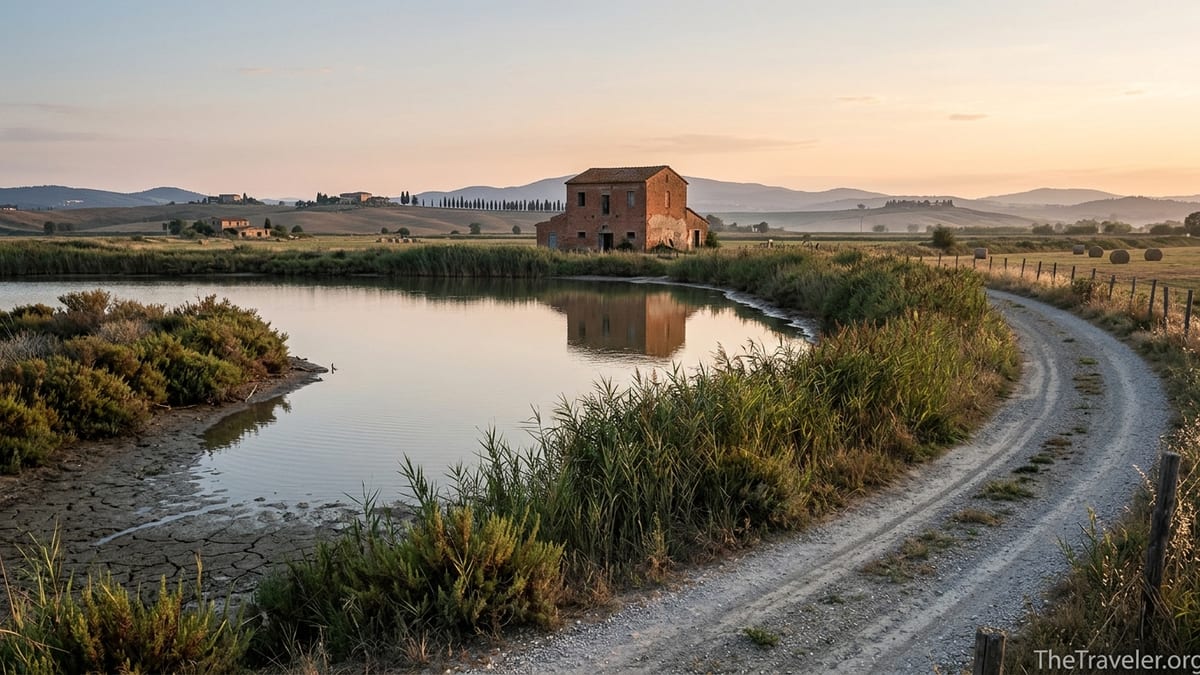
Ask people to picture Tuscany and most will think of dry hills, not water. Yet along the coast between Grosseto and Monte Argentario lie some of central Italy’s most significant wetlands, landscapes that many visitors drive past on their way to the beach resorts of Castiglione della Pescaia and Porto Santo Stefano. Between Grosseto and Castiglione, the Diaccia Botrona Nature Reserve preserves the marshy remains of the ancient Lake Prile, once a vast coastal lagoon. Today the reserve stretches across more than a thousand hectares of reeds, brackish channels and salt-tolerant plants, with a red-brick hydraulic building known as Casa Rossa Ximenes standing like a sentinel at its edge.
Most tourists see Casa Rossa Ximenes only as a distinctive landmark from the main road, perhaps snapping a quick photo from the car. What they miss is that guided boat trips and walking paths fan out from this point into the marsh, where herons, egrets, marsh harriers and seasonal flocks of flamingos feed in the shallows. Simple visits may cost only a modest guided-tour fee comparable to a museum ticket in Florence, and you can often have an entire boardwalk to yourself, especially outside peak summer. In spring and autumn, when inland Tuscany can still feel cool or rainy, these wetlands are alive with bird migration and soft coastal light.
Further south, the Orbetello Lagoon forms a large, shallow inland sea separated from the Tyrrhenian coast by sandy spits. Here too most visitors head straight for the Argentario beaches or the photogenic Spanish windmill in the water, unaware that the lagoon and adjoining WWF nature oasis shelter hundreds of bird species. At low tide you might see flamingos feeding in pale pink clusters, while ospreys and marsh harriers patrol above. A flat cycling path runs between pine forest and water, an easy half-day outing that feels far removed from crowded hilltown lanes.
Experiencing these landscapes changes your sense of Tuscany. Rather than a dry, static countryside dotted with villas, you begin to see it as a dynamic system shaped by water management, land reclamation and conservation decisions. Interpretation centers in places like Casa Rossa Ximenes explain how marshes were drained or partially preserved, how salinity has increased in some areas, and how modern conservation efforts attempt to protect remaining habitats. It is not glamorous in the conventional sense, but it is a powerful counterpoint to the manicured vineyard image many visitors arrive with.
Chestnut Forests and Stone Villages of Garfagnana
North of Lucca, the Garfagnana valley unfolds between the Apuan Alps and the Apennines, a pocket of deep green that feels worlds away from sunburned hills. Many international travelers never make it beyond the city walls of Lucca or the beach clubs of Viareggio, even though Garfagnana lies roughly an hour’s drive inland. The valley is laced with chestnut forests, terraced fields and riverside meadows, punctuated by stone villages like Castelnuovo di Garfagnana, Barga and San Romano. This is upland Tuscany, where landscapes are read through mushrooms, woodpiles and mountain weather rather than vineyard harvest dates.
Here, agriturismo stays and simple mountain inns often cost significantly less than their counterparts in Chianti or Val d’Orcia, particularly outside peak August holidays. A couple might find a farmhouse apartment with kitchen and breakfast included for the equivalent of 90 to 150 US dollars per night, sometimes less shoulder-season, with views over forested slopes instead of rows of Sangiovese. Instead of sunset wine tastings, evenings may revolve around hearty dinners of chestnut flour polenta, local sheep’s cheeses and slow-cooked game, reflecting how these landscapes have fed people for centuries.
Old mule tracks and cart roads crisscross the hillsides, remnants of a time when chestnut flour and charcoal traveled out of the valley on foot or by pack animal. Today, many of these paths are signed hiking routes, some starting directly from villages. Walking a two or three hour loop through beech and chestnut woods, you may pass abandoned terraces, small chapels and stone bridges that never appear in glossy brochures. On rainy days, cloud tends to cling to the peaks, creating a layered landscape of grey and green that feels more like an Alpine foothill region than the Tuscany most visitors think they know.
Spending time in Garfagnana also highlights how the region’s landscapes vary with elevation and soil. Acid, forested slopes support different crops and wild species than the calcareous, cultivated hills nearer Siena. In practical terms, that means the roadside stalls here sell porcini mushrooms and honey rather than olive oil tastings and designer wine. For travelers willing to trade famous names for atmospheric mountain scenery, Garfagnana offers a way to experience Tuscany while sharing viewpoints with local hikers rather than tour groups.
Marble Mountains and Industrial Landscapes of the Apuan Alps
Another Tuscan landscape that most visitors glimpse only from a distance is the white-slashed profile of the Apuan Alps above Carrara. From the Autostrada near Pisa and Forte dei Marmi you can see pale scars on the mountainsides, the marble quarries that have supplied stone since Roman times and reached global fame during the Renaissance. Many travelers assume these are distant snowy peaks and continue toward the beaches or inland to Florence, never considering that the quarries themselves and the surrounding ridges are visitable landscapes with their own complex story.
Driving inland to the quarry zones around Carrara or Colonnata, you enter an industrial environment rarely associated with romantic Tuscany. Huge marble blocks lie stacked beside narrow roads, and quarry faces tower above like vast open rooms of white stone. Guided tours in off-road vehicles or small buses bring visitors up into active or historic quarries for relatively modest fees, on par with city museum tickets. Standing amid the echoing space of a quarry cut directly into the mountain, you gain a new sense of scale for the statues and polished slabs that decorate churches and hotels around the world.
Above the quarry belts, hiking paths of the Apuan Alps Park traverse sharp ridges that afford expansive views down to the Tyrrhenian Sea on clear days. These are serious mountain routes, often requiring good footwear and comfort with steep, rocky terrain, and should be approached with proper maps or local guides. Yet even short walks from roadside passes can reveal meadows, karst sinkholes and scrubby slopes where the white of marble dust mixes with the green of Mediterranean vegetation. Few international tourists make the effort, so you are likely to share these viewpoints with local walkers and perhaps a handful of visiting climbers.
Seeing this side of Tuscany raises difficult questions too. Quarrying reshapes entire mountains, and local debates over environmental impact, employment and heritage are ongoing. Visiting with curiosity and respect allows travelers to recognize that Tuscan landscapes are not preserved museum pieces but contested working spaces. The Apuan Alps, with their blend of dramatic geology, industry and fragile ecosystems, complicate the region’s postcard image in a way that many travelers find memorable long after their trip.
Working Farms, Not Stage-Set Agriturismi
“Agriturismo” has become a key word in Tuscan travel marketing, yet many visitors arrive assuming that any farmhouse with a pool qualifies as a farm stay. In reality, some properties are working farms that shifted part of their income into guest rooms, while others are country villas that use the term loosely. The difference matters if you want to understand the landscape rather than simply look at it. On a genuine working farm in the hills above Siena, for example, your morning view might include tractors cutting hay, sheep being moved between pastures or olives being pruned, depending on season.
In less famous valleys and hill districts, especially away from Val d’Orcia and central Chianti, you are more likely to encounter agriturismi where agriculture is still the primary occupation. Rates can be modest by Tuscan standards, sometimes around the equivalent of 80 to 130 US dollars per night for a basic room or self-catering apartment. In exchange you may accept gravel access roads, simpler bathrooms and less curated “Instagram corners.” What you gain is a front-row seat to seasonal chores: vines being tied in early spring, grain harvested in June and July, or firewood stacked for winter in chestnut country.
Meals on these farms often reflect what the land around them actually produces. Near the Maremma coast this might mean grilled lamb, wild fennel, local pecorino cheese and wines from nearby cooperative cellars. In the foothills of Monte Amiata it could be soups thickened with farro, lentils from tiny plots and mushrooms gathered in the woods. Sitting at long tables on a summer evening, you may find yourself next to neighbors from the nearest village rather than only fellow tourists. The conversation at such tables ranges from the weather’s impact on the olive harvest to local debates about wind turbines or wildlife, opening a window onto how people who live with these landscapes see them.
Choosing this kind of stay also encourages slower travel. Without a checklist of iconic photo stops, guests often spend days walking farm tracks, visiting small weekly markets in nearby towns or helping children identify lizards on drystone walls. The landscape shifts from scenic backdrop to daily environment. That shift can make a week on an unfamous Tuscan hillside feel richer than a rushed circuit of the greatest hits, precisely because you have time to notice small, easily missed details like irrigation channels, field boundaries and the way light changes over a working vineyard rather than a curated viewpoint.
Forgotten Footpaths and Everyday River Valleys
Between the signature hills and the high mountains lie the river valleys and low ridges where most Tuscans actually live. These areas rarely appear in tourism campaigns, but they are where you can most easily see how the landscape functions for local communities. The Cecina valley south of Volterra, the Ombrone plain near Grosseto, the Elsa and Era rivers between Florence and Pisa: all are lined with small towns, industrial zones, orchards, and pockets of floodplain forest and farmland. Travelers often speed along main roads here en route to more glamorous addresses, missing the texture that binds the region together.
In these valleys, forgotten footpaths run between villages, churches and fields. Some have been re-signposted by local hiking groups or municipalities, while others remain unofficial tracks used by dog walkers, hunters and farmers. A short stroll along a gravel road beside the Ombrone at dusk may reveal herons fishing in irrigation ditches, dragonflies dancing above rice or maize plots, and silhouettes of old farmhouses with feed silos and solar panels side by side. It is not the Tuscany on calendars, but it is the Tuscany that feeds cities like Siena and Grosseto.
Many of these everyday landscapes can be explored without special gear or long drives. From smaller towns like Colle di Val d’Elsa, Pontedera or Pontremoli, you can often walk out of the historic center and within 20 minutes be among vegetable gardens, vineyards or riverside woods used almost exclusively by locals. Accommodation in such towns can cost markedly less than in international hotspots, especially midweek, making them good bases for travelers curious about real daily life. Cafes serve workers and students as much as visitors, and bar counters are lined with field workers on their way home rather than wine tourists comparing tasting notes.
Exploring these spaces helps you decode details you might overlook elsewhere. You begin to recognize the rhythmic pattern of irrigation channels cutting across fields, the different textures of wheat, sunflower and fallow land across seasons, or the way church towers and grain silos share ridgelines. By walking short sections of these minor routes, you connect the celebrated landscapes with the more functional ones that sustain them, much as locals do when they commute, shop or visit relatives in neighboring villages.
The Takeaway
Seeing Tuscany beyond its famous postcard views is less about secret spots and more about shifting perspective. The wetlands of Diaccia Botrona and Orbetello, the chestnut forests of Garfagnana, the marble mountains of the Apuan Alps, the working farms scattered across lesser known hills and the unsung river valleys in between all reveal a region that is ecologically varied and economically complex. These are not backdrops arranged for visitors; they are living landscapes where conservation, agriculture, industry and tourism intersect.
For travelers, the practical steps are straightforward. Allocate at least a few nights outside the most famous zones, even if that means choosing a small town over a celebrated hilltop village. Budget for simple guided visits to nature reserves or quarries, and allow unplanned hours to walk dirt tracks and sit in ordinary bars watching how people interact with the land around them. Accept that some of the most rewarding views will be ones you cannot easily capture in a single, spectacular photograph: morning mist over a marsh, autumn leaves in a chestnut grove, or the patterned fields of a modest river plain at harvest.
Above all, resist the temptation to treat Tuscany as a collection of checkboxes. The region’s real character emerges in the gaps between highlights, in the working spaces and quiet corners that rarely feature in itineraries but shape the daily experience of those who live there. By looking past the postcard, you not only find quieter and often more affordable places to stay and explore; you also come away with a richer understanding of how this landscape has evolved and continues to change. That memory endures longer than any single photograph.
FAQ
Q1. Is it realistic to visit both classic Val d’Orcia views and quieter landscapes in one trip?
Yes. With a week in Tuscany you can spend two or three nights near Val d’Orcia for classic views, then move to a less visited area like Maremma, Garfagnana or the Apuan Alps for the remainder, using a rental car to link them.
Q2. Do I need a car to explore wetlands, mountain valleys and small farm areas?
A car offers the most flexibility for reaching wetlands, upland villages and working farms, especially where public transport is sparse, but in some cases local buses, taxis and organized excursions from coastal towns or Lucca can provide limited access.
Q3. Are visits to places like Diaccia Botrona and the Orbetello Lagoon suitable for children?
Generally yes. Boardwalks, short walking trails and guided boat trips are usually family friendly, though parents should bring sun protection, water and insect repellent and check seasonal opening hours before setting out.
Q4. How do prices in less famous areas compare with popular Tuscan hotspots?
While rates vary widely, farm stays and small hotels in lesser known valleys and hill districts often cost noticeably less than comparable properties in central Chianti or Val d’Orcia, particularly outside peak summer and major holidays.
Q5. Are there safety concerns with hiking in places like Garfagnana or the Apuan Alps?
Marked trails in lower valleys and foothills are generally straightforward in good weather, but higher-level routes in the Apuan Alps can be demanding, so visitors should choose paths suited to their fitness, carry basic gear and seek local advice when in doubt.
Q6. Can I visit marble quarries independently, or do I need a guided tour?
Access rules vary; many active quarry zones require guided tours for safety and liability reasons, while some historic areas and viewpoints can be reached independently, so it is wise to check locally before driving into quarry roads.
Q7. What is the best season to experience these less visited Tuscan landscapes?
Spring and autumn typically offer mild temperatures, active farm and wildlife seasons and fewer crowds, while summer can be hot in lowlands but pleasant in mountain areas and winter can be atmospheric though quieter and with shorter daylight.
Q8. How can I tell if an agriturismo is a genuine working farm?
Property descriptions that mention specific crops or livestock, on-site production of oil, wine, cheese or grain and clear references to farm activities usually indicate active agriculture, and asking hosts directly before booking can clarify this.
Q9. Are there environmental etiquette rules I should follow in wetlands and rural areas?
Staying on marked paths, keeping noise low, not disturbing wildlife, respecting private property boundaries and avoiding litter are key; in working farm zones, visitors should also give way to tractors and close any gates they pass through.
Q10. Is it possible to enjoy these landscapes without speaking Italian?
Yes, especially in areas that see some tourism, but having a few basic Italian phrases and translation apps helps when arranging farm stays, local guides or public transport and shows respect for the communities you are visiting.