


Few cities manage to feel both ancient and current in the way Rome does. Stand on a cobbled lane near the Pantheon at golden hour and you can watch commuters on scooters zigzag past a 2,000-year-old temple, teenagers scrolling on their phones under baroque cornices, and visitors debating whether to order cacio e pepe or carbonara for dinner. Rome’s ability to fold everyday life into a setting of monumental history is precisely why it remains one of the world’s most timeless travel destinations.
Get the latest updates straight to your inbox!
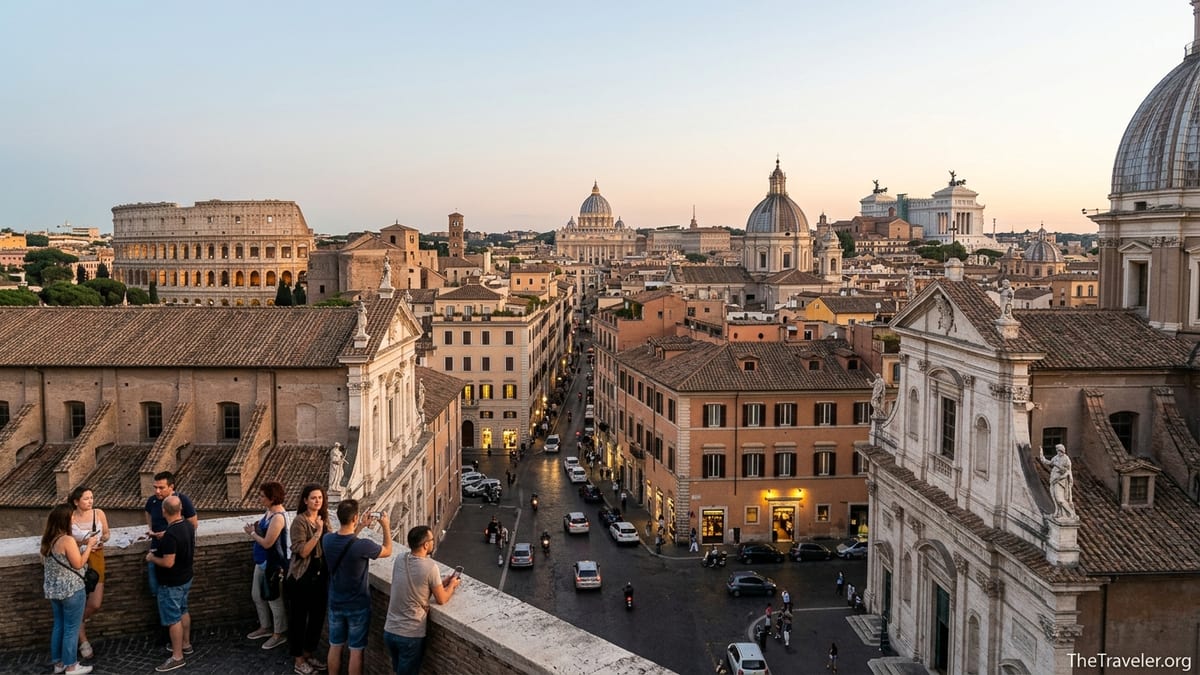
Where Everyday Life Shares the Street With Antiquity
Nowhere else does daily life flow so casually around ancient monuments as it does in Rome. On a typical Tuesday morning, office workers cut through the Roman Forum on their way to Via Cavour, using the same slopes and sightlines that senators once did. A standard 24-hour Colosseum ticket, currently about 18 euros for adults, includes access to the Forum and Palatine Hill, so a modern visitor can follow that same route in a single afternoon, emerging onto the traffic of Via dei Fori Imperiali where buses and taxis glide past the ruins.
Even small urban spaces are layered with history. Largo di Torre Argentina, once a fenced-off archaeological island best known online for its resident cat sanctuary, reopened to the public with raised walkways that allow visitors to stroll above four Republican-era temples and the remains of Pompey’s Theatre. You can now ride the number 8 tram from Trastevere, hop off at the Largo stop, and be standing above the site associated with Julius Caesar’s assassination within minutes, with city buses and shoppers continuing their routines just beyond the railings.
In the Centro Storico, the blend of past and present is constant. Piazza Navona hosts children kicking soccer balls around Bernini’s fountains while street artists sketch caricatures near remnants of the Stadium of Domitian that still shape the square’s elongated form. Around the corner, residents stop for an espresso at the bar counter of Sant’Eustachio or Tazza d’Oro before work, while travelers step out of the Pantheon having just looked up at the oculus that has been open to rain and sunlight since the second century.
This coexistence is not curated as a museum experience but lived as part of the city’s normal rhythm. When you order a quick slice of pizza al taglio from a counter on Via dei Serpenti and then carry it toward an evening view of the Colosseum, you are experiencing Rome exactly as many Romans do: as a place where history is the backdrop to grabbing lunch, commuting, and meeting friends.
Icons That Still Take Your Breath Away
Rome’s major monuments are instantly familiar from films and postcards, yet seeing them up close still stops even seasoned travelers in their tracks. The Colosseum continues to be Italy’s most visited archaeological site by a wide margin, welcoming many millions of visitors each year. Even with that level of familiarity, stepping into the amphitheater’s interior and looking down at the reconstructed arena floor and exposed hypogeum remains one of travel’s great “I am really here” moments.
The enduring appeal of these icons has led to thoughtful upgrades rather than gimmicks. Colosseum ticketing has evolved into clearer categories: a standard ticket around 18 euros opens the main levels, while a “Full Experience” option, priced higher, adds access to the arena floor or underground tunnels and extends the validity of Forum and Palatine Hill entry. That layered approach allows first-time visitors who want only the classic view, and history enthusiasts who want a guide explaining trapdoors and animal cages, to both have satisfying experiences without cluttering the monument with modern add-ons.
Elsewhere in the city, the Trevi Fountain remains a ritual stop, crowded until late into the night with visitors tossing coins over their left shoulders. Local authorities have experimented with measures to manage overtourism, from stationing police and wardens who stop people from sitting on the edge to discussing time-slot access, yet the essential experience is unchanged: the roar of the water, the cool stone in the shaded alleyways leading in, and the almost theatrical reveal as you turn a corner from a narrow street and suddenly face the full baroque cascade.
Other icons have grown even more approachable. The Pantheon, now charging a modest entry fee for non-residents, uses that income to support maintenance while still keeping access practical. Walk in on a rainy afternoon and you may see raindrops falling directly through the oculus, scattering across the marble floor as staff quietly rope off the slick area. In that moment, the Pantheon feels as alive and fragile as any contemporary building, even as it anchors nearly every traveler’s mental image of Rome.
A City That Rewards Slow, Repeated Visits
Rome’s timelessness is not only in its monuments but also in how endlessly revisitable it is. Many travelers return multiple times, each visit revealing a different layer. The first trip might focus on the Colosseum, Vatican Museums, and Piazza di Spagna. On a second visit, you might spend a morning wandering the less crowded Baths of Caracalla, where the looming brick walls and mosaic fragments sit in a residential neighborhood that runners and dog walkers use as their local park.
Neighborhoods that once barely registered on tourist maps have quietly become reasons to stay longer. In Testaccio, the former wholesale slaughterhouse has transformed into a cultural complex hosting museums, concert spaces, and temporary exhibitions, while the nearby covered market offers seasonal artichokes, pecorino cheese, and household goods for everyday Romans. Travelers staying in the area often find themselves having lunch at a simple trattoria where the daily menu is scrawled in Italian on a piece of paper taped to the wall, and where a robust plate of rigatoni all’amatriciana still comes in under 14 euros.
Similarly, in the Ostiense and Garbatella districts, old industrial architecture and 20th-century housing estates have attracted street art, craft breweries, and creative spaces without losing their lived-in feel. A visitor renting an apartment near the Piramide metro station will quickly learn the rhythms of local life: coffee at the bar downstairs for about 1.30 euros, a quick shot of espresso taken standing at the counter; a midweek aperitivo of spritz and small snacks for 6 to 9 euros at a neighborhood bar along Via del Porto Fluviale; and late-night gelato shared with families and students on the steps of a small piazza.
This ability to support repeat visits means Rome can be both a checklist destination and a place where you simply “live” in another city for a week. It is entirely plausible to rent an apartment a few minutes from Villa Borghese and spend your days jogging along the park’s tree-lined avenues, working remotely from a café near Piazza del Popolo, and treating the occasional afternoon at the Capitoline Museums as you might a spontaneous gallery stop at home.
Timeless Traditions in Food and Social Life
Rome’s culinary culture is another anchor of its timeless appeal. Dishes like cacio e pepe, carbonara, and gricia are rooted in a few ingredients that have defined local cooking for generations: pecorino Romano, cured pork cheek, black pepper, and local eggs. At a trattoria in Trastevere or Prati, a bowl of carbonara typically costs between 13 and 18 euros, and many establishments still follow the traditional recipe without cream, relying solely on egg and cheese for creaminess.
Daily rituals give short visits a sense of structure. Breakfast often means a cappuccino and a cornetto at a standing bar, with locals paying around 2.50 to 3 euros for the combination. In the late afternoon, Romans drift toward piazzas and neighborhood corners for aperitivo, ordering a spritz or glass of Frascati wine accompanied by small plates of olives, bruschetta, and cold cuts. In areas like Pigneto or San Lorenzo, these early-evening gatherings can feel like open-air living rooms, with conversations spilling into the street until dinner hours.
Rome has also embraced contemporary trends without losing its culinary roots. Modern food halls near Termini station and in Ostiense showcase everything from traditional porchetta sandwiches and supplì to natural wine bars and vegetarian counters, providing an approachable way for visitors to sample multiple regional specialties under one roof. Yet just a few blocks away in the Esquilino district, immigrant-run shops sell spices, Asian produce, and North African staples, reflecting the city’s evolving identity.
For travelers, these food traditions translate into a comforting predictability. You know that on a Sunday, many Romans will gather for long family lunches, that certain bakeries in the Ghetto will sell fried artichokes in spring, and that bars near the Vatican will be crowded with workers grabbing panini at midday. That steady rhythm, visible at street level, helps ground the more overwhelming aspects of Rome’s scale and history.
Timeless Routes, Modern Infrastructure
Rome’s infrastructure has struggled with its own age, yet incremental improvements in transport and visitor management help keep the city accessible without eroding its character. For short stays, integrated transport passes make navigating the city relatively straightforward. A 72-hour public transport ticket, for example, costs about 18 euros and allows unlimited travel on the metro, buses, and trams within the urban area, while a weekly pass costs around 24 euros and is good value for travelers planning intensive sightseeing.
In practice, visitors quickly discover that Rome is a walking city punctuated by short rides. The metro network’s Lines A and B, plus the more recent Line C and frequent buses, carry people between major nodes like Termini station, the Colosseum, the Vatican area, and Piazza del Popolo. Yet from most metro stops, travelers still walk 10 to 15 minutes through narrow streets to reach specific sights or restaurants. That last stretch on foot is a key part of the experience: emerging from Spagna station directly onto Via dei Condotti, or from Ottaviano into the flow of pilgrims heading toward St. Peter’s Square.
Visitor management continues to evolve around the most iconic sites. Time-slotted tickets are now standard at the Colosseum and Vatican Museums, spreading foot traffic and reducing hours-long queues in the sun. At Trevi Fountain and the Spanish Steps, clear rules against sitting or picnicking help protect the monuments’ surfaces while still allowing photos and brief pauses. Travelers benefit by planning ahead: booking a Colosseum slot for early morning, for instance, and then using the same combined ticket to enter the Forum and Palatine Hill later that afternoon when day-tripper crowds have thinned.
New and upgraded spaces also show how Rome adapts its infrastructure respectfully. The Ara Pacis Museum’s modern protective building, housing Augustus’s altar of peace, uses glass and travertine to create a contemplative interior while connecting visually to the nearby Tiber. Along the river, improved embankment paths host seasonal events and temporary installations, giving locals and visitors alike more ways to enjoy an area once dominated by traffic and car parks.
Art, Faith, and Culture Across the Centuries
Rome’s artistic and spiritual heritage stretches from pagan temples to Renaissance masterpieces and contemporary installations, making it a place where culture is not confined to museums. A single day might take a traveler from the gilt ceilings of Santa Maria Maggiore to the stark modern lines of the MAXXI museum in the Flaminio district, with a detour through the Borghese Gallery’s sculptural treasures.
The Vatican Museums remain an essential yet demanding experience. Time-slotted entry and extended hours on certain days help manage enormous demand, but the practical reality is that the long corridor leading to the Sistine Chapel still fills with visitors craning for glimpses of frescoes, tapestries, and maps. Savvy travelers often book the earliest or latest available slots, allowing them slightly more breathing room when they finally step beneath Michelangelo’s ceiling, or choose specialized tours that focus on a narrower section of the collection before guiding them into the chapel.
At street level, art and faith are woven into the urban fabric in quieter ways. Caravaggio’s canvases still hang in neighborhood churches with free entry, such as San Luigi dei Francesi near Piazza Navona, where a few coins in the light box illuminate the paintings for several minutes. On a weekday afternoon you might find a small group of students sketching at the back of the church while a handful of worshippers pray in the pews, a mix of contemplation and art appreciation that captures Rome’s particular atmosphere.
Contemporary culture is equally present. Venues around Testaccio, San Lorenzo, and the Auditorium Parco della Musica host film festivals, concerts, and outdoor events, while summer brings open-air cinema nights in parks and piazzas. International fashion brands cluster along Via dei Condotti and Via del Babuino, but independent designers and vintage stores in Monti or Rione Regola offer a more idiosyncratic take on style, ensuring that Rome’s cultural life never feels frozen in a single era.
The Takeaway
Rome endures as a timeless travel destination because it never settled into being only a museum of itself. Its monuments are carefully preserved and, in many cases, more thoughtfully managed than ever, yet they remain embedded in a living city where commuters ride the metro past the Colosseum, teenagers gather on the steps of smaller churches, and cooks argue over the correct pasta shape for amatriciana.
For travelers, that means each visit can balance the unforgettable “first time” moments with quieter, local experiences. One day might start with a timed ticket at the Colosseum and end with gelato on a side street in Trastevere; another might involve nothing more ambitious than reading in Villa Borghese and shopping for ingredients at a neighborhood market. Rome’s streets, sounds, and flavors change slowly, but they do change, so that return visitors continue to find new angles on a city they thought they knew.
In the end, what makes Rome feel timeless is not simply its age but its continuity. People still gather in piazzas at sunset, still pause for coffee at the bar, still weave between fountains and statues on their way to work. To step into that flow, whether for three days or three weeks, is to understand why the city continues to rank at the top of so many travel wish lists, year after year.
FAQ
Q1. How many days should I spend in Rome on my first visit?
Most first-time visitors find that three full days is the minimum to see the major sights without feeling rushed, while four to five days allows time for slower neighborhood wandering and a museum or two beyond the big names.
Q2. Is Rome very expensive compared with other major European cities?
Rome can be moderately priced if you eat where locals do and use public transport. A pasta dish at a neighborhood trattoria often costs 13 to 18 euros, espresso at the bar is about 1.30 euros, and a 72-hour transport pass costs around 18 euros.
Q3. Do I need to book Colosseum tickets in advance?
Yes, booking in advance is strongly recommended, especially from spring through early autumn. Official time-slotted tickets for the Colosseum, Roman Forum, and Palatine Hill often sell out days or weeks ahead in peak periods.
Q4. What is the best time of year to visit Rome?
Late March to early June and late September to early November usually offer pleasant temperatures and slightly more manageable crowds. July and August can be hot and busy, while January and February are quieter but cooler and sometimes rainy.
Q5. Is public transport in Rome easy to use for visitors?
Yes, once you understand the basics. The metro has a limited number of lines but connects major areas, and buses and trams fill in the gaps. Integrated tickets and passes let you use all modes with a single ticket validated at the start of your journey.
Q6. Which neighborhoods are good to stay in for a first-time visitor?
Areas like Centro Storico, Monti, Trastevere, and Prati are popular because they balance walkability with access to the metro or buses. Monti and Trastevere feel slightly more bohemian, while Prati is calmer and close to the Vatican.
Q7. Is Rome safe to walk around at night?
Central Rome is generally safe, and many people stroll in the evening, especially in busy areas like Trastevere and around Piazza Navona. As in any large city, it is wise to watch your belongings, avoid unlit backstreets, and use licensed taxis or ride-hailing services late at night.
Q8. Do I need to speak Italian to get by in Rome?
No, but learning a few basic phrases is appreciated. Staff in hotels, major restaurants, and tourist sites typically speak some English, while smaller neighborhood places may be more comfortable in Italian. Polite attempts at Italian often lead to warmer interactions.
Q9. Are there ways to experience Rome beyond the main tourist sights?
Yes. You can visit lesser-known sites like the Appian Way and the Catacombs, explore markets in Testaccio or Trionfale, attend a concert at the Auditorium Parco della Musica, or simply spend an evening people-watching in a residential piazza away from the main routes.
Q10. How much walking should I expect to do each day in Rome?
Most visitors walk far more than they expect, often 10 to 15 kilometers per day, because sights in the historic center are relatively close together. Comfortable shoes and regular café or gelato breaks make the distances manageable and enjoyable.