


It took exactly one step for Rome to overturn everything I thought I understood about history. I was crossing a busy street near the Colosseum when I noticed that the curb stone beneath my shoe was veined with marble. A traffic island, a scooter whirring past, a delivery cyclist swearing into his phone, and under it all a recycled fragment of an ancient world. In Rome, history is not something you enter through a ticket gate. It seeps up through the pavement and rearranges how you think about time, empire, and your own place in the story.
Get the latest updates straight to your inbox!
From Textbook Dates to Cobblestone Time
Most of us meet Rome in school as a list of dates: 753 BC, 44 BC, 476 AD. The narrative is clean and linear. Walking through modern Rome is the opposite. It is messy, layered, and stubbornly alive. You might start at Piazza Venezia, where buses idle and office workers gulp espresso at the bar, then look up and realize you are standing in front of the Vittoriano monument to Italy’s 19th century unification, built directly beside a medieval convent, which in turn rises over the ruins of Trajan’s Forum from the 2nd century. All three eras are visible in a single swivel of the head. The effect is quietly disorienting.
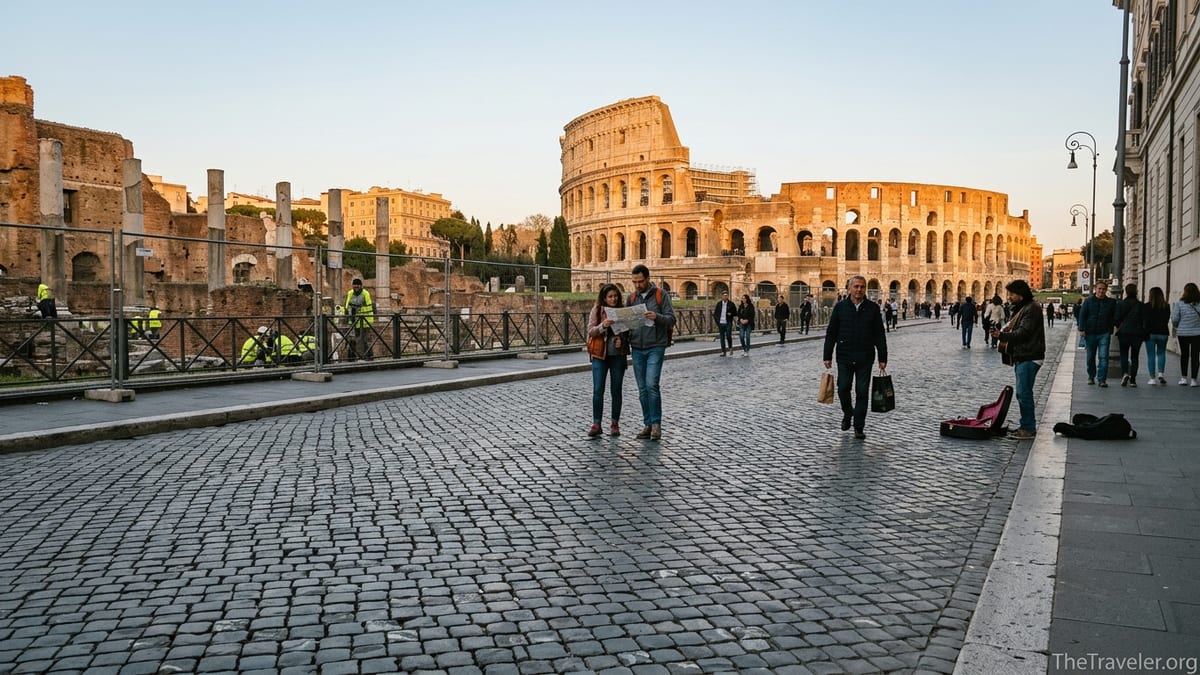
On Via dei Fori Imperiali, the broad avenue Mussolini cut through the imperial forums in the 1930s, this layered feeling is even more intense. Today sections of the road are regularly closed to cars on weekends and parts of it are being reworked to be more pedestrian friendly, so you can stroll almost casually between the Forum of Augustus on one side and Trajan’s Market on the other while joggers pass and kids lick gelato. Archaeologists are still working in the pits below, trowels and brushes flicking at soil that has not seen daylight for centuries. Suddenly “ancient Rome” is not a finished chapter; it is an ongoing project under your feet.
The city’s time scale begins to warp your own. A café may proudly advertise “since 1950” under a sign mounted on a Renaissance wall that itself was built by reusing bricks from Roman houses. You realize that “old” and “new” barely mean anything here. Rome is less a city with some historic sites than a living organism that has been continuously rearranging its own bones for almost three millennia.
The Colosseum: Concrete, Blood, and Ticket Prices
No building in Rome makes that collision between past and present feel more physical than the Colosseum. From the outside, the scene feels familiar: tour groups clustering under pastel flags, selfie sticks raised, vendors whispering “skip-the-line, my friend” as they tap laminated brochures. But once you step inside, especially if you walk down into the underground levels, history stops being abstract spectacle and becomes logistics, engineering, and money.
Official “Full Experience” tickets that include underground and arena access currently start around the mid-20 euro range when bought directly, but they are released in limited batches and can disappear within minutes. Third-party guided tours, which bundle those same official tickets with a licensed guide and often priority group entry, typically range between about 70 and 160 euros per person depending on group size, time of day, and how close you book to your visit. It is a jarring reminder that even a monument built to entertain Roman crowds is now part of a modern tourism economy that functions with its own ruthless efficiency.
Descending into the hypogeum beneath the arena floor, you discover that the real Colosseum story is not just gladiators and emperors. Your guide points out narrow corridors where caged animals once paced, the slots where eighty wooden lifts once rose through trapdoors, and the water channels used when the arena was sometimes flooded for mock naval battles. Down here, among rough stone walls and damp air, you can see the original Roman concrete, still holding after nearly two thousand years. The spectacle becomes a logistical operation, run by hundreds of invisible workers whose names have long vanished. The past looks less like marble heroism and more like backstage labor.
When you emerge again onto the arena floor and look up at the open sky, the stadium seating now filled with tourists in baseball caps, it becomes impossible to pretend that history is tidy. You are standing in a place that has hosted public executions, medieval fortifications, a small shantytown, papal ceremonies, political rallies, and now timed-ticket entry groups with audio headsets. The building has been reinterpreted by every generation that inherited it. That realization quietly challenges the idea that our age is merely observing history rather than actively rewriting it.
The Forum: Where Ruins Become a Neighborhood
From the Colosseum it is a short walk into the Roman Forum and up onto the Palatine Hill, an area that often surprises visitors who expect a single, neatly organized ruin. Instead, you encounter something closer to a faded city district where temples, basilicas, arches, and homes overlap in confusing ways. A guided ticket that combines Colosseum, Forum, and Palatine typically runs around three hours, which is just enough to realize how profoundly your mental image of “ancient Rome” has been simplified.
On one path, you pass under the Arch of Titus, built to celebrate the Roman conquest of Jerusalem, and then climb toward the remains of imperial palaces, where Augustus and later emperors lived. Interpretive panels on the Palatine point out that medieval farmers once grazed animals among these palatial ruins. What textbooks usually compress into a clean imperial narrative was in fact a cycle of construction, abandonment, reuse, and reinvention. In the Middle Ages the Forum partially filled with soil and debris; by the 18th century it was known as the “Campo Vaccino,” the Cow Field.
The most quietly radical moment for many visitors happens not at a famous arch but on Via Alessandrina, a 16th century street that now functions as an elevated walkway along the edge of the imperial forums. From its railings you can look down and see how Renaissance houses once clung to the sides of ancient Roman walls. Those homes were demolished in the 20th century to clear the view of the ruins. History here is not a single story of Roman greatness but a series of trade-offs: which layers get preserved, which are sacrificed, and whose memory gets foregrounded.
Sitting on a shaded bench overlooking the Forum, you might hear a guide explaining to a small group that what looks like a chaotic pile of broken columns is in fact the foundations of the Basilica Aemilia, burnt, rebuilt, then finally abandoned. A child nearby kicks a stray fragment of brick. It dawns on you that the glorious marble city of Rome has mostly survived in shards, and that what we admire today is a carefully curated selection of fragments. The past, you realize, is always edited.
Walking as a Time Machine: Neighborhoods Beyond the Postcards
Leaving the grand ruins behind, the most powerful shifts in perspective often happen in less celebrated streets. A late-afternoon walk from the Forum to Trastevere, for example, delivers a slow-motion lesson in how cities truly evolve. You might start on the Capitoline Hill, where Michelangelo redesigned the main square in the 16th century, then wind down narrow lanes toward the Tiber, passing modern apartment blocks whose facades swallow ancient brickwork. A carved fragment with Latin letters might be built into the corner of a wall above a bakery selling maritozzi and espresso for a few euros.
Crossing the Tiber on Ponte Sisto at sunset, buskers playing and teenagers leaning on the stone balustrade, you feel like you are in a modern European city. Yet the bridge itself follows the line of an earlier Roman bridge, and just upstream you can glimpse Tiber Island, used as a hospital center since antiquity. In Trastevere’s backstreets, ivy spills over walls, and laundry hangs above cobblestones laid in the characteristic black basalt “sampietrini” blocks. Here history is not curated behind ticket barriers; it is part of daily life. Locals sip a glass of house wine at a neighborhood trattoria for under ten euros while sitting beside a wall older than most countries.
Walking north into the quieter streets behind Piazza Navona or around the Campo de’ Fiori market early in the morning, you experience another collision of eras. Delivery vans unload crates of artichokes and tomatoes where public executions once took place. An unassuming doorway may open into a Renaissance courtyard, which in turn rests on Roman foundations. Guided food walks in these neighborhoods, typically priced around 60 to 100 euros for several hours of tastings and stories, often do more to bring the city’s social history alive than any monument, because they connect the grain of ancient bread in museum displays to the pizza bianca you are eating in your hand.
Museums, Passes, and the Cost of Curiosity
For many visitors, the moment history becomes personal is when they begin to navigate Rome’s museum system. A standard ticket for a city museum like the Museo di Roma in Trastevere, which focuses on the social and cultural history of the city, costs under ten euros at current rates. That means, in practice, that you can step out of a noisy bar and into a quiet gallery in the span of five minutes and for less than the price of a cocktail. Inside, black-and-white photographs from the early 20th century show street vendors and families in courtyards that look remarkably like the ones you just walked through.
Multi-attraction cards like the Roma Pass bundle public transport with free or discounted entries to many sites over 48 or 72 hours. Recent official information lists the 72-hour version at just over sixty euros, which roughly equates to the cost of visiting two or three major attractions individually, plus metro and bus rides. Using such a pass turns your relationship with the city into a series of curious detours. You might pop into a lesser-known site like the Centrale Montemartini, where classical statues stand against a backdrop of defunct industrial machinery, simply because entry is included. The juxtaposition of marble athletes and diesel turbines makes the point more clearly than any essay: Rome’s story did not stop with emperors; it continued through factories, power plants, and working-class neighborhoods.
Budget choices also alter your perception of history. A traveler who chooses one expensive underground tour at the Colosseum may balance that by exploring free sites like the Pantheon, now accessed with a modest reservation fee, or the open-air ruins scattered across the city. Sitting on the Spanish Steps in the evening, watching local teenagers chat and tourists compare photos, you realize that observing who uses these spaces and how reveals as much about Rome in the 21st century as any plaque on the wall.
Faith, Ritual, and the Weight of Continuity
Rome is often described as an open-air museum, but for many of its residents it is first and foremost a living religious center. Stepping into a small church during a weekday mass can be as revelatory as touring St Peter’s Basilica. In a side street near Largo Argentina, you may slip into a Baroque church where a handful of elderly Romans mutter prayers, students sit on the back pew scrolling their phones, and a priest chants words that would be recognizably familiar to worshippers from centuries ago. Frescoes peel, electric candles flicker beside marble altars, and outside scooters drone past. The ritual continues almost indifferent to the traffic.
A walk across the river to the Vatican area intensifies that sense of continuity. Pilgrims queue for the Vatican Museums, where admission fees comparable to other major European museums grant access to galleries filled with classical sculptures once unearthed on Roman soil, then collected by popes. In the Sistine Chapel, tourists crane their necks to admire Michelangelo’s ceiling while security guards intone “Silenzio” over the murmur. The tension between devotion and tourism, sacred and secular, becomes impossible to ignore.
On Wednesday mornings when papal audiences take place in St Peter’s Square, you might watch groups from Latin America, Poland, and the Philippines waving flags, singing, and cheering as the pope passes in the popemobile. Modern sound systems, giant screens, and security checkpoints create a very 21st century experience, but the underlying idea of pilgrims traveling to Rome to seek blessings and connection is as old as Christianity itself. History here is not something that ended; it is a living tradition that still draws people from across the world and shapes urban rhythms, security planning, and even bus timetables.
Modern Rome: Protests, Football, and Daily Life Among Ruins
Perhaps the most jarring moments in Rome’s historical education happen when contemporary events occupy ancient spaces. On some evenings, for example, you might find a labor protest or political rally in Piazza del Popolo or Piazza Venezia, with banners, microphones, and news cameras framed against centuries-old façades. A march might move down Via dei Fori Imperiali, past the same ruins where triumphal processions once celebrated imperial victories. The continuity of the route, repurposed for new causes, forces you to reconsider what “historic” streets are actually for.
On weekends during football season, bars and cafés that by day serve quick espresso and cornetti will fill with fans in AS Roma or Lazio jerseys, eyes glued to television screens. A goal is scored, the room erupts, and for a brief moment the city’s emotional energy is entirely focused not on emperors or saints but on a penalty decision in Serie A. Later that night, you might walk past the illuminated columns of the Pantheon or the softly lit fountains of Piazza Navona and realize that most Romans are at home, not wandering these postcard-perfect spaces. Their Rome is made of school runs, supermarket queues, public transport delays, and rent payments, all unfolding amid a backdrop that travel brochures frame as frozen in time.
Paying attention to these ordinary details can change the way you see your own city back home. In Rome, a trash truck rumbling past a baroque fountain or a delivery rider weaving between tourists near the Trevi Fountain is not a disruption of historical authenticity; it is proof that the city has refused to become a theme park. History and daily life coexist, awkwardly but productively. Once you notice that, it becomes difficult to think of “preserving the past” as something separate from supporting the communities who live among its remains.
The Takeaway
Walking through Rome does not simply fill in gaps in your knowledge of emperors and battles. It quietly dismantles the idea that history is a linear, sealed-off story. Every route between the Colosseum and Trastevere, every shortcut through a courtyard, and every church you duck into for a moment of cool shade becomes an encounter with multiple centuries at once. Ticket prices, metro lines, scaffolding, and café bills all become part of the narrative rather than background noise.
By the time you leave, it is hard to think of history as something that lives only in books or behind museum ropes. Rome shows you that the past is continually edited, reused, and renegotiated by the people who inherit it. You begin to see your own hometown differently: the old warehouse slated for conversion, the memorial in a park, the new tram line replacing a bus route. They are no longer just urban trivia; they are chapters in an ongoing story that someone, someday, may try to piece together from the traces you leave behind.
In that sense, the most important lesson Rome offers is practical. History is not over, and we are not bystanders. We are already building the ruins future travelers will walk through, and they will judge us not just by our monuments, but by how well we learned to live with the layers we inherited.
FAQ
Q1. Do I really need to walk Rome to understand its history, or can I just take tours and taxis?
While bus tours and taxis are convenient, walking exposes you to the small details that change how you see the city: fragments of reused marble, side-street churches, old shop signs, and everyday routines. Even a few hours on foot between major sites like the Colosseum, the Forum, and Trastevere will give you a far richer sense of Rome’s historical layers.
Q2. Which walking routes in Rome best show the city’s historical layers?
One of the most revealing routes runs from Piazza Venezia along Via dei Fori Imperiali past the Forum and Colosseum, then up to the Palatine Hill. Another is the stroll from the Capitoline Hill, down through the Ghetto area, across Ponte Sisto, and into Trastevere. Both combine monumental ruins with lived-in neighborhoods.
Q3. Are Colosseum underground tours worth the higher price?
For many visitors, yes. Official underground access sold directly is relatively inexpensive but hard to secure, while guided tours cost more yet include a licensed guide and structured access. Descending into the hypogeum, seeing the tunnels, lifts, and holding areas, often transforms the Colosseum from a generic “icon” into a complex working machine, which can deeply change how you imagine Roman entertainment and labor.
Q4. How can I experience Rome’s history without spending a lot on tickets?
Focus on walks through historic neighborhoods and free or low-cost sites. Wandering areas like Trastevere, the streets around Campo de’ Fiori, and the lanes near the Pantheon costs nothing. Many churches are free to enter, and city museums often charge modest admission. A multi-attraction pass can help if you plan to visit several paid sites in a short time.
Q5. Does visiting churches in Rome require religious knowledge or practice?
No. Visitors of any or no faith are welcome, provided they dress and behave respectfully. You do not need to understand all the theology to appreciate how long these places have been active and how they link ancient traditions with daily life in modern Rome. A simple moment of quiet at the back of a church can be as meaningful as a formal tour.
Q6. What surprised travelers most about seeing the Forum and Palatine Hill in person?
Many people are surprised by how rough and incomplete the ruins look compared with textbook illustrations. The Forum feels less like a single monument and more like an overgrown neighborhood of collapsed buildings. Seeing reused columns, patched walls, and layered foundations makes it clear that Rome’s history is one of constant rebuilding rather than a pristine golden age.
Q7. Is it safe to walk around Rome at night near historic areas?
Central areas around the main monuments, major piazzas, and well-lit streets are generally busy and feel reasonably safe, especially in the early evening when locals are out for strolls. As in any big city, you should stay aware of your surroundings, avoid deserted alleys very late, and watch your belongings in crowded spots. Most travelers find evening walks around places like Piazza Navona and the Trevi Fountain memorable and enjoyable.
Q8. How does using a pass like the Roma Pass change the experience of the city?
Having a multi-attraction pass encourages spontaneous detours into smaller museums and archaeological sites that you might skip if you had to buy individual tickets each time. This makes your understanding of Rome more varied, as you are more likely to visit industrial sites turned galleries, social history museums, and offbeat collections that show lesser-known sides of the city’s past.
Q9. Can food experiences really teach me anything about Rome’s history?
Yes. Traditional dishes and market routines reflect centuries of scarcity, trade, and local customs. Tasting simple foods like cacio e pepe, pizza bianca, or seasonal artichokes while hearing how ingredients were once taxed, rationed, or imported can connect what is on your plate to broader stories of empire, poverty, and adaptation.
Q10. How might walking through Rome change how I see my own hometown?
After experiencing Rome’s layers, you may start to notice the hidden histories of your own city: repurposed warehouses, renamed streets, old factories turned apartments, or memorials in small squares. Rome trains you to look for clues in ordinary buildings and public spaces, making it easier to see your hometown as part of an ongoing historical story rather than a static backdrop.