


On the Arctic Circle just outside Rovaniemi, Santa Claus Village has evolved from a modest cluster of wooden cabins into one of Finland’s most visited attractions. Families fly in from London, Dubai and Singapore for a few snowy days that revolve around one premise: meeting the real Santa in his official hometown. Yet the pull of this Lapland landmark goes beyond tinsel and toy shops. With nearly 800,000 people visiting the wider Santa Claus Village area in 2025, the site has become a cornerstone of Finnish tourism, mixing winter adventure, clever branding and authentic Arctic atmosphere into a destination that many travelers now place at the very top of their Finland itineraries.
Get the latest updates straight to your inbox!
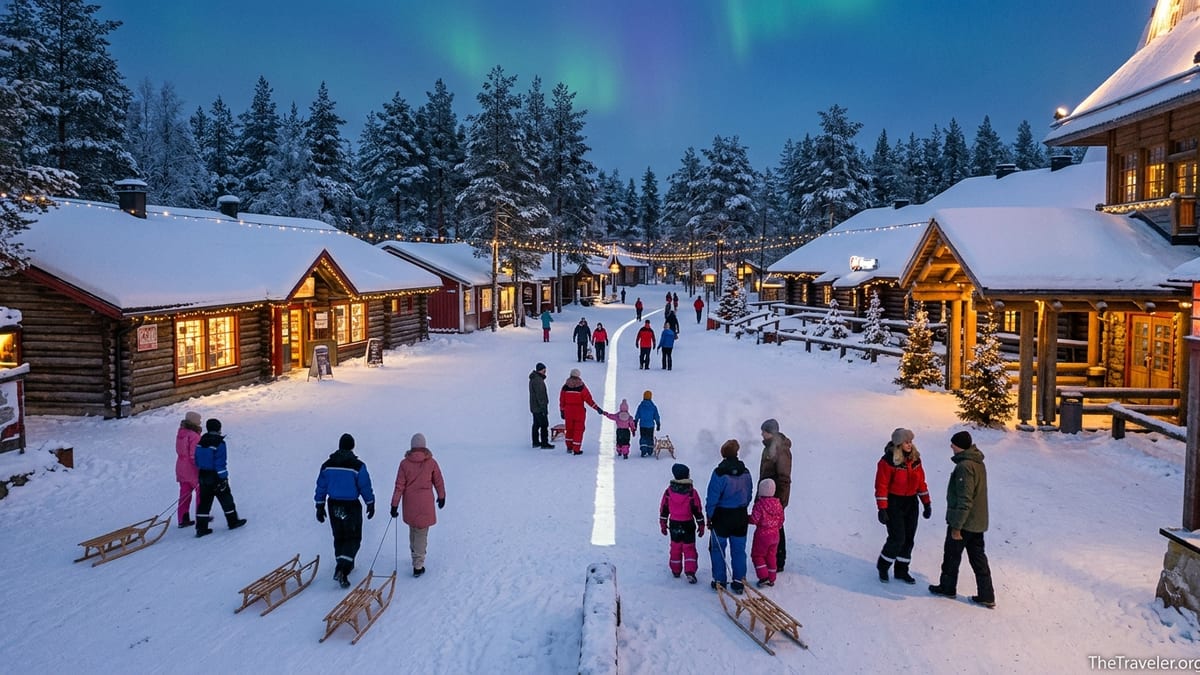
Where Christmas Meets the Arctic Circle
Santa Claus Village sits about 8 kilometers north of Rovaniemi, right on the latitude that marks the Arctic Circle. A white line runs through the central square, and crossing it is a small but memorable travel milestone. Many visitors pose for photos mid-stride, then step into the nearby tourist information office to buy or collect an official Arctic Circle Crossing Certificate, a simple paper memento that ends up framed in hallways from Madrid to Melbourne.
The idea of Santa “living” in Finnish Lapland dates back to mid-20th-century tourism campaigns, but the village today is a fully formed destination. It combines the symbolic Arctic Circle, the myth of Santa and the very real lure of Lapland’s deep winter. In practice that means you might spend the morning in a log cabin office chatting with Santa, the afternoon riding a husky sled under blue twilight, and the evening watching for the northern lights from a glass-roofed igloo hotel just up the hill.
Rovaniemi itself has grown into Finland’s second most international tourism city after Helsinki, and the village is its most famous calling card. Local development authorities highlight Santa Claus Village and the Arctic Circle as the main magnets drawing long-haul visitors to Lapland, especially in the peak season from late November to early January. That status feeds a virtuous circle: more flights, better infrastructure and a wider range of activities that keep the area high on travelers’ wish lists.
A Year‑Round Christmas Capital
One of the reasons Santa Claus Village ranks among Finland’s most visited sites is that it does not shut down when the Christmas tree lights would normally be packed away. Santa’s main office in the village advertises that Santa is on duty every day of the year, and visitors who arrive in July or September still find decorated streets, Christmas songs and shelves filled with ornaments. For families limited to summer school holidays, that year‑round operation is a major selling point.
In winter, the atmosphere matches most people’s idea of Lapland: thick snowbanks piled against red cottages, reindeer trotting past, and strings of warm lights glowing through the polar night. In July, the experience feels different but no less unusual. The midnight sun washes the village in soft light, kids run around the central square in T-shirts while snowmen decorations stand on gravel instead of ice, and parents snap photos of Santa in his fur-trimmed suit on a day when temperatures can nudge 20 degrees Celsius.
Visit Rovaniemi and local tourism studies point out that this year‑round Christmas concept extends the season far beyond the classic December rush. While winter still dominates, summer tourism is growing, encouraged by events, hiking in nearby Ounasvaara and new projects like a planned Moomin-themed attraction slated for the Santa Claus Village area. That kind of investment shows how central the site has become to Lapland’s strategy for attracting visitors even when there is no snow.
Built for Easy Access and First‑Time Visitors
Another reason Santa Claus Village is so heavily visited is its sheer convenience. Rovaniemi Airport is less than 5 minutes away by road, and local buses branded as Santa’s Express shuttle passengers between the city center, the village and the nearby SantaPark underground theme attraction. For a family landing on a two-hour flight from Helsinki with jet-lagged children, it is entirely possible to check into a cabin at Santa Claus Holiday Village, drop luggage and be in line to meet Santa before lunch.
The site is free to enter and walk around, which makes it especially appealing for budget-conscious travelers who can decide on the spot which paid experiences to add. Many families simply wander the central square, step into Santa’s Main Post Office to see walls stacked with children’s letters from around the world, and let kids clamber over snowbanks, only paying for a photo with Santa or a short reindeer ride. Others pre-book full-day packages that combine transfers from city hotels, a private Santa visit, a buffet lunch and time for souvenir shopping.
Infrastructure is designed for people who have never been this far north before. Rental shops in the village supply thermal overalls, boots and mittens for visitors who arrived in ordinary city clothing. Arctic Circle information desks offer multilingual advice on everything from bus timetables to how cold “minus 20” really feels on a face. Tour operators based in the village sell bundled experiences that remove the stress of arranging separate husky rides, snowmobile safaris and hotel transfers, which is reassuring for first-time winter travelers from countries without snow.
Signature Experiences You Cannot Get Elsewhere
For all its crowds and souvenir shops, Santa Claus Village still offers a cluster of experiences that are difficult to replicate elsewhere in Finland in quite the same way. The most obvious is the chance to sit down with Santa himself in a wood-lined office where photographers capture the moment for purchase. While you could arguably meet a costumed Santa in many cities in December, the ritual of doing so on the Arctic Circle, with elves chatting in multiple languages and a year‑round staff, gives the encounter a sense of occasion.
Just across the square, Santa’s Main Post Office functions as both working post office and attraction. Staff in red uniforms sort actual letters addressed to Santa from children worldwide, and visitors can send postcards stamped with a special Arctic Circle postmark. Many travelers choose to post Christmas cards in August using a “Christmas delivery” option so that they arrive back home in December with a Lapland stamp and a story to tell.
The Arctic Circle crossing itself has been turned into a ritual. Some visitors are content with a quick photo on the painted line and a free stamp in a passport. Others book a formal crossing ceremony in a Lappish-style wooden kota, where a local host tells stories about Lapland and presents an ornate certificate. Tour packages often combine this with a short snowmobile ride to a reindeer farm, where children receive a playful “reindeer driving license” after a slow loop around the forest behind a reindeer sled.
Then there are the classic Lapland activities clustered conveniently around the village. Arctic Circle Husky Park offers short and longer husky sled rides starting right by the central square. Reindeer farms just outside the village provide sleigh rides through snowy forests. In late autumn and early spring, northern lights tours depart from Santa Claus Village accommodations, giving guests the chance to step out of a warm cabin and straight into an aurora chase.
Anchor of Rovaniemi’s Tourism Economy
From an economic perspective, Santa Claus Village is more than a novelty; it is the main engine behind Rovaniemi’s tourism growth. BusinessRovaniemi and local research describe the city as Finland’s second most active international tourism hub after Helsinki, with Santa and the Arctic Circle regularly cited as the key motivations for visiting. When the city reports that close to 800,000 people visited the broader Santa Claus Village area in 2025, that figure translates into hotel nights, restaurant meals and tour bookings across the region.
Many international travelers book three to five-night trips that revolve around a day at the village but extend to other attractions. Families might spend one day meeting Santa and doing short rides, another visiting the Arktikum museum in downtown Rovaniemi, and a third on a full-day snowmobile or ice-fishing excursion in the surrounding wilderness. Without the initial draw of Santa Claus Village, many of those additional bookings would simply not exist.
The concentration of tourism services at the Arctic Circle has also made it easier for small local businesses to tap into global demand. Independent husky farms, Sámi handicraft sellers and Lapland restaurants operate under various brands within walking distance of each other. For example, a traveler might book a full-day “Arctic experience” through a safari company based in the village that includes visits to independent husky and reindeer farms, lunch in a traditional kotahovi-style restaurant and an afternoon circuit of the key village sights, all under one invoice.
This clustering effect strengthens Santa Claus Village’s position among Finland’s top attractions. When tour operators abroad put together Finland itineraries, the site is an obvious anchor: a place where clients can tick off “Santa,” “reindeer,” “husky,” “Arctic Circle” and often “northern lights” in a single location. That convenience keeps the village prominent in brochures and online travel platforms, reinforcing its reputation for new generations of visitors.
Family‑Friendly Design and Emotional Pull
Santa Claus Village is built with families in mind, and that focus plays a major role in its popularity. Most pathways are stroller-friendly, toilets are plentiful, and indoor attractions are spaced so that young children do not have to walk far between them in the cold. Restaurants serve familiar dishes alongside Lappish specialties, which means a hesitant child can order pizza or fries while parents sample reindeer stew or salmon soup.
The emotional pull is just as important as the practical design. For many parents, especially those traveling from milder climates, giving their children a few days in “real winter” is a lifelong wish. When that is combined with the moment a five-year-old walks into Santa’s office and stares at the bearded figure they have seen only in storybooks, the experience can feel worth the cost. Travelers often describe it as a “once-in-a-childhood” trip rather than something to repeat every year.
There is also an element of nostalgia at play. Adults who grew up watching Christmas specials or hearing about Lapland treat the village as a way to step inside a shared myth. Even child-free couples sometimes visit in shoulder season, taking a quick photo at the Arctic Circle line and browsing the post office simply because the idea of Santa’s hometown on the Arctic Circle is hard to resist. That mix of childhood fantasy and real, tangible place is a powerful combination few other Finnish attractions can match.
Critics point out that the village can feel commercial and crowded, especially in December when queues for meeting Santa stretch beyond an hour and popular restaurants report two-hour waits. Yet for many visitors, the very energy of the place, with dozens of languages heard in the square and children racing around in padded snowsuits, forms part of the charm. It feels like a global Christmas crossroads set against the backdrop of the Arctic night.
Sustainability and the Future of Santa’s Hometown
As visitor numbers have grown, Santa Claus Village and the wider Rovaniemi region have increasingly framed tourism through a sustainability lens. The Arctic Circle tourist information office, located in the village, has earned certifications such as Sustainable Travel Finland and Biosphere, signaling commitments to reducing environmental impact and supporting local communities. While those labels cannot solve every issue, they do indicate that the operators most closely tied to the village are thinking beyond the next winter season.
Practical steps are visible on the ground. Many activities departing from the village limit group sizes, both for animal welfare and to reduce pressure on nearby forests and trails. Reindeer and husky operators speak openly to guests about the costs of caring for animals year‑round, helping visitors understand why a short sled ride can cost significantly more than a basic bus tour in southern Finland. Recycling bins and clear signage encourage responsible behavior from the large, international crowds.
Looking ahead, the new Moomin-themed attraction planned for the Santa Claus Village area underlines how central this location has become to Finland’s broader tourism story. Local authorities highlight the synergy between Santa and the Moomins as Finland’s most recognizable cultural exports, and they see the Arctic Circle site as the natural home for both. If that project opens as scheduled, it will add another layer to the village’s appeal, especially for domestic travelers and repeat visitors who have already met Santa.
At the same time, debates continue within Finland about how to balance mass tourism in Rovaniemi with promoting quieter corners of Lapland. Some locals argue that visitors should treat Santa Claus Village as a gateway and then push further into the wilderness for more authentic nature experiences. Others point out that for many families, a well-organized, infrastructure-rich hub like the village is precisely what makes an Arctic trip possible. However those conversations evolve, it is difficult to imagine Finland’s tourism landscape without Santa’s Arctic Circle headquarters at its center.
The Takeaway
Santa Claus Village has become one of Finland’s most visited attractions because it condenses a set of powerful ideas into a single, easily accessible place. It offers the symbolic crossing of the Arctic Circle, the emotional resonance of meeting Santa, the practical convenience of a compact resort and the broader appeal of Lapland’s snow, reindeer and northern lights. Families can arrive with little winter experience and still piece together a seamless stay, while travel companies use the village as a reliable anchor for wider Finnish and Nordic itineraries.
The destination is not without its drawbacks. High-season crowds, premium prices for short activities and a somewhat manufactured atmosphere prompt some travelers to favor quieter villages deeper in Lapland. Yet even many of its critics acknowledge that Santa Claus Village plays an important role in drawing international attention and investment to northern Finland. For countless visitors, especially children seeing snow for the first time, it delivers precisely the kind of fairytale moment they imagined when they first heard about Lapland.
In that sense, the village’s success is less about any single attraction than about the story it allows people to step into. As long as the idea of Santa on the Arctic Circle continues to capture imaginations around the world, Rovaniemi’s Santa Claus Village is likely to remain not just a stop on the map, but one of the defining experiences of a trip to Finland.
FAQ
Q1. Where exactly is Santa Claus Village located? Santa Claus Village is about 8 kilometers north of Rovaniemi in Finnish Lapland, right on the Arctic Circle, a short drive from Rovaniemi Airport.
Q2. Is Santa Claus Village really open all year? Yes. While winter is the busiest season, Santa’s main office, the post office and many shops operate year‑round, including during summer and autumn.
Q3. Does it cost money to enter Santa Claus Village? Entry to the village and walking around the grounds are free, but you pay separately for activities such as photos with Santa, husky rides and reindeer safaris.
Q4. How long should I plan to spend at Santa Claus Village? Many visitors spend a half or full day, but families combining several activities, meals and shopping often stay two nights in cabins or nearby hotels.
Q5. Can I see the northern lights from Santa Claus Village? It is possible on clear, dark nights from roughly late August to early April, though light pollution means dedicated aurora tours outside the village give better odds.
Q6. What is the best time of year to visit with children? December feels most Christmassy but is very busy. Late November, January and early March often offer snow, activities and slightly shorter queues.
Q7. How cold does it get, and what should I wear? Temperatures in midwinter often range between minus 5 and minus 20 degrees Celsius. Dress in thermal layers, insulated boots, hat, gloves and a windproof outer shell.
Q8. Do I need to book activities in advance? In December and during school holidays it is wise to pre‑book popular experiences like meeting Santa, husky safaris and restaurant lunches to avoid long waits or sold‑out slots.
Q9. Is Santa Claus Village suitable for visitors without children? Yes. Couples and friends visit for the Arctic Circle experience, winter activities and northern lights, though the atmosphere is very family‑oriented in peak season.
Q10. How do I get from Rovaniemi city center to Santa Claus Village? You can take a local bus that runs between the city center and the village, use a taxi or join a guided tour that includes round‑trip transfers.