


Framed by the forested slopes of the Greater Caucasus and laced with cobbled streets, Sheki in northwestern Azerbaijan feels a world away from the glass towers of Baku. This former Silk Road trading town, now a UNESCO World Heritage site, has become a popular side trip for travelers looking for something more traditional and small scale. Yet its distance from the capital, limited nightlife and modest infrastructure mean it will not appeal to everyone. Whether Sheki is worth visiting depends very much on what you want from your time in Azerbaijan. This guide cuts through the hype and looks at what Sheki is really like, how to get there, typical costs, and what kind of traveler is most likely to enjoy it.
Get the latest updates straight to your inbox!
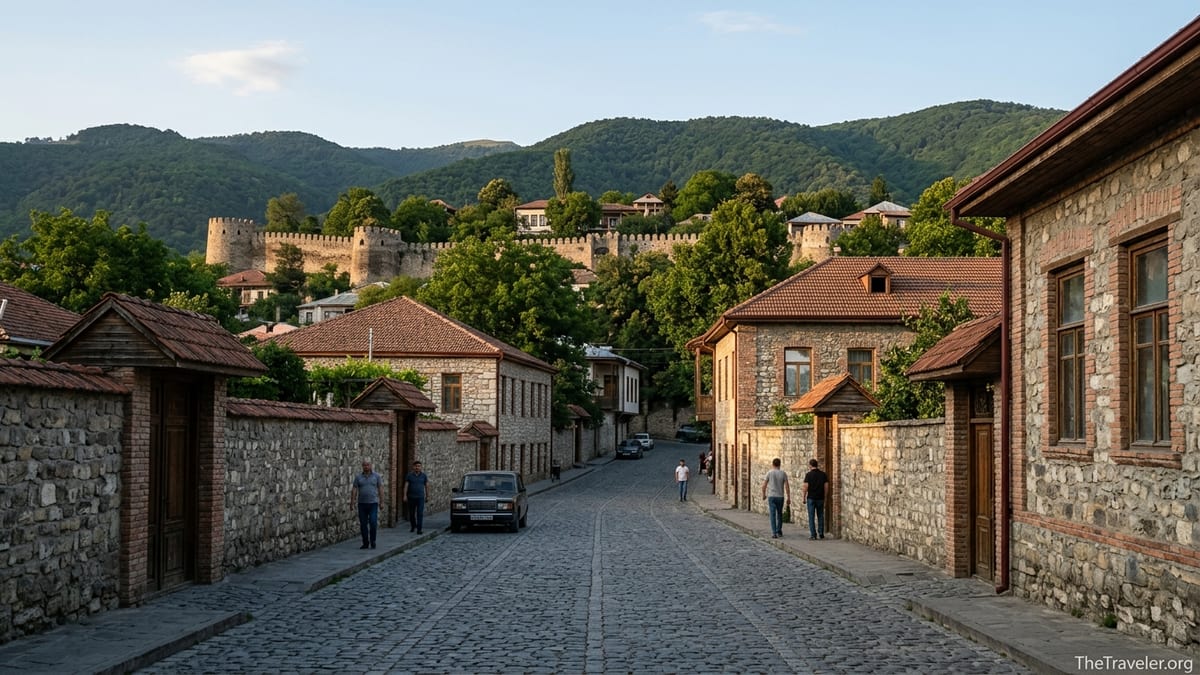
Where Sheki Is and Why It Matters
Sheki (often written Shaki) sits in northwestern Azerbaijan, about 300 to 350 kilometers from Baku depending on the route. The town lies on the southern slopes of the Greater Caucasus mountains, at the point where forested hills meet fertile plains. Historically, this geography placed Sheki on key trade routes that linked Persia with the North Caucasus and the Black Sea. Modern visitors still notice this crossroads feeling in the mix of architecture, languages and food influences.
In 2019, UNESCO recognized the Historic Centre of Sheki with the Khan’s Palace as a World Heritage site, highlighting its role as an 18th century silk and trading town with distinctive architecture and town planning. Within a compact area you can see the fortified khan’s complex, caravanserais where merchants once slept beside their pack animals, and winding lanes of low-rise houses with high brick or stone walls that protect inner gardens. Travelers who enjoy walking through preserved historic quarters rather than reconstructed “old towns” tend to find Sheki particularly rewarding.
The town itself is relatively small. Population estimates vary, but visitors usually experience Sheki as a relaxed regional center rather than a bustling city. This scale is part of the appeal. You can walk from the main square up to the fortress area in 20 to 30 minutes, stop for tea or sweets along the way, and never feel crushed by traffic or crowds. For many people coming from Baku, where major sights are spaced out across a large urban area, this slower pace is one of the main reasons Sheki feels worth the detour.
That said, Sheki is not a mountain resort village nor a national park. The surrounding hills are attractive and there are short hikes and village trips nearby, but if your main interest is serious trekking in the high Caucasus you may prefer destinations like Khinaliq or Lahij. It makes more sense to think of Sheki as a cultural and historical stop in a green setting than as a pure nature destination.
What Makes Sheki Special on the Ground
The single site that most often convinces visitors that Sheki is worth the journey is the Palace of the Sheki Khans. Built in the late 18th century as the summer residence of the ruling family, this two-story building sits inside the old fortress walls above town. Its exterior is covered with painted panels and intricate wood latticework, while the interior rooms are lined with frescoes, stained glass and delicate wood inlay. Many travelers compare it favorably with more famous palaces in Tbilisi or Isfahan, largely because the artistry is concentrated into a relatively small, beautifully preserved space.
Entry to the palace is usually inexpensive by international standards, typically just a few euros or dollars equivalent per adult, sometimes with a small extra fee for taking photos inside. Local guides at the entrance often offer short tours in English, Russian and sometimes other languages for a modest price. Recent travelers describe these 20 to 30 minute tours as very helpful for understanding the symbolism of the stained glass and wall paintings, which depict hunting scenes, floral motifs and geometric patterns rather than court portraits.
Just downhill from the palace is the cobbled upper town, where you find two historic caravanserais. Today, parts of these stone complexes function as a hotel and restaurant, with arched galleries around courtyards. Even if you are not staying there, it is worth walking through to get a feel for how merchants once lived on the Silk Road. Sitting in the courtyard in the evening with a glass of local wine or pomegranate juice can be a memorable experience, especially outside of high summer when temperatures are cooler.
Sheki is also known for its sweets, particularly halva and layers of nut pastry flavored with spices and syrup. Dozens of small confectionery shops line the main street between the town center and the fortress road. Travelers often mention popping into several shops to sample different family recipes. Prices are generally low enough that you can buy a small selection for the equivalent of a few dollars, making Sheki one of the better places in Azerbaijan to pick up edible gifts that are genuinely local rather than generic souvenirs.
How to Get to Sheki and How Long to Stay
Reaching Sheki takes a bit of effort and planning, which is one of the main reasons travelers debate whether it is worth including for shorter trips. From Baku, you can typically choose between an overnight train, a daytime bus or minibus, and private or shared taxi. Schedules change, but as of spring 2026, travelers report at least one night train most days from Baku’s central station to Sheki’s railway station, taking roughly six hours and arriving around dawn. Tickets booked directly with Azerbaijan Railways are generally affordable, often in the range of what you might pay for a mid-range dinner in Baku for one.
Bus services from Baku’s international bus terminal toward Sheki usually run several times a day. Travel times hover around five to six hours depending on traffic and road conditions. Ticket prices reported by recent visitors are budget friendly, commonly under the equivalent of 10 US dollars. The main trade-off is comfort: long-distance buses may lack onboard toilets and can feel crowded, especially around weekends or national holidays, so buying tickets a day in advance or via local ticketing apps is recommended when possible.
For small groups or travelers short on time, a private taxi arranged through a local driver, hotel, or ride-hailing app can cut the journey to roughly four to four and a half hours, depending on traffic and stops. Recent anecdotal reports suggest one-way fares from Baku to Sheki in the range of roughly 100 to 140 Azerbaijani manat, which can be reasonable if shared between three or four people. However, it is essential to agree the price in advance and clarify whether tolls or waiting time are included.
Because of the travel time, most independent travelers find that one full day in Sheki plus travel time on either side feels rushed. A common pattern is to arrive in the morning (by night train or early bus), spend that day and the following morning exploring the khan’s palace, caravanserais and town center, then depart the afternoon of the second day. If you also want to visit nearby villages like Kish, or relax at a countryside resort, two nights in the region is more comfortable. For a very short overall trip to Azerbaijan of four to five days, travelers often have to choose between focusing only on Baku and its surroundings or trading one Baku day for an overnight in Sheki.
Costs, Accommodation and Food: What to Expect
One of Sheki’s quiet advantages is cost. Outside a few polished resorts, most expenses are noticeably lower than in central Baku. Simple but clean guesthouses and small hotels in the old town have been reported at prices roughly equivalent to a budget hotel in a smaller European city, often including breakfast. Mid-range hotels in or near the center, such as converted historic buildings, tend to be more expensive but still competitive compared with similar heritage properties in Western Europe.
For travelers seeking more facilities, a handful of resort-style properties sit in the hills outside town, offering landscaped grounds, pools and family-friendly amenities. These are popular with domestic tourists from Baku, especially in summer and on weekends, so advance booking for Friday and Saturday nights is advisable. Prices at such resorts can approach those of international four-star hotels, but many travelers find them good value if they plan to spend full days on site enjoying the pools and spa areas rather than just sleeping there.
Eating out in Sheki is generally affordable. Local restaurants around the center and fortress road serve Azerbaijani staples such as kebabs, piti (a slow-cooked lamb and chickpea stew), and qutab (stuffed flatbreads). A typical sit-down meal for two with salads, main dishes and non-alcoholic drinks often costs less than a casual dinner for two in central Baku. Cafes in and around the caravanserai courtyards provide teas served in pear-shaped armudu glasses, Turkish-style coffee and light snacks. Vegetarian options exist but are usually limited to salads, breads, cheeses, egg dishes and vegetable stews, so strict vegetarians may want to bring extra snacks.
Alcohol is available in many restaurants and hotels, but the overall atmosphere is quiet rather than party focused. Travelers looking for craft cocktail bars or clubs similar to those in Baku or Tbilisi are likely to be disappointed. Evenings in Sheki usually revolve around long dinners, tea, and strolling the main streets or hotel grounds. This suits couples, families and slow travelers, but less so visitors whose priority is nightlife.
Best Time to Visit and On-the-Ground Practicalities
Sheki experiences warm summers, cool winters and pleasantly mild shoulder seasons. For most travelers, late April to early June and September to mid-October offer the most comfortable balance of temperature and foliage. During these periods, daytime highs are often warm enough for light clothing, while evenings call for a light jacket. In July and August, daytime heat can be strong, especially in the lower town, though the shade of trees and higher elevation compared with Baku make it somewhat more tolerable.
Winter, from December to February, brings colder temperatures and occasional snow. Some rural guesthouses may close or operate with reduced services, and outdoor cafes around the caravanserais can feel quiet. That said, winter can also be atmospheric if you enjoy off-season travel, with mist around the fortress walls and few other visitors inside the palace. The main consideration is shorter daylight, which makes time management more important if you are doing a quick visit from Baku.
On the ground, Sheki is walkable but hilly. The climb from the main square to the fortress and palace area takes most people 15 to 25 minutes on foot along a gradually rising road. Taxis are available for those who prefer not to walk uphill, and fares for short in-town trips are usually low. Streets can be uneven, with cobbles and occasional potholes, so comfortable walking shoes are more practical than sandals with thin soles.
English is increasingly spoken in hotels and by younger residents, but Russian and Azerbaijani remain the most common languages. At small restaurants and shops, you might need to rely on translation apps, pointing at menu items, or basic phrases. Travelers consistently report that locals are friendly and willing to help with directions and bus information, though information can be inconsistent, especially regarding departure times. It is wise to double-check schedules with your hotel or more than one local source the day before you travel.
Who Will Love Sheki (and Who Might Not)
Sheki tends to appeal strongly to travelers who enjoy history, architecture and atmosphere over box-ticking big sights. If the idea of spending an afternoon slowly exploring an 18th century palace, wandering through stone caravanserais and lingering in tea houses sounds appealing, Sheki will likely be a highlight. Photographers appreciate the combination of mountain backdrops, traditional houses and intricate stained glass. Many overland travelers between Baku and Tbilisi also find Sheki a natural stopover that breaks up what would otherwise be a long journey.
Couples on a relaxed itinerary, solo travelers who enjoy quiet towns, and families seeking a calm environment often rate Sheki highly. It is manageable in size and generally feels safe to walk around until late evening. Parents traveling with children sometimes prefer resort-style accommodation on the outskirts for pools and open space, using taxis or hotel shuttles to visit the historic center during the day.
On the other hand, travelers pressed for time, or those primarily interested in modern dining, shopping and nightlife, may find that Sheki does not justify the travel time from Baku. If you have only three or four full days in Azerbaijan, devoting a full day to travel there and back plus at least one night might feel like too much compared with simply exploring Baku’s historic core, seafront boulevard and day trips to Gobustan and the Absheron Peninsula. Likewise, hikers intent on multi-day treks at higher altitudes might prefer to head directly to more rugged mountain villages and treat Sheki as an optional extra rather than a core destination.
It is also worth noting that tourism infrastructure, while improving, still has gaps. Online booking for some local guesthouses can be patchy, credit card acceptance is not universal, and detailed English-language information at smaller museums is limited. For many travelers, these are minor inconveniences and part of the charm of visiting a less heavily touristed town. For others, particularly those who prefer highly polished, fully packaged experiences, this may be a reason to focus elsewhere.
The Takeaway
So, is Sheki worth visiting? For many travelers, the answer is yes, provided the expectations are right. The town’s UNESCO-listed historic center, the richly decorated Palace of the Sheki Khans, and the atmospheric caravanserais together offer a concentrated glimpse of the Caucasus’ Silk Road era that you simply cannot get in Baku alone. Combined with good value food and accommodation, friendly locals and a slower pace of life, Sheki can easily become the most memorable stop on an Azerbaijan itinerary.
At the same time, Sheki requires a real investment of travel time. Reaching it from Baku generally means at least five to six hours by road or train each way, which can be significant on a short trip. Its low-key evenings, limited nightlife and modest infrastructure will not suit everyone. If your priority is big-city attractions, beach clubs or high-end shopping, or you have very few days in the country, you may decide that the detour is not essential.
For travelers who enjoy history, traditional architecture, and the feel of a lived-in town framed by green hills, Sheki is more than worth the journey. Two nights give enough time to see the main sights, taste local sweets, perhaps visit a nearby village and still enjoy some unhurried hours in a teahouse courtyard. Approached with realistic expectations and a flexible schedule, Sheki rewards visitors with exactly the kind of grounded, real-world travel experience that many people hope to find in the Caucasus but do not always encounter in the most obvious places.
FAQ
Q1. How many days do I need in Sheki?
Most travelers find that one full day plus one or two nights is enough to see the khan’s palace, caravanserais and town center without rushing. If you also want to visit nearby villages or relax at a countryside resort, two nights in the region is more comfortable.
Q2. Is Sheki safe for solo travelers?
Sheki is generally perceived as safe, including for solo travelers walking in the evening around the main streets and old town. Normal precautions apply: keep valuables secure, avoid poorly lit alleys late at night and agree taxi prices before starting the ride.
Q3. Can I visit Sheki as a day trip from Baku?
Technically it is possible, but not recommended. Travel from Baku to Sheki usually takes five to six hours each way by road or rail, so a same-day return would leave very little time on the ground. Most visitors prefer to stay at least one night.
Q4. Do I need to book train or bus tickets to Sheki in advance?
For overnight trains, advance booking is strongly advised, especially in summer and on weekends, because berths can sell out. Bus tickets are often available on the day, but around public holidays or busy weekends it is wise to buy them at least a day ahead or use local ticket apps when possible.
Q5. Is Sheki expensive compared with Baku?
Overall, Sheki is usually cheaper than central Baku. Guesthouses and small hotels tend to be better value, restaurant prices are lower, and local sweets and souvenirs are relatively inexpensive. High-end resorts around Sheki can approach big-city prices but often include more space and facilities.
Q6. What should I wear when visiting the Palace of the Sheki Khans?
There is no strict dress code for the palace, but modest, respectful clothing is recommended. Comfortable shoes are important because floors can be uneven and you may walk up and down small staircases. In hot weather, light, breathable fabrics are best, with a shawl or light jacket for cooler palace interiors.
Q7. Are credit cards widely accepted in Sheki?
Major hotels and some larger restaurants accept credit cards, but many smaller cafes, shops and guesthouses operate on a cash basis. It is sensible to carry enough Azerbaijani manat for daily expenses and not rely solely on cards or mobile payments.
Q8. Is Sheki suitable for families with children?
Yes, many families enjoy Sheki’s relaxed pace, pedestrian-friendly streets and relatively low traffic in the center. Children often like exploring the fortress walls and palace gardens. Families may prefer hotels or resorts with outdoor space and, in summer, pools, then use short taxi rides to reach the historic center.
Q9. Can I combine Sheki with other destinations in one trip?
Sheki is often combined with Baku and other northern or western towns such as Gabala or Qakh. Some travelers use Sheki as a stopover on an overland route between Baku and Georgia. Just keep in mind travel times, as mountain roads and intercity journeys can take longer than the distance alone might suggest.
Q10. When is the best time of year to visit Sheki?
The most comfortable periods are usually late spring and early autumn, roughly from late April to early June and September to mid-October. Summer can be hot but is still popular, while winter sees fewer visitors and colder, sometimes snowy conditions, which can appeal to those who enjoy quiet, off-season travel.