


I thought I knew what a hard East Coast hike felt like. I had trained on steep New Hampshire trails, shuffled up rocky Catskills routes, and even done the famed Old Rag scramble in Virginia. So when friends suggested Whiteoak Canyon in Shenandoah National Park as a “moderate waterfall hike with a good workout on the way back,” I packed a light daypack and did not overthink it. Only later, clawing my way back out of the gorge, quads burning and water nearly gone, did I realize that the climb out of Whiteoak Canyon was far tougher than anything I expected.
Get the latest updates straight to your inbox!
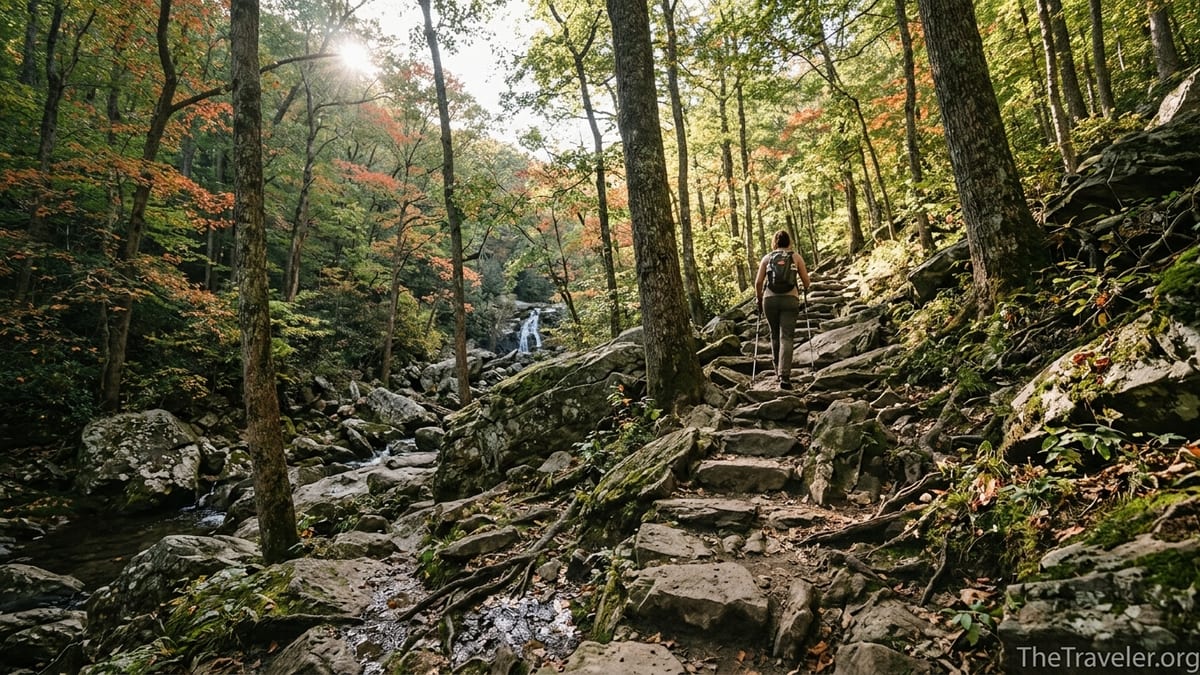
Meeting Whiteoak Canyon for the First Time
Whiteoak Canyon sits in the central district of Shenandoah National Park in Virginia’s Blue Ridge Mountains, a deeply cut gorge carved by the Robinson River. The area is renowned for a chain of six waterfalls, including one of the tallest in the park at roughly 80-plus feet, along with countless smaller cascades that crash over mossy ledges into clear, cold pools. From Skyline Drive, the trail drops steadily into the canyon, following the river as it tightens into a dramatic chute of rock and water.
Most visitors experience Whiteoak Canyon as either a 2-mile round-trip stroll to the lower falls from the park boundary or a 4.6-mile outing to the upper falls from the Skyline Drive side, both of which the National Park Service describes as ranging from easiest to moderate with around 500 to 1,040 feet of elevation gain. On paper, that sounds manageable for anyone comfortable walking a few hours on uneven ground. What those numbers do not fully convey is how that elevation is stacked into relentless grades, how rocky and rooty the tread can be, and how much the character of the trail changes when you combine segments into a longer loop.
When I arrived on a mild spring morning, the Whiteoak Canyon parking area off Skyline Drive looked inviting rather than intimidating. Families adjusted kids’ tiny hiking shoes, couples in running shorts stretched at the trailhead kiosk, and a pair of trail runners jogged past, poles tucked under their arms. The air smelled of damp leaves and hemlock. It felt like the start of an easy day, not the prelude to one of the hardest climbs I had done in Virginia.
The descent from Skyline Drive into the canyon lulled me into further complacency. The trail rolls gently at first, then begins to dip more decisively toward the sound of rushing water. In less than a mile the hum becomes a roar, and glimpses of the first cascades flash through the trees. You lose elevation quickly but almost without noticing, distracted by the growing intimacy of the gorge, the slick rock walls, and the spray that cools the air. That easy, almost playful start is part of what makes the climb back out so punishing.
Why the Climb Out Feels So Brutal
On the map, a typical upper Whiteoak Canyon hike is a straightforward out-and-back: about 4.6 miles and roughly 1,000 feet of elevation gain total. For hikers accustomed to Western mountain stats, that might sound nearly casual. The reality underfoot tells a different story. Unlike gradual switchbacks that spread climb over many miles, Whiteoak Canyon often pitches straight up the slope on rocky steps, roots, and eroded sections where rain has carved channels in the soil. The gain is compressed into long, sustained pulls that punish tired legs.
What makes the return so difficult for many people is the combination of cumulative fatigue and the psychological whiplash of reversing the route. The trip down is filled with payoffs: one waterfall after another, deep pools where hikers in late summer sometimes wade or even carefully slide down smooth rock chutes, and shaded boulders perfect for lunch breaks. You keep descending because there is always another view just ahead. When you finally turn around, the realization hits: every easy step downhill now has to be earned back on the way up, often under more heat and with less water than you planned.
On my climb out, I felt that reality almost immediately. After lingering at an overlook above one of the biggest falls, I started back just after midday. By then, temperatures in the canyon had crept into the upper 70s Fahrenheit, and the still air trapped humidity along the river. The ascent began on rough stone steps, some a full knee height, that demanded big, lunging movements. Within 15 minutes my heart rate was spiking, and my light daypack, which felt barely there on the way down, suddenly pulled on my shoulders like a small boulder.
The trail also narrows and tilts in places where water and use have worn the tread into slanted shelves of dirt and rock. On tired legs, that side-slope walking adds a subtle instability, forcing your stabilizer muscles to work harder with each step. For less experienced hikers or those in trail runners with minimal ankle support, it can feel like a battle for balance. Add in the steady procession of hikers still heading down as you climb, and you may find yourself pausing not just for breath but to let others pass on small, precarious platforms.
How Whiteoak Canyon Compares to Other Shenandoah Hikes
Shenandoah is famous for Old Rag, the 9-mile loop with roughly 2,300 to 2,500 feet of gain and a boulder scramble that has become a rite of passage among Mid-Atlantic hikers. In online discussions, an interesting pattern emerges: people who have done both sometimes report that Whiteoak Canyon, especially when combined with adjacent routes, feels harder in some ways than Old Rag. The difference is not only in raw numbers but in how the effort is delivered and how predictable it feels.
On Old Rag, the most strenuous section is obvious. After a long approach, you hit the exposed granite spine, where you hoist yourself over boulders, squeeze through cracks, and occasionally use your hands to pull up short ledges. It is intense, but the route is clear, and you know you are in the heart of the challenge. Once you crest the summit and start heading down the fire road, the grade becomes more forgiving, even if the mileage remains long.
Whiteoak Canyon, by contrast, delivers its difficulty more quietly. The waterfalls distract you from how much elevation you are losing. If you link Whiteoak Canyon with Cedar Run Trail or even push up to nearby Hawksbill Mountain, the park’s highest peak, the combined vertical gain can exceed 3,000 feet in a single day. Runners training for bigger mountain objectives in the Rockies or the Alps have been known to repeat Whiteoak Canyon to Hawksbill loops to accumulate 5,000 to 7,000 feet of vertical gain in a weekend. That is a serious workout by any standard, packed into the lower elevation forested hills of Virginia.
Even if you stick to a shorter Whiteoak outing, the terrain can feel more rugged than many “moderate” trails elsewhere in the park, such as the Hawksbill Summit loop from Skyline Drive, which offers big views for relatively modest effort, or the paved walkways around visitor centers like Big Meadows. If most of your hiking experience comes from well-groomed paths or rolling woodland walks, the rockiness and steepness of Whiteoak Canyon may take you by surprise.
Real-World Mistakes That Turn a Moderate Hike into a Sufferfest
Watching other hikers on my way out of Whiteoak Canyon, I realized how common it is to underestimate this trail. Several concrete missteps kept showing up. The first was water. Many people seemed to carry a single 16 or 20 ounce bottle, enough for an easy walk around a city park but not for a half-day effort on a humid mountain trail. By the time they began the climb back out, that bottle was long gone. Along one steep section, I passed a couple from Richmond who had stopped to ration the last few sips from a shared bottle, faces flushed and speech clipped. They had assumed the presence of a river meant water would be easy to access and safe to drink; they had not brought filters or purification tablets.
Footwear was another recurring theme. I saw more than a few people in gym sneakers with flat soles or casual slip-on shoes, the kind you might wear for errands on a paved sidewalk. On damp rock slabs near the falls, some of those hikers slid and windmilled their arms wildly to stay upright. On the climb out, the lack of tread and structure made every step feel like a gamble, especially on loose gravel over hardpack soil. Proper trail shoes or light hiking boots with grippy soles and at least some toe protection can make the difference between a confident, steady ascent and a nerve-wracking crawl.
Timing also played a major role. It is tempting to arrive late morning, especially if you are driving from Washington, D.C., Charlottesville, or Richmond and stopping at overlooks along Skyline Drive. But starting down into the canyon at 11 am or noon means turning back just as the day’s heat peaks. In July or August, the air along the river can feel like a sauna, and the climb out turns into a slow-motion grind. During my hike, I met a group of college students who had begun late after a night of camping. By the time they were halfway up, several had shirts soaked through and stopped every couple of switchbacks to rest on rocks, muttering that they had not realized “Virginia could feel like this.”
How to Prepare for the Climb Out
Approaching Whiteoak Canyon with the seriousness it deserves does not mean turning it into a high-altitude expedition. It simply requires realistic planning and basic mountain sense. Start with water. For most adults, carrying around 2 liters for a half-day effort in warm weather is a reasonable baseline, more if you know you sweat heavily. Many hikers use a 2-liter hydration bladder plus an extra 16 to 20 ounce bottle they can sip at viewpoints. If you plan to linger at the falls, consider bringing a compact filter bottle or lightweight pump so you can safely refill from the river if needed.
Food is almost as important as water for getting out of the canyon with some energy left. Think in terms of easily digestible snacks rather than a single, heavy meal. A mix of salty items like trail mix with nuts and pretzels, energy bars, and even a few pieces of fruit or gummy candies can give you steady fuel. During my climb, I found that nibbling every 30 to 40 minutes, even when I did not feel especially hungry, helped keep fatigue from snowballing into a full crash.
Clothing and gear should match the terrain. Lightweight hiking shoes or trail runners with aggressive tread provide traction on both dry and damp rock. In spring and fall, start with layers: a moisture-wicking base, a light long-sleeve or fleece, and a packable shell if rain is in the forecast. In summer, emphasize breathability but do not neglect sun protection. Even though much of the trail is shaded, some overlooks and stretches near the waterfalls are more exposed, and reflective rock can intensify the sun. A brimmed hat, sunglasses, and a small bottle of sunscreen are worth the weight.
Finally, treat the climb out as the main event, not just the final chore. Budget your time so you can ascend at a sustainable pace. If it took you two hours to reach your turnaround point, expect the return to take at least as long, often more. Build in pauses every 15 to 20 minutes to catch your breath, sip water, and stretch your calves and hip flexors. Using trekking poles, even inexpensive adjustable ones, can significantly ease the strain on your knees and quads during the steepest sections.
Seasonal Factors That Can Make the Climb Harder
Whiteoak Canyon changes dramatically with the seasons, and each brings its own challenges. In late spring, snowmelt and seasonal rains can swell the waterfalls and stream crossings, turning some rocks slick with algae and increasing the force of water in narrow chutes. The trail in May can be a patchwork of mud, damp roots, and shallow puddles, all of which demand careful foot placement on the climb out.
Summer introduces heat and humidity, especially in July and August. Afternoon thunderstorms can build quickly along the Blue Ridge, turning dry stone steps into small cascades and saturating the soil into a slick paste. Even when skies are clear, the shaded canyon can feel airless compared with breezier ridgelines like those near Hawksbill or Stony Man. Mosquitoes and gnats also make lingering at lower elevations less appealing, encouraging hikers to push faster than their fitness comfortably allows.
Autumn may be the most immediately beautiful time to visit, with maples and oaks painting the gorge in oranges and reds. But leaf litter can hide rocks and roots on the trail, turning what looks like a smooth path into an ankle-twisting obstacle course. Downed leaves also reduce traction on steeper pitches, especially after a light rain. Many hikers also underestimate cooler October or early November days, layering too heavily at the start and then overheating on the climb.
Winter transforms Whiteoak Canyon into a more serious undertaking. Ice can form on the waterfalls and spray the surrounding rocks and steps with a thin, nearly invisible glaze. In cold snaps, the stone steps that felt challenging in summer become treacherous. Microspikes or similar traction devices are strongly advisable if you plan to hike in freezing conditions, and daylight hours are short, leaving less margin for slow progress on the way out.
The Emotional Highs and Lows of the Climb
The physical difficulty of climbing out of Whiteoak Canyon is only part of the story. There is also an emotional arc that many hikers experience. The descent is full of anticipation and easy conversation: jokes traded among friends, kids asking how many waterfalls are left, partners planning where to stop for dinner after the hike. The river soundtrack keeps spirits buoyant, and each new cascade feels like a reward.
On the return, the mood often shifts. Conversation drops away as breathing becomes heavier. Some groups start to spread out, with stronger hikers pulling ahead and others falling behind. Short tempers can flare, especially if someone in the group pushed for the hike while others were unsure. I watched one family negotiate this dynamic in real time: a teenager pausing to glare at a steeper stretch, a parent quietly moving behind to offer a steadying hand, and eventually everyone sharing a relieved laugh when they reached a flatter section near the top.
Yet it is precisely this difficulty that makes the eventual exit onto Skyline Drive feel so satisfying. When you crest the final rise and see the parking lot, the sense of having earned the views and waterfalls below is profound. That evening, stopping at a casual restaurant in nearby Luray for a burger and a cold drink, I noticed the same dusty calves and tired but content faces among other diners. People compared notes about their day in Shenandoah, swapping stories of misjudged water needs and underestimated climbs, and more than one mentioned Whiteoak Canyon with a mixture of awe and respect.
For many hikers, this emotional journey becomes part of Whiteoak Canyon’s allure. It is not just a place to see waterfalls but a trail that pushes you enough to recalibrate your sense of what you can handle, all within a few hours’ drive of major East Coast cities. The climb out, in all its sweaty, slow-motion intensity, is what engraves the memory of the day.
The Takeaway
The climb out of Whiteoak Canyon was harder than anything I expected, not because the numbers on the map were extreme but because the terrain, conditions, and psychology of the hike combined to amplify the effort. Descending into a beautiful gorge can feel deceptively easy; reclaiming that lost elevation on steep, rocky steps under rising heat is another story. For anyone used to well-graded, short local trails, this Shenandoah classic can feel like a serious mountain workout.
That challenge, however, is part of Whiteoak Canyon’s enduring appeal. With realistic planning, adequate water and food, proper footwear, and respect for the season, hikers of moderate fitness can experience one of the park’s most dramatic landscapes and emerge with a deeper confidence in their abilities. The waterfalls, swimming holes, and lush forest make the descent unforgettable; the climb back out ensures you will never confuse this place with a casual stroll.
If you arrive with eyes open and expectations aligned with reality, Whiteoak Canyon becomes less an ordeal and more a powerful reminder that true rewards in the outdoors are often earned on the way back up. The climb may be brutal, but the memory of finishing it, looking back down the gorge from Skyline Drive, lingers far longer than the ache in your legs.
FAQ
Q1. How difficult is the Whiteoak Canyon hike really?
The difficulty ranges from easy to strenuous depending on the route, but many hikers find the climb out from the waterfalls surprisingly tough because of steep, rocky sections.
Q2. How much water should I bring for a day in Whiteoak Canyon?
Plan for about 2 liters per adult for a half-day hike in warm weather, and consider extra or a filter if you expect to linger at the falls.
Q3. Are the waterfalls at Whiteoak Canyon safe for swimming?
Some pools are commonly used for wading or careful swimming in summer, but currents, slippery rocks, and variable depths mean you should enter cautiously and always at your own risk.
Q4. What kind of shoes do I need for Whiteoak Canyon?
Sturdy trail runners or hiking boots with good tread and toe protection are strongly recommended due to rocky steps, roots, and occasionally wet, slick surfaces.
Q5. Is Whiteoak Canyon harder than Old Rag?
Old Rag has more total elevation gain and a rock scramble, but many hikers find long Whiteoak Canyon combinations just as tiring because of sustained climbs and rugged footing.
Q6. When is the best season to hike Whiteoak Canyon?
Late spring and fall usually offer the best balance of water flow, temperature, and trail conditions, though each season brings its own challenges like mud, heat, or ice.
Q7. Can families with children do the hike?
Yes, many families hike shorter versions to the lower waterfalls, but adults should be realistic about children’s stamina and plan turnaround points before the trail becomes too steep.
Q8. Do I need special permits to hike Whiteoak Canyon?
You need a Shenandoah National Park entrance pass, but no separate day-use permit is typically required for Whiteoak Canyon itself at this time.
Q9. How early should I start to avoid crowds and heat?
Starting between 7 am and 9 am usually helps you enjoy a cooler descent to the falls and makes the climb out more comfortable before midday heat and larger crowds arrive.
Q10. What should I do if I realize the climb out is too hard?
Slow your pace, rest often, hydrate, and snack regularly. If someone shows signs of heat illness or severe exhaustion, stop in a shaded area and be prepared to seek assistance from park staff or emergency services if needed.