


Ask frequent New York visitors where they stay, and more of them than ever will name Jersey City. For many, it starts with price: hotel rates that are often noticeably lower than Midtown, bigger rooms, and PATH access that can put you at the World Trade Center in minutes. But something surprising happens once they arrive. Between the skyline waterfront, neighborhood food scenes, and an energy that feels more local than touristy, travelers realize Jersey City is not just a budget base camp. It is a destination that quietly competes with the city across the Hudson.
Get the latest updates straight to your inbox!
Price First: How Jersey City Wins the Hotel Math
Most visitors discover Jersey City while comparing New York hotel prices. A mid-range chain property near Times Square can easily run several hundred dollars per night before taxes, especially in peak months. On the Jersey City waterfront, comparable hotels often price noticeably lower while offering more space and sweeping skyline views of Lower Manhattan. Properties around Newport and Exchange Place sit right on the Hudson, so your “cheaper” room may come with a view of One World Trade Center and the Statue of Liberty on clear days instead of a brick wall.
Travelers also find that overall trip costs can drop. Many hotels near the Grove Street PATH station or on the waterfront are within a short walk of casual restaurants and neighborhood bars, which means more dinners at local spots and fewer expensive taxis across town. Because downtown Jersey City is compact, visitors can walk between the waterfront, Newark Avenue’s pedestrian plaza, and historic brownstone streets without paying for extra transport.
Transit plays a major role in the value equation. PATH trains connect stations like Grove Street, Newport, Journal Square, and Exchange Place directly to Lower and Midtown Manhattan, with fare products that typically undercut most hotel-to-sightseeing taxi rides for budget-conscious travelers. For someone staying three or four nights and riding into Manhattan daily, that difference quickly adds up, especially compared with surge-priced ride-hailing or airport cabs from outer boroughs.
What surprises many visitors is how little “commuter friction” they feel. From a hotel in Newport or Exchange Place, you can walk to the station in a few minutes, ride under the river, and step out at the World Trade Center or 33rd Street. In practice, commuting from these Jersey City neighborhoods to Manhattan often takes less time than crossing Manhattan itself during rush hour.
Waterfront Views That Feel Like a Secret
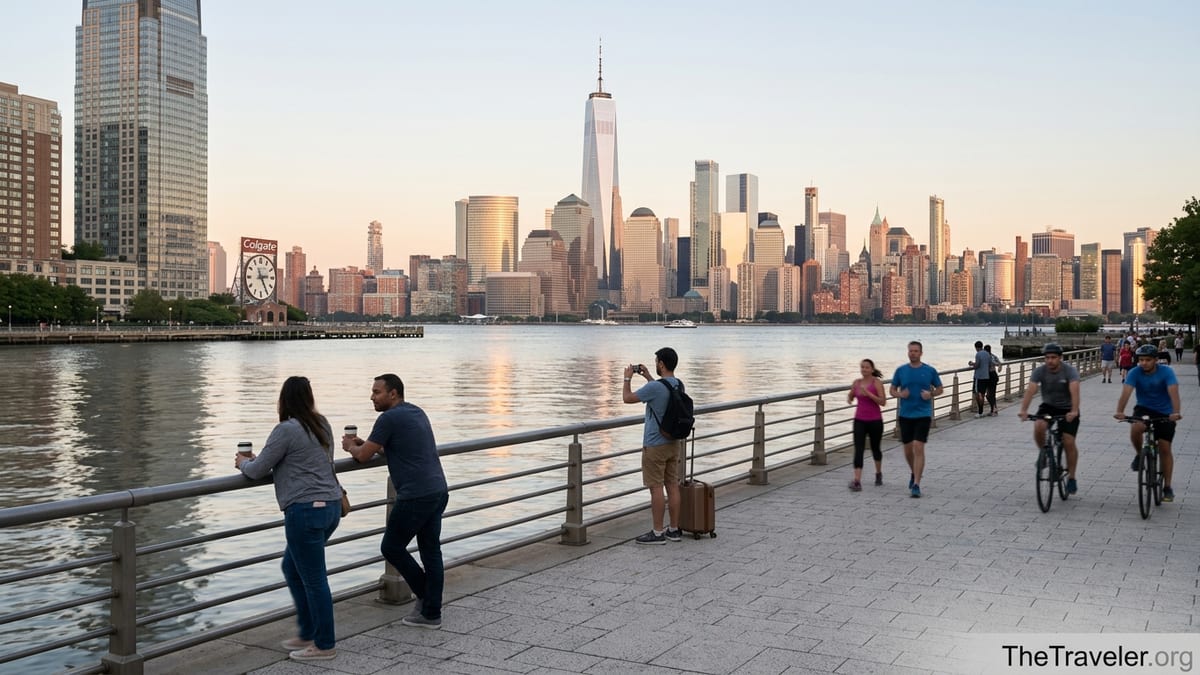
If price gets travelers to book Jersey City once, the Hudson River waterfront is often what convinces them to return. Between Newport, Paulus Hook, and Exchange Place, a continuous promenade frames one of the most cinematic views of New York’s skyline: glass towers in Lower Manhattan, ferries crossing back and forth, and the Colgate Clock anchoring the Jersey side. Visitors who expected a purely functional “sleep and commute” suburb instead find themselves lingering on benches, watching the light change over the city.
The waterfront path is especially powerful for travelers who do not have much time. After a full day of Manhattan sightseeing, many expect to collapse at the hotel; instead, they step outside for “five minutes of fresh air” and end up walking all the way from Exchange Place down toward Liberty State Park or north toward Hoboken. Joggers, families with strollers, dog walkers, and office workers share the path, giving it a lived-in, local feel that contrasts with the more heavily touristed piers across the river.
Specific moments tend to stick with people. A first sunrise, when the sun comes up behind the Manhattan towers and reflects off Jersey City’s own high-rises. A summer evening at the small waterfront parks near Paulus Hook, where kids play while adults sit with takeaway coffees or ice cream. Watching World Trade Center’s lights switch on at dusk from a quiet bench, while ferries and water taxis arrive and depart just steps away.
Because many hotels cluster within a short walk of this waterfront, it becomes part of the daily rhythm of a Jersey City stay. Guests step out each morning on their way to PATH, and again at night on the way back from dinner. By the end of a long weekend, what was booked as a money-saving compromise often feels like an upgrade: New York’s skyline as a private backdrop rather than a distant attraction.
Downtown Streets Where Travelers Feel Like Locals
Downtown Jersey City’s grid around Grove Street has quietly transformed into one of the region’s most walkable, neighborhood-feeling districts. Newark Avenue near Grove Street has been turned into a pedestrian plaza, creating a car-free stretch lined with restaurants, cafes, and bars with outdoor seating. For visitors, this feels instantly approachable: step off the PATH at Grove Street and you are already on a lively street where you can choose between Indian, Italian, ramen, tacos, or a quick slice of pizza within a block or two.
Unlike heavily curated tourist corridors, Newark Avenue and its surrounding blocks still function as a neighborhood main street. There are independent coffee shops where locals work on laptops, casual spots for dosa or biryani, relaxed wine bars, and late-night venues that draw residents from across the city. Travelers who expected to spend every evening in Manhattan quickly realize they can stay close to their hotel and still have a packed night out.
Venture a few minutes from Grove Street, and each pocket of downtown offers a different texture. Near Hamilton Park and Van Vorst Park, 19th-century brownstones line leafy streets, with small cafes and neighborhood restaurants on the corners. Around the Powerhouse Arts District, converted industrial buildings hint at the city’s port and rail history. In Paulus Hook, narrow streets end at tiny waterfront parks and ferry landings, where commuters hop across to Lower Manhattan.
Small details add up: a Thursday-night farmers’ market near Grove Street in warmer months, families queuing for ice cream on a side street, local musicians performing in small venues. These are not “sights” in the guidebook sense, but they create precisely the sort of everyday atmosphere that many travelers find missing in heavily touristed parts of Manhattan.
A Food Scene That Rewards Exploring
Food is often what turns a “maybe we’ll stay here again” into a firm tradition. Jersey City’s restaurant landscape has expanded quickly, especially downtown and along Newark Avenue, and visiting diners benefit from that growth. On a single block you might find a modern Indian spot serving butter chicken and vindaloo, a cozy Italian restaurant turning out slow-cooked ragù, a ramen bar with steaming bowls and gyoza, and a bar with creative small plates and a deep cocktail list.
Travelers who arrive assuming they will eat mainly in Manhattan often end up building nightly routines around local favorites. One evening might start with coffee and a pastry at a cafe on Newark Avenue, continue with a walk along the pedestrian plaza to find an outdoor table for dinner, and finish with a drink at a neighborhood cocktail bar. Another night might involve a short stroll to a West African or Caribbean restaurant tucked along a side street, or to a vegan cafe near Hamilton Park that doubles as a community hangout.
Breakfast and brunch are equally strong. Around Journal Square and along Newark Avenue, small cafes serve egg sandwiches, bagels, and yogurt parfaits to commuters and visitors alike. Closer to Grove Street, brunch-focused spots draw lines on weekends, with dishes like shakshuka, brioche French toast, or loaded breakfast tacos paired with coffee from local roasters. Because so many of these places are walkable from major hotels, travelers can skip a hotel buffet and dive straight into the local food scene each morning.
The diversity of options reflects Jersey City itself. Longtime residents have roots in South Asia, Latin America, the Caribbean, the Middle East, Eastern Europe, and beyond, and that mix plays out on menus. For visitors who enjoy eating their way through a destination, this means a stay that starts as a budget choice quickly becomes a culinary itinerary, often at prices lower than equivalent meals across the river.
Easy Access to Manhattan Without Sacrificing Calm
The other reason travelers stay in Jersey City is that they can dip into New York’s intensity as needed, then step back from it. PATH trains link downtown Jersey City directly to the World Trade Center and Midtown, and ferries from Paulus Hook and Exchange Place offer a more scenic route in good weather. With these options, many visitors find they can plan days around short, predictable rides instead of long crosstown treks.
A typical pattern might look like this: breakfast near Grove Street, PATH to Lower Manhattan for a morning at the 9/11 Memorial and nearby museums, lunch in Tribeca or Chinatown, then a mid-afternoon return to Jersey City for a rest. In the evening, visitors might head back for a Broadway show or dinner in the East Village, returning late at night to a quieter waterfront and a hotel lobby that feels more residential than transient.
Families and small groups often mention the psychological effect as much as the practical one. Younger children who are overwhelmed by the noise and crowds of Midtown can decompress in a playground near Hamilton Park or in Liberty State Park instead of spending the evening in another busy commercial district. Couples appreciate that they can have a full “city day,” then recover with a peaceful stroll along the Hudson and a relaxed dinner close to their hotel.
For business travelers, Jersey City can be an efficiency upgrade. Offices at the World Trade Center or in Lower Manhattan are one short train ride away, while meeting rooms and co-working spaces on the Jersey side provide additional options. Some companies even advise visiting colleagues to book Jersey City hotels for easier access to both corporate offices and nearby airports without navigating cross-town traffic.
Neighborhood Character and Green Space
What keeps many repeat visitors returning is the sense that Jersey City still feels like a collection of neighborhoods rather than a single tourist zone. Paulus Hook, one of the oldest waterfront communities, mixes historic brownstones with modern high-rises and small waterfront parks. The area around Hamilton Park and Van Vorst Park showcases restored 19th-century rowhouses and tree-shaded squares where children play and dog walkers gather, giving visitors a window into everyday life that can be harder to glimpse in central Manhattan.
Then there is Liberty State Park, one of the region’s most underrated green spaces. Spreading out along the Hudson just south of downtown, it offers biking and walking paths, meadows, and long views of the Statue of Liberty and Ellis Island. For travelers, the park serves several roles at once: morning jogging route, picnic spot, photography location, or simply a quiet place to sit after a crowded day in museums and subways.
Because the park is accessible by foot, bike, light rail, or a short car ride from downtown hotels, it often ends up as a spontaneous addition to itineraries. Visitors who had only planned to “sleep in Jersey” find themselves renting bikes, watching boats on the harbor, or taking photos of the Manhattan skyline reflected in the water. The contrast between this open, green expanse and the dense streetscapes across the river can feel like an unexpected luxury.
Smaller pockets of green also matter. Squares like Hamilton Park, Van Vorst Park, and local playgrounds break up the urban landscape and give families and solo travelers alike a place to slow down. For many, that balance of density and breathing room becomes one of Jersey City’s lasting impressions: urban energy without the constant sensory overload.
The Takeaway
Most travelers discover Jersey City when a hotel search shows they can stay close to Manhattan for less. They come for the numbers: lower nightly rates, easier parking options, and transit costs that make more sense for a multi-day visit. But once they arrive, the reasons to return tend to be different. Waterfront paths at sunset, dinners on a busy pedestrian street, quiet mornings in neighborhood parks, and the sense of stepping into a lived-in city rather than a stage set all leave a mark.
In practice, Jersey City offers an appealing blend of access and atmosphere. It is close enough that you can be in Lower Manhattan in minutes, yet distinct enough that evenings feel like they belong to a different trip entirely. Visitors wake up with the New York skyline outside their window, spend the day crossing and recrossing the river, and then find themselves at a local bar or cafe where staff recognize them by their second or third night.
For budget-conscious travelers, that might start as a pragmatic compromise. For many, it becomes the preferred way to experience the New York area: sleep with a skyline view on the quieter side of the river, play in the city that never sleeps, and savor a base that feels increasingly like its own destination. Jersey City may not be the first city that comes to mind when planning a New York trip, but for a growing number of visitors, it is the place they choose again and again.
FAQ
Q1. Is it really cheaper to stay in Jersey City than in Manhattan?
In many cases, yes. Hotel rates in Jersey City, particularly around the waterfront and Grove Street, are often noticeably lower than equivalent properties in Midtown or Lower Manhattan, and you may get more space and skyline views.
Q2. How long does it take to get from Jersey City to Manhattan?
From downtown Jersey City, PATH trains can reach the World Trade Center in just a few minutes of travel time, and trains from Newport or Grove Street to Midtown take roughly the length of a typical subway ride within Manhattan.
Q3. Is Jersey City safe for tourists to walk around at night?
Areas where visitors typically stay, such as the waterfront, Grove Street, Newark Avenue’s pedestrian plaza, and the historic downtown districts, are busy with locals and commuters and are generally considered safe, though standard city precautions still apply.
Q4. Which Jersey City neighborhoods are best for first-time visitors?
Downtown areas near Grove Street, the waterfront districts around Newport and Exchange Place, and the historic streets of Paulus Hook and Hamilton Park are popular with first-timers due to walkability, dining options, and easy transit.
Q5. Can I see the Statue of Liberty from Jersey City?
Yes. From parts of the waterfront and especially from Liberty State Park, you can enjoy clear views of the Statue of Liberty, Ellis Island, and the Lower Manhattan skyline.
Q6. Do I need a car if I stay in Jersey City?
Not necessarily. Many visitors rely entirely on PATH trains, light rail, ferries, and walking. A car can be useful for exploring New Jersey beyond the immediate area, but it is optional for a city-focused trip.
Q7. What is the food scene like in Jersey City?
Jersey City’s dining scene is diverse and growing, with options ranging from Indian, Italian, ramen, and Latin American spots around Newark Avenue to cafes and neighborhood restaurants near Hamilton Park, Van Vorst Park, and Journal Square.
Q8. Is Jersey City a good base for families visiting New York?
Yes. Families often appreciate the quieter evenings, access to parks like Liberty State Park and Hamilton Park, and the convenience of quick train or ferry rides into Manhattan for sightseeing.
Q9. Are there things to do in Jersey City itself, or is it mainly for commuting?
Beyond serving as a base for New York, Jersey City offers waterfront walks, neighborhood parks, local festivals, a growing arts scene, and a lively pedestrian district around Grove Street that give travelers plenty to do without crossing the river.
Q10. How many days should I plan if I choose to stay in Jersey City?
Many visitors find that three to five nights work well, allowing time for major Manhattan sights plus at least a day or two to enjoy Jersey City’s waterfront, food scene, and parks.