


Open any backpacker forum or digital nomad group in 2026 and the same name keeps coming up when people ask how to handle money abroad: Wise. Once a niche option for tech-savvy freelancers, Wise has moved firmly into the mainstream of travel finance, often replacing traditional bank accounts, debit cards and wire transfers for people who cross borders frequently. The reasons go beyond marketing. For many travelers, the combination of lower fees, clearer pricing and more flexible multi-currency features has made Wise a practical alternative to the high-friction experience of using a conventional bank on the road.
Get the latest updates straight to your inbox!
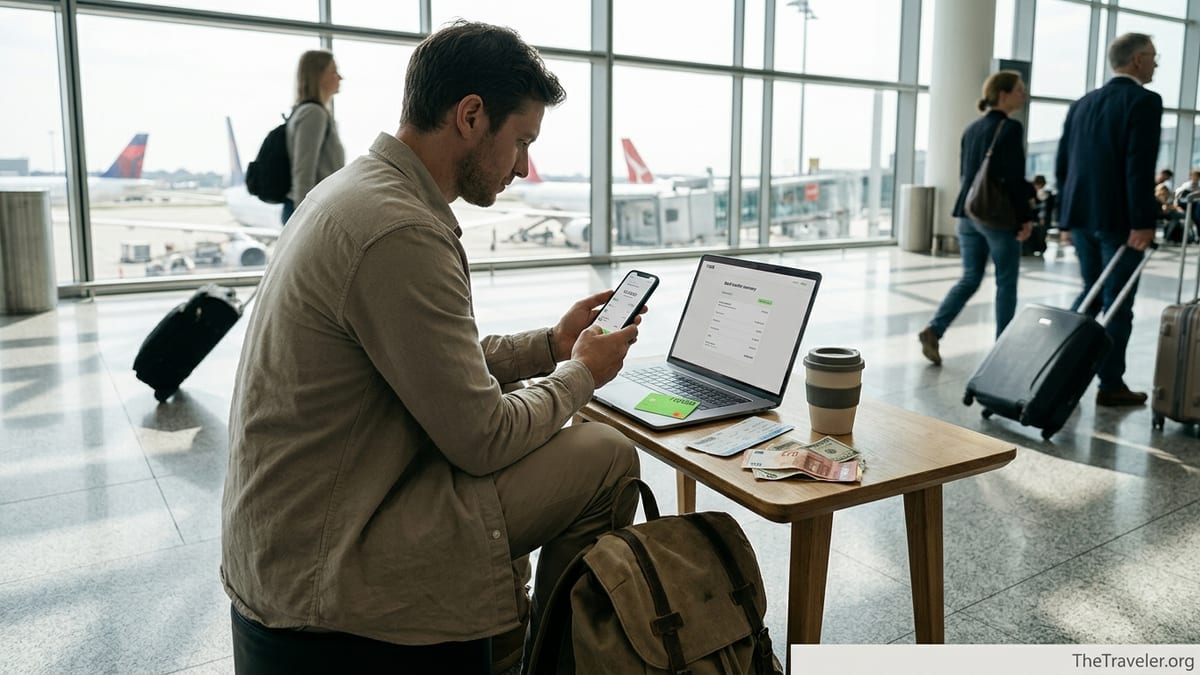
From Bank Queue to Phone Screen: How Wise Fits Modern Travel
Traditional banks were built for an era when most people lived, earned and spent in a single country. When you take those products abroad, the gaps show quickly: opaque exchange markups, international wire charges and fraud alerts that lock your card as soon as you buy a train ticket in another time zone. Wise, by contrast, was designed from day one for people who move money across borders regularly, whether they are short-term tourists, remote workers or long-term expats.
A typical example is a U.S. traveler flying from New York to Lisbon, then on to Bangkok. With a standard U.S. bank debit card, every ATM withdrawal in Europe may trigger a foreign ATM fee plus a bank surcharge, and the purchases often include a foreign transaction fee of around 3 percent on top of a quietly padded exchange rate. Wise instead lets that traveler load dollars into a single multi-currency account, convert some of it to euros and Thai baht at the mid-market rate with a clearly shown fee, then pay in shops or online without opening a local bank account in each country.
For long-term travelers and digital nomads the difference is even more pronounced. Many remote workers use Wise as a hub account: they receive payments in dollars or euros, keep balances in several currencies and then spend or withdraw cash locally with the Wise debit card. That setup would usually require multiple accounts at different banks, often with monthly maintenance fees and residency requirements. Wise compresses that into one app focused on cross-border use, which is precisely where traditional banks often feel the most cumbersome.
None of this means Wise replaces a home-country bank for every purpose. Mortgages, large cash deposits and in-branch services still sit in the banking world. But for the specific act of moving and spending money abroad, the architecture of Wise usually aligns better with the messy reality of modern travel than the domestic focus of most high street and big U.S. banks.
Fees and Exchange Rates: Where Travelers Actually Save
For many travelers, the starting point is simple: international banking with a legacy bank feels expensive. A typical U.S. bank may charge an outgoing international wire fee that ranges from about 5 to 40 dollars depending on the method and currency, plus an incoming wire fee that can reach around 25 dollars when money is received from overseas. On card payments and ATM withdrawals, some banks add a foreign transaction fee and an exchange rate markup that can together approach 3 to 5 percent of the transaction amount.
Wise tackles the problem in two main ways. First, it shows the mid-market exchange rate, the same rate you see on financial news sites, and then adds a clearly itemized transfer fee instead of hiding its profit inside the rate. Reviews from comparison sites and independent testing typically find Wise’s total fee for major currency transfers is often around 0.5 to 1 percent, made up of a small fixed charge plus a variable percentage. That means a traveler sending the equivalent of 1,000 U.S. dollars to themselves in Europe might pay something in the region of a few dollars in total Wise fees, rather than a flat 30 dollar wire charge plus exchange markup at a traditional bank.
Consider a concrete case: an American student needs to move tuition money to a university account in Germany. If their U.S. bank charges 40 dollars for an international transfer in dollars and then uses an exchange rate a few percent worse than the market rate, the cost of a 5,000 dollar payment can easily exceed 150 dollars once everything is accounted for. With Wise, the same student can convert and send euros directly to the German IBAN, seeing an upfront fee that is typically a fraction of that amount for a mainstream currency pair. Over a semester of repeated payments and living costs, the savings can reach the level of an extra short-haul flight or several weeks of groceries.
Even at smaller scales the difference matters. A traveler splitting an Airbnb bill with a friend in another country might send 300 dollars through a traditional bank, only to discover both sender and recipient incur fees, plus a weak exchange rate. Doing the same transfer through Wise usually keeps the cost to a few dollars or less, which is why many travel communities now recommend it as the default for peer-to-peer transfers across borders.
Multi-Currency Accounts: One Wallet for Many Countries
One of Wise’s strongest attractions for travelers is its multi-currency account. Instead of juggling separate bank accounts, you can hold and convert balances in more than 40 currencies inside a single app. Many accounts also come with local bank details in major currencies such as U.S. dollars, euros and British pounds, so you can receive payments as if you held a domestic account in several countries at once.
For a freelance designer based in Mexico but paid by U.S. clients on platforms that support local bank deposits, this is a practical advantage. They can give the client U.S. account details generated inside Wise, receive dollars domestically, and then either keep a dollar balance for future trips to the United States or convert part of it to Mexican pesos at the mid-market rate. If the designer later spends a month in Spain, they can convert some of the same balance to euros ahead of the trip and use the Wise card for everyday expenses in Barcelona, all without opening any new local bank accounts.
Traditional banks struggle to replicate this experience at a reasonable cost. Some offer “global” accounts, but these often come with higher minimum balances, monthly fees or residency requirements in specific markets. Travelers who try to stitch together multiple national bank accounts can find themselves blocked by requests for proof of local address, tax numbers or in-person visits. Wise sits in a middle ground: it is not a full international private bank, but it offers enough multi-currency flexibility for most travel scenarios.
That flexibility shows up in simple moments on the road. A Canadian traveler in Japan, for example, can see their balances in both Canadian dollars and Japanese yen inside Wise, decide when to convert based on the current rate, and then pay in yen at a restaurant using the Wise card. Instead of accepting whatever rate the terminal or home bank chooses on the day, the traveler has already locked in a conversion they understand.
Card Use, ATM Withdrawals and the Fine Print
For day-to-day spending abroad, many travelers use the Wise debit card in the same way they would use a normal bank card: tap to pay in shops, add the card to Apple Pay or Google Pay where available, and withdraw cash from local ATMs when needed. The appeal is that payments are typically charged at close to the mid-market exchange rate, without the foreign transaction fees that many traditional banks apply on top of the card-network rate.
ATM withdrawals are where travelers need to pay more attention. Wise offers a certain level of fee-free cash withdrawal each month, after which it charges a combination of a flat fee and a percentage fee on additional amounts. For U.S. customers, Wise states that ATM withdrawals up to a certain dollar equivalent each month are free from Wise’s own ATM fee, with a percentage fee applying above that threshold, and it also sets daily withdrawal limits for security and compliance reasons. From May 2026, Wise has updated its global ATM withdrawal structure, increasing the fee above certain monthly thresholds to around the high two-percent range in some markets, which has sparked debate in online travel and finance communities.
This is where comparing to traditional banks gets nuanced. A traveler using a typical U.S. or European bank card may face the bank’s foreign ATM fee, the local ATM owner’s fee and a foreign transaction or exchange markup, but those banks sometimes offer high withdrawal limits and in rare cases reimburse third-party ATM surcharges. Meanwhile, a traveler relying solely on Wise must track their monthly free withdrawal allowance and, once they pass it, decide whether it is still cheaper than using a home bank’s card. In countries where cash is still important, like Thailand or parts of Eastern Europe, those thresholds can be reached quickly.
Experienced travelers often use a hybrid strategy. They keep Wise as their primary card for purchases and moderate ATM use, then pair it with a home-country bank card that has a high ATM limit or fee reimbursements. For instance, an American digital nomad might use Wise for most point-of-sale spending in Portugal, then switch to a domestic credit union debit card for a single large ATM withdrawal that attracts a fixed foreign fee but no percentage-based charge, reducing the impact of Wise’s graduated ATM fees. The key is to understand that Wise shines on exchange rates and card payments but has grown less generous on heavy cash withdrawals, particularly after the 2026 changes.
Transparency, Speed and User Experience vs. Bank Bureaucracy
Another reason travelers gravitate to Wise is psychological: the experience feels more transparent than dealing with a large bank. In the Wise app, when you set up a transfer from, say, dollars to euros, you see the exact amount the recipient will get, the mid-market rate used, and the Wise fee itemized before you confirm. If Wise expects additional fees for a specific route, such as using the SWIFT network to send dollars to a bank in a country where it cannot pay out locally, it estimates those extra costs upfront wherever possible.
By contrast, travelers using traditional banks often complain that they only discover the real cost of a transfer when they check their statement later. A bank might advertise “no fee” transfers but quietly apply a weaker exchange rate, or it may not be able to predict what intermediary banks in the SWIFT chain will charge. This is particularly frustrating when paying foreign landlords, schools or medical providers who require bank transfers rather than card payments, since the amount received can be lower than expected once intermediate fees are deducted.
Speed is another factor. Many Wise transfers between major currencies settle within minutes or a few hours, provided both sides of the transaction use local payment rails. This matters when a traveler is standing at an apartment agency in Berlin or a language school office in Tokyo and needs to show proof that funds have arrived. Traditional international wires can still take several working days, especially when they cross multiple banking systems, creating anxiety and potential late-payment issues.
The app-driven experience is also simply better suited to people who live on the move. Updating a phone number, freezing a card when it is lost in a hostel locker, or changing travel plans can often be done directly in the Wise interface. With many legacy banks, especially outside of premium tiers, similar changes still involve phone queues, in-person visits or mailed paperwork. For travelers who may not be in their home country for months at a time, that kind of bureaucracy can make the difference between using a product and abandoning it.
Limitations, Risks and When Banks Still Win
None of this means Wise is universally better than traditional banks for every traveler or every situation. Wise is not a bank in most jurisdictions, even though it is heavily regulated as a financial institution. That means deposit protection and insurance regimes can differ from what you are used to with a domestic bank account. Travelers holding large balances for long periods may feel more comfortable keeping the bulk of their savings at a fully insured bank and using Wise mainly as a transactional account.
Regulatory limits and compliance checks are another consideration. Wise applies transaction and balance limits that can vary by country and account verification level, and large or unusual transfers may be delayed while additional documentation is reviewed. Traditional banks have similar processes, but they sometimes allow higher limits for long-standing customers, which can matter if you are moving a large sum to buy property abroad or fund a long-term visa.
There is also the issue of changing fees. In recent years, Wise has gradually increased charges on some services, particularly ATM withdrawals over certain monthly amounts, prompting criticism from parts of its long-time user base. Travelers who first adopted Wise when almost all ATM use felt cheap and frictionless need to check the latest fee tables in the app before a big trip. Traditional banks can also change their terms, but because many people already view bank fees as high, incremental increases draw less attention.
In a few scenarios, a traditional bank still clearly wins. Some U.S. and European banks offer premium accounts with no foreign transaction fees and reimbursements of ATM surcharges worldwide, in exchange for a monthly fee or high minimum balance. For a traveler who mainly uses card payments, rarely sends international transfers and can meet those balance requirements, such an account can be more convenient than managing multiple digital providers. Likewise, when you need a local loan, a mortgage or a large cash deposit service, you are still firmly in traditional bank territory rather than the Wise ecosystem.
Real-World Traveler Use Cases
To understand why so many travelers prefer Wise in practice, it helps to look at concrete itineraries. Imagine a Canadian couple taking a six-month sabbatical across Europe and Southeast Asia. Before departure, they open a Wise account, order the card and fund it from their home bank. As they plan their route, they convert part of their balance to euros for the first leg in Portugal, Spain and Italy, then later shift some funds into Thai baht and Indonesian rupiah for the Asian leg. Throughout the trip they pay for accommodation booked through international platforms, train tickets and restaurant bills with the Wise card, while relying on local ATMs for modest amounts of cash. Their Canadian bank account remains mainly in the background, used for salary deposits and bill payments back home.
A different scenario is a U.S. remote worker who spends three months at a time in different countries under various digital nomad visas. She invoices clients in dollars, has them pay into U.S. bank details generated by Wise, and then converts only what she needs into the currency of her next destination. When she lands in Croatia or Costa Rica, she already has local currency available on her Wise card at a rate she checked and accepted in advance, with no need to predict exact arrival times at airport exchange counters or pay big credit card surcharges on every small transaction.
Meanwhile, a French student doing an exchange semester in Australia uses Wise as a bridge between family support and local spending. His parents send euros from their bank in France to his Wise account. He holds part of the balance in euros to cover future trips within the euro area and converts the rest to Australian dollars to pay rent and groceries. When he visits New Zealand on a mid-semester break, he continues to spend with the same Wise card, letting the app convert his Australian dollar balance to New Zealand dollars at the point of sale.
In each of these cases, the travelers could theoretically lean on their domestic banks instead, but the frictions add up: higher transfer costs, slower processing, occasional card blocks for “suspicious” foreign use, and the need to explain to bank staff that spending in three countries in one month is normal for them. Wise does not remove every problem, yet it is built around the assumption that moving between currencies and countries is part of everyday life, not an exception that triggers alarm bells.
The Takeaway
For travelers in 2026, the choice between Wise and traditional banks is rarely all or nothing. Wise excels at what legacy banks have historically treated as peripheral: modest international transfers, multi-currency card spending and receiving money across borders without heavy paperwork. Its strengths lie in transparent fees, close-to-market exchange rates and an app experience tuned to people who treat borders as routine rather than exceptional.
Traditional banks still matter for large, long-term financial needs and for the security of insured deposits, but their products often feel blunt and expensive when dragged into a multi-country itinerary. Many frequent travelers respond by combining the two: keeping a home bank for stability and credit, while using Wise as the flexible, cross-border wallet that lives in their pocket. As fees and rules continue to shift, the common thread is that travelers who understand both options in detail, and who run the numbers on their own itineraries, are the ones most likely to keep more of their money for the things they actually travel to enjoy.
FAQ
Q1. Is Wise always cheaper than using my regular bank when I travel?
Not always, but it is often cheaper for international transfers and everyday card spending. Wise tends to offer close-to-market exchange rates with a transparent fee, while many banks add hidden markups and fixed wire charges. However, some premium bank accounts with no foreign transaction fees and ATM reimbursements can rival or beat Wise for certain types of card use, so it is worth comparing your exact bank terms.
Q2. Can Wise completely replace my traditional bank account?
For most people, no. Wise is excellent as a travel and cross-border spending tool, but it is not a full-service bank in many countries. You will usually still need a domestic bank for things like cash deposits, loans, mortgages, local direct debits and sometimes salary payments. Many travelers treat Wise as a secondary account dedicated to international activity.
Q3. How safe is it to keep money in a Wise account while I travel?
Wise is a regulated financial institution in the regions where it operates and uses safeguards such as segregated client funds and two-factor authentication. That said, protections can differ from traditional deposit insurance at your home bank. As a precaution, many travelers keep day-to-day travel money in Wise and hold longer-term savings or emergency funds at insured banks.
Q4. What happens if my Wise card is lost or stolen abroad?
You can freeze or replace the card directly from the Wise app, which usually blocks new transactions instantly. Wise can issue a new physical card and, in many regions, you can continue to pay with virtual cards or mobile wallets while you wait. It is still wise to carry at least one backup card from a different provider in case of delays or local acceptance issues.
Q5. Are there limits on how much I can withdraw or spend with Wise while traveling?
Yes. Wise sets daily and monthly limits for ATM withdrawals and card payments that vary by country and account status. It also offers a certain amount of free withdrawals each month before percentage-based ATM fees apply. You can view your personal limits and remaining free allowance in the app, and you should check them before relying on Wise for large cash needs.
Q6. How does Wise handle exchange rates compared with my bank card?
Wise uses the mid-market exchange rate and adds a clearly shown fee. Many bank cards use card-network rates plus a bank foreign transaction fee and, in some cases, an additional exchange markup. In practice, Wise is often cheaper for converting between major currencies, especially on transfers and non-reward card purchases, although some travel credit cards waive foreign transaction fees and can come close on rate while offering points or miles.
Q7. Can I get paid like a local while working abroad using Wise?
In many cases, yes. Wise can provide local account details in several major currencies, such as U.S. dollars, euros and British pounds. Clients or employers in those regions can pay you as if you had a domestic account, and you can then hold, convert or spend those funds within the Wise ecosystem. Always confirm with your employer or platform that these details are accepted for payroll or payouts.
Q8. What are the downsides of using Wise for ATM withdrawals?
The main downsides are the monthly free withdrawal limits and the percentage fee that kicks in once you exceed them. After recent updates, the percentage charged on higher withdrawal amounts can be relatively steep compared with some bank debit cards, especially in cash-heavy countries. Local ATM operators may also charge their own fees, which Wise cannot refund. This is why many travelers pair Wise with a home bank card for larger or less frequent cash withdrawals.
Q9. Will every hotel, restaurant or shop accept my Wise card abroad?
Wise cards run on major payment networks such as Visa or Mastercard, so acceptance is broadly similar to any standard debit card from your bank. However, there are still places that accept only local cards or cash, particularly in smaller towns or developing regions. You should always carry some local currency and, ideally, a backup card from another provider in case a terminal rejects your Wise card.
Q10. How should I combine Wise and my traditional bank for a long trip?
A common strategy is to keep your primary checking or savings account at a traditional bank for income, bills and long-term savings, while using Wise as your everyday travel wallet. You move money from your bank into Wise before or during the trip, convert to local currencies as needed at transparent rates, and use the Wise card for most purchases and moderate cash needs. At the same time, you carry at least one bank-issued debit or credit card as a backup and for situations where your bank offers better perks, such as high ATM limits or travel rewards.