


Herculaneum is one of the most evocative archaeological sites in Italy, but even this compact sister to Pompeii can feel intense: heat, history, crowds, and logistics all hit at once. With a bit of planning, though, you can trade stress for a slow, absorbing visit that lets the ancient town unfold at your pace. This guide focuses on concrete, real-world strategies so you experience Herculaneum deeply without feeling overwhelmed.
Get the latest updates straight to your inbox!
Choosing the Right Time So Herculaneum Feels Calm
When you visit matters as much as how you visit. Herculaneum opens at 8:30 am year-round, with closing times varying between about 5:00 pm in winter and 7:30 pm in the peak season from mid-March to mid-October, with last entry typically an hour and a half before closing. If you arrive within the first hour of opening, you are likely to share streets and houses with a fraction of the visitors who show up around late morning and midday, when tour buses and cruise excursions are most common.
Early morning is especially helpful in summer, when temperatures climb quickly and the sun reflects off pale stone. For example, a couple staying near Napoli Garibaldi might take a Circumvesuviana train around 8:00 am, reach Ercolano Scavi in roughly 20 minutes, and be inside the site soon after opening, exploring shaded lanes before the stone starts to radiate heat. In cooler months, a late-afternoon visit often feels just as quiet, as day trippers drift back toward Naples and Sorrento.
Season also shapes how overwhelming the site can feel. The busiest period runs roughly from late March through October, especially on weekends and during Italian school holidays. In July and August, even Herculaneum, which is much smaller and generally calmer than Pompeii, can feel crowded by late morning. If your schedule is flexible, shoulder seasons such as April, May, late September, and October help balance comfortable temperatures with moderate crowd levels, so you can linger in houses and read information panels without a queue forming behind you.
Day of the week matters too. Saturdays and days when major cruise ships call at Naples tend to be heavier. Midweek mornings, particularly Tuesday to Thursday, usually mean fewer large groups. If you must visit at a peak time, simply knowing to expect more noise and foot traffic can make it feel less overwhelming, and you can adapt by seeking quieter corners of the site during the midday rush.
Tickets, Passes, and Practicalities That Reduce Stress
Sorting out tickets in advance is one of the simplest ways to keep your visit calm. Standard Herculaneum entry tickets are generally in the low double digits in euros for adults, with free or reduced entry for visitors under 18 from the European Union, and discounted rates for some categories such as EU students and teachers. Herculaneum is also often included in regional passes such as the Campania Artecard, where a 7-day version costs in the low 40 euro range and offers free entry to a set number of major sites, including Herculaneum, then reduced rates at others.
Buying your ticket before arriving, either directly from the official ticketing partner or via a reputable agency, means you can bypass most of the queue at the on-site ticket office, especially on busy weekends. For instance, a family traveling from Rome by train can prebook entry for a specific date, arrive around 9:30 am, collect any necessary paper tickets at the reserved counter, and be through security in minutes instead of waiting in line in the sun while juggling backpacks and kids.
Think through what you carry with you. Bags are usually allowed, but rolling suitcases and very large backpacks can be awkward across uneven stone streets and may be subject to restrictions. A small daypack with water, a sun hat, and a light snack is ideal. Many visitors underestimate how draining the combination of heat, walking, and information can be; having a refillable bottle, light clothing that covers shoulders, and comfortable walking shoes with good grip makes it easier to stay focused on what you are seeing rather than how tired or thirsty you feel.
Allow a generous time frame so you do not feel rushed. The site itself is compact enough that a focused visit can take around two hours, but many travelers find three to four hours more realistic if they want to read panels, take photos, and sit occasionally. If you also plan to visit the small on-site antiquarium or combine Herculaneum with the nearby Virtual Archaeological Museum in Ercolano on the same day, blocking out most of a day removes the pressure of watching the clock.
Getting There Without Turning the Journey Into an Ordeal
For most visitors, Herculaneum is an easy half-day trip from Naples or Sorrento, but figuring out trains can feel overwhelming if you are not prepared. The primary route is the Circumvesuviana regional railway, which runs between Naples and Sorrento and stops at Ercolano Scavi, the station for the archaeological park. Direct trains depart from Napoli Porta Nolana and Napoli Garibaldi (the lower-level platforms beneath Napoli Centrale) and take roughly 15 to 25 minutes to reach Ercolano Scavi, depending on the service. Tickets are affordable and can be bought from staffed windows or machines in the station.
To make this journey calmer, build in at least 15 minutes extra at Naples to find the right platform and buy tickets. Signage for the Circumvesuviana is generally clear but can still be confusing in a busy station. A typical approach is to walk down from the main Trenitalia platforms to the lower level, follow signs to Circumvesuviana, purchase a single ticket to Ercolano Scavi, and check the departure boards carefully, as trains can be crowded during commuter periods. If the regular local train feels too packed, some travelers choose the Campania Express, a tourist-oriented train running a few times per day along the same line with reserved seating and luggage space at a higher price.
From Ercolano Scavi station, the walk to the archaeological park takes around 10 to 15 minutes downhill along Via IV Novembre. This short stroll can itself be overwhelming if you are anxious about directions. In practice, it is straightforward: you exit the station, follow the main road downhill toward the sea, and soon see brown tourist signs pointing to the Parco Archeologico di Ercolano. Cafes and small shops line the street, making it easy to pause for a coffee or bottle of water before entering the site. On the way back, keep in mind that the walk is uphill; allowing a few extra minutes helps if you are catching a specific train.
Taxi and ride-hail options from central Naples are also possible for those who prefer to avoid crowded trains, though they cost more than local rail tickets. A couple staying near Piazza del Plebiscito, for example, might choose to take a licensed taxi from a marked stand directly to the Herculaneum entrance, arriving in around 25 to 30 minutes depending on traffic. This door-to-door option can be especially attractive to families with young children, older travelers, or anyone visiting in the peak of summer heat when stations are particularly busy.
Guided, Self-Guided, or Hybrid: Choosing the Right Depth for You
One of the most common sources of overwhelm at Herculaneum is too much information too quickly. The site brims with detail: carbonized furniture, vibrant frescoes, upper-story balconies, and intricate mosaics. To keep this richness from becoming exhausting, choose the level of structure that fits your style: guided tour, self-guided exploration, or a mix of both.
Many travelers opt for a small-group guided tour with an archaeologist or licensed local guide. These tours typically run around two hours and start from just outside the entrance, often including skip-the-line access. Prices commonly start around 40 to 60 euros per person for a small group, with private tours costing more but allowing total flexibility. For example, a private morning tour for a family of four can be tailored so the guide spends more time in the houses with vivid frescoes and less in areas that might not hold the children’s attention, with frequent pauses in the shade.
If you prefer to go at your own pace, a self-guided approach works well at Herculaneum because of its manageable size. Printed maps offered at the entrance usually highlight key houses, baths, and public buildings. Some visitors use a reputable guidebook, while others download an audio guide app focused on Herculaneum’s main sights. The advantage is that you can sit on a shaded stone bench overlooking the ancient shoreline and listen to a short segment, then put your phone away and simply walk through the streets without constant commentary.
A hybrid strategy suits many. One practical example is to join a 2-hour small-group tour that covers major spots such as the House of the Deer, the House of the Mosaic Atrium, the shops along the main decumanus, and the ancient shoreline with the boat houses, then stay in the site on your own afterwards. You can revisit the places that resonated most, take photos at a slower pace, and explore corners that were skipped during the tour, all without the pressure of keeping up with a group or absorbing new information non-stop.
On-Site Strategies to Avoid Feeling Overloaded
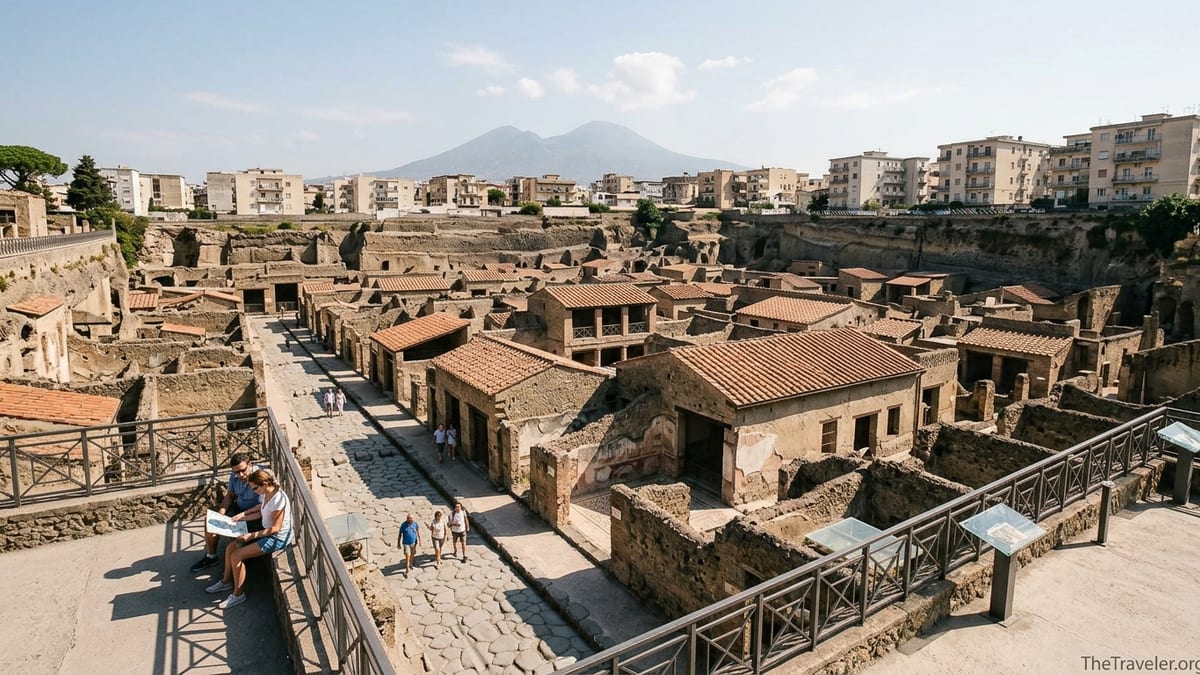
Once inside the archaeological park, it helps to think of your visit as a series of short, focused episodes rather than one long march through ruins. Start with an overview: walk to a vantage point overlooking the excavated bowl of the town, where you can see the grid of streets, the seafront arches, and the remains of upper floors. Spending five or ten minutes here orienting yourself can make the rest of the visit feel more coherent and less like a maze.
Set a rough structure. For example, you might decide to spend the first hour exploring domestic life in a handful of houses, the second hour on public buildings and shops, and the final stretch simply wandering and revisiting spaces you loved. This mental framework keeps you from trying to see and understand everything at once. If one area is crowded, such as a particularly photogenic house that a tour group has just entered, simply move along to a quieter lane and circle back later rather than waiting in the sun.
Regular micro breaks transform the experience. Sit in the shade of a portico or on a low wall, drink some water, and let your eyes rest on details like charred wooden beams or tiny floor tiles rather than scanning entire buildings. A solo traveler might, for instance, pause midway through the visit near the ancient shoreline, imagining the waterline as it was before the eruption, then continue with renewed attention. These small pauses keep your mind and body from becoming overloaded while still immersed in the site.
Finally, accept from the start that you will not absorb every detail, and that is fine. Even professional archaeologists return repeatedly to focus on different themes each time. Choosing one or two themes that interest you most, such as how Roman shops worked, how houses were decorated, or how people used public baths, immediately narrows your mental bandwidth. Any additional insights you pick up as you wander become a bonus rather than an obligation.
Combining Herculaneum With Other Sights Without Burning Out
Herculaneum sits at the foot of Mount Vesuvius and close to other major sites, which makes it tempting to cram multiple big experiences into one day. It is possible, for example, to visit Herculaneum in the morning and then take a shuttle or local bus from near Ercolano to the Vesuvius crater in the afternoon, hiking the short but steep path to the rim. Some travelers even attempt to combine Herculaneum and Pompeii on the same day because they share the same Circumvesuviana line.
While ambitious itineraries can work, they can easily become overwhelming. Walking for hours over uneven stone in the sun, followed by an exposed volcano hike or another huge archaeological park, is demanding even for fit travelers. A more sustainable approach is to pair Herculaneum with a lighter activity. For instance, you might spend the morning in the ruins, then enjoy a leisurely lunch at a nearby trattoria in Ercolano and stroll through the town’s seafront area or visit the local Virtual Archaeological Museum, which presents the eruption and excavations through multimedia exhibits in air-conditioned comfort.
If you are set on combining Herculaneum with Vesuvius, pace yourself consciously. Choose the earliest Herculaneum entry you can manage, limit your on-site time to about two and a half hours, and book an afternoon Vesuvius time slot that leaves at least an hour between leaving the ruins and boarding the bus or shuttle. Use that buffer to hydrate, eat something substantial, and, if possible, change into lighter or drier clothing. Listening to your energy levels and being willing to shorten one part of the plan is key to avoiding the feeling of being on an exhausting checklist.
Families and travelers with limited mobility may find it best to dedicate an entire day just to Herculaneum and its immediate surroundings. Spending a relaxed morning in the ruins, taking a long lunch, and then perhaps adding only a short, low-stress activity afterward keeps the day enjoyable. In many cases, visitors report remembering more and feeling more emotionally connected to what they saw when they consciously did less.
Mindset, Expectations, and Respectful Enjoyment
Herculaneum is not just a picturesque backdrop for photos; it is a place where around two thousand years ago, real people lived and died. Keeping this in mind can subtly shift your experience from rushed sightseeing to thoughtful engagement, which often feels less overwhelming. Instead of hurrying from one “must-see” spot to the next, you might choose to stand quietly in a modest house’s courtyard, listening to distant city sounds and imagining daily life before the eruption.
A realistic mindset also helps. The site, while very well preserved, includes areas under conservation where access may be restricted, and not every fresco or mosaic will be fully visible on a given day. Understanding that conditions change and that preservation takes priority reduces frustration. If a particular house is temporarily closed, use it as a chance to explore another building you might otherwise have skipped rather than fixating on a single missed sight.
Respectful behavior goes hand in hand with preserving the calm atmosphere. Staying on marked paths, not touching fragile walls or frescoes, and keeping voices at a moderate level contribute to an environment where everyone can reflect and learn. If you are traveling with children, setting expectations in advance, such as no climbing on low walls and no loud games, avoids stressful moments where staff need to intervene.
Finally, give yourself permission to step back when needed. If you feel saturated, walk toward an open area with fewer people, such as the ancient shoreline, and simply look out toward the modern city and the distant sea. Taking a few minutes to reset, breathe, and cool down can turn a visit that was tipping toward overload back into an experience of wonder.
FAQ
Q1. How long should I plan for a visit to Herculaneum so it does not feel rushed?
Most visitors find that two to three hours inside the archaeological park is enough for a satisfying visit, while three to four hours allows time for breaks and more in-depth exploration without feeling hurried.
Q2. Is Herculaneum less crowded than Pompeii, and does that make it easier to handle?
Yes, Herculaneum is significantly smaller and generally receives fewer visitors than Pompeii, which makes it easier to navigate and understand in a single visit, and usually less overwhelming, especially outside peak midday hours.
Q3. What is the best time of day to visit if I want to avoid feeling overwhelmed by heat and crowds?
Arriving within the first hour after opening, around 8:30 to 9:30 am, usually offers the coolest temperatures and the smallest crowds; late afternoons can also be calmer than midday, particularly outside of high summer.
Q4. Do I need to book tickets in advance, or can I just show up?
You can often buy tickets on arrival, but booking in advance helps you avoid ticket-office lines at busy times and gives peace of mind, especially in peak season or when traveling with a group or children.
Q5. Is a guided tour worth it if I am worried about information overload?
A small-group or private guided tour can actually reduce overload by organizing the visit into a clear story and selecting key highlights, while a hybrid approach, with a short tour followed by free time, works well for many travelers.
Q6. How difficult is the walk from the Ercolano Scavi train station to the site?
The walk takes about 10 to 15 minutes downhill along a straightforward main road; it is manageable for most visitors, but you should allow extra time on the return, which is uphill, and wear comfortable shoes.
Q7. Can I combine Herculaneum with Mount Vesuvius in one day without overdoing it?
It is possible but can be tiring, especially in hot weather; to keep it manageable, visit Herculaneum early, schedule Vesuvius for later in the afternoon, and plan rest, food, and water breaks between the two activities.
Q8. What should I bring to stay comfortable during the visit?
Comfortable walking shoes, a refillable water bottle, a sun hat, light breathable clothing, and sunscreen are essential, and a small snack or energy bar helps you maintain focus without having to rush out for food.
Q9. Is Herculaneum suitable for children or travelers who tire easily?
Yes, its compact size and shorter walking distances make it more manageable than many large archaeological parks, especially if you plan for frequent shade breaks and do not try to see every single structure.
Q10. How can I keep the experience meaningful instead of just ticking off sights?
Focusing on a couple of themes that interest you, taking quiet moments to sit and observe, and allowing time for reflection before moving on all help turn the visit into a thoughtful, memorable experience rather than a rushed checklist.