


Naples can feel intense, especially if you spend your days weaving through Spaccanapoli’s alleys, queuing at pizzerias, and hopping trains to Pompeii or the Amalfi Coast. Bosco di Capodimonte, the vast royal park that wraps around the Capodimonte Palace and its famous museum, offers a very different side of the city: wide lawns, woodland trails, and views over the bay. But is it worth carving out half a day from a tight Naples itinerary? The answer depends on what kind of traveler you are, how long you are staying, and how much you value art, greenery, and quiet.
Get the latest updates straight to your inbox!
What Exactly Is Bosco di Capodimonte?
Bosco di Capodimonte, often called the Real Bosco, is the huge historic park surrounding the Royal Palace of Capodimonte, a Bourbon hunting residence turned art museum on a hill north of central Naples. The park stretches over roughly 130 hectares, making it one of the largest green spaces in the city, with a mix of wooded sections, open meadows, and formal avenues radiating from the palace. Designed as a royal hunting estate in the 18th century and later reshaped in the 19th century into an English-style landscape garden, it still feels more like a noble country domain than a typical urban park.
For visitors, the key point is that Bosco di Capodimonte and the Capodimonte Museum are part of the same complex but function separately. The museum, housed inside the palace, holds one of Italy’s most important painting collections, including works by Caravaggio, Titian, Raphael and a famed Farnese collection. The park, by contrast, is free to enter and is primarily a place to walk, run, picnic and enjoy respite from the noise of the centro storico. You can easily spend an hour or two just in the gardens, or pair a stroll with a museum visit for a fuller half-day excursion.
The atmosphere is quite different from Naples’ compact historic squares. Paths are broad, lines of plane trees and pines create shade, and there are a handful of historic buildings sprinkled through the grounds, from old hunting lodges to the former Royal Porcelain Factory. While some structures are used for exhibitions or events, others are simply part of the park’s slightly faded but fascinating royal scenery.
Practicalities: Opening Hours, Cost and How Much Time You Need
One of the strongest arguments for visiting Bosco di Capodimonte is that the park itself is free. As of mid 2026, there is no admission charge to enter the Real Bosco, so you can simply walk in through one of the gates during opening hours and wander at will. The museum requires a ticket, but the park does not, which makes it an attractive option for budget-conscious travelers or anyone looking for a low-pressure activity on an arrival or departure day.
Opening hours vary by season, with earlier closing times in winter and longer hours in spring and summer. In cooler months the park typically opens in the early morning and closes in the late afternoon, while in late spring and summer it tends to remain open into early evening. Official signage at the gates and the museum’s information panels provide the current schedule, and it is worth checking before you head up, especially if you are planning a late-afternoon visit. The park is usually closed on a handful of major holidays such as New Year’s Day and Christmas Day, and specific sections may close temporarily for maintenance or weather-related reasons.
In terms of time, most travelers find that 1.5 to 3 hours is enough for the park itself, depending on how much you like to walk and whether you stop for a coffee or picnic. If you pair the park with a full museum visit, you are looking at a solid half day, and art enthusiasts can easily turn it into a full day, especially if a major temporary exhibition is running. For example, during recent seasons the museum has hosted high-profile shows of Italian and international artists that drew visitors specifically up to Capodimonte for the day.
Who Will Love Bosco di Capodimonte (and Who Might Skip It)
Bosco di Capodimonte is particularly rewarding for travelers who crave green space and quieter corners during a city trip. If you are spending three or more days in Naples, the park offers a valuable change of pace: joggers can run long loops on the broad avenues, families can spread a blanket on the lawns while children kick a ball, and couples can find shaded benches with views towards the palace. Visitors staying in lively central neighborhoods like the Spanish Quarters, Piazza Dante or around Via dei Tribunali often come to Capodimonte precisely to decompress from the urban energy.
Art and history lovers have a second reason to make the climb. The Capodimonte Museum ranks alongside the National Archaeological Museum as one of Naples’ flagship institutions. Travelers who enjoy spending two or three hours in front of Renaissance and Baroque masterpieces, porcelain collections and historic royal apartments will find the combination of museum plus park an excellent use of time. A common pattern is to visit the museum in the late morning, break for a simple lunch or snack at the onsite café or nearby bar, then stroll the park in the early afternoon.
On the other hand, if you have only one full day in Naples and are choosing between Pompeii, the Archaeological Museum, Castel dell’Ovo, and a walk along the seafront, Bosco di Capodimonte may feel less essential. The park is lovely, but it is still a park, and some visitors with very tight schedules prioritize the more iconic coastal scenery or archaeological sites. Likewise, if you dislike walking uphill or have very limited mobility, the logistics of getting to and from Capodimonte and navigating the large grounds might not justify the visit when compared with more compact attractions in the center.
What It Actually Feels Like: Atmosphere, Views and Facilities
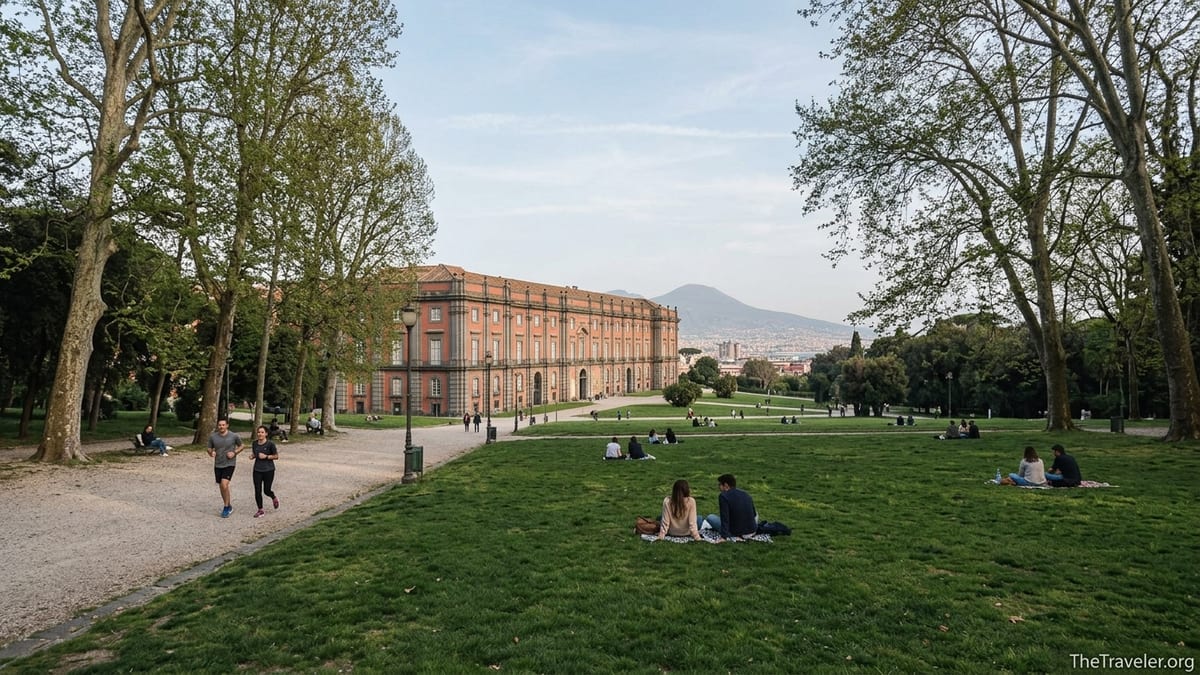
On a clear spring Saturday, Bosco di Capodimonte feels like Naples at leisure. Locals arrive with dogs on leashes and footballs under their arms, older residents stroll slowly in small groups, and students cluster on the grass near the main avenues. The air is cooler and cleaner than in the city’s lower streets, and from certain vantage points you glimpse the Bay of Naples and Mount Vesuvius beyond the urban sprawl. The palace itself, a long reddish structure with grey stone trim, acts as an anchor; many visitors start by crossing the formal Spianato lawn in front of the building before disappearing into the tree-lined paths.
Facilities inside the park are relatively modest but adequate. You will find drinking fountains, public toilets near main entrances and around the palace, and a couple of kiosks or bars where you can buy an espresso, bottle of water, or a simple sandwich at prices roughly comparable to a normal Naples café. Expect to pay around 1.20 to 1.50 euros for an espresso and 2 to 3 euros for a soft drink, depending on the stand. There are also plenty of benches, and large flat lawns where people sit on blankets or low camping chairs they bring from home. Compared with many manicured European palace gardens, Bosco di Capodimonte feels slightly wilder and more relaxed.
The trade-off is that not every corner of the park is perfectly maintained. You may see some worn paths, patches of long grass or areas with less frequent cleaning, especially after busy weekends. Lighting is concentrated around key avenues and entrances rather than every minor path. During daytime this adds to the sense of a semi-rural estate perched above the city, but it does mean the park is much more atmospheric in daylight than after dark. Most visitors prefer to leave before closing time and spend their evenings back in the center where lighting, restaurants and public transport are more convenient.
How to Get There: Buses, Walking and Taxis
Reaching Bosco di Capodimonte from central Naples is straightforward, though the hilltop location means you should factor in travel time. From the area around the National Archaeological Museum, several city buses head up towards Capodimonte, typically marked with destination signs including “Capodimonte” or “Museo di Capodimonte.” As of 2026 these routes can vary, but a common pattern is to catch a bus from Piazza Museo Nazionale or Via Santa Teresa degli Scalzi that takes about 15 to 25 minutes to reach stops near the main entrances. A standard single ticket on Naples public transport is inexpensive and can be purchased at metro stations, tobacco shops, or some newsstands before boarding.
Walking is possible if you are reasonably fit and comfortable with hills. From the Archaeological Museum area, it can take 30 to 40 minutes to climb to the palace on foot, partly along Via Santa Teresa degli Scalzi and through the Sanità district, then up towards the park. The incline is steady, and in summer heat it can feel demanding, so many travelers choose to ride up by bus and walk down into the city afterwards, enjoying views and side streets on the descent.
Taxis and ride-hailing services, where available, offer the most convenient but priciest option. A taxi from central Naples to Capodimonte will typically cost more than a short urban hop, but for a small group or family splitting the fare, the convenience can outweigh the extra euros, especially if you are visiting on a hot afternoon or with young children. When heading back, you can either order a taxi by phone or app from near the main entrance or walk a short distance to a busier road where taxis pass more regularly. In any case, allow a buffer of at least 30 minutes when returning for timed train departures from Napoli Centrale, as traffic in Naples can be unpredictable.
Combining the Park With the Capodimonte Museum
For many visitors, the most compelling reason to visit Bosco di Capodimonte is the chance to pair outdoor time with one of Italy’s great art museums. The Capodimonte Museum inside the palace houses major works from the Farnese collection, Neapolitan painting, and Italian Renaissance and Baroque masters. You can expect to see celebrated canvases by Caravaggio, Titian and others, along with royal apartments, tapestries, and porcelain rooms that reflect the opulence of the Bourbon period. Special exhibitions often highlight individual artists or themes, adding contemporary or thematic layers to the permanent collection.
A practical itinerary might look like this: arrive at the park in the morning, enter through the main gate, take a gentle 15-minute stroll up the main avenue toward the palace, and then spend two to three hours in the museum. Afterward, step outside to the Spianato lawn, find a bench or sit on the grass for a simple picnic lunch of pizza al taglio or bakery snacks you brought up from town, then wander deeper into the Bosco in the afternoon. This approach balances indoor and outdoor experiences and works well in spring and autumn when temperatures are mild.
If you are short on time, you can reverse the emphasis: enjoy a focused 60- to 90-minute circuit of the key museum rooms, then devote a quick hour to the park just to get a feel for the greenery and the views before heading back down. Travelers who do not care for art at all may still find the palace exterior and the royal surroundings atmospheric, but without interest in the museum, the park alone is more akin to a pleasant local green space than a must-see cultural attraction.
Safety, Neighborhood Context and When to Go
Capodimonte itself, as an area, is largely residential and associated with the palace and park, rather than nightlife or heavy tourism. During daytime, especially on weekends, Bosco di Capodimonte is filled with local families, joggers and dog walkers, which contributes to a generally relaxed and safe feeling. Standard big-city precautions apply: keep wallets and phones secure, avoid leaving bags unattended on the grass, and stay on well-used paths. The most common nuisance in Naples remains petty theft and pickpocketing in crowded areas rather than targeted crime inside parks.
That said, it is still wise to plan visits to Bosco di Capodimonte during daylight hours and to leave before or around closing time. The surrounding northern districts, like many on the outskirts of European cities, are more about everyday life than tourism, and street lighting is not uniform on every small road. If you do find yourself leaving close to dusk, head directly to a bus stop or call a taxi rather than wandering aimlessly through side streets. Travelers typically report feeling no more uncomfortable here than in other non-touristy parts of Naples, especially compared with the sometimes chaotic atmosphere around the central train station at night.
Seasonally, spring and autumn are ideal, with comfortable temperatures for walking and picnicking. In July and August, the park’s shade can be a relief from the heat, but you will still want water, sun protection and perhaps to plan your visit for early morning or late afternoon. In winter, sunny days can be beautiful and quiet, though some lawns may be damp and the trees bare, giving the park a starker character. Weather in Naples is often milder than in northern Europe, so even a January stroll can be pleasant if you catch a clear day.
The Takeaway
So is Bosco di Capodimonte worth including in your Naples itinerary? For travelers staying at least two or three days in the city, the answer is usually yes, especially if you appreciate art, history, and a break from traffic and scooters. The park itself costs nothing to enter, offers generous space for walking and relaxing, and frames one of Italy’s outstanding art museums in a setting that reflects the city’s royal past. It is a reminder that Naples is more than its narrow lanes and hectic port: it also has hilltop estates, leafy avenues and quiet viewpoints over the bay.
If your time is extremely limited or you are focused mainly on coastal scenery and archaeological sites, you might reasonably prioritize Pompeii, the Archaeological Museum, or a stroll along Via Caracciolo and Posillipo over a trip up to Capodimonte. But for many visitors, especially those who start to feel saturated by churches, alleys and crowds, a half day in Bosco di Capodimonte can become a trip highlight precisely because it shows a different, more spacious Naples. Think of it as a chance to breathe, to see masterpiece paintings without crushing crowds, and to share a lawn with Neapolitans enjoying their city at a slower pace.
FAQ
Q1. Is Bosco di Capodimonte free to visit?
The park, known as the Real Bosco, is free to enter, with no admission charge. You only pay if you choose to visit the Capodimonte Museum inside the palace.
Q2. How much time should I plan for a visit?
Plan 1.5 to 3 hours for the park alone, or a half day if you combine it with a museum visit. Art lovers may easily spend longer exploring both.
Q3. Is it safe to visit Bosco di Capodimonte?
During the day, the park is generally considered safe and is frequented by families and joggers. Use normal city precautions and aim to leave before or around closing time.
Q4. What is the best way to get there from central Naples?
Most visitors take a city bus from near the National Archaeological Museum or adjacent streets, which climbs up to the Capodimonte area. Taxis are faster but more expensive, and walking up is possible if you are comfortable with hills.
Q5. Is Bosco di Capodimonte suitable for children?
Yes. The wide lawns, open space and relatively low traffic inside the park make it family friendly. Children can run, play ball games and enjoy a picnic, though you should keep an eye on them near wooded areas and uneven ground.
Q6. Can I visit the park without going into the museum?
Absolutely. Many locals use the park only for walking or relaxing and never enter the museum. You can enjoy the palace exterior and grounds even if you skip the galleries.
Q7. Are there places to eat inside or near the park?
There are small bars or kiosks where you can buy drinks and simple snacks, and plenty of spots to enjoy a picnic. For a more substantial meal, most visitors eat in the city center before or after their visit.
Q8. Is Bosco di Capodimonte accessible for people with limited mobility?
The main avenues near the palace are relatively flat and paved, but the park is large, with some slopes and uneven paths. Visitors with limited mobility may prefer to focus on the central area around the palace rather than the more distant woodland sections.
Q9. When is the best time of year to visit?
Spring and autumn offer the most comfortable temperatures and greenery. Summer visits are pleasant in the shade but can be hot midday, while winter can be quiet and atmospheric on sunny days.
Q10. Is Bosco di Capodimonte worth it if I only have one day in Naples?
If you have just one day, you may want to prioritize headline sights like the Archaeological Museum, historic center and seafront. Bosco di Capodimonte becomes more worthwhile if you have at least two or three days and are looking for a calmer, greener experience.