

I almost walked straight past the Church of St Blaise. In a city as theatrically beautiful as Dubrovnik, with stone walls, sea views and café terraces competing for attention, this compact Baroque church on Luža Square initially blended into the backdrop. But the few minutes I finally spent pausing on its steps and walking inside became one of the most revealing moments of my time in the Old Town. If you are tempted to treat it as just another pretty facade, resist the urge. Skipping St Blaise would be a mistake.
Get the latest updates straight to your inbox!
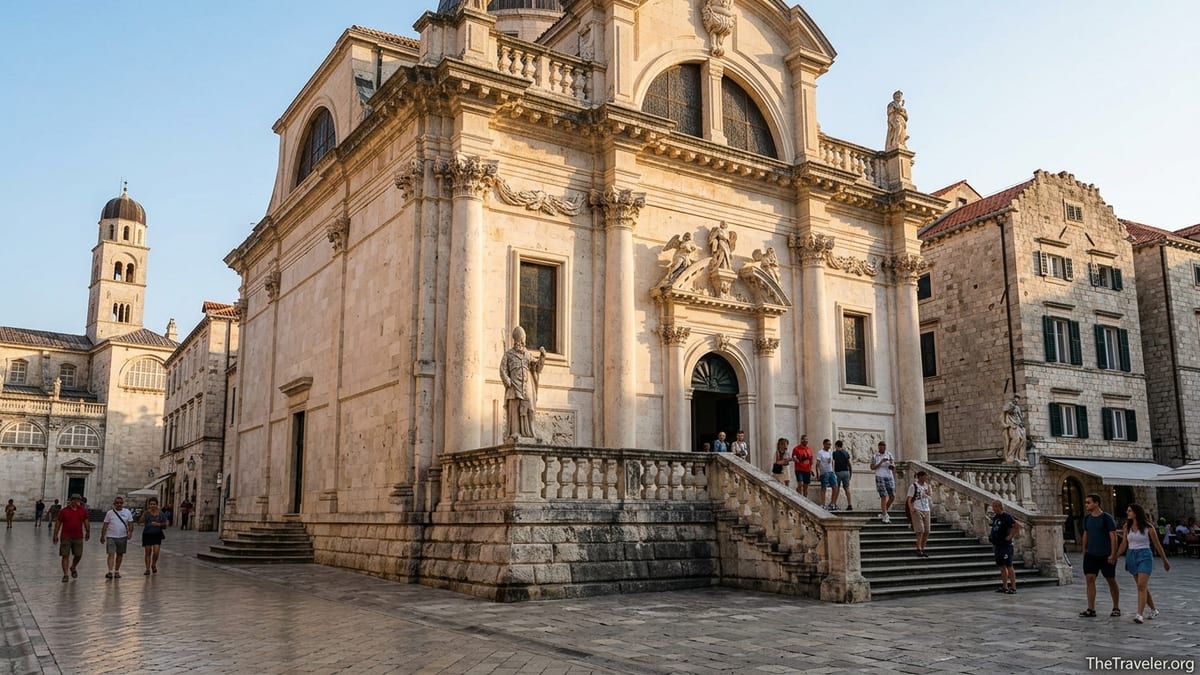
The Church You Think You See vs The One You Actually Enter
What changed my mind was a small detail: the statue of a bearded bishop above the main portal, holding a tiny model of a walled city in his hand. This is St Blaise himself, Dubrovnik’s patron, presenting the city he protects. Once you notice this gesture, the church stops being anonymous stone and starts to feel personal. It is no longer just a building, but a compact summary of how Dubrovnik sees itself: guarded, resilient, proudly independent.
Stepping inside, the shift in atmosphere is immediate. The square outside is bright and noisy, especially in summer when street musicians compete with the clink of coffee cups. The interior is dimmer and cooler, the air scented with candle wax and polished marble. Even if you are not religious, the contrast between the chaos outside and the contained calm within makes you understand why this space has anchored Dubrovnik’s life for centuries.
That first impression revealed what I would have missed if I had kept walking: St Blaise is less a sightseeing stop and more of a living key to understanding the city’s past, its disasters, its rituals and even its stubborn optimism.
From Fire and Earthquake to Baroque Splendour
The current Church of St Blaise dates from the early 18th century, but the story it tells is older and far rougher around the edges. A church dedicated to St Blaise has stood on or near this spot since at least the Middle Ages. It survived wars and political shifts, but not the combination of natural disaster and accident that struck Dubrovnik in the 1600s.
In 1667 a devastating earthquake ripped through the city, flattening large sections of the Old Town and killing thousands of residents. The earlier, largely Romanesque church of St Blaise was badly damaged. A generation later, in 1706, a fire destroyed what remained of the building and most of its interior furnishings. Almost everything inside was lost. Almost, but not quite.
One object survived the flames: a 15th century gilt silver statue of St Blaise, holding a model of the pre‑earthquake church and the fortified city in his hand. Local accounts describe how this statue was rescued from the burning building and later placed at the heart of the new Baroque church that rose on the same site between about 1705 and 1717, influenced by contemporary Venetian architecture. That survival story alone explains some of the emotional weight the church carries for Dubrovnik residents today.
When you enter and see the statue on the high altar, framed in marble and soft light, you are not just looking at an artwork but at a survivor of both earthquake and fire. The model of Dubrovnik he holds shows the city as it once appeared, before 1667, making this one of the most tangible visual links to the medieval and Renaissance republic that thrived here for centuries.
Reading the Facade: A Quick Art Lesson on the Steps
If you pause before going inside, the facade of St Blaise becomes a kind of open‑air classroom in Baroque architecture. Four Corinthian columns rise above the steps, framing a central portal with carved angels and decorative swirls that feel almost theatrical. Above them, a curved gable and balustrade carry three statues: St Blaise in the middle, flanked by personifications of Faith and Hope. It is a composition that rewards slow looking rather than a passing glance on the way to the city walls.
Because the church is relatively small compared with grand Baroque buildings in cities like Rome or Vienna, the details feel approachable. You can stand at the bottom of the steps and trace each curve in the stonework with your eyes, noticing the way light catches the carved folds of garments or the feathers of an angel’s wings. Go in the late afternoon and the sun tends to rake across the facade, emphasizing textures in the limestone and casting long shadows from the statues that shift as you move.
Travelers interested in photography will find this facade particularly rewarding. A standard 24 to 70 millimeter lens on a full‑frame camera allows you to capture the entire frontage from the cobbles of Luža Square, then zoom in to isolate details like the raised hand of St Blaise or the curls of the central pediment. Even with a smartphone, switching to a 2x or 3x zoom and shooting from an angle instead of straight on gives the scene a more natural, less postcard‑perfect feel.
Most visitors stand centered in front of the steps for one quick photo. If you spend five minutes walking to the sides, crouching low or stepping back towards Orlando’s Column, you will notice how the church interacts with the square, the cathedral dome rising behind it and the openings of side streets framing passing locals. That is when the building starts to feel embedded in a living city rather than frozen in a guidebook.
Inside the Baroque Jewel Box
Once your eyes adjust to the lower light inside the church, the interior reveals itself as a compact but richly decorated space. A single nave leads towards the high altar, where warm‑toned marble, gilded accents and painted surfaces work together to create a theatrical backdrop for worship. Corinthian columns rise to support a central dome, its lantern letting in a vertical shaft of daylight that shifts over the course of the afternoon.
The high altar is the main focus. Look closely and you will see St Blaise in silver and gold, holding the small model of Dubrovnik in his left hand. The level of detail is remarkable: you can make out the city walls, towers and the earlier form of the church itself. Two kneeling angels flank the saint, their polished surfaces catching every candle flame. This is one of the most important pieces of religious art in Dubrovnik and carries a significance that far exceeds its modest size.
Side altars in white and colored marble, carved railings and decorative stucco complete the effect of a Baroque jewel box. Even the floor, worn by centuries of footsteps, tells a story. On a typical summer day, you might share the space with a small mix of worshippers, older Dubrovnik residents sitting quietly in the back pews, and visitors speaking softly in Italian, French or English as they tilt their heads to study the ceiling.
Entry to St Blaise is usually free, which makes it an easy stop even if you are traveling on a tight budget. In the height of the season, when Dubrovnik’s city walls can cost the equivalent of a substantial restaurant meal and popular attractions quickly add up, this quiet, donation‑based church visit offers remarkable value: some of the city’s finest Baroque art and architecture for the price of a coin in a collection box, if you choose to leave one.
Living Tradition: The Feast of St Blaise
The Church of St Blaise is not a static monument. It comes most vividly alive each year around 3 February, when Dubrovnik celebrates the Festivity of Saint Blaise. This event has been held annually since the 10th century and is recognized by UNESCO as intangible cultural heritage, highlighting its deep roots in local identity and ritual.
The celebrations begin the evening before, when the city’s bells ring and white doves are traditionally released in front of the church as symbols of peace. On the feast day itself, a solemn Mass is held in the morning, followed by a procession that winds through the Old Town. Clergy and laypeople carry relics of the saint, along with parish banners from the wider Dubrovnik region, before returning to St Blaise’s steps.
One of the distinctive customs associated with St Blaise is the blessing of throats. Participants approach to have two crossed candles held near their necks as a short prayer is spoken asking the saint’s intercession for protection from illness. Even if you do not share the faith behind the ritual, witnessing it offers a powerful glimpse into how this community continues to weave centuries‑old traditions into modern life.
If you happen to plan a winter visit to Dubrovnik, timing your stay around early February will give you a very different experience of the city compared with the crowded summer months. Accommodation prices tend to be lower, street traffic is thinner and the focus shifts inward to local rituals such as this festival. In that context, the Church of St Blaise is less a sightseeing stop and more the beating heart of a civic celebration that spills out over the entire Old Town.
Fitting St Blaise into a Walk Through the Old Town
One practical reason travelers nearly miss St Blaise is that it sits at a crossroads of so many other attractions that it is easy to treat it as background. Stand on its steps and you can see the Stradun stretching west towards the Pile Gate, the bell tower rising above Luža Square, the Sponza Palace diagonally opposite, and Dubrovnik Cathedral just behind the church. Most walking tours pass this spot, but some give the church only a brief gesture.
A more rewarding approach is to plan a short “church and square” loop that begins or ends at St Blaise. For example, start your morning at the Pile Gate and walk the Stradun while it is still relatively quiet. Stop for a quick espresso at one of the cafés near the Onofrio Fountain, then continue to Luža Square. Give yourself at least fifteen minutes to study the facade and interior of St Blaise before stepping around the corner to visit the cathedral and its treasury.
If you have purchased a Dubrovnik city pass or combined ticket that covers multiple museums and churches, you can organize your day so that paid and free sites balance each other. Spend an hour in the charged exhibitions of the Rector’s Palace or the Maritime Museum, then decompress with a peaceful, cost‑free visit back to St Blaise in the late afternoon when the light on the steps softens and bus tours thin out.
Because the church stands at such a central point, it also works as a meeting place. If you are traveling with others who want to climb the city walls while you prefer to linger in town, agree to regroup “on the steps of St Blaise” at a set time. As people drift in from different directions, you will see the church perform one of its quiet everyday roles: a stable landmark in a city that can sometimes feel like it is in constant motion.
How Not to Miss What Matters
There is a risk in cities as picturesque as Dubrovnik that you treat beauty as a kind of wallpaper. St Blaise is one of those places that reminds you the wallpaper has layers. To avoid walking past what matters, it helps to slow down and adopt a few simple habits the next time you cross Luža Square.
First, always look up. From street level, the church might seem almost compact compared with the bulk of the city walls, but raising your gaze to the dome and statues changes your sense of scale. You notice how the building anchors the eastern end of the Stradun. Second, take advantage of small natural pauses in your day. Waiting for friends who are grabbing gelato on the square, or for a guided tour to start, is a perfect moment to slip inside for five quiet minutes.
Third, listen. Step just inside the door and stand still long enough to hear the difference between the square’s hum and the interior silence. On some days you may catch the tail end of a short service, a choir rehearsal or an organist practicing. These unscripted encounters are often what turn passing curiosity into lasting memory.
By treating the Church of St Blaise as more than a facade, you also give yourself a way to connect disparate threads of Dubrovnik’s story: the independence of the old republic, the trauma of earthquakes and fires, the endurance of local customs, the role of faith in daily life and the quiet resilience of a city that has repeatedly rebuilt itself without losing its sense of self.
FAQ
Q1. Where exactly is the Church of St Blaise in Dubrovnik’s Old Town?
The Church of St Blaise stands on Luža Square at the eastern end of the Stradun, close to the bell tower, Sponza Palace and Dubrovnik Cathedral.
Q2. Is there an entrance fee to visit the Church of St Blaise?
Entry is typically free, although visitors are encouraged to make a small voluntary donation to help with maintenance and the church’s ongoing activities.
Q3. How much time should I plan for a visit?
Most visitors spend between 10 and 25 minutes inside, depending on how closely they study the artwork and whether a service is taking place.
Q4. Are photographs allowed inside the church?
Photography is generally allowed for personal use, but it is important to avoid flash, respect any posted signs and refrain from taking pictures during religious services.
Q5. What is the best time of day to visit?
Early morning and late afternoon are usually quieter, with softer light on the facade and fewer tour groups passing through the square.
Q6. Can I attend a Mass at the Church of St Blaise?
Yes. Regular Masses are held, and travelers are welcome to attend provided they dress respectfully and maintain silence during the service.
Q7. What should I wear when visiting St Blaise?
As with most churches in Croatia, modest clothing is recommended, with shoulders and knees covered, especially if you plan to stay for worship.
Q8. Is the church accessible for visitors with limited mobility?
There is a short flight of steps leading up to the entrance, which may pose challenges for some visitors, so it is wise to assess in person or seek assistance.
Q9. Why is St Blaise such an important figure for Dubrovnik?
St Blaise has been honored as the city’s patron since the early centuries of the republic, credited in local tradition with protecting Dubrovnik from threats and disasters.
Q10. Is it worth visiting the church outside the Feast of St Blaise in February?
Absolutely. Even outside the February festivities, the church’s architecture, artwork and quiet atmosphere make it one of the most rewarding small stops in the Old Town.