


In a city of fortress walls and marble streets, it was not a sweeping panorama or a famous viewpoint that stayed with me, but a tiny silver detail in the half-light of a church. Inside Dubrovnik’s Church of St Blaise, surrounded by Baroque drama and tourist footsteps from Luža Square outside, I found myself transfixed by something small enough to fit in one hand: a miniature city held by a gilded statue of a saint.
Get the latest updates straight to your inbox!
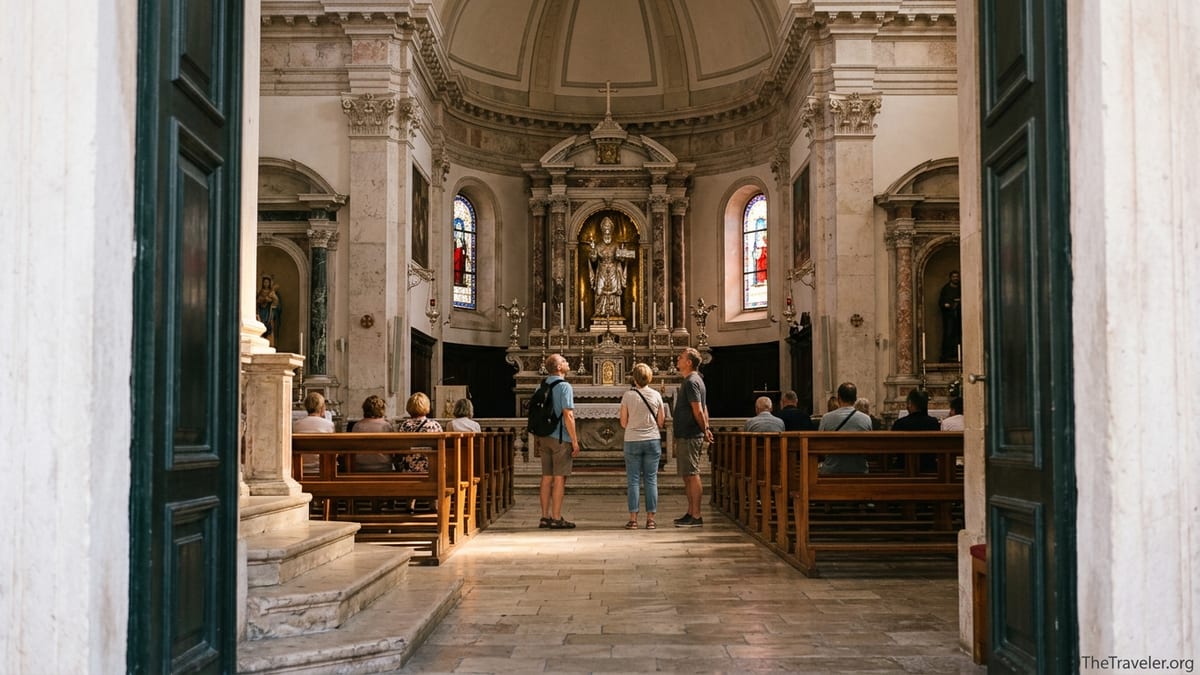
Stepping In From The Blinding Light Of Luža Square
Most visitors arrive at the Church of St Blaise almost by accident. It stands at the eastern end of Stradun, Dubrovnik’s polished limestone main street, where Luža Square opens like a stone stage. Cafés clatter, cruise groups cluster around raised umbrellas, and the bell of the nearby clock tower punches through the Adriatic brightness. The church itself is modest in height but crowned with a dome, its Baroque façade softened by centuries of salt air.
Climbing the short flight of stone steps and pushing through the heavy door, the city’s glare falls away in a single breath. Inside, a single nave opens in the form of a Greek cross, edged with marble and Corinthian columns that seem to glow a soft cream. Even in peak season, when Dubrovnik can feel crowded from dawn to midnight, the interior is surprisingly calm. Conversations flatten to a murmur, sandals on stone turn into an echo rather than a clatter.
The first impression is theatrical. Light filters through stained-glass windows designed in the 20th century by local artist Ivo Dulčić, scattering muted reds and blues across the white and polychrome marble of the altars. It is easy to be distracted by the sweep of the dome, the painted organ loft above the entrance, the play of color on the stone. Yet what I remember most clearly is not this grand stage, but one figure placed quietly at its center.
As my eyes adjusted from the Croatian noon outside to the dimmer light within, the main altar came into focus: a Baroque composition in white and colored marble, rising in tiers of ornament. And there, high in a niche above the altar table, was the small detail that would follow me long after I left Dubrovnik: a silver-gilt figure of Saint Blaise, holding in his left hand a tiny model of the old city.
The Saint With A City In His Hand
The statue itself dates from the 15th century, created by an unknown master of Dubrovnik’s goldsmithing school. It survived both the devastating 1667 earthquake that destroyed much of the city and the fire of 1706 that consumed the original Romanesque church on this site, when almost everything else was lost. Today it sits in a high niche of the 18th-century Baroque church that replaced that earlier building, its metal surface tempered to a deep, soft gleam.
At first glance, the saint, known locally as Sveti Vlaho, looks like many other bishops in European churches. He wears a mitre, carries a crosier, and lifts his right hand in blessing. Many visitors give him only a passing look, then turn their cameras back toward the dome or the stained glass. It took me several minutes of standing in the central aisle, shifting slightly left and right to catch the angle of the light, to really see what he was holding.
In his left hand, secured on a little platform of silver like a treasure within a treasure, sits a miniature of Dubrovnik as it was before the earthquake. There are the city walls in delicate relief, the towers and churches crowded between them, the outline of the harbor. Unlike the idealized cityscapes in many medieval artworks, this is specific. Each turret and roofline records a real building that once stood outside these doors.
In travel writing it is tempting to search for big symbols: a skyline, a coastline, a monumental gate. Yet here was Dubrovnik reduced to something the size of a loaf of bread, and that, paradoxically, was what made it so powerful. This tiny city in the saint’s hand is treated as a relic of memory, a three-dimensional archive of the streets that the earthquake rearranged. Standing there, you realize that for the people who rebuilt Dubrovnik, this small object was as important as any plan or map.
A Micro-Map Of A Lost Dubrovnik
The longer I looked, the more the miniature felt less like devotional decoration and more like an early urban document. Before seismologists graphed tremors and conservationists traced heritage zones on computer screens, this silver city was already preserving what the old Dubrovnik looked like. Local guides sometimes point to it as the most accurate surviving representation of the pre-1667 urban fabric, a kind of three-dimensional snapshot taken before disaster struck.
To understand its significance, it helps to think about what was lost. The 1667 earthquake killed thousands and flattened much of the medieval city. Buildings that today feel timeless, such as the cathedral and the Sponza Palace arcades, were damaged, repaired, or reconstructed. Facades shifted into the more restrained Baroque rhythm we now associate with Dubrovnik. In photographs taken from Mount Srđ, the city appears seamless, a grid of red roofs inside stone walls. The silver miniature reminds you that this apparent unity is the result of catastrophic change and careful rebuilding.
As you study the model under its glass, you might notice that some churches and towers appear closer together than they do today, or that a line of buildings curves differently from the modern street. For architectural historians, such details are clues. For a traveler, they are an invitation to look outside with different eyes. When you step back into Luža Square afterward, the church’s own dome and the nearby bell tower are no longer just pretty features on a postcard. They become survivors in an ongoing conversation between past and present.
What moved me most was not technical accuracy but the gesture itself. A community chose to place its entire city into the hands of its patron, to be carried not on a flag or a coin this time, but into the heart of its principal church. In an age before modern archives, that was an act of both faith and urban self-awareness: to say that the form of your city matters enough to be immortalized in precious metal and raised above the altar.
Faith, Identity, And A Patron Saint Who Is Everywhere
Outside the Church of St Blaise, the saint’s presence in Dubrovnik is almost impossible to miss. His image appears above the Pile and Ploče gates, on street corners, carved into the city walls. Historically, he looked out from the banner of the Republic of Ragusa, and during the annual Festivity of Saint Blaise on 3 February his relics are still carried through the streets in a procession that has earned a place on UNESCO’s list of intangible heritage.
Inside the church, however, this single statue condenses all of that civic devotion into one intimate scene. Saint Blaise does not loom over the congregation in heroic scale. He stands at a human height within the altar composition, his gesture of blessing almost understated. Yet his left hand is full of meaning: an entire city entrusted to his care. For the people of Dubrovnik, especially in the centuries when the republic navigated between Venice and the Ottoman Empire, that image expressed something crucial: their belief that the survival of their small, independent state depended as much on divine protection as on diplomacy.
For a modern visitor, who may have flown in on a budget airline and arrived by airport shuttle at Pile Gate, that symbolism can feel far away. But if you linger, small details have a way of closing the gap. I watched an elderly local woman slip into a side pew late in the afternoon, grocery bag still at her feet, and make the sign of the cross toward the altar before she sat down. For her, Saint Blaise was not an abstract emblem of medieval independence but a living protector over everyday life.
In that sense, the miniature city in his hand is not just a historical record but a reminder of vulnerability. Dubrovnik’s massive walls give the impression of invincibility, yet the city’s history is one of fragility: earthquakes, sieges, fires, the shelling of the 1990s. To place the city into the saint’s hand is to acknowledge that no fortification is absolute. The tiny silver walls atop the altar are a quiet corrective to the proud stone walls outside.
Seeing The Church Differently After One Small Detail
Once I had noticed the miniature city, everything else inside the Church of St Blaise rearranged itself around that point of focus. The way light filtered through Ivo Dulčić’s stained glass no longer felt purely decorative. In the late afternoon, when the sun drops behind the ridge above the Old Town, soft rays fall diagonally across the nave and glance off the silver of the statue’s robes and the little towers he holds. The city in his hand seems, for a moment, to glow on its own.
That detail also changed how I moved through the rest of the space. On the left side of the nave, near a side altar, I watched a group of visitors who had wandered in straight from Stradun. One of them lifted a phone for a quick photo, then another leaned forward, squinting up at the main altar and asking the guide quietly, “What is he holding?” Within seconds, their hurried pace slowed. Someone stepped closer to point out the outline of the walls; someone else whispered about the earthquake they had just read about on an information board outside the Rector’s Palace.
In that moment, the church itself seemed to do what good religious architecture often does: it used beauty and small curiosities to invite reflection. The painted organ loft behind the altar, with its early 18th-century decoration, the carved marble balustrades, the side chapels and confessionals all became part of a narrative about how this community has expressed its faith in stone, wood, glass and metal. The tiny silver Dubrovnik was the key that unlocked that story for me.
It also followed me back out into the city. Walking later along the city walls, looking down on terracotta roofs and laundry lines, I found myself trying to match the real skyline with the one I had seen in the saint’s hand. I could not, of course; centuries of rebuilding have rearranged the details. But the act of comparison made the living city feel layered rather than simply picturesque. I was not just admiring a view; I was aware of its earlier versions, compressed into that small object above the altar.
Practical Tips For Visiting St Blaise’s Church
The Church of St Blaise stands at Luža Square, directly facing Orlando’s Column and close to the bell tower, making it one of the easiest landmarks to find in Dubrovnik’s Old Town. Most visitors pass by it multiple times a day without stepping inside. Entry is typically free, though donations are appreciated, and the church is generally open from morning until late afternoon, with slightly shorter hours on Sundays and feast days.
If you want to appreciate the small details, timing matters. In high summer, Stradun can be crowded from about 9 a.m. when the first cruise excursion groups arrive until early evening. The church itself is rarely packed, but the atmosphere is very different depending on when you visit. Slip in early, between 8 and 9 a.m., and you might share the space with a few locals stopping in on the way to work, or with parish staff preparing for Mass. Visit around noon on a hot July day and you will likely find a mixed crowd of visitors grateful for the cool stone and the shade.
To see the miniature city clearly, walk down the central aisle until you are about halfway between the door and the altar, then pause and look up. The statue sits within the high niche of the main altar, behind protective glass. A small travel tip: if you stand slightly off-center, the reflections on the glass are less distracting and you can make out the contours of the silver city more easily. On sunny days, the best light often falls on the statue in mid-morning or late afternoon, when the sun is at an angle rather than directly overhead.
Out of respect for worshippers, avoid loud conversations and flash photography, especially during services. If you arrive during a Mass or during the Festivity of Saint Blaise in early February, expect the church to be full of local parishioners and visiting clergy. It can be a remarkable window into living traditions, but it is not the time to stand in the center aisle with a camera held high. Instead, slip to the side, observe quietly, and let the small details of ritual and architecture speak for themselves.
The Takeaway
Travel in a place like Dubrovnik often revolves around sweeping gestures: walking the full circuit of the walls, cruising around Lokrum Island, lining up for the sunset view from Mount Srđ. Those experiences are rightly celebrated, but they can sometimes crowd out the quieter, more intimate moments that stay with us long after a trip ends. Inside the Church of St Blaise, the tiny silver city cradled in a saint’s hand became that kind of moment for me.
It is, on the face of it, a small thing: a detail high on an altar that many visitors never really notice. Yet within that miniature are condensed centuries of history, fear, resilience, and pride. It bridges the gap between the medieval republic and the modern cruise port, between the earthquake that shattered the city and the air-conditioned buses that now deliver visitors by the thousands. It is both an object of devotion and an early kind of urban memory, preserving the contours of a lost Dubrovnik.
As you plan a visit to the Old Town, you will likely mark the usual highlights on your map: the cathedral, the walls, the Rector’s Palace, the cable car. When you reach Luža Square, take a moment to climb the steps of the Church of St Blaise and step inside. Stand in the central aisle, let your eyes adjust, and look up toward the altar. Somewhere in that play of marble and light, a saint is holding a city within his hand. Give it a moment, and you may find it holds something of your own journey too.
FAQ
Q1. Where exactly is the Church of St Blaise located in Dubrovnik?
The Church of St Blaise stands on Luža Square at the eastern end of Stradun, Dubrovnik’s main street, facing Orlando’s Column and near the city bell tower.
Q2. Is there an entrance fee to visit the Church of St Blaise?
Entry is typically free, though visitors are encouraged to leave a small donation to support the church’s upkeep and community activities.
Q3. What are the usual opening hours of the church?
The church is generally open daily from morning until late afternoon, with slightly reduced hours on Sundays and religious feast days; times can vary by season.
Q4. Why is Saint Blaise so important to Dubrovnik?
Saint Blaise is the city’s patron and protector, associated with a medieval vision that warned Dubrovnik of an impending attack, and his image has symbolized local identity ever since.
Q5. What is special about the statue on the main altar?
The 15th-century silver-gilt statue of Saint Blaise holds a detailed miniature of Dubrovnik as it looked before the 1667 earthquake, preserving a lost version of the city.
Q6. Can visitors see the miniature city in the saint’s hand clearly?
Yes, if you stand halfway down the central aisle and slightly off-center, you can make out the city walls, towers and roofs of the tiny model under favorable light.
Q7. Is photography allowed inside the Church of St Blaise?
Photography is generally tolerated for personal use, but visitors should avoid flash, stay discreet, and never photograph during services in a way that disturbs worshippers.
Q8. Does the church have set times for Mass that visitors should know about?
There are regular daily and Sunday Masses, usually in the morning and sometimes evening; current times are posted at the entrance or on local parish notices.
Q9. What is the best time of day to visit for a peaceful experience?
Early morning or late afternoon outside of peak cruise ship hours usually offers the calmest atmosphere, softer light and fewer tour groups inside the church.
Q10. How is the Church of St Blaise involved in the Festivity of Saint Blaise?
The church is the focal point of the February 3 celebrations, hosting liturgies and processions where the saint’s relics are carried through the Old Town streets.