


Choosing between Yesim and Airalo is no longer a niche tech decision. In 2026, these two eSIM brands sit on the home screens of millions of travelers who want to land, scan a QR code, and be online before the seatbelt sign goes off. Both promise cheap data in 200 plus destinations without roaming fees, but the fine print on pricing, coverage and speed can mean a very different experience once you are actually on the road.
Get the latest updates straight to your inbox!
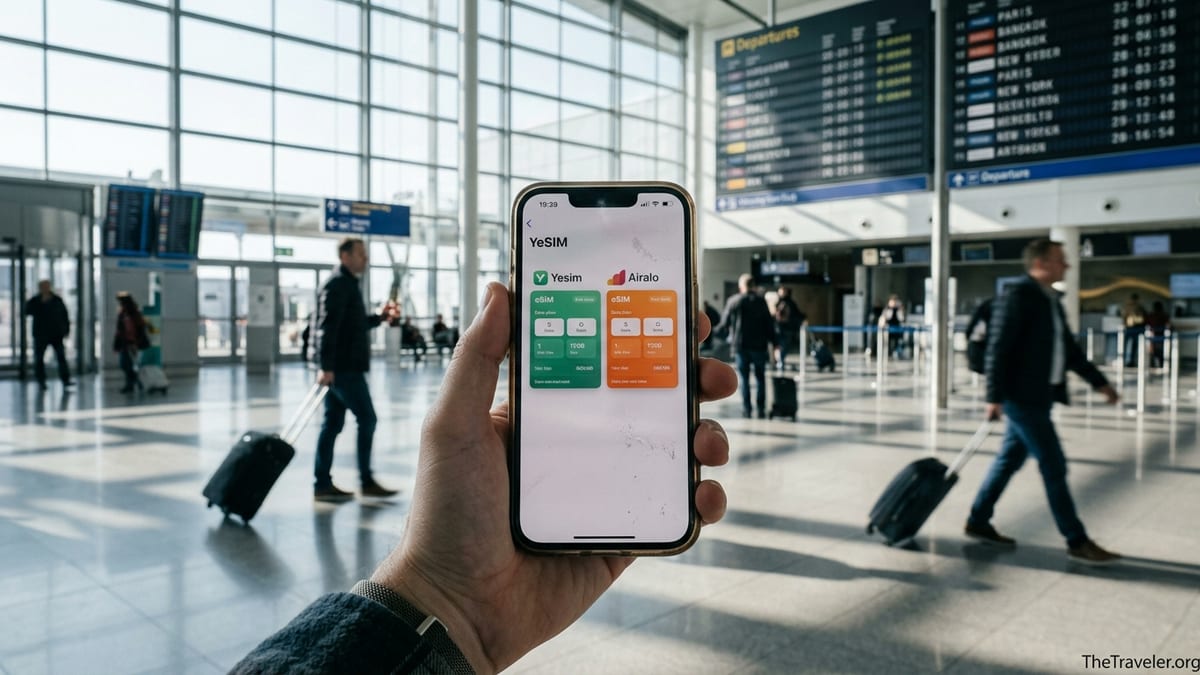
Yesim and Airalo in 2026: What Each Provider Actually Offers
Both Yesim and Airalo sell prepaid, data first eSIMs that you install through their apps or with a QR code before or after you land. You keep your regular SIM for calls or two factor texts from home, and let the eSIM handle data for maps, rideshares, messaging and light work. On paper, both providers look similar: apps on iOS and Android, coverage in over 200 destinations, and a mix of local, regional and global plans.
Airalo positions itself as a global marketplace for eSIMs, with local plans for individual countries like France or Thailand, regional bundles such as “Eurolink” for Europe, and global eSIMs that cover dozens of countries at once. In practice, that means you can buy a 1 GB plan for a single country for just a few dollars, or a 30 day global pass that works across multiple stops on a round the world itinerary.
Yesim, a Swiss based provider launched in 2019, focuses on straightforward data packages with a heavy emphasis on app driven activation. It offers local plans for major destinations, multi country regional bundles and global options for frequent travelers. A recent round of price cuts announced in June 2026 targeted popular destinations like the United States, parts of Europe and Southeast Asia, reflecting intense competition in the travel eSIM market.
Where the two start to diverge is not in basic functionality, but in how they price data, structure plans across regions, and how those plans behave in real world situations like crossing borders in Europe, working remotely for several weeks in one city, or trying to stay connected in more challenging markets such as mainland China.
Price Comparison: What You Pay for a Typical Trip
Because both apps show live pricing that can fluctuate with promotions and exchange rates, exact numbers change week to week. Still, current pricing snapshots give a realistic sense of how Yesim and Airalo compare for common trips. For a short city break in Europe, Airalo’s Europe eSIM page lists unlimited data options that start around the low double digits in US dollars for three days of use in more than 40 countries, including France, Italy, Spain and Germany. Longer unlimited options for 15 or 30 days climb steadily into higher price brackets that can add up quickly for budget travelers.
For travelers who do not need unlimited data, Airalo also offers standard fixed data plans, often starting around a few dollars for 1 GB or 2 GB with 7 to 15 days of validity. For instance, Airalo’s United States plans have recently included tiers like 1 GB for roughly the price of a coffee for 7 days, scaling up to 20 GB for around the cost of a modest restaurant meal, all valid for 30 days. These small plans can be cost effective for light users who mainly rely on Wi Fi in hotels and cafes.
Recent independent reviews of Yesim’s catalog in 2026 suggest its prices typically sit a few dollars below Airalo for similarly sized data buckets in the same country or region, especially after its June 2026 price cuts. For example, in a number of European destinations, reviewers found that a mid range Yesim plan of 5 to 10 GB for 10 to 15 days tended to undercut an equivalent Airalo local or regional plan by approximately 2 to 4 US dollars. That difference is small on a one week vacation, but it starts to matter if you buy multiple eSIMs a year or share costs across a family.
On the other hand, Airalo frequently runs targeted promotions, including free or very low cost starter packs that give new users a few hundred megabytes for a couple of days. That can be enough to get you from airport to accommodation and test the service before committing to a bigger bundle. Yesim is more likely to appeal on everyday baseline pricing rather than teaser deals, which is helpful if you are trying to estimate your data budget months in advance for a long trip.
Coverage and Reliability: Where Each Brand Works Best
In terms of raw coverage, both Airalo and Yesim now claim support for well over 200 destinations globally. For most mainstream trips, including multi country itineraries around Western and Central Europe, Southeast Asia, Japan, Australia, and North America, you will find multiple plan options from both providers. Travelers who use Airalo in Europe often lean on its Eurolink regional eSIM, which currently covers more than three dozen countries, letting you ride a train from Paris to Berlin to Prague without ever thinking about swapping SIM profiles.
A common real world strategy with Airalo is to skip the regional pass and buy a specific national eSIM tied to a European carrier that offers free EU wide roaming. For example, some travelers report success with Airalo’s Czech Republic plan, which effectively behaves like a local Czech operator eSIM and roams across the European Union. That approach can provide a better price per gigabyte than the Europe wide Eurolink pass while still working in multiple countries, though it does require a bit more research.
Yesim’s coverage map is similarly broad, with local plans for most European countries and regional options for Europe, Asia, the Middle East and beyond. Many long term travelers praise Yesim for solid performance across popular beach and backpacker routes in Thailand, Vietnam and Indonesia, where they used the eSIM continuously for maps and ride hailing without noticeable issues. Yesim’s app typically allows you to create a multi country pass by selecting several destinations and letting the app quote a combined price, which is useful for complex trips.
The biggest caveats for both providers show up in edge cases. In mainland China, some travelers have reported frustrating experiences with Yesim, including slow activation or unclear billing. Airalo is not immune to issues here either, and in both cases national regulations and network management, not just the eSIM brand, play a role. In remote rural areas and islands, performance depends heavily on the local carrier partner. A Yesim plan that works beautifully in central Bangkok might drop to 3G or edge speeds on an island, just as an Airalo plan that is fast in Rome might feel sluggish in a small village. In these scenarios, local physical SIMs sometimes still win on raw speed and price.
Speed, Fair Use Policies, and “Unlimited” Plans
For many travelers, the headline number is not gigabytes but whether TikTok loads in HD and video calls stay stable. Airalo has built a reputation for generally strong speeds in North America and much of Europe, helped by its partnerships with major carriers. In the United States, for example, speed tests compiled by reviewers in 2025 and 2026 show Airalo plans often achieving performance comparable to mainstream prepaid SIMs when used in major cities like New York, Chicago and Los Angeles, especially on mid and high tier data packages.
Yesim’s speeds vary by destination but are typically on par with other travel eSIMs that resell capacity from the same underlying networks. Independent testing in early 2026 found Yesim competitive with better known rivals on everyday tasks such as Google Maps navigation, messaging, ride hailing and browsing, with only modest slowdowns during peak hours in some dense urban areas. Most reviewers concluded that for typical tourist use, any speed differences between Yesim and Airalo are less important than plan size and price.
Where travelers need to be more careful is with so called unlimited plans. Airalo’s Europe page, for example, now includes unlimited data options for periods ranging from three to thirty days, which look extremely appealing for stream heavy users. However, like most providers, Airalo applies fair use policies and may reduce speeds after a certain high data threshold in order to manage network load. The exact limits are often buried in plan details and can change over time, so heavy users should read them closely.
Yesim also offers high capacity and in some cases unlimited style plans in certain regions, but the real value depends on how aggressively fair use caps are enforced. In practice, if you mostly use your phone for maps, social media, browsing and a bit of streaming, both providers’ larger fixed data bundles, such as 10 to 20 GB for a two week trip, are usually a safer and more transparent bet than unlimited offers that may slow down mid trip.
Ease of Use, Apps, and Customer Support
Both Airalo and Yesim lean heavily on their mobile apps, and for most travelers that is where the decision will feel day to day. Airalo’s app is mature and polished, with support for dozens of languages and multiple currencies. Installing a new eSIM typically involves selecting a destination, choosing a plan, paying with a card or digital wallet, then following step by step instructions to add the eSIM profile in your phone’s settings. For many users, the entire process takes less than ten minutes, especially if done over home Wi Fi before leaving.
Yesim’s app takes a similar approach but is often praised for its clean, simplified interface that guides less technical users through installation. Once your eSIM profile is on the device, you can keep topping it up or buying new plans from within the app without reinstalling. A useful Yesim feature for frequent travelers is that credit purchased in the app can remain valid for months, letting you preload funds and only convert them into local plans when needed during future trips.
Customer support is another area where experiences differ. Airalo advertises 24/7 support through in app chat and channels like WhatsApp. Many travelers report quick responses and helpful troubleshooting, especially when activation problems are caused by phone settings rather than network outages. At the same time, negative anecdotes exist, including travelers who felt their queries about failed activations or poor coverage were not resolved to their satisfaction.
Yesim likewise offers in app support, and user reviews in 2026 describe a mixed but generally positive picture: some travelers receive fast, clear help during activation hiccups, while others complain about slower responses or limited refunds in complex cases. The key takeaway is that no travel eSIM provider is perfect; if staying connected is absolutely mission critical for work, you should consider eSIM plus a backup solution such as a local physical SIM or an additional eSIM from a second provider.
Who Gets Better Value: Solo Travelers, Families, and Remote Workers
The question “Which provider offers better value?” only makes sense when attached to a specific type of trip and traveler. For a solo city breaker visiting London and Paris for five days with light data needs, Airalo’s small fixed data plans or a short duration Europe unlimited option may look attractive. The convenience of buying a single regional eSIM, knowing it will just work through the whole trip, can be worth paying a modest premium over a slightly cheaper but more fragmented approach.
For a long weekend in Bangkok, Bali or Ho Chi Minh City, frequent travelers often highlight Yesim as a strong value play. Its post price cut plans in parts of Southeast Asia typically offer competitive data per dollar, and if you only need 5 to 10 GB for a week, saving a few dollars compared to Airalo or other competitors is meaningful. Backpackers doing multi month trips in the region sometimes combine Yesim in cheaper markets with local physical SIMs where they are significantly less expensive.
Families and groups have different priorities. Managing four or five separate eSIMs on different phones can be tedious. Airalo’s vast catalog and often generous plan durations make it attractive if you want to set up each family member once with a 30 day plan that will survive the whole vacation. However, the total cost can add up quickly when multiplied by several people. In contrast, some families use a mix of one large Yesim or Airalo plan on a parent’s phone for hotspot sharing, combined with smaller individual plans or continued roaming on the children’s lines for backup texting.
Remote workers and digital nomads tend to focus on stability and predictable monthly costs. Many in this group use Airalo or Yesim as a bridge for the first few days in a new country, then switch to a local monthly SIM from a domestic operator once they have time to visit a store. In this workflow, the fine grained pricing differences between Airalo and Yesim matter less than how reliably each provider connects you on arrival. Still, reviews suggest that in Europe and North America, Airalo’s regional and national plans often strike the better balance between price and stability for multi week stays, while Yesim may have the pricing edge in some parts of Asia and selected destinations elsewhere.
The Takeaway
There is no single winner between Yesim and Airalo for every kind of traveler, but clear patterns emerge when you look at real world use in 2026. Airalo excels as a broad, highly polished marketplace with strong coverage in Europe, North America and many popular regions, plus a huge range of plan sizes from a few hundred megabytes to large unlimited style bundles. It is especially appealing if you value a single familiar app you can reuse from trip to trip, or if you want Europe wide or global coverage without thinking too hard about local operators.
Yesim, on the other hand, often delivers slightly better headline prices on comparable data buckets, particularly after its recent price reductions on major routes. Its straightforward app and long lasting account credit structure make it attractive if you travel multiple times a year and prefer a simple, repeatable process to get online. Some destination specific issues do exist, particularly in more complex markets like mainland China, but for mainstream trips across Europe and Asia many travelers report solid experiences.
For most travelers, a pragmatic strategy is to treat Airalo and Yesim as complementary rather than mutually exclusive. Before each trip, check both apps for your specific route and dates, paying attention to data amount, validity, and whether the plan is local or regional. If one provider is clearly cheaper for the same coverage and you do not see red flags in recent reviews, go with it. If the difference is only a couple of dollars, choose the app you find easier to use or where you already have an account, and consider buying a small backup plan from the other provider if connectivity is mission critical.
Ultimately, the best value abroad is the one that lets you navigate new cities, call a ride, message your accommodation and share memories without worrying about surprise roaming bills. Both Yesim and Airalo can do that effectively for most trips in 2026. The smarter move is to understand where each shines, match that to your itinerary, and not be afraid to mix and match providers as your travel style evolves.
FAQ
Q1. Is Yesim or Airalo cheaper for travel in Europe in 2026?
In many recent price snapshots, Yesim tends to be a few dollars cheaper than equivalent Airalo plans in parts of Europe, especially mid range packages of 5 to 10 GB. However, Airalo’s Europe wide passes and frequent promos can close the gap. The best approach is to check both apps for your specific countries and dates, since prices and offers change regularly.
Q2. Which eSIM is better for a multi country trip across Europe?
Airalo often has the edge for multi country Europe itineraries because of its Eurolink regional eSIM and certain national plans that roam EU wide. These let you cross borders without swapping plans. Yesim also offers regional Europe coverage and multi country bundles, so if its price is noticeably lower for your route, it can still be a strong alternative.
Q3. Which provider works better in Asia, especially Southeast Asia?
Both Yesim and Airalo cover major Southeast Asian destinations such as Thailand, Vietnam, Indonesia and Malaysia. Traveler reports in 2026 suggest Yesim can sometimes be slightly better value on price in certain countries after its recent cuts, while Airalo may partner with more familiar carrier brands. For typical tourist use in cities, either provider should be sufficient.
Q4. Are the unlimited plans from Airalo or Yesim truly unlimited?
In practice, no travel eSIM unlimited plan is entirely unlimited. Both Airalo and Yesim may apply fair use policies that reduce speeds after high data usage to protect network quality. These thresholds and conditions are usually listed in the plan details. Heavy streamers and remote workers are often better served by large fixed data plans rather than relying solely on unlimited offers.
Q5. Can I use Yesim or Airalo for calls and SMS, not just data?
Most plans from both providers are data only, designed for apps like WhatsApp, Telegram and FaceTime rather than traditional calls and SMS. Airalo does offer some packages that include a phone number and limited calling or texting, usually at higher prices and with identification requirements. Yesim is generally focused on data only, so you would keep your home SIM active for receiving texts while using data on the eSIM.
Q6. How difficult is it to install an eSIM from Yesim or Airalo?
On modern eSIM compatible phones, installation is usually straightforward. You download the app, choose a plan, pay, then follow on screen steps to add the eSIM in your phone’s settings. Both apps provide detailed instructions and often complete activation in a few minutes. It is best to install over a stable Wi Fi connection before your flight or as soon as you find reliable internet on arrival.
Q7. What happens if my eSIM does not work when I land?
If your eSIM does not connect, first check basic settings like whether the eSIM is enabled for mobile data, data roaming is on, and the correct network is selected. If that fails, both Yesim and Airalo offer in app support where you can share screenshots and error messages. Resolution quality varies, so many travelers carry a backup option, such as a second eSIM from another provider or the willingness to buy a local physical SIM at the airport.
Q8. Is it safe to rely only on an eSIM provider like Yesim or Airalo for a long trip?
For many travelers on trips of one to four weeks, relying on a single well chosen eSIM works fine, especially in regions with strong coverage. For longer or more remote journeys, there is more risk of hitting fair use caps, running into network issues, or needing support. In those cases, it is prudent to treat Yesim or Airalo as part of a toolkit that also includes local SIMs or secondary eSIMs.
Q9. Do I need to buy a new eSIM every time I travel?
With both providers, you usually keep one eSIM profile on your phone and simply buy new plans or top ups within the app as you visit new destinations. You only need to install a fresh eSIM profile if you change to a different provider or if the app explicitly requires a new profile. This makes repeat travel far easier once you have gone through the initial setup.
Q10. How should I choose between Yesim and Airalo for my next trip?
Start by checking both apps for your key destinations, dates, and approximate data needs. Compare total price, validity period, and whether each plan is local or regional. If one provider is clearly cheaper and has recent positive reviews for that region, choose it. If prices are close, consider which app you find easier to use, where you already have an account or balance, and whether you want regional passes like Airalo’s Europe eSIM. When in doubt, using one as your primary solution and the other as a backup gives you flexibility at low extra cost.