


Fast Cover has built its reputation on making travel insurance quick and simple for Australians, with straightforward online quotes and local claims teams. Yet many travelers still discover at the worst possible moment that their policy does not work the way they assumed. The problem is usually not the brand, but how the policy was chosen, read and used. If you buy Fast Cover thinking it is a magic safety net for “anything that goes wrong overseas,” you are almost certainly using it wrong.
Get the latest updates straight to your inbox!
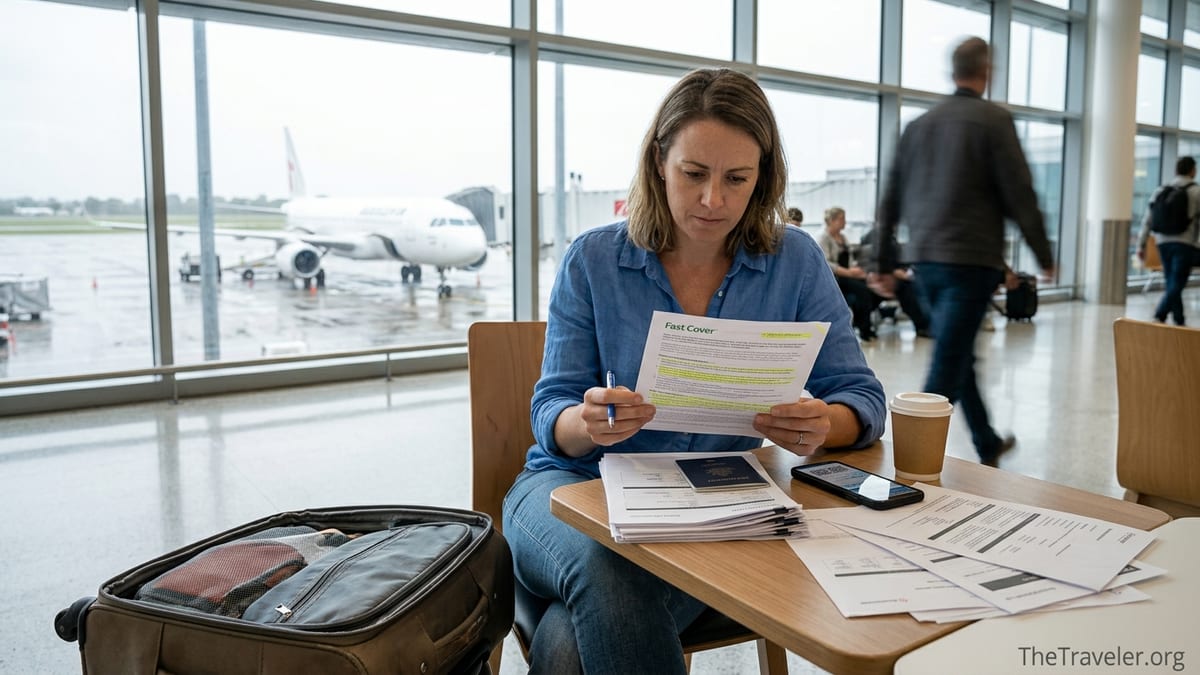
Fast Cover Is Not One Policy: Choosing the Wrong Type of Cover
One of the most common mistakes is assuming that all Fast Cover policies work the same. Fast Cover offers several tiers, such as Basics (medical-only), Standard Saver, and Comprehensive, plus options for domestic trips, international trips and special products for cruises. Each has different inclusions and limits. If you buy on price alone, you might end up with a Basics policy that covers urgent overseas medical expenses but does not cover cancellation fees or disrupted travel plans, which can be a painful surprise if you need to cancel a $7,000 Europe trip.
Consider an example: An Australian couple from Brisbane books a three-week holiday to Italy and Spain, with non-refundable flights, train passes and prepaid villas worth around $9,000. They choose a cheap Fast Cover Basics policy for around one-third less than Comprehensive because “we just need something for the hospital overseas.” When a parent back home has a sudden stroke two days before departure and they must cancel, they discover the Basics policy does not cover cancellation costs at all. They correctly assumed Fast Cover would help in an overseas medical emergency, but they used the wrong type of cover for the way they actually needed protection.
On the other hand, a solo traveler booking a last-minute surfing trip to Bali on flexible airfare and hostel beds might reasonably opt for a Basics or Standard Saver policy because their main concern is being medevaced to a hospital in Denpasar or flown back to Australia. In that case, paying extra for higher cancellation benefits may not make sense. Using Fast Cover correctly starts with matching the policy type and limits to the real financial risks of your particular trip, instead of defaulting to the cheapest option or copying what a friend once bought.
Before you buy, look beyond the headline price on the quote screen and compare medical benefits, cancellation limits, luggage cover, rental car excess cover and special features like cruise or snow sports options. Fast Cover’s own site repeatedly directs travelers to the Product Disclosure Statement and Target Market Determination for this reason: the right policy for a budget backpacker is not the right policy for a family on a once-in-a-decade North America holiday.
Buying Too Late or After You Leave Australia
Another way travelers misuse Fast Cover is buying the policy too late. Many Australians assume they can wait until just before they fly, or even buy cover from the airport. While Fast Cover does allow you to purchase cover close to or even after departure in some situations, postponing your purchase usually means you miss out on one of the most valuable parts of any travel insurance policy: pre-trip cancellation cover and cover for things that go wrong before you leave.
Imagine you book a $15,000 family trip to Japan for the September school holidays. You lock in flights on sale in March and prepay a ski lodge in Hokkaido for the Christmas portion of the trip. You think, “I’ll sort travel insurance a week before we go.” In July, your partner is diagnosed with a serious medical condition, and doctors advise against flying. If you only buy Fast Cover in August, when you already know a family member is unfit to travel, your ability to claim for trip cancellation is likely to be severely limited. Insurers typically expect you to buy the policy when you still have no reason to foresee a claim, not after problems emerge.
Fast Cover also sets specific rules around buying cover after leaving Australia. For instance, some policy summaries make it clear that you may only purchase cover if you have been overseas less than a certain number of days and, in some cases, have been continuously covered by another policy that has only recently expired. If you ignore this and attempt to buy a new policy weeks into your round-the-world backpacking trip after travelling uninsured, you might find that illnesses or injuries that have already developed are not covered, or that you are simply not eligible to buy that policy at all.
Using Fast Cover correctly means treating your travel insurance like any other essential booking. For most international trips, you should purchase your policy at or soon after paying your first substantial deposit for flights or tours. That way, if a close relative falls ill, a natural disaster affects your destination or you suffer an accident that makes you unfit to travel before departure, you have a chance of claiming those pre-paid, non-refundable costs, subject to the policy terms.
Not Reading the PDS: Assumptions That Kill Claims
The single biggest way people misuse Fast Cover is by not reading the Product Disclosure Statement at all. Fast Cover advertises a simple, plain-language PDS, but many travelers still rely only on marketing blurbs or comparison-site summaries. They assume that “unlimited medical cover” means every hospital bill is covered in every circumstance, or that “lost luggage” means any misplaced item is automatically reimbursed. In reality, almost every benefit has limits, exclusions and conditions, and these are only spelled out in full in the PDS.
For example, Fast Cover’s materials clearly explain that medical expenses incurred after you have returned to Australia are not covered by the policy. A traveler who injures their knee snowboarding in Canada, returns home to Sydney, and then expects Fast Cover to pay for months of physiotherapy and elective surgery will be disappointed. The policy is designed to pay for emergency overseas treatment, medical evacuation and, in some cases, your trip home, not to function as long-term domestic health insurance.
Another classic misunderstanding relates to luggage. Suppose a business traveler flying from Melbourne to Singapore checks in a bag containing a $3,000 professional camera, a $2,000 laptop and several designer suits. Their bag disappears in transit. When they claim, they discover that Fast Cover, like most travel insurers, applies per-item and total limits to baggage cover. If the policy’s single-item limit for electronics is well below the actual value, and if proof of ownership is weak, the payout may be far lower than expected. The PDS typically sets out these limits very clearly, but they are easy to miss if you never open the document.
To use Fast Cover correctly, set aside 20 to 30 minutes before purchasing to at least skim the sections in the PDS on benefits, key exclusions, pre-existing medical conditions, sports and activities, valuables and claims. You do not need a law degree; you just need to spot where your expectations might be wrong. If a term or condition is unclear, contact Fast Cover’s support team before you buy and get written clarification. That simple step can prevent expensive misunderstandings later.
Ignoring Pre-Existing Medical Conditions and Stability Rules
Pre-existing medical conditions are one of the most sensitive areas in any travel insurance policy, and Fast Cover is no exception. Many travelers either under-declare or over-assume here. Some believe that a long-term condition like well-controlled asthma or type 2 diabetes is “no big deal” and therefore does not need to be disclosed, even if they have had recent medication changes or hospital visits. Others assume that buying a mid or top-tier Fast Cover policy automatically covers every aspect of their health history without any need for assessment or extra premium.
In practice, Fast Cover draws a clear line: some straightforward conditions may be automatically covered if they meet strict stability criteria, while others require individual assessment or are excluded. If you have had changes to your medication, hospital admissions, or new symptoms within a defined period before your trip, that condition may not be automatically covered. If you later need to cancel your trip or seek treatment overseas because of that condition, your claim can be denied if you failed to disclose it accurately at the time of purchase.
Take a realistic scenario. A 62-year-old traveler from Perth with a history of high blood pressure and a stent procedure two years ago books a cruise around New Zealand. She buys a Comprehensive Fast Cover policy online but downplays the seriousness of her heart condition when answering the medical questions, thinking that being “mostly fine” is enough. On the cruise she experiences chest pain, is evacuated to a hospital in Dunedin and requires treatment. When she claims, the insurer reviews her medical records, sees a recent medication change and an unreported review with her cardiologist, and may class the heart issue as an undeclared or unstable pre-existing condition. Some or all of her medical costs and evacuation expenses could be declined as a result.
To use Fast Cover correctly, answer all health questions with complete honesty and detail, and do not guess. If you are unsure whether a condition counts as “pre-existing” or “stable,” check the definitions in the PDS and speak with both your doctor and Fast Cover before purchasing. It is usually better to pay a higher premium or accept certain exclusions upfront than to face a six-figure overseas hospital bill because a crucial condition was not fully disclosed.
Overlooking Activity Limits, Driving and Alcohol
Many Australians buy Fast Cover for adventurous trips, then assume that “adventure” automatically means “covered.” In reality, most travel insurance policies distinguish between low-risk activities included as standard and higher-risk activities that are excluded or require an upgrade. Fast Cover’s policy documents detail which activities are covered and which are not, including items like snow sports, off-piste skiing, scuba diving beyond certain depths, motorcycling above specific engine sizes and certain volunteer or manual work.
Imagine a group of friends from Adelaide on a two-week trip to Queenstown in winter. They buy a Standard Saver Fast Cover policy for each traveler, assuming that because Queenstown is a popular Australian destination and the package includes lift passes, ski accidents must automatically be covered. If they read the PDS closely, they might find that some snow sports require a specific add-on or that off-piste skiing without a professional guide is excluded. If one friend is injured while skiing off-piste after a heavy snowfall, the claim for medical evacuation might not be paid if that activity sits outside the policy’s terms.
The same goes for scooter and motorbike rentals in places like Thailand, Vietnam or Bali. Fast Cover typically sets conditions such as holding a valid Australian motorcycle licence for the class of bike you are riding, wearing a helmet and obeying local laws. If you rent a 150cc scooter in Phuket without the appropriate licence and are injured in a collision after drinking, the policy may limit or exclude cover. Many travelers assume “everyone does it” means “it must be covered,” which is not the case.
Alcohol and drugs can also affect claims. While Fast Cover does not expect travelers to abstain completely, it generally excludes claims arising from being under the influence of alcohol or illegal drugs, especially where impairment clearly contributed to the incident. If you slip and break your ankle in a Tokyo bar after several strong cocktails and a blood alcohol test shows a high reading, the insurer may have strong grounds to reduce or deny the claim.
Assuming COVID-19 and Pandemics Are Fully Covered
COVID-19 has changed how travelers think about risk, but not every COVID-related scenario is treated the same way in a policy. Fast Cover offers some benefits that relate to COVID-19 on certain policies, subject to specific terms, but many travelers still assume that any pandemic-related disruption is automatically covered. That includes changes of mind, government border closures and fear of travel, which are often excluded.
Consider an example. A family in Sydney books a school holiday trip to Fiji with flights, resort accommodation and a non-refundable reef tour. Their Fast Cover policy might provide some cover if they are personally diagnosed with COVID-19 and cannot travel, or if they catch COVID overseas and need medical treatment there. But if the Australian or Fijian government changes entry rules, or their airline cancels flights due to new border restrictions that affect all travelers, coverage may be more limited. In those cases, refunds or credits often come from the airline or resort rather than from travel insurance.
To use Fast Cover correctly in the COVID era, treat pandemic-related cover as a narrow, defined set of benefits, not a universal protection for every disruption. Examine the specific COVID-19 wording in the latest PDS and check how it interacts with general exclusions about epidemics, government actions and “disinclination to travel.” If border rules or your comfort level are uncertain, prefer flexible bookings with good airline and hotel change policies, and then use Fast Cover primarily as your back-up for personal illness or emergency medical costs.
Mismanaging Documentation and the Claims Process
Even when travelers choose the right Fast Cover policy, many still use it poorly at claim time. The most frequent errors involve weak documentation, delays in notifying the insurer and poor record-keeping. Fast Cover’s claims team, like any insurer, needs evidence: medical reports, police or loss reports, receipts, airline delay letters and proof that you attempted to recover costs from airlines or service providers before claiming.
Imagine a backpacker in South America whose phone and wallet are stolen from a hostel dorm room in Buenos Aires. She reports the theft to hostel staff but does not obtain a police report, thinking the local police will not do much. She also has no receipts for her phone or clear bank statements to prove ownership and value. When she later submits a claim to Fast Cover, the lack of official report and evidence may lead to a reduced payout or even a declined claim. The policy wording typically requires prompt reporting of theft to the local police or relevant authority and reasonable proof of ownership.
Or take a delayed flight case. A traveler flying from Sydney to London via Dubai is caught by a long weather delay that causes missed connections and an enforced overnight stay. They throw away meal receipts, fail to ask the airline for written confirmation of the delay and simply vent on social media. When they return home and lodge a claim weeks later, Fast Cover will ask for documentation of the delay and proof of extra expenses incurred. Without that paperwork, the claim becomes harder to assess and may be reduced.
To use Fast Cover correctly, think like an investigator whenever something goes wrong. Keep all receipts, screenshots of airline notifications, hotel invoices and booking confirmations in a single digital folder or cloud drive. Report thefts, injuries or serious incidents promptly to local authorities, airlines or accommodation managers and ask for written confirmation. Then lodge your claim with Fast Cover as soon as practicable, following their checklist. The smoother your evidence trail, the easier a legitimate claim is to approve.
The Takeaway
Fast Cover is designed to keep travel insurance simple for Australians, but simplicity on the website does not remove the need to look closely at the details. Most horror stories you hear about travel insurance, including with reputable brands like Fast Cover, trace back to one of a handful of predictable missteps: choosing the wrong type of policy, buying too late, ignoring pre-existing medical conditions, overlooking activity and alcohol limits, or failing to keep proper documentation when something goes wrong.
Used correctly, a Fast Cover policy can do exactly what it promises: provide financial protection when unforeseen events derail your trip or land you in a foreign hospital. That means matching the policy to your actual itinerary and risk profile, purchasing soon after you start paying deposits, giving full and accurate medical information, reading the PDS for the fine print that could matter to you, and treating documentation like gold whenever there is a disruption or loss.
If you approach Fast Cover as a partnership rather than a magic wand, and invest a modest amount of time in understanding how it really works, you are far more likely to have your claim paid quickly when you need it most. The peace of mind that comes from that preparation is worth far more than the few minutes you save by skipping the details at purchase time.
FAQ
Q1. Does Fast Cover automatically cover all my pre-existing medical conditions?
Not necessarily. Some straightforward conditions may be automatically covered if they meet strict stability requirements, while others require individual assessment or may be excluded. You need to check the PDS and answer medical questions honestly when you buy.
Q2. If I buy Fast Cover after booking my trip, will cancellation still be covered?
Often yes, but only for new, unforeseen events that arise after you buy the policy and within the policy terms. If you wait until after a medical issue or other problem appears, you generally cannot buy cover for that specific event retroactively.
Q3. Does Fast Cover pay for medical treatment when I get back to Australia?
No. Fast Cover is designed to cover emergency medical treatment, evacuation and related costs while you are overseas and, in some cases, to get you home. Ongoing treatment after you return is usually a matter for Medicare and any private health insurance.
Q4. Are snow sports and adventure activities automatically included?
Not all. Some lower-risk activities may be included, but higher-risk sports such as certain snow activities, off-piste skiing, scuba diving to specific depths or riding large motorbikes can be excluded or require special conditions. Always check the activities section of the PDS.
Q5. Will Fast Cover compensate me for every lost or stolen item at full value?
No. Policies usually have overall baggage limits and per-item limits, particularly for electronics and valuables. Claims also require proof of ownership and may be reduced if you did not take reasonable care of your belongings.
Q6. Does Fast Cover fully protect me against COVID-19 disruptions?
Only in limited, defined ways. Some policies have benefits if you personally contract COVID-19 or need medical care overseas, but broad disruptions like government border closures or simple fear of travel are often not covered.
Q7. What happens if I ride a scooter overseas without the right licence?
If you do not hold the appropriate Australian licence for the scooter or motorbike you are riding, or if you ignore local laws or safety requirements such as helmet use, Fast Cover may not cover injuries or liabilities arising from an accident.
Q8. How important are receipts and reports for a Fast Cover claim?
They are critical. For theft, delays or medical emergencies, Fast Cover will usually require police or authority reports, receipts, airline letters and medical documentation. Without these, your claim may be delayed, reduced or declined.
Q9. Can I buy Fast Cover once I am already overseas?
In some circumstances you can, but there are strict eligibility rules and limitations. You may need to have been overseas for less than a set number of days and some existing health issues or events may not be covered. Check the latest conditions before relying on this.
Q10. How can I make sure I am using Fast Cover the right way?
Start by matching the policy type and limits to your trip, buy soon after paying deposits, disclose all relevant medical conditions, read key sections of the PDS and keep thorough documentation of any incident. If in doubt, contact Fast Cover for clarification before you travel.