


More news on this day
Queen Alia International Airport in Amman is experiencing a sharp spike in operational disruptions, with 53 delayed flights and 11 cancellations reported over a short window, affecting regional and long-haul services between Jordan, Europe and the United States.
Get the latest news straight to your inbox!
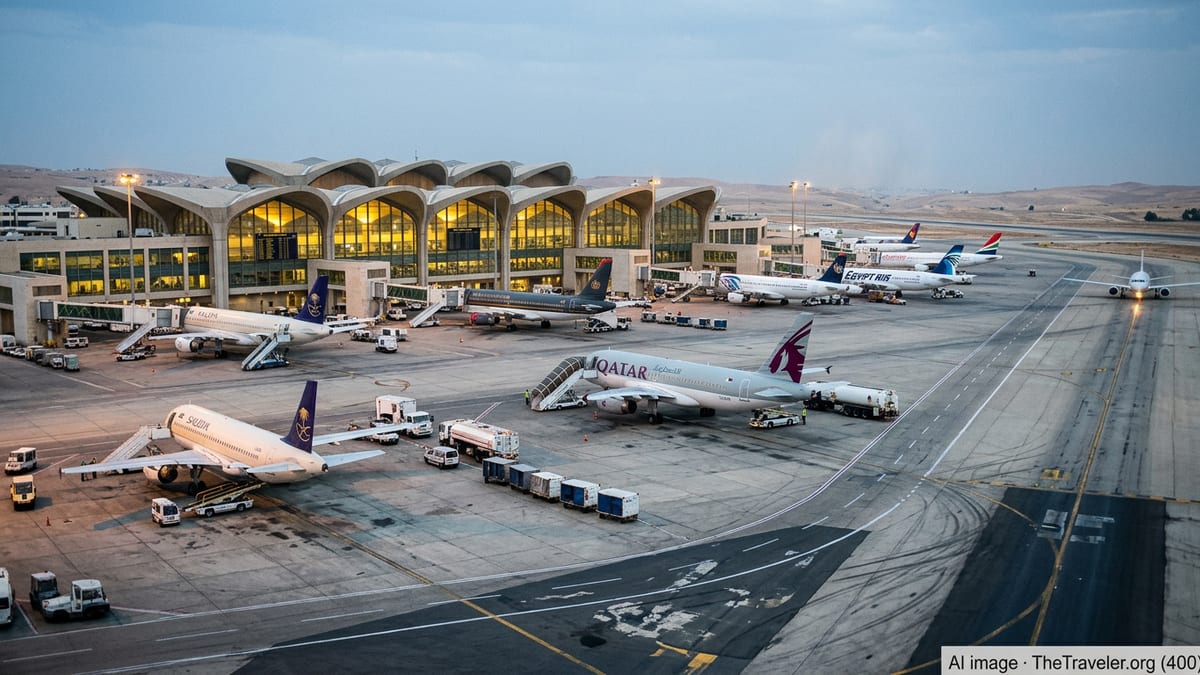
Wave of Irregular Operations Hits Amman Hub
Operational data and airport dashboard snapshots indicate that Amman’s Queen Alia International Airport has entered a period of heightened disruption, with 53 recorded delays and 11 outright cancellations concentrated across a single operating cycle. The irregularities are clustered around peak departure and arrival banks, amplifying the knock-on effect for passengers using the airport as a transfer point.
The pattern shows delays ranging from modest schedule slips of 30 to 45 minutes to multi-hour hold-ups, particularly on medium and long-haul sectors. While the airport itself remains open and fully functional, the concentration of off-schedule movements has strained ground handling, gate allocation and baggage operations during the busiest periods of the day.
The disruptions occur against a backdrop of otherwise improving traffic metrics at Queen Alia International Airport, which has been reporting steady recovery in passenger numbers and flight frequencies during 2026. This contrast between broader recovery and short-term operational turbulence has left many travelers facing missed connections, extended layovers and the challenge of rebooking onward journeys at short notice.
Publicly available airport and aviation operations updates suggest that the current disruption is not linked to a closure of Jordanian airspace but rather to a convergence of airline-level scheduling issues, network constraints and aircraft availability challenges across multiple carriers.
Impact on Major Airlines and Key Transit Routes
The 53 delays and 11 cancellations are spread across a mix of national, regional and international airlines that use Queen Alia International Airport as a gateway and transfer point. Royal Jordanian, as the home carrier, is particularly exposed due to its role in feeding passengers between Europe, the Middle East and North America. Disruptions on its regional spokes can quickly cascade into long-haul banks heading toward major European cities and the United States.
Other global and regional operators serving Amman, including carriers from the Gulf, North Africa and Europe, have also been affected as tight aircraft rotations leave little slack in their schedules. When an inbound aircraft arrives late into Amman, subsequent departures on that same airframe are forced to operate behind schedule, compounding the delays across the day.
Available flight-status snapshots show that cancellations have tended to concentrate on services with alternative same-day options or those deemed less critical in terms of connectivity. In several cases, airlines have opted to consolidate flights, moving passengers to later departures or rerouting them through partner hubs in the Gulf or Europe to minimize overnight strandings.
For airlines, the timing is particularly sensitive. Carriers serving Jordan have been rebuilding networks and seat capacity following earlier regional volatility, and operational reliability is central to sustaining that recovery. The present cluster of disruptions highlights the ongoing fragility of schedules that operate with minimal spare aircraft and tight turnaround times.
Amman’s Links to Europe Under Strain
Amman’s role as a bridge between Jordan and Europe makes any spike in disruption especially visible on European routes. Recent schedule expansions, including new services to German cities and the return of low-cost carriers from several European markets, have increased the volume of traffic funneled through Queen Alia International Airport. That has strengthened connectivity for Jordan-bound tourists and business travelers, but it has also made the network more sensitive to bottlenecks.
In the current episode, delayed departures to major European hubs have produced a ripple effect across connecting banks, as passengers miss onward flights or arrive hours later than planned. This is particularly challenging on itineraries where Amman is used as a midpoint between Europe and destinations further east or south, since misaligned connections can require complete re-routing.
Airline scheduling data and operational summaries show that European carriers and their partners are attempting to absorb the disruptions by rebooking passengers on alternative same-day flights or, where possible, adjusting minimum connection times in their systems. However, during peak summer demand, spare seat capacity is limited, and travelers may find themselves re-accommodated onto flights one or more days later than originally booked.
The situation underscores how tightly coupled European and Middle Eastern aviation networks have become. Even without a systemic shutdown of airspace, localized disruption at a key node such as Amman can quickly manifest in missed connections and rolling delays across a broad swath of the continent’s route map.
Transatlantic and U.S. Connections Feel the Knock-On Effects
Although the majority of the 53 delays and 11 cancellations are focused on regional and intra-European operations, the consequences are extending onto long-haul itineraries linking Amman with the United States. Transatlantic routes typically rely on carefully timed feeder services from across the Middle East and Europe to ensure viable connection windows at Queen Alia International Airport.
When those feeder flights arrive late or are cancelled, long-haul services can be affected in two ways. In some cases, departure times are held to allow additional connecting passengers to board, contributing to late arrivals into North American hubs. In other cases, long-haul flights depart on time but with a higher proportion of empty seats, while disrupted passengers are re-routed via alternative gateways such as major Gulf or European hubs.
Publicly available flight information suggests that airlines are prioritizing the integrity of their transatlantic schedules, seeking to avoid outright cancellations on U.S. services where possible. Instead, the primary impact for North America-bound travelers has been extended connection times in Amman, last-minute rebookings, and occasional misalignment with onward domestic flights once they reach the United States.
For travelers heading in the opposite direction, from North America to Jordan and beyond, delays on U.S. departures can also reverberate in Amman. Late-arriving transatlantic flights reduce the buffer before onward regional departures, leading to tight or missed connections onto shorter-haul services across Jordan and neighboring countries.
Guidance for Affected Travelers and Outlook for Operations
For passengers caught up in the wave of disruptions at Queen Alia International Airport, publicly available guidance from airlines and aviation authorities emphasizes the importance of closely monitoring flight status and managing connections proactively. Travelers are encouraged to check their flight’s status repeatedly on the day of departure, as schedules may be updated multiple times in response to shifting aircraft and crew availability.
Operational notices from carriers indicate that passengers whose flights are cancelled are generally being offered free rebooking onto the next available services, subject to seat availability. In cases of long delays or missed onward segments, many airlines are providing hotel accommodation and meal vouchers in line with their own policies and, for eligible journeys, applicable consumer protection rules in the regions where tickets were issued.
Looking ahead, aviation performance updates for Jordan and the wider region point to a gradual normalization of traffic patterns, even as airlines continue to navigate global capacity constraints and intermittent regional tensions. Queen Alia International Airport has been highlighted in recent traffic reports as demonstrating resilience and steady year-on-year recovery in both passenger numbers and flight movements.
The present cluster of 53 delays and 11 cancellations therefore appears to reflect a period of acute, but likely temporary, operational stress rather than a fundamental change in the airport’s status. Nonetheless, the episode serves as a reminder that travelers using Amman as a hub between Jordan, Europe and the United States should build in additional buffer time for connections, particularly during peak travel seasons when networks are operating close to capacity.