


Landing at Zanzibar’s Abeid Amani Karume International Airport (ZNZ) is often the moment the trip finally feels real. The runway runs almost to the sea, the air is warm and humid, and within minutes you are in the middle of the organised chaos typical of a small Indian Ocean hub. For a first visit, though, the mix of visa checks, baggage, taxi touts and unfamiliar currencies can be overwhelming. This guide walks you through exactly what to expect, from the arrivals hall to your resort, with concrete examples on prices, routes and services so you can step off the plane prepared rather than guessing.
Get the latest updates straight to your inbox!
Understanding Zanzibar’s Airport and Arrivals Process
Zanzibar’s main airport is Abeid Amani Karume International Airport, code ZNZ, about 5 kilometres south of Stone Town. You will sometimes see older names like Kisauni Airport or “Zanzibar International Airport” on booking confirmations, but they refer to the same place. For most visitors arriving from Europe or the Middle East on airlines such as Qatar Airways, Turkish Airlines, KLM or flydubai, flights use the newer Terminal 3, which handles the bulk of international traffic. Many regional and domestic airlines, such as Precision Air, Air Tanzania and coastal safari carriers, use Terminal 2, which also operates some international services.
On arrival you disembark directly onto the tarmac or via basic airbridges, then walk into the terminal for immigration. If you need a visa on arrival, follow the signs to the visa counters before the passport control desks. Queues can build up when several wide-body flights land within an hour, so it is common to spend 30 to 60 minutes getting through in the late afternoon and evening peaks. Having your passport, return ticket details and accommodation address on hand speeds things up. Once stamped in, you pass through a short duty free area before reaching baggage claim.
The baggage hall is compact and can feel crowded when two flights arrive at once. Baggage delivery times vary: some travelers report bags on the belt within 15 minutes on early morning flights, while others arriving on busy evening flights have waited 45 minutes or more. Airport trolleys are usually available free of charge, though they can run short at peak times. Before exiting customs, several officials may ask you to put bags through a scanner. They are primarily looking for restricted items rather than personal electronics or clothing.
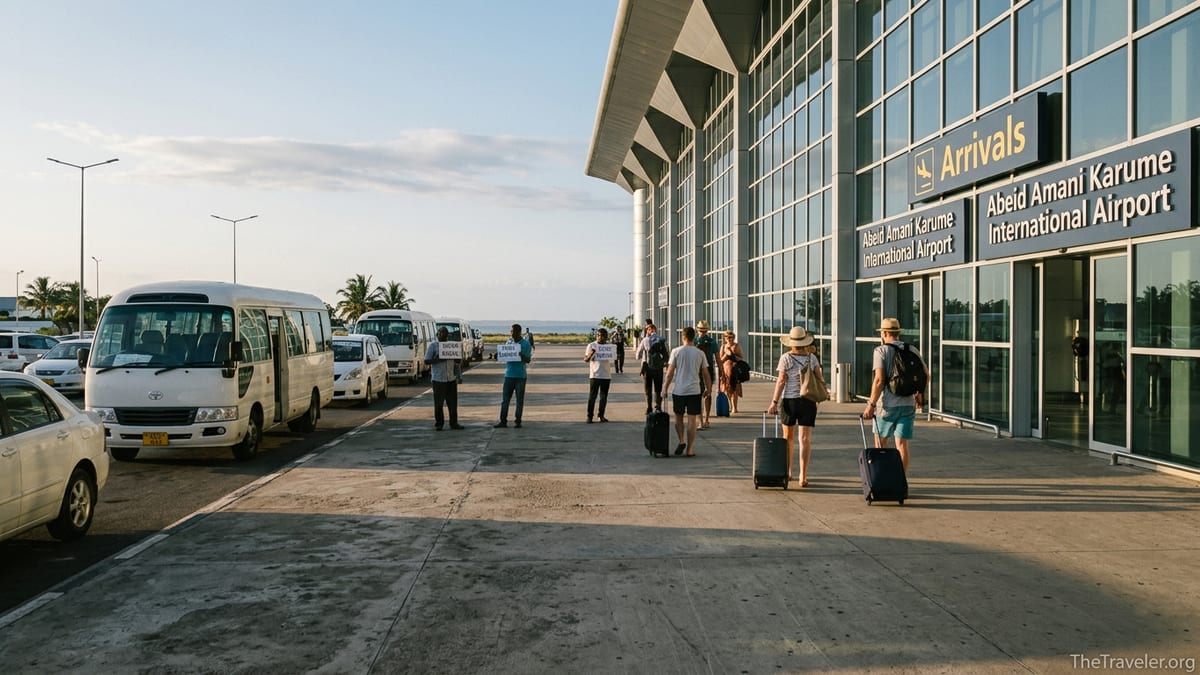
Immediately after customs you enter the main arrivals concourse, where the atmosphere shifts from formal to hectic. Expect a mix of hotel representatives holding signs, pre-booked transfer drivers, taxi drivers calling out for business, and a cluster of small booths offering money exchange, SIM cards and tour bookings. This space is where most first-time visitors feel the most pressure, but taking a slow breath, stepping to the side and getting your bearings for a minute will make the rest of the process far easier.
Terminals, Transfers and Domestic Connections
Although many websites still describe a clean split where Terminal 3 is “international” and Terminal 2 is “domestic,” the reality on the ground is more flexible. Both terminals can handle both domestic and international flights, and airlines are distributed by agreements rather than by clear passenger logic. As of 2026, major international carriers like Qatar Airways, Turkish Airlines, KLM, Oman Air and flydubai generally use Terminal 3, while several regional airlines, charter operators and some Air Tanzania and Precision Air flights use Terminal 2.
If you are connecting from an international flight to a domestic hop to the mainland, for example ZNZ to Dar es Salaam or Arusha, it is likely you will need to collect your checked bags, clear immigration, exit arrivals and then check in again at the relevant terminal. Even when both sectors are on one ticket, Zanzibar is not set up like a big hub with sterile international transit. A common real-world itinerary would be arriving on Turkish Airlines in the afternoon, exiting through Terminal 3, walking or being driven the short distance to Terminal 2, and then checking in for an evening Precision Air flight to Kilimanjaro. Make sure you leave several hours between flights because queues, baggage delays and the short transfer between terminals all take time.
The distance between Terminal 2 and Terminal 3 is walkable in around 5 to 10 minutes for most travelers, along internal airport roads and marked paths. In the heat and humidity, dragging heavy luggage might feel longer, but it is manageable. Some tour operators and hotels that handle both legs of a journey will include an internal terminal transfer in their service. In practice that usually means a short ride in a minivan or microbus around the perimeter, which is convenient if you are traveling with children or bulky safari bags.
Facilities across the two terminals are basic but improving. You can find ATMs, a couple of small cafes, souvenir kiosks and washrooms in both, and air conditioning generally works better in Terminal 3 than in Terminal 2. Do not expect large airport lounges or international restaurant chains. If you have a long layover, many travelers choose to leave the airport and spend a few hours in Stone Town rather than waiting in the terminal, especially during the day. The short distance makes this easy as long as you factor in time for security on return.
SIM Cards, Connectivity and Staying Online
Mobile data in Tanzania is inexpensive compared with North America or Western Europe, and a local SIM card is usually the most economical way to stay connected during a stay in Zanzibar. The main mobile operators active on the islands are Vodacom, Airtel, Halotel and Zantel, with Tigo more present on the mainland. At ZNZ you will see small branded counters or shared kiosks in the arrivals area selling prepaid SIM cards for these networks. Prices change often, but as an example in mid 2026 many travelers report paying the equivalent of around 8 to 12 US dollars in Tanzanian shillings for a package that includes a physical SIM plus several dozen gigabytes of data valid for two to four weeks.
By Tanzanian law, every SIM card must be registered to an individual using a valid ID. At the airport this means you will be asked to hand over your passport for scanning or photographing. At busy times registration can be slow, with one agent handling several customers at once and dealing with occasional network issues. A simple way to manage this is for one person in your group to buy and register a SIM at the airport to have immediate connectivity for ride coordination and messaging, while others wait and buy cheaper packages in Stone Town at official shops. For instance, you might pay a small premium at ZNZ for a 20 GB Vodacom or Airtel package, then see slightly lower rates at a main store near Darajani Market the next day.
Many first-time visitors consider eSIM options such as Airalo or Holafly before traveling. These are convenient because they can be installed before departure, but real-world reports from 2025 and 2026 suggest performance in Zanzibar can be mixed. Some users find that eSIMs connected to Halotel work fine for messaging and basic browsing in Stone Town but struggle with speed in beach areas like Jambiani or Matemwe, where local physical SIMs on Vodacom or Airtel often perform better. If you rely on stable video calls or remote work, it is safer to budget a few minutes at the airport or in town to buy and test a local SIM, rather than depending entirely on an international eSIM.
Wi-fi is increasingly common in hotels and guesthouses, from upscale resorts in Nungwi and Kendwa to boutique lodges in Paje. However, quality varies. A five-star resort might advertise high-speed connections, but the actual link may still be based on shared mobile data rather than fiber. For essential tasks like confirming onward flights, speaking with safari operators or downloading offline maps, a local SIM with enough data offers more control. Before leaving the airport arrivals hall, quickly test your new SIM’s data by loading a map of Stone Town or your resort area to make sure it is fully activated.
Money, ATMs and What Things Really Cost
The official currency is the Tanzanian shilling, though US dollars are widely accepted for tourist services like hotels, tours and some taxis. In the arrivals hall you will find a small number of foreign exchange desks and a couple of ATMs. Exchange rates at the airport tend to be slightly worse than in Stone Town, but many travelers still change a modest amount here, for example 50 to 100 US dollars, to cover immediate costs such as a taxi and a snack. If you plan to pay your accommodation and excursions in dollars, you will still want shillings for small purchases, tips and local restaurants.
Card acceptance is growing but is not universal. Larger international resorts in areas like Nungwi or Kiwengwa usually accept Visa and Mastercard with no problem, although they may add a small processing surcharge. Small guesthouses, beach bars and independent drivers remain cash-oriented. A realistic first-day strategy would be to withdraw the equivalent of 150 to 250 US dollars in shillings from an airport ATM, then top up later in town where banks can offer higher machine limits. For example, if your taxi from the airport to Stone Town is quoted at 40,000 to 50,000 shillings, a simple lunch at a local restaurant might be 10,000 to 20,000 shillings per person, and basic items like a bottle of water or soft drink typically cost under 3,000 shillings in shops away from resorts.
As for what airport transfers actually cost, there is no official metered taxi system in Zanzibar and the airport authority does not publish a regulated tariff. That means prices are negotiated, but over the last few years patterns have become fairly consistent. As of 2026, a reasonable one-way fare between the airport and Stone Town for a standard car is often quoted between 12 and 20 US dollars, depending on your bargaining, time of day and whether you book in advance or hire on the spot. To the popular north coast area of Nungwi, you will commonly hear quotes around 40 to 60 US dollars, while routes to east coast villages like Paje, Jambiani or Matemwe are usually somewhere between 30 and 50 US dollars for a private car.
Hotel-arranged transfers are usually at the upper end of this range but come with predictability and a driver waiting with a sign. A boutique hotel in Stone Town might charge 20 to 25 US dollars for a one-way airport pickup, while a high-end resort in Kendwa may quote 60 or more for the 1.5 to 2 hour drive. Independent taxi operators listing prices on their own websites sometimes undercut these by a few dollars. Whichever you choose, confirm in advance if the price is per car or per person, ask whether payment in shillings is accepted at a fair rate if you do not want to use dollars, and keep some small notes handy for tipping.
Taxis, Private Transfers and Getting to Your Resort
Stepping into the arrivals forecourt at ZNZ, you will immediately notice a line of taxis and a number of drivers approaching newly arrived passengers. Because there are no ride-hailing apps such as Uber or Bolt operating in Zanzibar as of 2026, these taxis and pre-booked transfers are the primary way to leave the airport. The experience is similar whether you are heading to Stone Town, the north or east coasts: you either find your pre-arranged driver holding a sign with your name, or you negotiate directly with one of the taxi drivers clustered near the exit.
Pre-booked private transfers arranged through your hotel or an established local transport company are generally the least stressful option for first-time visitors. For instance, a guest house in Paje might pre-arrange a private car for 35 to 40 US dollars door to door, with the driver tracking your flight and adjusting for delays. This can be particularly valuable for late-night arrivals, families with small children, or travelers carrying bulky dive or kite-surfing gear. Many operators also allow you to add return transfers and mid-stay moves between beach areas to the same booking, turning your airport pickup into a simple package of three or four rides.
Hiring a taxi on the spot can work well if you are comfortable negotiating. A typical interaction on arrival might start with a driver suggesting 25 US dollars to Stone Town, with you countering at 15, and the two of you settling around 18 to 20, which is in line with many recent visitor reports. On longer routes, such as to Nungwi, initial quotes can be higher than the going rate, so it helps to know approximate target prices before you arrive. If several drivers cluster around you, pick one, agree clearly on a total price in either shillings or dollars, specify that it is for the entire car, and confirm whether the price includes any quick stops, for example at an ATM or shop.
Shared shuttles are less formalised than in some destinations. A few local operators and tour agencies group passengers arriving on the same flight into vans going north or east, which can reduce costs, but you usually need to arrange this by email or messaging in advance rather than booking on a central platform. As an example, a shared minivan transfer to Nungwi might cost each passenger around 15 to 20 US dollars if four or more people are on board, compared with 40 to 60 for a private car. For solo travelers on a budget, another tactic is to look for fellow passengers heading in the same direction while waiting for bags and propose splitting a taxi.
From Airport to Stone Town and Beach Resorts
Reaching Stone Town from ZNZ is straightforward and quick. The drive is only about 15 minutes in light traffic, though it can stretch to 25 or more during busy afternoon periods. Routes typically follow a simple path along the main airport road toward the town, passing a mix of small shops, petrol stations and local housing before reaching the more historic and densely built area near the seafront. Many hotels within the old alleys cannot be reached directly by car, so drivers will drop you near a known landmark such as Forodhani Gardens or a larger hotel, from where a porter or hotel staff may walk you the final few minutes. Using a hotel-arranged porter is common, and a small tip in shillings is appreciated.
Getting from the airport to Zanzibar’s beach resorts takes longer, and journey times depend heavily on the direction and quality of the roads. To the north, the ride to Nungwi or Kendwa typically takes around 1.5 to 2 hours. The route first skirts Stone Town, then follows the main tarmac road north through local villages. Potholes and speed bumps are frequent, so travel times can fluctuate. To the east coast, popular for kite-surfing and more relaxed beaches, you can expect roughly 1 to 1.5 hours to Paje or Jambiani, and about the same to Kiwengwa or Matemwe. These drives give a first glimpse of island life, with roadside fruit stands, schoolchildren in uniforms and the occasional troop of monkeys near patches of forest.
Some resorts, especially higher-end properties on the north and east coasts, bundle airport transfers into package rates or offer them at discounted prices if you book activities through them. For example, a property in Matemwe might offer a private airport transfer plus a day trip to Mnemba Atoll at a combined price lower than booking each separately once on the island. If you are comparing hotel offers, it is worth asking in advance whether transfers are included or can be added at a fixed rate. This can be more comfortable than negotiating at the taxi line after a long overnight flight.
If you plan to explore the island independently, car rental is available, though most rental offices are based in Stone Town rather than directly at the terminal. Rates for basic small SUVs and compact cars often start around 25 to 40 US dollars per day, depending on season and insurance. Driving is on the left, and police checkpoints are common on main routes. Many first-time visitors choose to rely on taxis and arranged drivers for longer journeys and use walking or occasional short rides within Stone Town, leaving driving for a later visit once they are more familiar with local road conditions.
First-Time Zanzibar Tips: Health, Safety and Practicalities
Beyond logistics, a few practical habits can make your first arrival in Zanzibar smoother. The climate is hot and humid much of the year, so drinking water and light clothing matter as soon as you step off the plane. Carry a refillable bottle and fill it with safe water at your hotel or in reputable restaurants rather than relying on airport vendors, where prices tend to be higher. When you exit arrivals into the open air, the combination of heat and the press of touts can be surprising; taking a moment under shade to organise cash, confirm your hotel’s address and check your transfer details on your phone can lower stress considerably.
Security at ZNZ is visible but generally unobtrusive. You will pass at least one security screening when entering the terminal for departure, and sometimes an additional check at the gate. Keep your passport and boarding pass accessible but secure and avoid flashing large amounts of cash. Petty theft is relatively uncommon inside the airport itself, but as in any crowded transit space, you should keep hand luggage close and avoid leaving phones unattended on seats or in public charging areas. If you are approached by someone inside the terminal offering “fast track” services that you have not booked in advance through your airline or hotel, politely decline unless you have time to verify their legitimacy.
Health-wise, many visitors entering Tanzania from regions with yellow fever risk are asked to show proof of vaccination, so keep any relevant certificates in your hand luggage just in case. Malaria is present in Zanzibar, particularly during and just after the rainy seasons, so talk to a healthcare provider before travel about prophylaxis options appropriate for you. At the airport itself, mosquitoes are seldom a major issue inside the terminal, but they can appear around the parking areas in the evening, so having repellent in an accessible pocket is practical if you will spend time waiting outdoors.
Culturally, Zanzibar is predominantly Muslim, and while the atmosphere is relaxed and tourism-focused, it is respectful to dress modestly in public areas, especially when passing through the airport and nearby town streets. Swimwear and very revealing clothing are accepted at resort pools and beaches but are not appropriate in the airport concourse or Stone Town’s bazaars. Simple choices like a light shirt over a tank top when you land, or a sarong to cover swimwear when returning to the airport at the end of your trip, go a long way toward fitting in with local expectations.
The Takeaway
Arriving for the first time at Zanzibar’s Abeid Amani Karume International Airport can feel intense, but with realistic expectations it soon becomes just another small chapter in a much larger journey. Knowing that there is no metered taxi system, that airport SIMs are slightly pricier but convenient, that terminals are only a short walk apart and that Stone Town is barely 15 minutes away helps you filter out the noise and focus on what matters.
In practical terms, if you land with a pre-booked transfer, a rough idea of fair taxi prices, a plan for getting local data, and a little cash in Tanzanian shillings, you are already ahead of most first-time visitors. From there the island tends to take over: once you are settled in your resort or guesthouse, watching the sunset over the Indian Ocean or the dhows sailing past Stone Town’s seafront, the memory of the arrivals hall fades quickly. Preparation at ZNZ simply buys you extra energy and time to enjoy that first sunset rather than recovering from avoidable confusion.
FAQ
Q1. How long does it usually take to get through arrivals at Zanzibar Airport?
At quieter times you might clear immigration and baggage in about 30 minutes, but when several international flights arrive close together it can easily take 60 to 90 minutes from landing to exiting customs.
Q2. Which terminal will my flight use at ZNZ?
Most long-haul and major regional international flights use Terminal 3, while many domestic and some regional services use Terminal 2. Because airlines can change terminals, always check your booking or with your carrier a day or two before departure.
Q3. What is a fair taxi price from the airport to Stone Town?
As of 2026, a typical one-way fare for a standard car from ZNZ to Stone Town ranges from about 12 to 20 US dollars, depending on whether you pre-book or negotiate on arrival and on the time of day.
Q4. How much should I expect to pay for a transfer to Nungwi or Kendwa?
For the north coast, private airport transfers commonly cost between 40 and 60 US dollars per car each way. Higher-end resorts may charge a bit more, while some independent operators advertise slightly lower rates if booked in advance.
Q5. Can I buy a local SIM card at Zanzibar Airport and what does it cost?
Yes, you can buy prepaid SIM cards from operators like Vodacom, Airtel, Halotel and Zantel in the arrivals area. Recent visitors report paying roughly 8 to 12 US dollars in local currency for a SIM plus several dozen gigabytes of data valid for a couple of weeks.
Q6. Do ride-hailing apps like Uber operate in Zanzibar?
No, ride-hailing services such as Uber or Bolt do not operate in Zanzibar as of 2026. Most travelers use airport taxis, pre-booked private transfers or hotel-arranged cars to leave the airport.
Q7. Is it better to pay in US dollars or Tanzanian shillings for taxis and small expenses?
Many airport taxis and tourist-facing services quote prices in US dollars and will accept them, but using Tanzanian shillings often gives you more flexibility and can make small payments and tips easier. A mix of both works well for most visitors.
Q8. How far is Zanzibar Airport from Stone Town and how long is the drive?
The airport is about 5 kilometres from Stone Town, and the drive normally takes around 15 minutes in light traffic. During busy times or in heavy rain it can stretch to 25 minutes or a little more.
Q9. Are there ATMs at Zanzibar Airport and do cards work reliably?
There are usually one or two ATMs in the arrivals area, and most international Visa and Mastercard debit or credit cards work, though occasional outages or cash shortages can occur. It is sensible to withdraw a modest amount on arrival and plan a larger withdrawal in Stone Town if needed.
Q10. Is Zanzibar Airport safe for solo travelers arriving at night?
ZNZ is generally considered safe, and many solo travelers arrive on late flights without issues. As with any airport, stay aware of your belongings, use licensed taxis or pre-booked transfers, and avoid following unsolicited individuals away from the main arrivals area.