


Abeid Amani Karume International Airport is only a short drive from Stone Town, but working out how to make that journey on a budget can be confusing. Official airport taxis, prebooked transfers, local touts, and bare-bones public minibuses known as dala-dalas all compete for arriving travelers. For many visitors the question is simple: can you realistically use public transport from the airport, especially with luggage, or is it not worth the hassle?
Get the latest updates straight to your inbox!
Understanding Zanzibar Airport and Its Surroundings
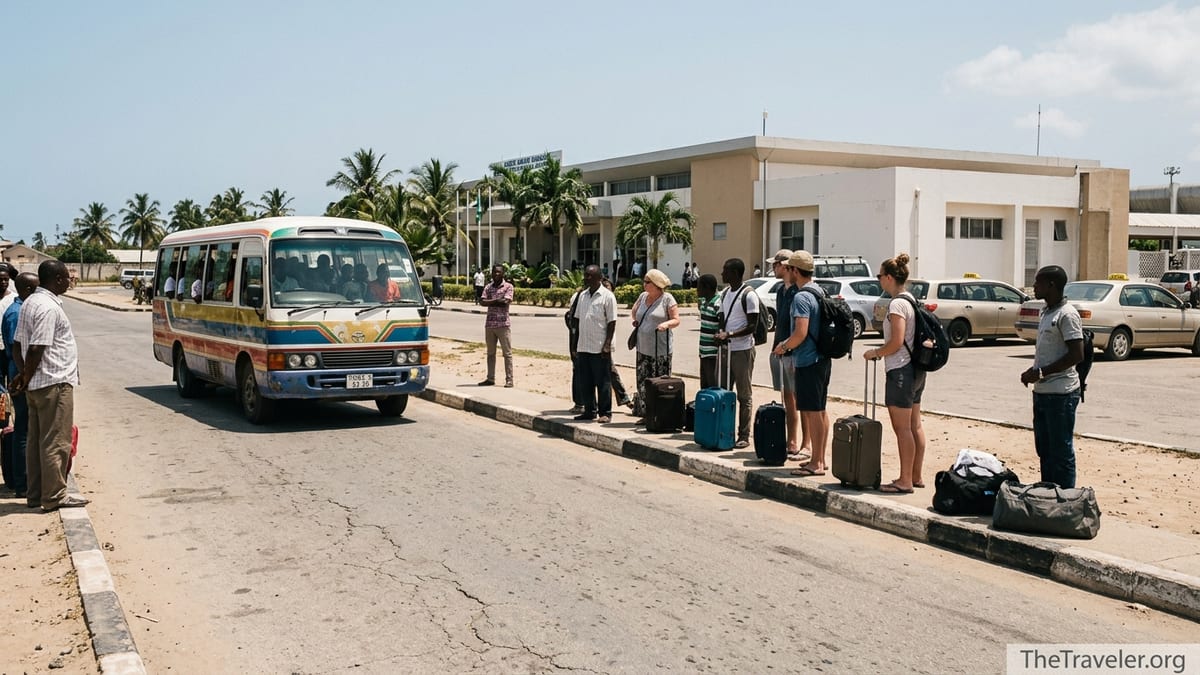
Zanzibar’s Abeid Amani Karume International Airport sits roughly 5 to 7 kilometers south of Stone Town, depending on where in town you are staying. In clear traffic, a taxi covers the distance in about 15 minutes, while a local dala-dala usually takes 15 to 25 minutes because it stops frequently to pick up and drop off passengers. The road between the airport and town is paved and generally in decent condition, although traffic can be slow at peak times when flights arrive together or when trucks and local traffic clog the junctions just outside Stone Town.
The airport itself is compact. International flights mainly use the newer Terminal 3, while many domestic and some regional services still use Terminal 2. Both terminals open directly to a forecourt area where taxis, hotel drivers, and family pickups wait. There is no integrated public bus terminal connected directly to the arrivals hall in the way many European or Asian airports have. Instead, dala-dalas run along the main airport access road a short distance away, which is the first reason public transport is less straightforward here than in some other destinations.
Stone Town, the historic heart of Zanzibar City, is a dense maze of narrow lanes where vehicles often cannot pass. Even once you have reached the town by taxi or dala-dala, you may still need to walk several minutes along alleys to reach a hotel near popular spots such as Forodhani Gardens, Shangani, or the streets around Gizenga and Kenyatta Road. That final walk can be atmospheric and fun if you are traveling light, but it becomes tiring quickly if you are hauling a large suitcase in midday humidity after a long flight.
Because of this combination of a basic airport layout, lack of a true bus station at the terminal, and the physical character of Stone Town itself, the “last mile” is where many budget travelers underestimate the effort involved in using public transport from the airport.
What Dala-Dalas Are Really Like
Dala-dalas are the backbone of local public transport in Zanzibar. These vehicles are usually converted minibuses or open-sided trucks fitted with benches along the sides. They operate on fixed but informal routes radiating from Stone Town to towns such as Nungwi, Paje, Kiwengwa, and other villages. Most services start from or pass through central hubs near Darajani Market, Mwanakwerekwe, or other busy intersections on the outskirts of town. You pay in cash, typically in Tanzanian shillings, directly to a conductor when you get off.
On the airport route, dala-dalas running between Stone Town and southern or eastern villages pass the junction to the airport along the main road. Recent traveler accounts and local transport guides describe a short journey between the airport road and Stone Town costing roughly the equivalent of a few hundred to around one thousand shillings per person, which is well under one US dollar. This extreme affordability is what tempts budget-minded visitors to consider public transport in the first place, especially when compared to a taxi fare of 10 to 20 dollars for the same stretch.
The trade-off is comfort and predictability. Dala-dalas rarely have air conditioning and can be crowded, especially in the morning and late afternoon when local commuters are traveling. Seating is informal, and people may squeeze onto small benches or stand bent over in the aisle. Luggage space is limited. Locals often travel with bags of produce, building materials, or everyday shopping, not with large wheeled suitcases. While a small backpack or duffel bag usually fits without issue, a hard-shell suitcase can be awkward to stow and may need to be wedged near the door, on your lap, or even on the roof in some cases, which is not ideal in wet weather.
The atmosphere on board is also different from a structured city bus system. Conductors call out destinations, tap the side of the vehicle to communicate with the driver, and manage constant on-and-off movement. For visitors used to clearly signed bus stops and electronic displays, the experience can feel chaotic. That said, many independent travelers enjoy at least one dala-dala ride during their stay because it offers a close look at everyday life at a fraction of the cost of private transport.
Why Using Dala-Dalas From the Airport With Luggage Is Difficult
Although dala-dalas are cheap and accessible to the main road near the airport, several practical factors make them challenging right after a flight, particularly if you are carrying large or multiple bags. The first is that there is usually a walk involved. Most public guides and recent local advice point out that you must leave the terminal building, cross the immediate taxi and parking area, and then continue to the main road, where passing dala-dalas can be flagged down. For a solo backpacker with one small pack, this walk is manageable. For a family of four with two large suitcases and carry-on luggage, it can be an exhausting start, especially in the midday sun.
Second, luggage simply does not fit neatly into most vehicles. Imagine arriving with a 23-kilogram wheeled suitcase and a cabin bag after an overnight flight. By the time you reach the roadside stop, a half-full dala-dala pulls up. The conductor may wave you onboard, but once you climb in you may find that there is no obvious place to put the suitcase. It will likely need to be hoisted into the corner, squeezed between passengers, or wedged near your knees while others climb over it. During busy periods, people boarding and alighting at intermediate stops may nudge or step over your bag.
Third, flight schedules and dala-dala operating times are not coordinated. Public transport on Zanzibar often runs more frequently during local commuting hours, roughly from early morning until the late afternoon. After sunset, services diminish or stop on many routes. If your flight lands in the evening, or is delayed into the night, you may find there is no practical dala-dala option at all and you must negotiate a taxi anyway. Even in daytime, the wait for the right route can be unpredictable. You might walk out and find a minibus immediately, or you might stand in the heat for 30 minutes watching full vehicles pass by without enough space for you and your bags.
Finally, there is the issue of information. While some local tourism offices and language schools publish outline maps of routes and approximate fares, there is no fully standardized, constantly updated network map or timetable covering every service. Visitors who do not speak Swahili may struggle to understand which route they are boarding without help from locals. The risk of getting on a dala-dala that takes a slower or indirect route, or one that drops you on the outskirts of Stone Town rather than near your guesthouse, is real. After a long day of travel, this extra layer of uncertainty is often not worth the handful of dollars saved.
Connecting Between the Airport, Stone Town, and the Beaches
For most itineraries, Stone Town acts as a transport hub. If you plan to stay a night or two in town, your immediate challenge on arrival is simply getting from the airport to your hotel. Typical taxi fares, based on recent traveler reports and local transfer guides, fall somewhere in the region of 10 to 20 US dollars for this short hop, depending on the time of day, how crowded the arrivals area is, and your negotiation skills. Some beachfront hotels bundle airport pickup into their room rates or offer it for a fixed fee, while smaller Stone Town guesthouses may recommend trusted drivers who offer similar pricing.
Once you are settled in Stone Town, dala-dalas become a far more attractive budget option. For example, the route between Stone Town and Nungwi, on the northern tip of the island, costs only a small fraction of what a private taxi would charge and takes around 90 minutes in light traffic. Similarly, services to Paje and Jambiani on the southeast coast offer a very cheap way to reach the beaches if you are prepared for a slow and sometimes crowded ride. In these cases, you can leave excess luggage at your Stone Town hotel, travel with a smaller daypack, and focus on the experience instead of worrying about large bags.
If you want to use public transport from the airport straight to a beach area without staying in Stone Town first, be prepared to change vehicles. A typical budget route to Paje might involve taking a local minibus from the airport road to a junction near Stone Town, transferring to another dala-dala heading toward the southeast coast, and then possibly walking or taking a short motorbike or taxi ride from the main road to your beachfront accommodation. The same pattern applies if you are heading to places like Kiwengwa, Matemwe, or Kendwa. Each transfer adds time and complexity, and if you have luggage, each change means unloading and reloading bags into a new vehicle.
A practical approach many budget travelers adopt is to pay for a taxi between the airport and Stone Town both on arrival and departure, and then use dala-dalas for day trips or for moving between Stone Town and the beaches once they are rested, familiar with the environment, and carrying lighter bags. This hybrid strategy keeps costs reasonable while reducing stress at the most tiring point of the journey, which is often the moment you step out of the terminal.
Route Quirks, Changes, and How to Cope
The dala-dala network on Zanzibar is more of a living organism than a rigidly fixed system. Vehicles are privately operated, and routes sometimes shift over time as roadworks, tourist demand, and local needs change. A service that once terminated at a certain market might be extended a few kilometers, while another may bypass a particular street for several weeks because of construction. Recent local commentary also notes that heavy road improvement projects on some stretches of the island can temporarily lengthen travel times and prompt drivers to favor alternative lanes or pick-up points.
For example, travelers have reported that while there are vehicles running from Stone Town toward areas like Nungwi or Kiwengwa on the north and northeast coasts, exact boarding points can differ slightly between mornings and afternoons or between weekdays and weekends. In practice, drivers and conductors shout out destinations, and locals instinctively know where to wait, but visitors may need to ask someone working at a shop or food stall which side of the road to stand on. Asking “Ndege?” for the airport or “Stone Town?” for the city center in simple English or basic Swahili usually gets a helpful pointer.
On the airport side, routes that once ran very close to the terminal occasionally shift a short distance away due to security perimeters or small road changes. This is another reason most current advice emphasizes that you should expect a brief walk, and that you should not be surprised if your driver drops you on the main road and points you toward the terminal rather than driving right to the door. The walk itself is not long, but travelers with children, strollers, or heavy bags might find it inconvenient, especially if they are trying to make a flight and time is tight.
The best way to cope with this flexibility is to treat dala-dalas as an experience rather than a precise transport solution when schedules are critical. If you must catch a ferry or a flight, give yourself far more time than you think you need or choose a taxi instead. For non-urgent journeys, build in an extra hour so that a missed or full vehicle, a minor route deviation, or a surprise transfer does not derail your day. In Stone Town, asking your hotel reception or host for the current boarding point and approximate frequency for your chosen destination remains the most reliable up-to-date information, given how dynamic the informal network can be.
When Dala-Dalas Are Not Worth the Hassle
There are many situations where the romantic idea of traveling like a local on a dala-dala collides with practical reality. The most obvious is timing. If your flight lands late at night, very early in the morning, or significantly delayed after a schedule change, the public minibuses crawling along the main road may simply not be running at all. Waiting on a dimly lit roadside with luggage in the hope that a minibus appears is not a sensible start to a holiday. In these cases, arranging a taxi or prebooked transfer in advance is the safest and most realistic choice.
Another factor is group size and baggage. A solo traveler with a 30-liter backpack and no tight schedule might reasonably accept a 30-minute wait and a slightly uncomfortable ride in exchange for saving 10 to 15 dollars. A family of five with two large suitcases, a stroller, and hand luggage will quickly find that squeezing into a half-full dala-dala is physically difficult, even if the driver waves them aboard. By the time you consider buying an extra seat just for luggage or standing awkwardly in the aisle with children, the cost saving compared to a private minibus or taxi starts to look marginal relative to the stress involved.
Health, safety, and heat also matter. Dala-dalas are open to the elements to varying degrees, and air conditioning is rare. On a hot afternoon, inside temperatures can feel stifling, especially when the vehicle is full. If you are arriving after a long-haul flight or traveling with someone who is elderly, pregnant, or sensitive to heat, the extra strain of a crowded, slow-moving minibus is often not worth it. A standard taxi, while more expensive, provides a seat, quicker transit, and immediate access to your hotel room or guesthouse shower.
Finally, consider the overall value of your time. Many beach hotels on Zanzibar cost 50 to 200 dollars per night or more, and long-haul flights to the island are rarely cheap. In that context, paying an extra 10 or 15 dollars to reach your accommodation smoothly and start enjoying your stay a full hour earlier is a trade-off most travelers find reasonable. You can still experience local public transport on a later day trip between villages or from the beach back to Stone Town using only a small daypack and no fixed schedule.
Practical Tips for Budget Travelers Arriving at Zanzibar Airport
If you are determined to keep costs down and still have a manageable arrival, a few simple strategies make a big difference. One is to organize your luggage with the possibility of a short walk and a crowded ride in mind. Packing in a medium-sized backpack or soft duffel instead of a hard-shell suitcase makes it far easier to tuck your bag under a bench or between your legs on a dala-dala. Even if you ultimately choose a taxi, you will appreciate being able to move quickly through Stone Town’s narrow alleys.
Another tip is to have small-denomination Tanzanian shillings ready before you try any public transport. Airport ATMs often exist but can be unreliable, and money change counters may not always offer the best rates, so withdrawing a modest amount in town before your departure to Zanzibar, or using a well-known bank ATM once you reach Stone Town, can help. Dala-dala fares are very low, so handing over high-value banknotes can cause friction or delays while the conductor searches for change. Having enough small notes to cover a few rides in cash keeps interactions smooth.
Communication also matters. Learning a handful of basic Swahili words, such as “habari” for hello, “asante” for thank you, and destination names like “Ndege” for airport and “Mjini” or “Stone Town,” makes it easier to confirm you are on the right vehicle. When in doubt, ask a local shopkeeper or another passenger, pointing at yourself and stating “Stone Town?” in a questioning tone. Most people are used to visitors and will indicate where you should wait or where to get off. Still, if you feel uncomfortable or confused, it is perfectly reasonable to default to a taxi, especially at the airport where drivers are always present.
Finally, be realistic about your own travel style. Some people thrive on improvisation and enjoy figuring out a new city’s informal transport system on the fly, taking delays and wrong turns in stride. Others find this stressful. In Zanzibar, the cost difference between a taxi and a dala-dala on the short airport to Stone Town run is relatively small in absolute terms. Choose the option that lets you arrive feeling calm and ready to explore, rather than fixating on achieving the absolute minimum spend on day one.
The Takeaway
Public transport in Zanzibar, and dala-dalas in particular, plays an important role in how locals move around the island and can be an interesting experience for open-minded travelers. However, Abeid Amani Karume International Airport is not built around a user-friendly bus station, and the combination of a short walk to the main road, informal boarding practices, cramped interiors, and limited luggage space means that dala-dalas are rarely the best choice immediately after you land with bags in hand.
For most visitors it makes sense to treat the airport to Stone Town segment as a separate, higher-priority leg of the trip. Paying for a negotiated taxi or a prebooked transfer to your hotel on arrival and on departure provides a predictable start and finish, while the cost is limited to a small fraction of your overall budget. Once settled, you can experiment with dala-dalas on routes between Stone Town and the beaches, ideally with lighter bags and more flexible timing.
In short, dala-dalas are part of the Zanzibar experience, but they are not a requirement for traveling on a budget. Use them where they shine, on relaxed daytime journeys between towns and villages, and allow yourself the comfort of a taxi when stepping out of the terminal with luggage or when catching a flight. That balance lets you save money where it truly matters while still keeping your arrival and departure as smooth as possible.
FAQ
Q1. Can I take a dala-dala directly from Zanzibar Airport to Stone Town?
Yes, you can reach Stone Town by dala-dala, but services usually run along the main road outside the airport, so you will need to walk from the terminal to the roadside and flag one down rather than boarding at an organized bus bay.
Q2. How much does a dala-dala from the airport area to Stone Town cost?
Fares are very low, typically the equivalent of well under one US dollar per person for the short journey, paid in Tanzanian shillings to the conductor when you get off the vehicle.
Q3. Is it safe to use dala-dalas with luggage from the airport?
It is generally safe in the sense that locals use these vehicles every day, but space for large suitcases is limited, boarding can be rushed, and you must keep a close eye on your belongings in crowded conditions.
Q4. What is the typical taxi price from Zanzibar Airport to Stone Town?
Recent traveler reports suggest that most visitors pay roughly 10 to 20 US dollars for a private taxi between the airport and central Stone Town, with prices depending on negotiation, time of day, and demand.
Q5. Are dala-dalas reliable for catching an early morning flight?
Dala-dala schedules are informal and not aligned with flight times, so they are not recommended when you must be at the airport by a specific hour; in such cases, arranging a taxi or transfer is much safer.
Q6. Can I use dala-dalas to go straight from the airport to beach areas like Nungwi or Paje?
Not usually in a single ride; you will typically need at least one change of vehicle near Stone Town and may also need a short taxi or motorbike ride from the main road to your actual hotel, especially if it is directly on the beach.
Q7. What is the luggage situation on dala-dalas?
Vehicles have limited space, and they are designed around people carrying small bags or everyday items, so backpacks and soft duffels are manageable, but large wheeled suitcases are awkward and can be difficult to stow without inconveniencing others.
Q8. Do dala-dalas run at night from the airport?
Most services operate mainly in daylight and early evening hours, with reduced or no service late at night, which makes relying on them for late arrivals risky; a taxi is more realistic after dark.
Q9. How do I know which dala-dala to take for Stone Town?
Conductors usually call out destinations and route names, and locals generally know which vehicles go toward Stone Town; if you are unsure, ask a nearby shopkeeper or another passenger to confirm before boarding.
Q10. Is using a dala-dala from the airport really worth the savings?
For many travelers the small cash saving compared with a taxi does not justify the extra effort, walking, and uncertainty with luggage, so a common compromise is to take a taxi at arrival and use dala-dalas later for relaxed, low-stakes journeys between towns.