


Landing in Zanzibar and heading straight to the kitesurfing hub of Paje is one of East Africa’s classic beach arrivals. The route from Abeid Amani Karume International Airport to the island’s southeast coast is straightforward, but the experience you have on day one depends heavily on how you plan your transfer. From private taxis and hotel-organised cars to shared vans and last-minute bargaining at the airport gate, this guide explains the best ways to reach Paje and nearby east-coast hotel zones, with clear examples, realistic prices and specific tips for kitesurfers and late-night arrivals.
Get the latest updates straight to your inbox!
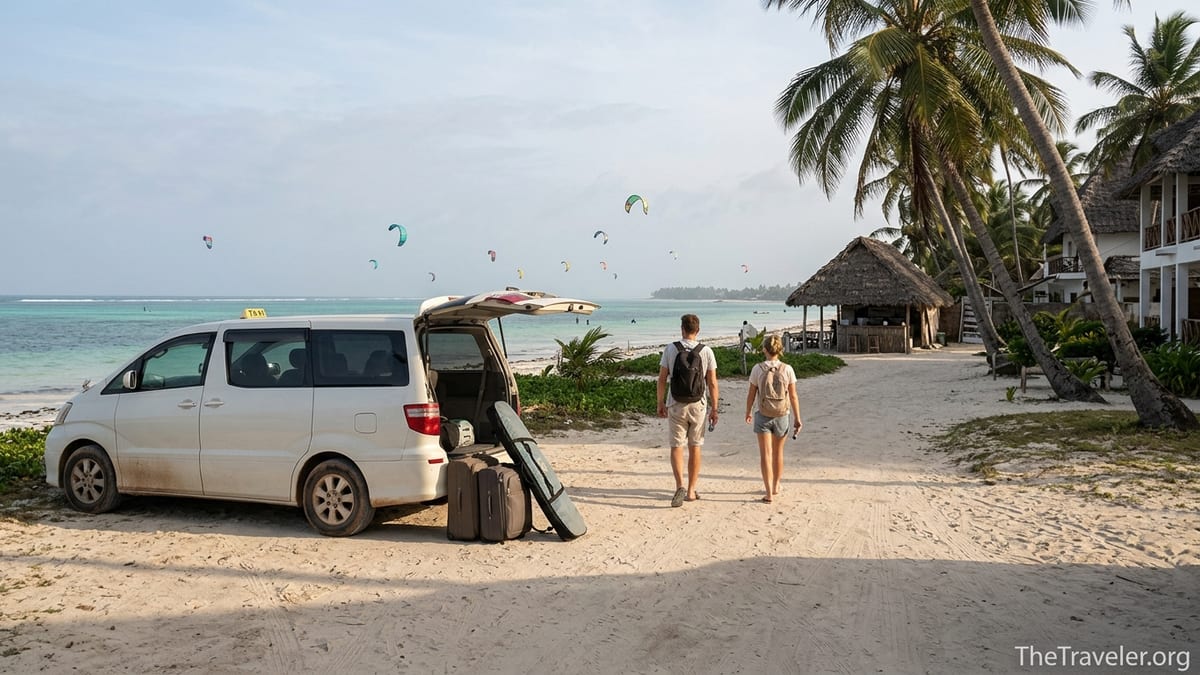
Understanding the Route from Zanzibar Airport to Paje
Zanzibar’s main gateway, Abeid Amani Karume International Airport (often simply called Zanzibar Airport, code ZNZ), sits just outside Zanzibar City on the island of Unguja. Paje lies on the southeast coast, about 50 to 55 kilometres away depending on the exact hotel. In normal traffic, the drive takes roughly 1 hour 10 minutes to 1 hour 30 minutes. At night, when roads are quieter, some drivers do it in about an hour, but visitors should plan on at least 75 minutes door to door once luggage collection and payment are factored in.
The journey itself is a scenic cross-island run. After leaving the airport area and skirting the edge of Stone Town’s suburbs, the road passes through villages and low forest, then cuts across the island toward junctions signposted for Paje, Bwejuu, Jambiani and other east-coast beaches. There are no tolls. The final stretch narrows as you approach Paje village, where you turn down sandy side roads to reach beachfront hotels such as Mr Kahawa, Beach Bohème, Paje Beach Apartments & Hotel and various kitesurf lodges.
Unlike some airports where trains or buses go directly to resort areas, Zanzibar Airport has no formal public transport system to Paje. You will not find a scheduled airport bus to the east coast, and local “dala dala” minibuses that criss-cross the island are not set up for jet-lagged visitors with large bags or kite gear. Practically speaking, almost every traveller to Paje arrives by taxi, private transfer, or a prearranged shared shuttle run by a hotel, tour operator or kite school.
For most visitors, the key decisions are when to book, who to book with, and how much structure they want on arrival. A solo backpacker with just a small bag will have more flexibility than a couple bringing two large suitcases and a twin set of kite bags. Families, honeymooners and kiters with valuable equipment often prefer prebooked transfers, while budget travellers may be willing to negotiate on the spot to save a little money.
Typical Prices, Travel Times and How to Avoid Overpaying
As of mid 2026, the going rate for a standard private taxi from Zanzibar Airport to Paje for up to four passengers in a regular car is usually in the range of 35 to 50 US dollars one way. Many hotels in Paje, such as mid-range beachfront guesthouses and kite-focused lodges, will quote around 40 to 45 dollars for a private airport pickup. Boutique properties at the higher end on the southeast coast, including upscale beachfront hotels north of Paje toward Bwejuu, sometimes quote closer to 50 or 55 dollars, especially if the vehicle is larger or the arrival is late at night.
On the budget end, travellers who walk out of the terminal and negotiate directly with freelance taxi drivers sometimes secure fares around 30 to 35 dollars, especially during the day and in low season. This usually involves a little bargaining and a willingness to wait a few minutes while the driver gathers other airport passengers going in roughly the same direction. If your flight lands during peak holiday periods such as Christmas to New Year or August, demand is high and drivers are less inclined to discount, so expect prices to sit nearer the upper end of the range.
Travel time does not vary hugely between different taxi options, though prebooked drivers waiting with a sign in arrivals can save 15 to 20 minutes compared with arranging something after you exit customs. Realistically, if your plane lands at 16:00 and you clear the airport within 45 minutes, a 75 minute transfer means you might check in at a Paje hotel such as Ananda Beach Hotel or Beach Bohème around 18:00, just in time to see the lagoon glowing at low tide. For late arrivals after 22:00, baggage handling and queues at immigration can sometimes add another half hour, but the road across the island is usually quiet at night.
To avoid overpaying, it helps to know both a fair range and what your hotel charges. Before you arrive, ask your hotel in Paje explicitly: “What is your one-way airport transfer price in US dollars for two people?” If they quote 60 dollars or more for a simple sedan, you can compare that to independent transfer companies often mentioned by recent travellers on social platforms, many of whom charge around 40 to 45 dollars for the same route. At the airport, politely declining the first quote and asking two or three drivers for their rates usually brings the price into a fair band quite quickly.
Private Taxis and Hotel Transfers: Smoothest Door-to-Door Options
For most first-time visitors, especially those arriving from long-haul flights via hubs like Doha, Istanbul or Dubai, a prearranged private transfer is the least stressful way to reach Paje. Many popular properties on the east coast either run their own vehicles or work with trusted local drivers. Hotels like Paje Beach Apartments & Hotel, Beach Bohème, and kitesurf-oriented guesthouses often bundle airport transfers into their stay packages or Kite & Stay offers, so your driver and accommodation are organised together.
These private transfers are typically in standard Toyota sedans or minivans with air conditioning. The driver waits in the arrivals hall with your name on a sign, helps you with luggage and kite bags, and knows exactly which sandy track to follow when you say you are staying near Mr Kahawa or a specific kite school such as Kite Centre Zanzibar or Aquaholics. For kiters bringing two or three large bags, this door-to-door familiarity is more important than it might seem. The lanes in Paje are unmarked and can feel confusing in the dark, and a driver who regularly serves these hotels will know whether a particular lodge is behind the main road, on the beach or accessed via a tighter alley better suited to a smaller vehicle.
From a practical standpoint, prebooking also locks in the price in advance, which can be comforting after a long journey. Travelers arriving from Europe on evening flights, with landing times around 21:00 to 23:00, often prefer this certainty. It means not needing local cash immediately, since hotel-organised transfers are frequently added to the room bill and paid later by card or via online payment. Independent transfer companies sometimes accept both US dollars and Tanzanian shillings at the airport, and it is common to pay in cash directly to the driver at the end of the ride.
If you are travelling as a group of three or four, private transfers can be cost-effective. For example, a group of four friends heading to a modest kitesurf guesthouse in Paje might pay 45 dollars for a private minivan. Split four ways, that is just over 11 dollars per person, barely more than some shared shuttles. Families with young children also value private vehicles for the flexibility to make quick stops at roadside shops for water or snacks along the way, and to adjust air conditioning and music without having to coordinate with strangers.
Shared Transfers, Dala Dalas and Other Budget Options
While the public transport system is not designed around airport arrivals, there are still ways to reduce costs if your budget is tight and time is flexible. Some tour operators and kite schools operating around Paje, Jambiani and Bwejuu occasionally run shared vans for staff and guests. For example, a kitesurf school that welcomes many students on the same seasonal flight might coordinate a shared pick-up, charging each person a lower fixed rate than a private taxi. These arrangements are usually informal and must be requested in advance via email or messaging apps.
As a rule of thumb, if you see a transfer advertised as “shared shuttle” in Zanzibar, it will likely be a minivan that stops at several hotels along the east coast. Prices can be in the 15 to 25 dollar per person range, depending on distance and whether the operator needs a minimum number of passengers. The trade-off is time. An airport shuttle van with guests going to Paje, then Jambiani, then Michamvi could take up to two hours or more door to door, especially if there are check-in delays at each stop.
For the lowest-cost experience, some independent travellers piece together a route using local buses known as dala dalas. This normally involves taking a short taxi or ride from the airport area into a bus station near Stone Town, then boarding a dala dala heading toward Paje or Jambiani. While fares on dala dalas are extremely cheap by international standards, often just a small amount in local currency, these vehicles are designed for residents commuting with light bags, not visitors carrying surfboards and large suitcases. They are crowded, open to the elements and slow, so they are rarely a good choice straight from a long-haul flight.
Occasionally, travellers arrange ad hoc shared taxis while standing just outside the airport, by asking other passengers if they are heading to the east coast and proposing to split a cab. For example, two solo travellers who meet at baggage claim and realise they are both staying near the kite lagoon in Paje might agree on a 40 dollar taxi and share it, effectively paying 20 dollars each. This can be an excellent compromise between price and comfort, but it relies on timing and luck rather than being something you can fully plan for.
Planning for Luggage and Kitesurf Gear
Paje’s reputation as one of the best beginner and intermediate kitesurf spots in East Africa draws travellers with unusually bulky luggage. Kitesurfers often arrive carrying two checked suitcases plus a long kite bag that includes one or two boards, multiple kites and a harness. While most Zanzibar taxis can handle standard holiday luggage with ease, not every car can safely fit a 150 to 160 centimetre board bag, especially if it needs to lie flat to avoid damage.
If you are travelling with your own equipment, it is important to mention this clearly when booking. Tell your hotel or transfer company the approximate length and number of your bags, and ask for a minivan or larger wagon instead of a compact sedan. For example, a pair of kiters heading to a beachfront property like Ananda Beach Hotel or a kite lodge next to Aquaholics might request a higher-roof vehicle. This can add a small surcharge to the transfer but significantly reduces the stress of trying to wedge a board bag through a small trunk opening after midnight.
Inside the car, keep your harness, helmet and a change of clothes in a separate smaller bag that you can easily access. After a long, potentially warm flight, many travellers appreciate being able to change into lighter clothes mid-journey or as soon as they reach the hotel. While the main road is paved, access tracks into Paje village and along the beach can be sandy and bumpy, so secure fragile items well, especially camera gear, laptops and kitesurf bars with delicate depower systems.
If you plan to rent equipment in Paje instead of bringing your own, transfer logistics become simpler. Several well-established kite centres and hotels located right on the beach, including schools associated with Paje Beach Apartments & Hotel, Summer Kite Center, Kite Centre Zanzibar and other local outfits, offer full rental packages, from twin-tip boards to foil gear. In that case, you may arrive with just regular luggage and a small backpack. This can make even a smaller, cheaper taxi or shared van a practical option, and you will not need to worry about where your board bag will ride.
Choosing the Right East-Coast Zone: Paje, Bwejuu, Jambiani and Beyond
Although this guide focuses on Paje, many travellers staying along the east coast use Paje and its lagoon as a reference point. The main clusters of accommodation run roughly north to south along the shoreline from Bwejuu and Bwejuu-Paje beach area, down through Paje itself, and on to Jambiani and further toward Makunduchi. Transfer times from the airport are similar for all these spots, usually between 1 hour 15 minutes and 1 hour 40 minutes depending on exact location and road conditions.
Kitesurfers often prefer to base themselves directly in Paje because of its reliable trade winds, wide sandy lagoon and range of kite schools and beach bars. Hotels like Beach Bohème, Ananda Beach Hotel, Paje Beach Apartments & Hotel and a number of kite lodges sit right behind the sand, within a few minutes’ walk of launch areas and schools. The atmosphere is active and social, especially in the windy seasons, with colourful kites filling the sky at mid-tide and relaxed evenings at casual beachfront cafes.
Travellers seeking a quieter stay sometimes choose Bwejuu or the stretch between Bwejuu and Paje, where some boutique resorts and villa-style properties look onto a quieter version of the same reef-protected lagoon. South of Paje, Jambiani has a more laid-back village feel and a growing number of guesthouses and small hotels, popular with couples and families who want a slower rhythm while staying close enough to Paje for kitesurfing lessons or nightlife. Taxi drivers from the airport are used to dropping guests in any of these villages and generally know the main hotels along the coast.
If your hotel is outside Paje but you plan to kitesurf there regularly, consider how you will get to and from the lagoon each day. Some resorts arrange daily shuttles to specific kite schools, while others rely on local taxis. A short taxi hop from Jambiani to Paje might cost the equivalent of a few dollars each way, but over a week-long trip those costs can add up. In that situation, staying in Paje itself and paying slightly more per night for a beachfront room can prove cheaper and more convenient in the long run.
Late Arrivals, Early Departures and Safety on the Road
Zanzibar’s flight schedules mean many international visitors arrive in the late evening or depart very early in the morning. Flights from Europe and the Middle East often land between 20:00 and 02:00, and regional connections to the mainland can leave around sunrise. Either way, you may find yourself travelling the airport to Paje route in darkness. This is generally safe as long as you use a reputable, sober driver and a roadworthy vehicle, but there are a few extra considerations worth planning for.
First, always confirm that your driver knows your exact hotel and has your phone contact in case plans change. For example, if your flight arrives an hour late and you booked a transfer through a Paje hotel, the driver should still be waiting. Many travellers arrange to message the driver via common apps once they are through immigration. For departures, hotels often suggest leaving Paje around three hours before an international flight, which means leaving at 03:30 for a 07:00 departure. This feels early, but it allows for any overnight roadworks or unexpected checks.
If you have not prebooked and need to arrange a taxi late at night, go to an official taxi desk or a clearly marked driver area immediately outside the terminal, rather than following individuals into the parking lot. Agree on the price in US dollars or Tanzanian shillings before you get into the car, and if you are travelling alone and feel more comfortable, send the vehicle’s registration number and driver’s name to a friend or to your hotel reception. Paje has a busy but friendly beach-town atmosphere, and late-night arrivals are common in the main hotel zones.
For both very early departures and very late arrivals, some travellers choose to spend the first or last night closer to the airport or in Stone Town, then transfer to or from Paje by daylight. This can be particularly appealing if you want to explore Stone Town’s historic alleys or have dinner with a harbour view before flying out. In practice, however, many visitors go straight to the east coast on arrival, sleep off the journey and wake up to their first sunrise over the Indian Ocean.
The Takeaway
Reaching Paje and Zanzibar’s east coast from the airport is comparatively simple, but the smoothness of your journey depends less on distance and more on planning. Private taxis and hotel-organised transfers are the most common options, typically costing between about 35 and 50 US dollars for a journey of around 75 minutes. Shared shuttles and ad hoc taxi sharing can reduce the price per person, but add time and complexity, which is less attractive after a long-haul flight.
Kitesurfers with board bags, families with young children and travellers arriving late at night are usually best served by prebooking a vehicle, making sure the driver knows how much luggage to expect and exactly which hotel lane to follow in Paje, Bwejuu or Jambiani. Budget-conscious travellers willing to improvise will find informal options on the ground, from negotiation with airport taxis to occasional shared vans arranged by kite schools and guesthouses.
Whichever route you choose, think ahead about luggage, arrival time, and your first night’s priorities. If your main goal is to step out of the car, feel the warm sand under your feet and watch kites in the sunset breeze as soon as possible, then securing a reliable transfer from Abeid Amani Karume International Airport to Paje is one of the best investments you can make in your Zanzibar trip.
FAQ
Q1. How long does it take to get from Zanzibar Airport to Paje?
The drive from Abeid Amani Karume International Airport to Paje usually takes about 1 hour 10 minutes to 1 hour 30 minutes, depending on traffic, time of day and the exact location of your hotel.
Q2. How much should I expect to pay for a taxi from the airport to Paje?
Most travellers pay between roughly 35 and 50 US dollars for a private taxi carrying up to four people. Higher-end hotels and late-night transfers can be slightly more expensive, while hard bargaining at the airport may bring the price closer to the lower end of that range.
Q3. Is it better to book my Paje transfer in advance or on arrival?
For first-time visitors, late-night arrivals, families and kitesurfers with large bags, booking in advance through your hotel or a reputable transfer company is usually worth it. Solo travellers light on luggage who arrive during the day sometimes prefer to negotiate with airport taxis on the spot.
Q4. Are there shared shuttles from Zanzibar Airport to Paje?
There is no large, official shuttle network, but some tour operators, hotels and kite schools organise shared vans when they have several guests arriving on the same flight. Prices are often around 15 to 25 dollars per person, and you need to arrange these options ahead of time.
Q5. Can I use public transport or dala dalas from the airport to Paje?
It is technically possible but not convenient. You would need to reach a dala dala stand near Stone Town, then board a local minibus heading toward Paje or Jambiani. These vehicles are cheap but crowded and not ideal if you have large luggage or have just arrived from a long flight.
Q6. What should kitesurfers know about transfers with gear?
If you are travelling with a board bag and multiple kites, tell your hotel or transfer provider in advance. Ask for a larger vehicle such as a minivan, and confirm that the driver expects bulky luggage so you are not trying to fit long bags into a small sedan at midnight.
Q7. Is it safe to travel from Zanzibar Airport to Paje at night?
Most visitors who use reputable drivers or hotel-arranged transfers find the route safe, even late at night. As a precaution, confirm your driver’s details, agree a price in advance and, if travelling alone, share your transfer details with someone you trust.
Q8. Do I need local currency to pay for the transfer?
Many airport taxis and hotel-organised drivers accept US dollars for the trip to Paje. If you are using an independent taxi, having some Tanzanian shillings as well can be helpful. Hotel-organised transfers are often added to your room bill and can be paid by card later.
Q9. How early should I leave Paje for my departing flight?
For international flights, most hotels recommend leaving Paje about three hours before your scheduled departure time. This allows around 75 minutes for the drive, plus a buffer for check-in, security and any unexpected delays.
Q10. Which east-coast areas are easiest to reach from the airport?
Paje, Bwejuu and Jambiani are all relatively straightforward to reach by private taxi or hotel transfer, with similar driving times. Paje is the most popular choice for kitesurfers and travellers who want both an active lagoon and a good selection of beach bars, dive centres and kite schools within walking distance.