


Landing at Zurich Airport and heading for the city centre is refreshingly straightforward if you know how the trains, tickets and zones work. Zurich Flughafen station sits directly beneath the terminal complex, with frequent S-Bahn and mainline trains that reach Zurich Hauptbahnhof (Zurich HB) in around 10 to 13 minutes. This guide walks you step by step through buying the right ticket, choosing the best train, understanding zones, and avoiding the small but common mistakes that can lead to fines or unnecessary costs.
Get the latest updates straight to your inbox!
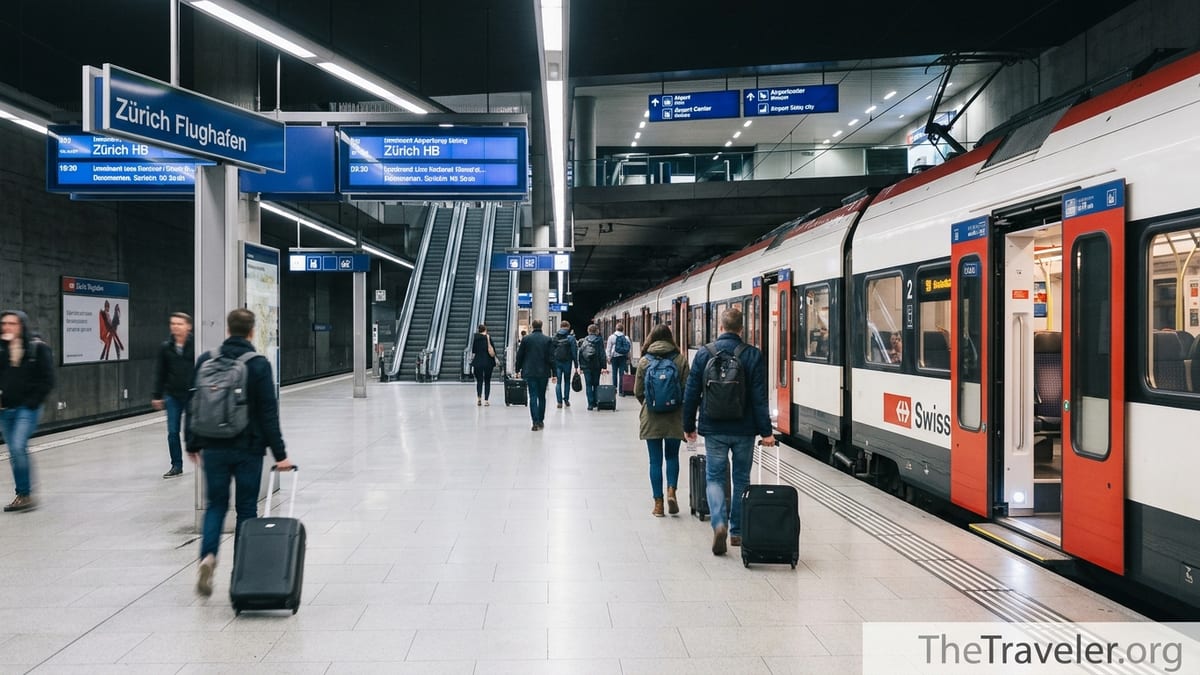
Zurich Airport Station and Zurich HB at a Glance
Zurich Airport’s railway station, Zürich Flughafen, is directly underneath the airport’s Airport Center. After leaving customs, you simply follow the blue “Bahn / Trains” signs down the escalators into the underground concourse. There is no need for a shuttle or taxi to reach the station, which is a surprise for many travelers arriving from airports where rail links are remote or infrequent.
Zurich HB, short for Zürich Hauptbahnhof, is the main city centre station and one of the busiest in Europe. Nearly all visitors heading to central hotels in districts 1, 4 and 5, or to business areas around Bahnhofstrasse, Paradeplatz or Europaallee, will pass through Zurich HB at least once. From here, you can connect to trams, buses, and additional S-Bahn lines that fan out across the city and canton.
The travel time between Zurich Airport and Zurich HB is typically around 10 minutes on faster mainline trains and up to about 13 minutes on S-Bahn commuter services. Trains run from early morning until late at night with very dense frequencies at peak times. In practice, you rarely wait more than a few minutes before boarding a train into the city.
Because Zurich Airport is so well integrated into the Swiss rail network, the station also hosts long-distance InterCity and InterRegio services to cities like Basel, Bern, Lucerne and Geneva. This means that some travelers can skip Zurich HB entirely and connect directly to their onward destination from the airport platforms.
Which Trains Run Between Zurich Airport and Zurich HB
The most straightforward options from the airport to Zurich HB are the Zurich S-Bahn commuter lines and the frequent InterRegio and InterCity trains. For first-time visitors, it helps to know the line numbers you are likely to see. S-Bahn lines S2, S16 and S24 are the main commuter routes that serve the airport station and run via Zurich HB. These white-and-red suburban trains are designed for short to medium urban trips and appear on screens and platform boards with a white “S” and a number.
In addition to the S-Bahn, a mix of InterRegio (IR) and InterCity (IC) trains also link Zurich Airport with Zurich HB and beyond. These are the blue-and-red long-distance trains that continue to places like Basel, Lucerne and St. Gallen. For example, an IR train marked “IR Zürich Flughafen – Basel SBB” will typically call at Zurich HB on its way out of the city. For the short hop into town, they are functionally similar to the S-Bahn but may be slightly faster or offer more comfortable interiors.
From a price perspective, there is no special supplement for taking an S-Bahn versus an IR or IC train on this stretch, as long as you hold a valid ticket covering the correct zones. A visitor who buys a standard two-zone ticket from a machine at the airport can board the next departing service that stops at Zurich HB, whether it is labeled S2, IR, IC or similar. This flexibility is one of the strengths of the integrated Zurich transport system.
One practical example: arriving around 08:30 on a weekday, you might see an S2 to “Ziegelbrücke,” an S16 to “Meilen” and an IR to “Luzern” all departing within minutes of each other and all calling at Zurich HB. Rather than chase the “perfect” train, most travelers simply board the first one heading to Zurich HB, which is clearly indicated on the platform departure boards.
Ticket Types, Zones and Typical Prices
Zurich and its surrounding region operate on a zone-based fare system managed by the Zürcher Verkehrsverbund (ZVV). Zurich Airport lies in fare zone 121, and central Zurich, including Zurich HB and most inner-city tram stops, is in the large core zone 110. To travel between the airport and central Zurich you need a ticket that includes both zones 121 and 110; in practice, machines offer this as a simple two-zone ticket for the required duration.
For many visitors, the entry-level product is a single 2nd class ticket valid for two zones (121 and 110) for about one hour. As of mid-2026, this typically costs in the region of a few Swiss francs in 2nd class. The ticket is valid across trains, trams, buses and even some boats within the zones printed on it, not just on one specific train. Travelers staying only one night and going straight from the airport to a city hotel may combine this single ticket with a similar ticket on departure day and rely on point-to-point purchases in between.
If you plan to make several journeys in one day, such as exploring multiple districts, riding the Polybahn funicular, or taking the lake boat within the city zones, a 24-hour ticket for zones 110 and 121 usually offers better value. It costs roughly the price of two single tickets and allows unlimited travel within the included zones for a full 24 hours from the time of purchase. This is especially convenient if your arrival flight lands in the morning and you want freedom to use trams and trains all day without thinking about separate fares.
For longer stays, options like the Zürich Card or regional day passes can make sense, particularly if you intend to visit the Uetliberg viewpoint, take a full circular boat tour on Lake Zurich or make short trips into the neighboring suburbs. These passes still rely on the underlying zone system but bundle popular visitor routes and attractions, which can reduce both cost and complexity for first-time travelers.
Using Ticket Machines and Buying in Apps
The most common way to buy your airport-to-city ticket is at the blue or red ticket machines located on the station concourse and platform level. Modern ZVV and SBB machines are touchscreen-based and allow you to switch the language from German to English, French or Italian with a single tap at the start of the process. This is particularly useful if you are jetlagged and not ready to decode unfamiliar abbreviations.
On these machines, the fastest route is usually the dedicated button or on-screen option marked “Zurich City” or similar, which automatically issues the correct two-zone ticket for the city centre. Alternatively, you can use the “single ticket” menu and select zones 110 and 121 manually. Payment is straightforward, with most machines accepting contactless credit and debit cards, mobile wallets, and Swiss francs in coins or notes. Visitors frequently comment that buying a basic ticket takes less than a minute once you know where to tap.
Many travelers now prefer to buy digital tickets through the official SBB Mobile app or the ZVV app before even stepping onto the platform. These apps are available in English and allow you to search “Zurich Airport” to “Zürich HB,” then purchase the exact same zone-based ticket that the machines offer. Mobile tickets are inspected in the same way as paper tickets and are particularly helpful if you expect to make connections later in the day or combine your airport journey with a longer Swiss rail itinerary.
Real-world example: a business traveler arriving from New York may purchase a Zurich day pass in the SBB app during the taxi-in phase of the flight, then walk straight from baggage claim to the train platform without stopping at a machine. Conversely, a family with children might prefer paper tickets so each adult can carry their own and present them easily to inspectors, keeping the phone free for navigation and messaging.
Frequency, Travel Time and Choosing the Best Route
Trains between Zurich Airport and Zurich HB run very frequently throughout the day. During daytime hours, you can expect multiple departures each quarter hour when you count all S-Bahn, InterRegio and InterCity options that serve both stations. Late at night the pattern thins out, but there are still regular trains until around midnight, with special nighttime S-Bahn services on weekends covering the busiest hours after bars and clubs close.
The pure travel time on the train is short. Fast IR or IC trains can cover the distance in roughly 10 minutes, while S-Bahn services usually take around 12 or 13 minutes, often calling at Zürich Oerlikon on the way. The difference for most visitors is minimal compared with potential waiting time on the platform, so a good rule of thumb is simply to board the first train shown on the departure board that lists “Zürich HB” as a stop and is permitted by your ticket.
There are a few situations where a slightly more strategic choice makes sense. If you are staying in the Oerlikon business district, for instance, you might be better off taking an S-Bahn or IR that stops at Zürich Oerlikon and then walking to your hotel, bypassing Zurich HB completely. Similarly, if your onward train to another Swiss city departs Zurich HB from a specific platform within a tight connection window, taking an IR or IC that arrives on adjacent platforms can cut connecting time compared with an S-Bahn arriving deeper in the underground sections of the station.
Delays on this short stretch are relatively uncommon, but they can occur. If you see that your planned IR train is running ten minutes late and an S-Bahn is leaving on time, it often makes sense to switch to the S-Bahn instead. Your zone ticket is valid on both, and arrivals into Zurich HB are well integrated with trams and buses, so small timing variations rarely disrupt wider plans.
Understanding Zones Beyond the Airport–City Journey
While most visitors focus on the simple airport-to-HB leg, understanding zones pays off as soon as you venture beyond the immediate centre. Zone 110 covers central Zurich and counts as two zones for fare calculation because it is so large and dense. Surrounding zones, such as 121 around the airport and several others around the lake and hills, represent suburban and regional areas. Ticket prices increase with the number of zones your journey touches, not with the exact distance traveled.
For example, if you plan to ride from Zurich Airport to Zurich HB in the morning, continue by tram to the Zürichhorn lakefront in the afternoon, and then head up to Uetliberg for sunset, a 24-hour ticket covering zones 110 and 121 is likely to remain valid for the first two legs but not for the mountain segment if additional zones are involved. In that case you can buy a temporary “zone upgrade” rather than a completely new ticket. Ticket machines and apps both offer these upgrades, and they are valid only in combination with your original pass.
Another practical zone-related scenario involves hotel locations at the edge of the city. A property in Glattbrugg or Opfikon, for example, may sit just outside zone 110, meaning your journeys between the hotel and city centre cross one additional zone on top of those already covered by your airport ticket or day pass. Frequent business travelers often buy monthly or weekly passes for a fixed cluster of zones that reflect their most common routes, such as zones 110, 121 and a neighboring commuter belt zone, and then occasionally add single tickets or upgrades when venturing further.
If you find zones confusing, remember that most ticket machines and apps can calculate the required zones automatically once you enter origin and destination. Visual zone maps are posted at many stations, including Zurich Airport, and staff at the airport’s Service Center can quickly advise whether a specific hotel or attraction falls within zone 110 or requires a wider pass.
Common Mistakes and How to Avoid Them
Despite the system’s flexibility, several small but costly mistakes recur among first-time visitors. One of the most frequent is boarding a train without a valid ticket, assuming that tickets can be purchased on board like in some other countries. In Zurich’s system, tickets must be purchased before boarding, and inspectors carry out random checks across trains and trams. Being caught without a valid ticket usually results in an on-the-spot fine that is significantly higher than the ticket price.
Another common issue is buying the wrong type of ticket. Travelers sometimes purchase a short-distance or local network ticket from the airport machine, which is not valid for the full journey to Zurich HB. The ticket may look cheaper at first glance but does not include zone 110. If checked, you may be treated as traveling without a valid ticket. To avoid this, always select the option that explicitly mentions Zurich city or check that both zones 121 and 110 are shown on the display before confirming payment.
A third trap involves underestimating transfer times at Zurich HB. While the station is well signposted, it is large, with multiple levels. If you are changing from a train arriving from the airport to a long-distance service on another platform, leaving only a few minutes for the connection may be stressful, especially with luggage. Padding your schedule by at least 10 to 15 minutes between arrival from the airport and any onward long-distance departure is a safe strategy, particularly during busy hours.
Finally, remember that tickets are generally sold for a time window rather than a specific train. There is no benefit in rushing to catch a particular service if the next one leaves only a few minutes later and your ticket remains valid. This is markedly different from some neighboring countries where advance-purchase tickets tie you to an exact departure; in Zurich, flexibility is built into the standard products, which is especially reassuring if your flight is delayed or baggage claim takes longer than expected.
The Takeaway
Traveling by train from Zurich Airport to the city centre is one of the easiest airport transfers in Europe, provided you understand the basics of zones, ticket types and service patterns. With trains departing every few minutes during the day and a travel time of around 10 to 13 minutes, the rail link is faster and often cheaper than taxis or ride-hailing services, especially for solo travelers or couples.
For most visitors, the simplest formula is to purchase a two-zone ticket covering Zurich Airport and central Zurich, either as a single ticket or as a 24-hour pass if you plan to use trams and buses later in the day. From there, you can board whichever S-Bahn, InterRegio or InterCity train is next to depart for Zurich HB, confident that your ticket will be accepted across all of them.
By buying your ticket before boarding, double-checking that your zones include both 121 and 110, and allowing a little extra time for connections at Zurich HB, you avoid the most common mistakes that trip up new arrivals. Once you have completed the journey once, you will likely find yourself moving around Zurich’s wider network with ease, using the same principles for every tram, bus and train you take during your stay.
FAQ
Q1. How long does the train from Zurich Airport to Zurich HB take?
Most trains take around 10 to 13 minutes between Zurich Airport and Zurich HB, depending on whether you board an S-Bahn commuter service or a slightly faster InterRegio or InterCity train.
Q2. How often do trains run from Zurich Airport to the city centre?
During the day, trains typically run every few minutes when you consider all S-Bahn, InterRegio and InterCity services that stop at both Zurich Airport and Zurich HB.
Q3. Do I need a separate ticket for different train types on this route?
No. As long as your ticket covers the correct zones, usually 121 for the airport and 110 for central Zurich, you can ride S-Bahn, InterRegio and InterCity trains on this stretch without any surcharge.
Q4. Where can I buy tickets at Zurich Airport?
You can buy tickets from the touchscreen ticket machines in the station area, at staffed counters in the airport’s Service Center, or via official mobile apps such as SBB Mobile and the ZVV app.
Q5. What happens if I board a train without a valid ticket?
If inspectors find you traveling without a valid ticket, you will usually be charged an on-the-spot penalty that is much higher than the normal fare, and the fine is still due even if the mistake was unintentional.
Q6. Is it better to buy a single ticket or a 24-hour pass?
If you are only making one simple journey between the airport and your hotel, a single ticket may be enough, but if you plan multiple trips by tram, bus or train in one day, a 24-hour pass that includes zones 121 and 110 is often better value.
Q7. Are the ticket machines and apps available in English?
Yes. Ticket machines at Zurich Airport allow you to switch the interface to English, and major apps such as SBB Mobile and the ZVV app also offer full English-language support.
Q8. Can I go straight to my hotel without passing through Zurich HB?
In some cases, yes. If your hotel is in areas like Oerlikon or near intermediate S-Bahn stops, you can get off before Zurich HB, provided your ticket covers the necessary zones.
Q9. Does my airport-to-city ticket cover trams and buses in Zurich?
If your ticket includes zone 110, it is valid on trams, buses and many local trains within that zone for as long as the ticket remains time-valid, which is particularly useful once you reach Zurich HB.
Q10. What should I do if my flight is delayed and I miss my planned train?
Standard Zurich zone tickets are generally valid for a time window, not for a specific departure. As long as your ticket is still within its validity period, you can simply board the next suitable train heading to Zurich HB.