


Zurich Airport regularly wins awards for its efficiency and passenger experience, and its lounge network is a major reason why. Whether you are flying SWISS in business class, connecting on another Star Alliance carrier, or simply hoping to buy your way into a quiet corner with Wi-Fi and a shower, Zurich offers an unusually rich mix of airline and independent lounges. The key is understanding which lounge fits your ticket, budget and schedule, and when paying to get in actually makes sense.
Get the latest updates straight to your inbox!
How Zurich Airport’s Lounge System Is Organized
Zurich Airport is compact but layered, and the lounge layout follows the same logic. The main Schengen departures area is Dock A, with additional Schengen gates in Dock B when it is configured for intra-European flights. Dock D covers non-Schengen flights in the midfield terminal, while Dock E handles most long-haul and non-Schengen widebody services. Lounges are spread across all of these areas, so the first practical step is to know which pier your flight leaves from before choosing where to settle in.
SWISS dominates the airport and operates several branded lounges: Business and Senator lounges in Dock A and Dock E, an Alpine Lounge in Dock A, and a smaller Business Lounge in Dock D. There is also a dedicated Arrivals Lounge landside for eligible passengers who want a shower and breakfast after an overnight flight rather than before departure. These spaces primarily serve Star Alliance premium and status passengers, but some can be accessed via day passes issued at check in depending on load and operating rules at the time.
Alongside the SWISS network are independent lounges such as the Aspire Lounge at Dock E, the Primeclass Lounge and a Zurich Airport-branded lounge used by various carriers and lounge programs. These are crucial for travelers flying airlines without their own facilities in Zurich, for holders of Priority Pass-style memberships, and for economy passengers willing to pay for a quieter environment with food, drinks and sometimes showers.
For connections, remember that changing from a Schengen to a non-Schengen flight usually involves an underground train to Dock E and passport control. In practice, that means a passenger departing on a long-haul flight from E may want to skip the crowded Schengen lounges in Dock A and instead plan to spend most of their time in the newer lounges at Dock E, whether SWISS or independent.
Inside the SWISS Lounges: Access, Atmosphere and Food
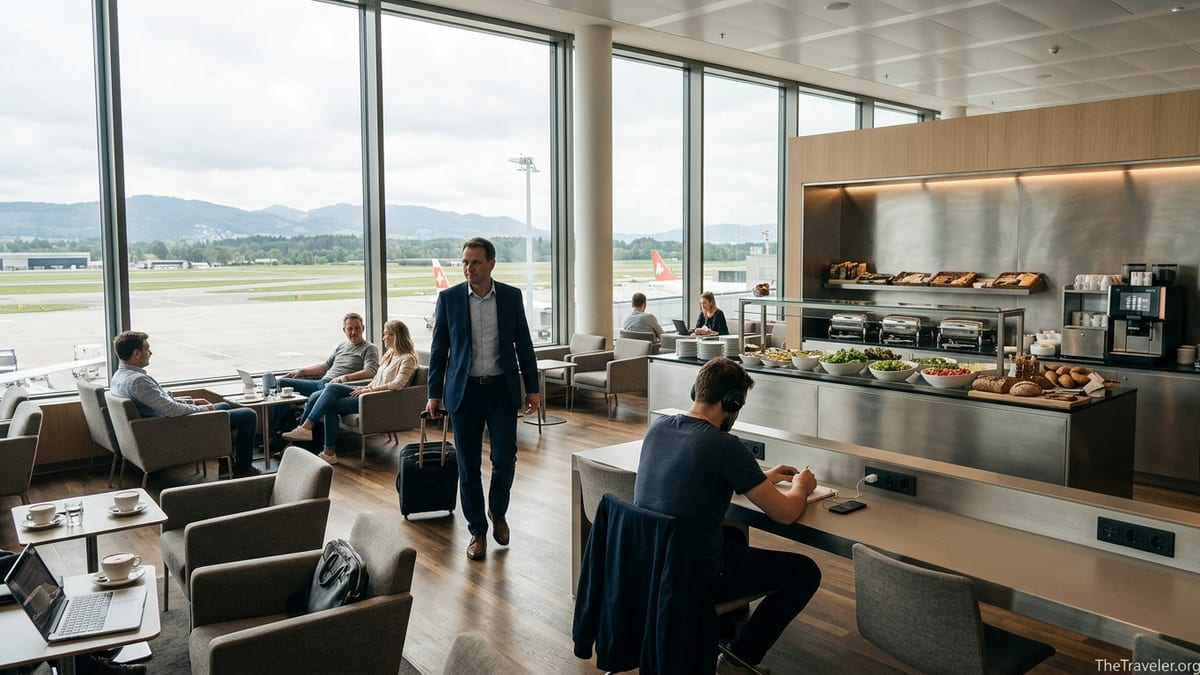
For many travelers, the SWISS lounges are the main attraction. In the Schengen area, the SWISS Business Lounge A and the adjacent Senator Lounge serve passengers flying within Europe. Reviews published in 2025 and 2026 describe a bright, airy space with floor-to-ceiling windows, a mix of armchairs and workbenches, and self-service hot and cold buffets that vary by time of day. Morning visits typically see yogurts, breads, cold cuts and scrambled eggs, while lunchtime and evenings offer pasta, salads and at least one hot main dish, with quality generally described as solid if not memorable.
The SWISS Business Lounge E and Senator Lounge E, used primarily by long-haul and non-Schengen passengers, are regarded as the flagship facilities. Travelers in 2026 reports highlight the generous size, impressive runway views and more substantial dining options compared with the Schengen side, including live cooking stations during peak periods and a fuller buffet. Business travelers particularly value the quieter corners and better chances of finding a seat, though peak evening waves to North America and Asia can still make the lounge busy.
Access depends on ticket and status. Business class passengers on SWISS and other Star Alliance airlines departing from Zurich normally have access to the relevant Business lounge. Star Alliance Gold members traveling in any cabin can enter the Senator lounges. SWISS First passengers and HON Circle members have their own, more exclusive spaces, which are outside the scope of this general traveler guide but are widely regarded as among Europe’s best for à la carte dining and private rest areas.
One important nuance is arrival versus departure. Unlike some carriers, SWISS does run a dedicated Arrivals Lounge at Zurich, typically open in the morning through early afternoon, which offers showers, a light buffet and workspaces. Access rules can be strict, often limited to passengers arriving on SWISS or a partner in long-haul business or first class, so it is worth checking the latest conditions when booking if a post-red-eye shower is essential to you.
Independent and Priority Pass Lounges: Aspire, Primeclass and More
Not everyone in Zurich flies SWISS or holds Star Alliance status, and that is where the independent lounges come in. The best known is the Aspire Lounge at Dock E, which the airport promotes as a premium retreat with runway views, buffet food, an open bar and comfortable seating. It is used both by airlines that do not have their own facility and by walk-up guests who pay at the door or pre-book online. As of mid 2026, Zurich Airport’s own materials show typical access prices in the range of what you would see across Europe, with time-limited stays of about three hours and pricing that can rise during peak seasons.
Primeclass and other independent lounges fill similar roles. Many of these lounges come in and out of networks like Priority Pass, LoungeKey or DragonPass, and there has been some confusion in 2026 as apps and websites catch up with contract changes. Travelers have reported that even when a lounge temporarily disappears from one app’s list, it may still appear on a program’s web search or be accessible with a lounge card plus a supplemental fee. The lesson is to check both your membership app and the specific lounge information a few days before travel and to be prepared for staff to refer to their own current access list, not an outdated screenshot.
For economy passengers, these spaces can be bought as stand-alone products. A traveler on a low-cost carrier to Spain, for example, might pre-book the Aspire Lounge E for a late-morning departure, gaining access to breakfast items, coffee and a quiet workspace for around the cost of a hot meal and drinks in the public concourse. Families sometimes choose to pay for a lounge during long connections because the reserved seating and inclusive soft drinks offer predictable costs compared with restaurant prices in Switzerland, which can be high for international visitors.
Most independent lounges enforce time limits, commonly 3 hours, and peak times before major long-haul waves can see Priority Pass-style walk-ins turned away if the lounge is at capacity. If your credit card offers a set number of free lounge visits per year, think carefully whether Zurich is the place you want to redeem one of those entries, especially if your layover is short. When your connection is only 60 to 90 minutes, you may find that security, passport control and transit time to Dock E swallow most of your buffer.
Showers at Zurich Airport: Where to Freshen Up
Showers are one of Zurich’s biggest selling points, especially for overnight arrivals from North America or Asia and for long daytime connections. Several SWISS lounges have shower suites, with the Business and Senator lounges in Dock A and Dock E both offering modern cubicles. In these lounges you usually request a shower at reception, hand over your boarding pass in exchange for a key, and receive a towel along with basic amenities. At busy times there may be a waiting list, so it pays to put your name down as soon as you enter.
The SWISS Arrivals Lounge also focuses on the shower-and-breakfast combination, allowing business or first class passengers to clean up before heading into the city. Typical feedback in 2026 from frequent travelers suggests that while the food selection is modest compared with the main departure lounges, the showers are spotless and the atmosphere is calm. For a traveler landing around 7:00 a.m. from New York, this can be the difference between arriving at a morning meeting refreshed or feeling like an overnight train passenger.
Independent options exist for those without lounge access. Zurich Airport offers paid showers in its transit hotel area, with current price lists showing that a couch in the rest area or short-stay room for up to four hours starts around double-digit Swiss franc figures, and additional day extras can be purchased. There are also reports of pay-per-use shower rooms attached to landside hotels such as the Radisson Blu, typically costing a few dozen Swiss francs for a short slot including towel service. These can be a good backup if you are traveling on a low-cost carrier or arrive on an airline without lounge agreements.
When comparing shower options, think about timing and location. A traveler connecting from a Schengen flight to a long-haul departure from Dock E may prefer to wait and shower in a lounge at E rather than in Dock A, to avoid re-boarding the train or rushing after passport control. Conversely, if your long-haul arrival is followed by a short European hop, squeezing a shower into the arrivals lounge or transit hotel before re-entering the Schengen zone might make more sense.
Food and Drink: How Good Are Zurich’s Lounges Really?
Food quality in Zurich’s lounges is generally described as respectable rather than lavish, with some important differences between locations. In the SWISS Business Lounge A, recent reviews talk about a “pretty good” selection for a European business-class lounge: fresh breads, cheeses and cold cuts for breakfast, followed by simple hot dishes such as pasta and soups later in the day. The Senator sections often layer on slightly upgraded options and a broader bar selection, though expectations should be calibrated to a busy hub rather than a boutique first class facility.
In the Dock E lounges, both airline and independent, the catering steps up. The SWISS Business Lounge E, in particular, has been praised for its larger buffet and sometimes live cooking, offering dishes like grilled meats or regional specialties prepared in an open kitchen. Views over the tarmac and runway enhance the experience, and for aviation enthusiasts the chance to watch widebody movements while eating a hot meal can be a highlight of a Zurich connection.
Independent lounges such as Aspire and Primeclass typically serve international comfort food: pastries, salads, soups and one or two hot mains, plus snacks like crisps and nuts. Alcoholic drinks are usually included, with self-service wine, beer and a limited range of spirits. Reviews over the last few years are frank that these offerings tend to feel more like a good cafeteria than a restaurant, but for many travelers the trade-off is acceptable when compared with paying for an à la carte meal in the main terminal.
Where Zurich stands out is consistency. Catering across the SWISS network of lounges is reasonably aligned, so once you have experienced one of the Business lounges you have a fair idea what to expect in the others. That predictability is valuable on tight connections or after a long flight, when knowing you can quickly grab a reliable plate of food and a coffee without navigating crowded terminal restaurants can be more important than culinary surprise.
What Lounge Access Costs and When It Is Worth It
The cost of lounge access at Zurich varies widely depending on how you obtain it. For business and first class passengers, entry to airline lounges is normally bundled into the ticket price. If you paid a premium for SWISS business class across the Atlantic, for example, your access to the SWISS Business Lounge E is already factored into the fare. For Star Alliance Gold members traveling in economy, lounge access is a core benefit of status and can make a low-cost ticket feel more premium.
For everyone else, two main options exist: membership programs and pay-per-use. Priority Pass and comparable schemes, often bundled with premium credit cards, grant access to participating independent lounges either for free visits or a capped number of entries per year. UK and US financial publications in 2024 and 2025, such as MoneyWeek, have noted how some cards include around four lounge visits annually as a side benefit, which can be used at Zurich in lounges that remain under those networks. At check-in, your card is swiped or your QR code scanned, and you are admitted subject to capacity limits.
Direct pay-per-use is the other route. Zurich’s independent lounges typically publish prices online, and at the door you can expect to pay in the region of several dozen Swiss francs for a two or three hour stay, with children sometimes discounted. When comparing this with the cost of buying food, drinks and Wi-Fi individually in the terminal, the lounge fee can quickly become competitive. A simple meal and drink in an airport restaurant might easily cost 25 to 35 francs per person, so a family of four could see value in a lounge that includes unlimited soft drinks and snacks for a flat rate.
Whether it is worth paying depends on your circumstances. For a solo traveler on a 90 minute connection, buying access is rarely sensible unless you specifically need a shower or guaranteed workspace. For a six hour layover, especially with children or after an overnight flight, the combination of quiet seating, power outlets, showers and inclusive refreshments can easily justify the price. Travelers should also consider non-lounge alternatives such as Zurich’s airside transit hotel, where a short-stay room for up to four hours starts at around the cost of two or three lounge entries but offers a bed, privacy and sometimes a private bathroom.
Realistic Scenarios: Which Zurich Lounge Should You Choose?
Consider a traveler flying economy from London to Zurich on a low-cost carrier, then onward to Bangkok on a full-service airline with no lounge partnership. They arrive mid-afternoon with a four hour layover before an evening departure from Dock E. In this case, buying access to an independent lounge like Aspire at E through a lounge program or directly at the door makes practical sense. The traveler can clear passport control, head to Dock E, and spend the bulk of the layover close to their gate while enjoying food, drinks and Wi-Fi rather than wandering the mall-like concourses.
Now take a Star Alliance Gold passenger flying Zurich to Rome in economy on an early morning SWISS flight from Dock A. Security and Schengen passport checks are quick at that hour, and the traveler can settle in the SWISS Senator Lounge A for coffee, breakfast and a shower before a busy workday on arrival. For them, the lounge is integral to the value of their frequent flyer status, and Zurich delivers a consistent experience that may influence their decision to keep shifting flights onto Star Alliance carriers.
Families face a different calculation. A couple traveling with two children on a long daytime connection from North America to a Mediterranean holiday destination may find the lounges in Dock E attractive simply as fenced-off space. Unlimited juice, snacks and Wi-Fi can be cheaper and calmer than repeated restaurant visits in the public area, and parents may value having a fixed base where one adult can wander the terminal with a child while the other guards seats and hand luggage. In this scenario, pre-booking a lounge slot to avoid capacity-related refusals at the door is often a wise move.
At the opposite end of the spectrum are ultra-premium VIP services at Zurich that go far beyond standard lounges. The airport’s 2025 VIP price list shows packages where a single passenger can pay four-figure Swiss franc sums for private suites, limousine transfer to the aircraft and personal agents handling all formalities. These products are targeted at celebrities, executives and travelers for whom privacy and time savings are worth substantially more than the cost of a business class ticket, and most leisure travelers will not consider them. Their existence, however, underlines how layered Zurich’s ground experience can be.
The Takeaway
Zurich Airport offers one of Europe’s more sophisticated lounge ecosystems, anchored by a network of SWISS Business and Senator lounges and complemented by independent spaces such as Aspire and Primeclass. For eligible business and status passengers, the value is clear: reliable food, strong Wi-Fi, showers and a calm environment can make tight connections or red-eye recoveries far more manageable. Among these, the long-haul focused lounges in Dock E stand out for better catering and views, while the Dock A lounges provide solid support for frequent European travelers.
For those without bundled access, the decision to pay hinges on time, needs and alternatives. A quick domestic-style hop hardly justifies a separate lounge fee, but a multi-hour connection, a need for a shower, or the desire to contain food and drink costs can tilt the equation in favor of using an independent lounge. Zurich also offers non-lounge options such as transit hotel rooms and paid showers, which may be more appropriate for travelers who value sleep and privacy over buffet meals.
Ultimately, Zurich’s lounges are not about over-the-top luxury so much as reliable comfort. Prices in Switzerland are high, and the airport is no exception, so many travelers will find that paying once for lounge access is simpler and better value than piecing together meals, drinks and quiet workspaces in the public areas. Going in with realistic expectations and a clear sense of your priorities will help you get the most from the facilities on offer.
FAQ
Q1. Do all SWISS lounges at Zurich Airport have showers?
Not all, but the main SWISS Business and Senator lounges in Dock A and Dock E, along with the Arrivals Lounge, have dedicated shower suites available on request.
Q2. Can I access a Zurich Airport lounge if I am flying economy?
Yes. You can enter if you have eligible frequent flyer status, a business class onward connection, a Priority Pass-style membership covering partner lounges, or by paying for a day pass at independent lounges.
Q3. Which Zurich lounge is best for long-haul departures?
For most travelers, the SWISS lounges in Dock E are the strongest choice due to better food, more space and excellent runway views, provided your ticket or status grants access.
Q4. How much does it cost to buy lounge access at Zurich?
Prices vary, but expect to pay roughly the cost of a simple meal and drink in the terminal per person for a time-limited stay, with exact rates set by each independent lounge.
Q5. Are Priority Pass and similar cards widely accepted at Zurich?
They are accepted at several independent lounges, although specific partnerships can change. Always confirm current access in your membership app or with the lounge before travel.
Q6. Is lounge food at Zurich good enough to replace a full meal?
In most cases, yes. Buffets typically include enough hot and cold options to serve as a main meal, even if they feel more like quality cafeteria dining than restaurant cuisine.
Q7. What are my options if lounge showers are busy or I have no access?
You can book a short-stay room or shower in the airport’s transit hotel area, or in some cases pay for shower access at nearby airport hotels connected to the terminal.
Q8. Is it worth using a valuable lounge visit at Zurich if my layover is short?
If your connection is under 90 minutes, it may not be worth it once you account for walking, security and boarding times, unless you especially need a shower or quiet workspace.
Q9. Can I use a lounge at Zurich on arrival rather than before departure?
Yes, but options are limited. The SWISS Arrivals Lounge is typically open to eligible long-haul business and first class passengers; most independent lounges are for departing passengers only.
Q10. Are Zurich’s airport lounges suitable for families with children?
Generally yes. Many families find lounges helpful for long layovers thanks to reserved seating, inclusive snacks and drinks, and easier supervision compared with crowded public areas.