


Landing at Zurich Airport and heading straight to Interlaken is one of the classic entries into the Swiss Alps. Within a few hours you can go from airport arrivals hall to standing on the platform at Interlaken Ost, with snow‑dusted peaks in the distance and mountain trains fanning out toward Lauterbrunnen, Grindelwald, and the Jungfraujoch. Choosing the right route, ticket type, and timing will make that first day in Switzerland feel effortless instead of confusing.
Get the latest updates straight to your inbox!
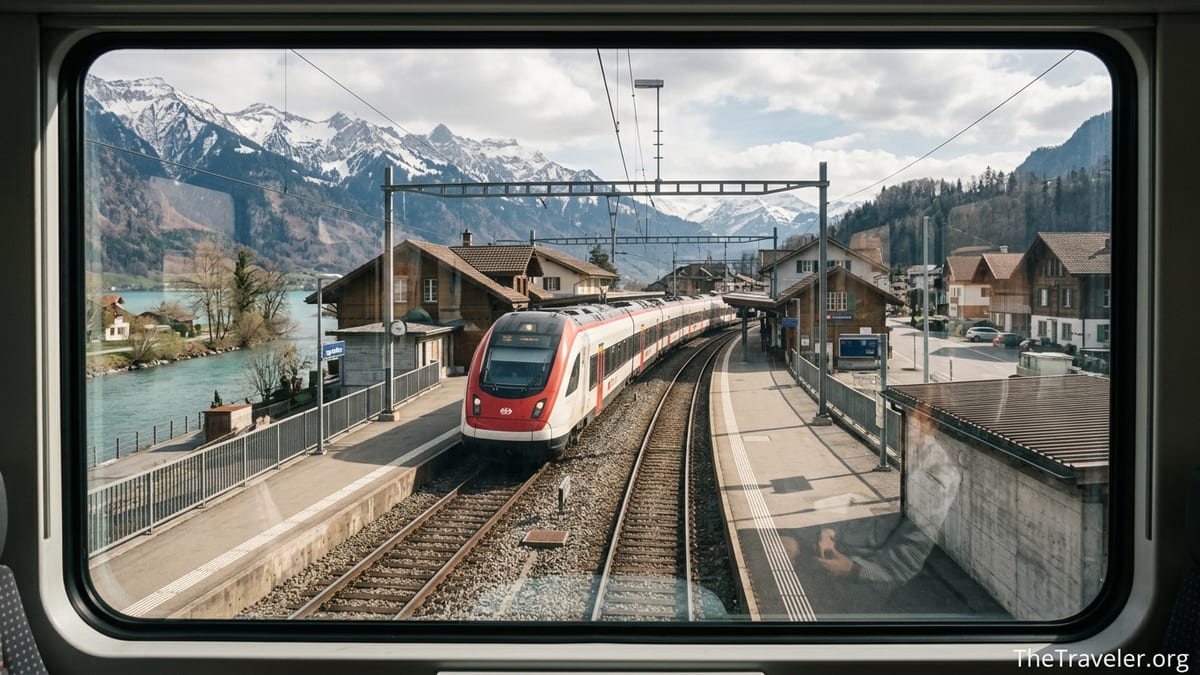
Understanding the Zurich Airport to Interlaken Journey
The good news for first‑time visitors is that Zurich Airport has a full Swiss Federal Railways (SBB) station directly underneath the terminal complex. You walk from baggage claim into the public arrivals hall, follow the train symbols down one level, and you are at “Zürich Flughafen” station. From there, frequent trains connect you into the national rail network without needing a taxi or bus transfer.
Interlaken is not on a direct main‑line from Zurich Airport, so you always change trains at least once. The two standard options are via Zurich main station and Bern, which is the fastest, or via Zurich main station and Lucerne, which is slower but significantly more scenic. Both routes end at Interlaken Ost, the station used for onward trains into the Jungfrau region.
On a typical daytime schedule, the fastest Zurich Airport to Interlaken journeys take just over 2 hours from platform to platform, with one easy change at Zurich main station and a second at Bern. Many flights from North America land early in the morning; in practice, travelers who clear immigration and baggage around 08:30 can usually be in Interlaken a little after 11:00, in time for lunch on Höheweg or a short excursion up Harder Kulm.
Because trains run so frequently, advance planning is more about comfort and cost than about whether you will actually find a train. The SBB online timetable and SBB Mobile app show the same real‑time information you see on station departure boards, so you can check platforms and connection times while standing in the baggage hall or sitting on the train from the airport.
Fastest Route: Zurich Airport – Zurich HB – Bern – Interlaken Ost
Most travelers aiming to start hikes or mountain excursions on arrival day will want the fastest route via Zurich main station and Bern. From Zurich Airport, you normally take an InterCity or InterRegio train directly to Zurich Hauptbahnhof, often in about 10 minutes. These long‑distance trains are more comfortable than suburban S‑Bahn services and have luggage racks and toilets in every coach.
At Zurich Hauptbahnhof, you change to an InterCity or InterRegio train toward Interlaken Ost or Bern. On many hourly patterns, a direct InterCity from Zurich to Interlaken does not exist, so you change in Bern to a connecting InterCity or RegioExpress along Lake Thun. In practice, the Zurich HB to Bern leg takes roughly 1 hour, and Bern to Interlaken Ost around 50 minutes. Including both changes, total travel time from Zurich Airport is commonly about 2 hours 10 to 2 hours 30, depending on the exact departure.
In real‑world terms, a passenger landing at 07:30, clearing the formalities, and reaching the station by 08:30 might catch an InterCity from the airport to Zurich HB around 08:40, connect to an InterCity to Bern leaving a few minutes after 09:00, and step off the train at Interlaken Ost a little after 11:00. The connections are designed with comfortable transfer windows, often 10 minutes or more, with clear platform signage and escalators between levels.
This route is especially well suited to families and travelers with heavy suitcases. Platforms in Zurich and Bern are wide and mostly level, carriage entrances are at typical European train‑floor height, and you can roll standard suitcases directly onboard. Because the fast InterCity trains usually have restaurant or bistro cars, you can have a coffee and simple breakfast on the way instead of waiting in the airport.
Scenic Route: Zurich Airport – Zurich HB – Lucerne – Interlaken Ost
Travelers with a little more time and a focus on scenery often prefer the route via Lucerne and the Brünig Pass. After arriving at Zurich Airport, you still take a short train into Zurich main station. There you change to a train to Lucerne, a journey of about 45 to 60 minutes depending on the connection. Lucerne itself is a picturesque lakeside city, so some visitors deliberately schedule a few daytime hours here before continuing to Interlaken.
From Lucerne, the Luzern–Interlaken Express runs roughly hourly across the Brünig Pass to Interlaken Ost. This service, operated by Zentralbahn, takes about 2 hours and is part of the broader GoldenPass route. The line is narrow‑gauge over the pass, with lakes, waterfalls, and chalet villages close to the tracks. The train climbs above Lake Lungern, crosses the Brünig Pass using short rack sections, and then descends through Meiringen and along Lake Brienz before arriving at Interlaken Ost.
Unlike branded panoramic trains such as the Glacier Express, the Luzern–Interlaken Express runs as a regular regional express service. There are no compulsory seat reservations and it is fully covered by major passes such as the Swiss Travel Pass and Eurail Global Pass. You board with ordinary luggage, find a seat in standard or first class, and can move freely between coaches to enjoy different viewpoints.
Door to door from Zurich Airport, the Lucerne route usually adds 45 to 60 minutes compared with going via Bern. As an example, a traveler landing at midday might reach Zurich main station around 13:00, travel to Lucerne by around 14:00, and ride the Luzern–Interlaken Express departing shortly afterward, arriving at Interlaken Ost around 16:00. For many visitors, those extra scenic hours are a welcome, jet‑lag‑friendly introduction to the Alps.
Tickets, Passes, and What Trips Typically Cost
Most visitors face the same choice on arrival: buy a simple point‑to‑point ticket from Zurich Airport to Interlaken Ost, or travel on a regional or national pass such as the Swiss Travel Pass or Half Fare Travelcard plus individual tickets. For a straightforward one‑way trip without other train travel, a standard second‑class ticket from Zurich Airport to Interlaken Ost is a significant but predictable expense relative to the rest of a Swiss holiday.
Travelers staying several days and riding multiple mountain and lake services often benefit from the Swiss Travel Pass, which covers nearly all mainline travel including Zurich Airport to Interlaken. With this pass active, you can simply board the next suitable train in the relevant class and show the pass during ticket checks. For those based long‑term in Switzerland or returning visitors, the Half Fare Travelcard can reduce most ticket prices by about half, including the airport to Interlaken journey, but it pays off only if used frequently.
For cost‑conscious visitors with fixed arrival times, SBB’s supersaver tickets and Saver Day Pass can be attractive. A Saver Day Pass, available in limited quantities and at tiered prices, allows unlimited travel on a given day on most mainline trains across Switzerland, including Zurich Airport to Interlaken. Supersaver tickets, sold for specific departures and often appearing as discounted options in the SBB app, can lower the price considerably if you are willing to commit to a particular train and time. Because these offers are quota‑based and prices vary day by day, it is safest to think in terms of rough ranges and check the app a few weeks before travel to see what is available for your arrival date.
Many international visitors now purchase their initial ticket online before flying, either through the official SBB channels or well‑known international retailers. Others simply use the ticket machines in the airport station upon arrival. Machines and counters accept major credit cards, and English is available in the on‑screen menus. As a practical example, a couple arriving from the United States without any pass might decide in the arrivals hall whether to buy normal point‑to‑point tickets to Interlaken or an SBB Saver Day Pass that will also cover an afternoon boat cruise on Lake Thun once they arrive.
Managing Luggage and Connections Smoothly
Swiss trains are built with travelers in mind, and the Zurich Airport to Interlaken journey is particularly forgiving for those with suitcases. Once you reach Zürich Flughafen station, escalators and elevators bring you directly to the platforms. On board, you will find luggage racks at carriage ends and overhead shelves above the seats. Most travelers place one medium suitcase in a rack and keep a cabin bag or backpack by their seat.
During changes at Zurich Hauptbahnhof, Bern, or Lucerne, it is normal to roll your own bags between platforms. The stations are compact compared with large international hubs, and 10 minutes is typically plenty of time to walk between tracks and verify the departure boards. If you prefer more time, you can always choose a connection with a longer transfer window when planning your trip in the SBB app.
For those with especially bulky luggage or mobility limitations, SBB offers various luggage services that can transport bags between the airport and many Swiss stations. Options range from simple station‑to‑station baggage, where you drop bags at an SBB counter and collect them later in the day, to flight luggage services that integrate airline check‑in and baggage handling. These services must usually be arranged in advance and can be a worthwhile upgrade if you are moving several heavy ski bags or traveling with young children and prefer to keep transfers as light as possible.
Realistically, most visitors find that wheeling their own suitcases is entirely manageable. A family of four traveling with one medium suitcase per person can board an InterCity from Zurich Airport, change at Zurich and Bern, and arrive in Interlaken without needing special assistance. The key is to keep luggage streamlined rather than bringing several oversized pieces per person, because overhead and end‑of‑carriage space, while generous, is not unlimited during peak holiday periods.
Day‑of‑Travel Tips: Timing, Seat Choices, and Onboard Comfort
The simplest way to avoid stress on arrival is to avoid locking yourself into unrealistically tight schedules. Flights can arrive late, baggage belts can be slow, and you may want a shower or coffee before boarding a train. Instead of reserving a specific departure that leaves you only minutes of margin, plan to take the first suitable connection you can comfortably reach once through arrivals. With trains running frequently on both the Bern and Lucerne routes, you rarely gain much by chasing a specific early departure.
Seat reservations are generally not required on these routes and are not commonly used by locals for domestic journeys. You simply board and find free seats in your class of travel. On InterCity trains, quiet zones and family zones are clearly marked, and first‑class coaches are usually at one end of the train with more legroom and slightly fewer passengers. If you value scenery, try to sit on the right‑hand side when traveling from Bern to Interlaken for better views over Lake Thun, and on either side of the Luzern–Interlaken Express for alternating lake and mountain views.
Food and drink options depend on the specific train. Many InterCity services between Zurich and Bern have restaurant or bistro cars offering hot dishes, coffee, and simple snacks. InterRegio and regional trains may have only trolley service or vending machines. Most travelers pick up a sandwich, pastry, or bottled drink in Zurich Airport’s shopping level or in the station concourse at Zurich HB before boarding, which guarantees something to eat even if the dining car is busy. Tap water on board is not always clearly labeled as potable, so many visitors simply carry bottled water.
Switzerland’s trains are air‑conditioned, but temperatures can still vary as the train goes from lowland cities into mountain valleys. Layered clothing works best. If you are arriving after an overnight flight, consider keeping a lightweight fleece or scarf handy on the train, as you may feel cooler when tired. Power sockets are widely available in second and first class on InterCity and InterRegio trains, and mobile reception is generally good along the route, although tunnels and deep valleys can briefly interrupt data service.
Should You Overnight in Zurich or Go Straight to Interlaken?
The decision to sleep in Zurich on arrival or continue straight to Interlaken depends on arrival time, jet lag, and your priorities for the first day. Morning and early‑afternoon arrivals almost always allow plenty of time to reach Interlaken in daylight, even with a scenic detour via Lucerne. Many visitors enjoy stepping out of the airport, riding directly into the mountains, and waking up the next morning already in position for excursions to places like Schynige Platte or First.
For very late arrivals, for instance flights that land around 21:00 or later, an overnight at an airport hotel or in central Zurich can be more sensible. While Swiss trains run late into the evening, connections become less frequent, and arriving in a new mountain town near midnight can feel disorienting. Staying in Zurich also allows you to adapt to the time zone gently, enjoy an evening walk along the Limmat or Lake Zurich, and catch a mid‑morning train to Interlaken the following day.
Another option is to overnight in Lucerne instead of Zurich or Interlaken on the first night. This works particularly well for travelers landing in the late afternoon. You can ride directly from the airport to Lucerne, drop bags at a hotel near the lake, and then take the Luzern–Interlaken Express the next morning when you are rested and ready to enjoy the views. It breaks the journey into two short, manageable segments and creates time for a quick visit to the Chapel Bridge or city walls.
Families with young children and travelers on longer itineraries often balance cost and energy by designing a flexible first day. For example, a couple arriving at 10:00 might pencil in Interlaken as the goal but pre‑book a cancellable Zurich hotel as a backup. If weather forecasts show heavy rain and low clouds in the mountains on day one but sunshine the following day, staying in Zurich or Lucerne for a night can actually improve the overall experience of the Bernese Oberland.
Making the Most of the First Evening in Interlaken
Arriving in Interlaken by mid‑afternoon or early evening leaves enough time to get oriented and enjoy a gentle introduction to the Alps. From Interlaken Ost, many hotels are reachable on foot or by a short local bus ride, and taxis wait outside the station. Checking in, freshening up, and then taking a stroll along Höheweg, the main promenade between Interlaken Ost and Interlaken West, is a classic way to stretch your legs after a flight and train journey.
On clear evenings, you can often see the snowy triangle of the Jungfrau rising above the valley from parks along Höheweg. Restaurants and cafes on and near the promenade cater heavily to international visitors, so you can find everything from simple Swiss dishes to pizza and Asian cuisine. Some travelers book a short funicular ride up to Harder Kulm for sunset views over Lake Thun and Lake Brienz, although this is weather‑dependent and may not be ideal if you are heavily jet‑lagged.
If you have chosen the scenic route via Lucerne, the transition into Interlaken often feels gradual and satisfying. The final stretch along Lake Brienz gives way to the compact townscape, and within minutes of stepping off the train you are in a walkable resort center with easy access to grocery stores, outdoor shops, and tour operators. Many hotels are accustomed to early‑evening arrivals from Zurich and can store luggage if your room is not immediately ready.
For travelers planning an early‑morning mountain excursion the next day, it can be useful to stop at the ticket counters or machines in Interlaken Ost on arrival and check departure times up to Wengen, Grindelwald, or Kleine Scheidegg. That way, you go to bed with a clear plan and minimize queuing in the morning when other groups are also setting out for peak‑time Jungfraujoch departures.
FAQ
Q1. Is it better to go from Zurich Airport to Interlaken via Bern or via Lucerne? Via Bern is usually faster and more direct, often around 2 hours 10 to 2 hours 30, while via Lucerne is slower but more scenic over the Brünig Pass.
Q2. How long does the train from Zurich Airport to Interlaken usually take? Typical daytime journeys take just over 2 hours on the fastest connections and up to about 3 hours if you choose a scenic route or longer transfers.
Q3. Do I need to reserve seats on the trains from Zurich Airport to Interlaken? For domestic Swiss trains on these routes, seat reservations are generally not required, and most travelers simply board with a valid ticket and choose any free seat.
Q4. Can I use a Swiss Travel Pass for the whole journey from Zurich Airport to Interlaken? Yes. A valid Swiss Travel Pass covers standard trains from Zurich Airport through Zurich HB and either Bern or Lucerne all the way to Interlaken Ost in the chosen class.
Q5. Are there discounts if I book my Zurich to Interlaken ticket in advance? Often there are. SBB offers supersaver tickets and Saver Day Passes in limited quotas, so booking earlier can yield lower prices if you commit to specific trains or travel days.
Q6. Is it manageable to do this trip with heavy luggage or ski bags? Yes. Trains have luggage racks and level boarding, and stations have elevators and escalators, though very bulky or multiple bags may benefit from SBB’s luggage services.
Q7. Should I stay a night in Zurich after landing or go straight to Interlaken? Morning and early‑afternoon arrivals usually allow an easy same‑day trip to Interlaken; very late arrivals often work better with an overnight in Zurich or Lucerne.
Q8. Which side of the train has the best views on the way to Interlaken? On the Bern route, the right‑hand side facing the direction of travel offers better views over Lake Thun. On the Lucerne route, good scenery appears on both sides.
Q9. Is the Lucerne–Interlaken Express the same as the GoldenPass route? It is one major section of the GoldenPass corridor, running between Lucerne and Interlaken over the Brünig Pass, and is operated as a regular scenic express without mandatory reservations.
Q10. Can I easily connect onward from Interlaken Ost to places like Lauterbrunnen or Grindelwald? Yes. Interlaken Ost is the hub for Berner Oberland trains, with frequent connections to Lauterbrunnen, Wengen, Mürren (via cableways), and Grindelwald, all timed to connect with mainline arrivals.