


More news on this day
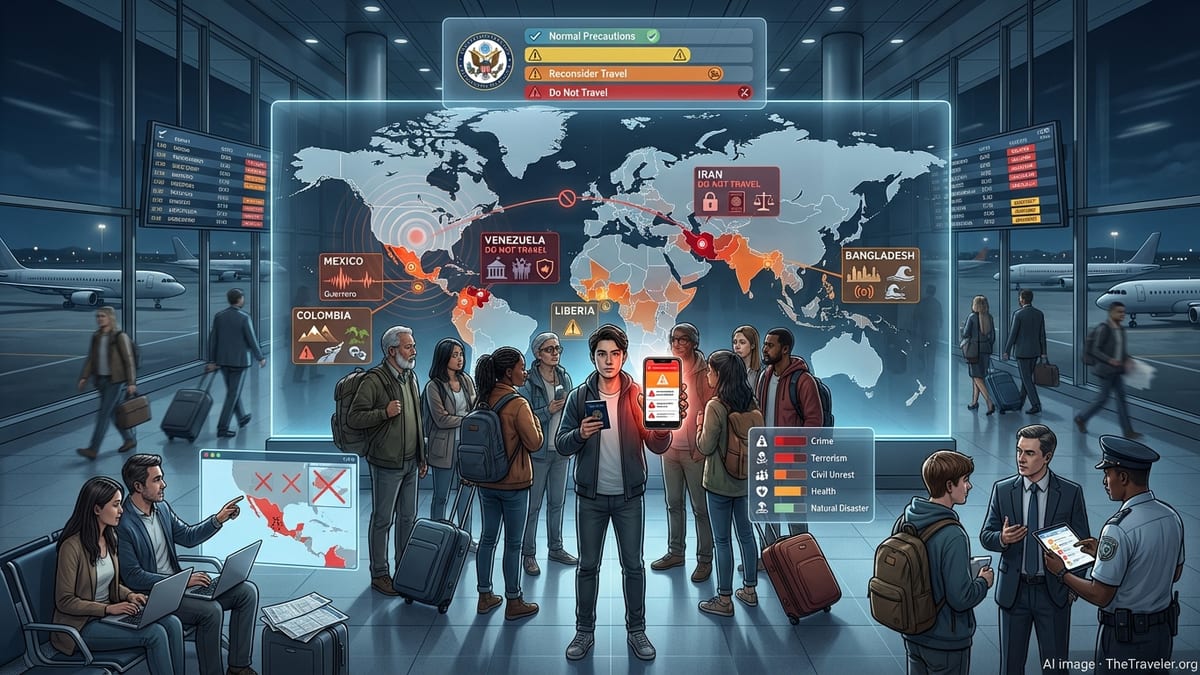
The United States has placed 11 African nations under its highest Level 4 “Do Not Travel” advisory as of late October 2026, highlighting a mix of armed conflict, terrorism, kidnapping, crime and health emergencies that U.S. officials assess as posing life threatening risks to travelers.
Get the latest news straight to your inbox!
Which African Countries Are on the Level 4 List
Publicly available information from the U.S. State Department’s travel advisory database shows that 11 African countries are currently rated at Level 4, the strictest “Do Not Travel” category. These include Libya, Sudan, South Sudan, Somalia, Central African Republic, Democratic Republic of the Congo, Mali, Burkina Faso, Niger, Chad and Nigeria. The configuration reflects a concentration of severe risk across the Sahel, the Horn of Africa and parts of Central Africa.
The list evolves as advisories are updated, but recent advisories for these countries consistently cite overlapping concerns such as widespread armed conflict, terrorist attacks targeting civilians, kidnappings for ransom, banditry on highways and very limited ability by local authorities to ensure security outside major urban centers. For several of the countries, the U.S. government also notes constrained capacity to provide consular assistance if travelers get into difficulty.
In some cases, Level 4 applies nationwide. In others, advisories differentiate between especially high risk provinces and relatively calmer capital areas, even though the overall country rating remains at “Do Not Travel.” The resulting picture underscores how fragmented security conditions can be on the ground, with volatile regions adjacent to areas that still host limited business and humanitarian travel.
The 11 African nations on the list are part of a wider global group of just over twenty countries worldwide under Level 4, placing Africa at the center of the current map of places the U.S. government advises its citizens to avoid entirely.
Why These Countries Reached the Highest Warning Level
The U.S. travel advisory system uses a standardized scale from Level 1 (“Exercise Normal Precautions”) to Level 4 (“Do Not Travel”). At Level 4, the State Department indicates that travelers face a significantly higher likelihood of life threatening risks and that, during an emergency, U.S. government assistance may be very limited. Official guidance materials explain that Level 4 is generally reserved for situations involving active armed conflict, large scale terrorism, severe civil unrest or complete breakdowns in public order.
Most of the 11 African countries on the current Level 4 list are experiencing some combination of insurgency and political instability. In Mali, Burkina Faso, Niger and parts of Nigeria and Chad, insurgent and extremist groups operate across borders, targeting military forces, government officials and civilians. Travel advisories highlight roadside ambushes, improvised explosive devices and attacks on public venues in these areas.
Elsewhere, chronic civil conflict is the dominant driver. In Sudan and South Sudan, reports describe fighting between rival armed factions, mass displacement of civilians and destruction of infrastructure. Advisories for Libya and the Central African Republic point to the presence of multiple armed groups controlling territory, along with frequent clashes and criminal activity that can make overland travel especially hazardous.
Health and humanitarian conditions also factor into Level 4 decisions. Recent coverage of the Ebola outbreak affecting parts of Central Africa notes strains on already fragile health systems in countries such as the Democratic Republic of the Congo and South Sudan. In these environments, travelers may face both heightened risk of infectious disease and very limited access to advanced medical care, particularly outside capital cities.
How the Advisories Affect Travelers and Airlines
Level 4 advisories are not legally binding bans on travel by U.S. citizens, but they carry significant practical effects. Travel insurance providers often use the State Department’s ratings when setting coverage rules, and many policies exclude or sharply limit benefits for trips to countries under a “Do Not Travel” warning. Industry guidance indicates that travelers may find it difficult to obtain evacuation coverage, and premiums can rise sharply even when limited coverage is available.
Commercial aviation links to some of the 11 African countries remain in place but are more limited than for lower risk destinations. International carriers continue to serve major hubs such as Tripoli, Khartoum, Juba, Mogadishu, N’Djamena, Niamey and Kinshasa, sometimes via regional connections, yet route maps show reduced frequencies compared with pre conflict periods. Airlines and foreign ministries alike have periodically suspended or rerouted flights in response to airport security incidents or nearby fighting.
For travelers who proceed despite the advisory, routing often involves complex itineraries through regional hubs like Addis Ababa, Nairobi or Johannesburg, followed by shorter connections into Level 4 destinations. Transit rules can also grow more restrictive during disease outbreaks, with some neighboring states imposing health screenings or temporary entry limits on travelers arriving from affected countries in Central or East Africa.
Diplomatic presence and consular capacity are another critical factor. In some Level 4 African countries, U.S. embassies operate with reduced staff or have periodically drawn down personnel due to security concerns. In others, on the ground presence is limited, increasing the difficulty of replacing lost documents, arranging medical evacuations or coordinating departures if conditions deteriorate suddenly.
Regional Security Trends Behind the Warnings
Regional dynamics across the Sahel and Central Africa help explain why so many neighboring states have converged at the highest U.S. advisory level. Over the past decade, jihadist and other non state armed groups have spread from northern Mali into Burkina Faso, Niger and parts of coastal West Africa, exploiting porous borders and limited government control of remote areas. Public reporting from research institutes and multilateral agencies describes a patchwork of armed actors who tax traders, control smuggling routes and at times clash with one another.
Military coups in Mali, Burkina Faso and Niger since 2020 have also altered security partnerships with Western countries and regional blocs. According to policy analysis published in 2025 and 2026, withdrawals or reconfigurations of foreign security missions have coincided with surges in attacks in some rural zones, further complicating the risk environment for both local residents and any visiting foreigners.
In the Horn of Africa, Somalia’s long running conflict with Al Shabab continues, while tensions and localized fighting in parts of Sudan and South Sudan contribute to fluid front lines and repeated population displacement. In Libya and the Central African Republic, competing political factions and foreign mercenary involvement have entrenched a semi permanent state of instability that periodically flares into open clashes around urban centers and key transport corridors.
These regional patterns mean that road travel between some Level 4 countries can carry equal or greater risk than flying into a single capital. Cross border bus and trucking routes frequently pass through areas affected by banditry or insurgent activity, a reality reflected in advisories that repeatedly warn against overland travel between certain cities and border posts, even when airports remain open.
What Prospective Travelers Should Consider Now
For U.S. citizens assessing travel to Africa, the cluster of 11 countries under Level 4 highlights the importance of checking both country specific advisories and subnational guidance. The same continent that includes these high risk destinations also features many African nations rated Level 1 or Level 2, where travel is comparatively straightforward and tourism sectors are actively promoting visits.
Reports from travel risk consultants recommend that anyone with essential reasons to visit a Level 4 country conduct detailed, route specific security planning, maintain flexible evacuation options and prepare for rapid changes in local regulations such as curfews, airport closures or new health screening requirements. Organizations sending staff often require specialized security support, armored transport in some locations and strict movement controls, especially outside capital cities.
For leisure travelers, analysts generally advise redirecting itineraries to safer alternatives when a destination moves to Level 4. This may mean substituting coastal West African nations that remain at lower advisory levels for Sahel states, or focusing on East and Southern African destinations with established tourism infrastructure, while continuing to monitor developments in neighboring high risk countries.
Observers note that travel advisories are reviewed regularly and can change as peace agreements take hold, security forces regain territory or health emergencies subside. For now, however, the 11 African countries on the U.S. government’s highest warning list illustrate how conflict, terrorism and fragile health systems can converge to reshape travel patterns across an entire region.