


More news on this day
Saul “Canelo” Alvarez has landed in Riyadh ahead of his October 31 super middleweight title fight, arriving in Saudi Arabia as a heightened United States travel warning spotlights rising security concerns around the kingdom’s airports and major events.
Get the latest news straight to your inbox!
Fight week begins under heightened security backdrop
Published coverage indicates that Alvarez arrived in the Saudi capital early on Monday, October 26, six days before he is scheduled to challenge WBC super middleweight champion Christian Mbilli in Riyadh. The bout is part of a “Mexico vs The World” card and is set for Saturday, October 31, at an arena in the city often described in reports as The Venue, a hub for high-profile combat sports.
Reports from sports outlets show that the fight week schedule, including a Thursday pre-fight press conference and other promotional events, is proceeding largely as planned. Organizers continue to position the showpiece bout as a highlight of Riyadh Season, the country’s multi-month entertainment program that has turned the Saudi capital into a recurring destination for international boxing fans.
Alvarez’s early arrival follows weeks of speculation over whether the event would move or be postponed in response to regional tensions. Boxing-focused coverage notes that the four-division champion had privately indicated he remained committed to competing in Riyadh “no matter what happens,” a stance that has become central to how the fight is being framed globally.
For visiting spectators, the confirmation that Alvarez is on the ground in Riyadh is the clearest signal so far that, barring a late change in security conditions, the card is expected to go ahead on the scheduled date.
US travel advisory raised as Houthis target Saudi airports
The fighter’s arrival coincides with a more severe security picture than many previous Saudi-hosted sporting events. According to the latest information published by the US Department of State, the Saudi Arabia travel advisory was updated on October 23, 2026, to Level 3, “Reconsider Travel,” alongside an ordered departure for non-emergency US government employees and their eligible family members.
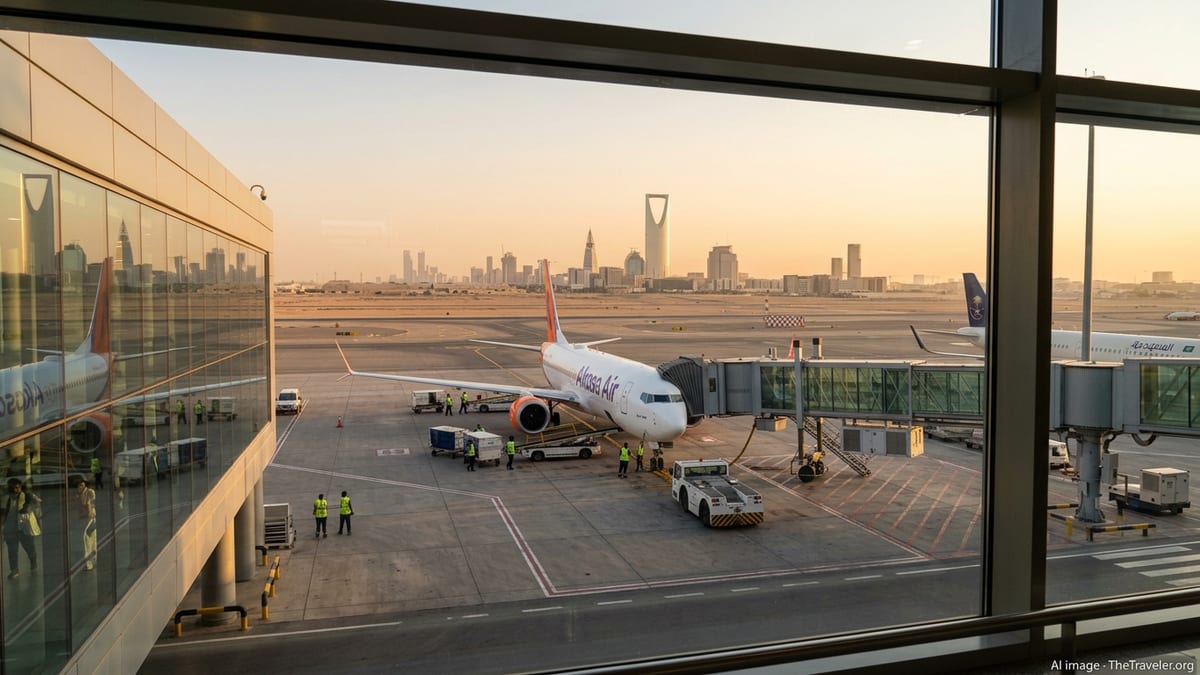
The advisory cites escalating attacks by Iran-aligned Houthi forces from Yemen, including missile and drone strikes on Saudi infrastructure and civilian airports. Publicly available reporting on the October 2026 incidents describes a series of attacks on multiple Saudi airports that caused dozens of deaths and hundreds of injuries, with King Khalid International Airport outside Riyadh among the facilities affected.
The US Embassy in Riyadh has also issued recent security alerts urging “extreme caution” at Saudi airports and tightening rules for embassy personnel, including additional authorization requirements for domestic air travel. The alerts highlight the possibility of sudden disruptions, diversions, and closures affecting both international and internal flights.
These developments mean that Alvarez, his team, and thousands of supporters are entering a country where official guidance from Washington urges travelers to carefully weigh risks related to air travel, potential attacks, and the possibility of rapidly changing conditions on the ground.
Riyadh doubles down on mega-events despite cancellations elsewhere
Even as the State Department warning level has risen, Saudi Arabia has continued to push ahead with many elements of its events calendar. Regional sports coverage notes that Riyadh has quickly become a key stop for global boxing, mixed martial arts, and professional wrestling, with major cards and shows clustered around the autumn entertainment season.
At the same time, some competitions have already been postponed or called off amid the security climate. International media reports indicate that a high-profile golf tournament, esports finals, and several cycling events in the kingdom were delayed or canceled in recent weeks following the airport attacks and a broader escalation in tensions.
Against that backdrop, the decision to carry on with Canelo vs Mbilli stands out. Commentators point to the commercial and reputational stakes for local organizers and international partners who have invested heavily in Riyadh Season programming. The event has also become a test case in how far major sports properties are willing to proceed in environments where Western governments are urging caution.
For travelers, this mix of continued high-profile events and selective cancellations translates into a more complex risk assessment. Visitors weighing a trip for the fight in Riyadh must navigate both the lure of a marquee boxing card and the reality that some other international competitions in Saudi Arabia have already stepped back.
What the situation means for fans traveling to the fight
Publicly available travel advisories and embassy notices now form an essential part of trip planning for anyone considering a visit to Saudi Arabia around the October 31 bout. The US government’s Level 3 advisory does not prohibit private travel, but it explicitly encourages US citizens to reconsider non-essential trips and to prepare for potential disruptions.
Reports referencing recent embassy guidance in Riyadh stress that aviation infrastructure has been a focus of past attacks and that conditions can change quickly. Travelers are being urged in open-source information to stay alert for mobile emergency notifications in the city, to monitor airline communications closely for schedule changes, and to have contingency plans if flights are delayed or rerouted.
Coverage of fight week preparations also highlights that some teams and support staff have looked at routing options that avoid long layovers in Saudi airports, while others continue to fly directly into Riyadh. For independent travelers, that divergence underscores how participants are interpreting the same set of risks in different ways.
In addition to security considerations, visitors still need to comply with Saudi entry rules, including visa requirements that can usually be met through an e-visa platform or visa-on-arrival for eligible nationalities. However, the possibility of sudden airspace restrictions or airport closures has added an extra layer of uncertainty to what, in previous years, had become a relatively straightforward trip for many international sports fans.
A showcase bout in a shifting regional landscape
The Alvarez–Mbilli matchup was already notable as the Mexican star’s first appearance since his 2025 loss to Terence Crawford and as another example of Saudi Arabia’s efforts to host undisputed or lineal title fights. Now, it is also framed by a more volatile regional security context that could shape how future destination events are evaluated by promoters, athletes, and travelers.
Commentary in international outlets suggests that, if the card proceeds smoothly despite the elevated travel advisory, it may reinforce Riyadh’s pitch as a resilient host city capable of staging large-scale events amid regional instability. Conversely, any significant incident or disruption around fight week would likely prompt renewed scrutiny of decisions to concentrate global sports fixtures in the Gulf at times of heightened tension.
For now, Alvarez’s arrival means that boxing fans watching from abroad can expect fight week activities to unfold in Riyadh as scheduled, even if some would-be travelers decide to stay home in light of official warnings. The situation offers a clear example of how modern sports tourism increasingly intersects with geopolitics, security assessments, and personal risk calculations far beyond the ring itself.