


More news on this day
Mexican boxing star Canelo Alvarez has arrived in Riyadh ahead of his super middleweight title clash with Christian Mbilli on October 31, touching down in the Saudi capital just days after the United States sharpened its security warning for travelers to the kingdom.
Get the latest news straight to your inbox!
Fight week begins under tightened security climate
Alvarez’s arrival on October 26 comes as fighters, trainers, promoters and broadcast crews converge on Riyadh for the “Mexico vs the World” card, one of the centerpieces of this year’s Riyadh Season entertainment program. Publicly available schedules indicate that Alvarez will face WBC super middleweight champion Christian Mbilli in the main event at an arena in the Saudi capital, with undercard bouts featuring a mix of international and local talent.
Reports from boxing outlets describe Alvarez checking into a central Riyadh hotel and beginning light fight-week activities after completing the main phase of his training camp in Europe. Social media footage shared by event organizers shows the four-division champion walking through a hotel lobby in the early hours of Monday local time, alongside heavyweight star Oleksandr Usyk, in a choreographed welcome that blended Mexican and Saudi cultural elements.
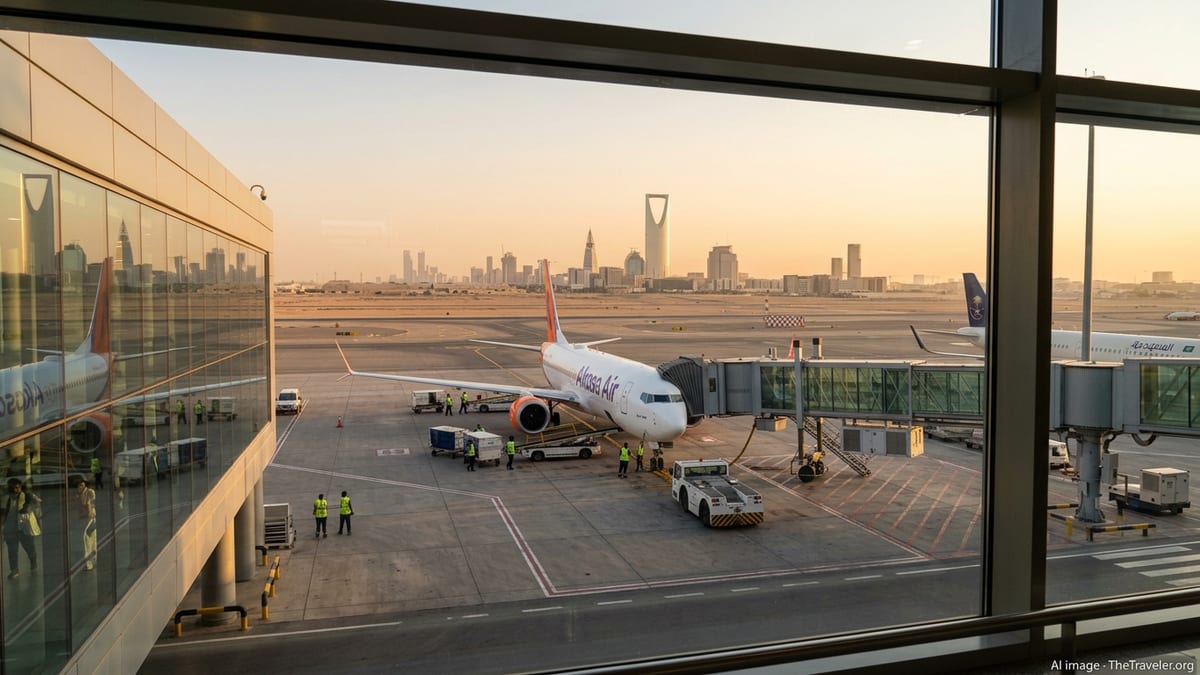
The carefully staged scenes stood in contrast to the tense atmosphere around the city’s air links in recent weeks. King Khalid International Airport, the main gateway to Riyadh, only recently resumed fuller passenger operations following an October 10 missile strike that killed more than a dozen people and injured hundreds, according to regional and international media coverage.
While local aviation authorities have since reopened key terminals, Houthi-aligned spokespeople in Yemen have publicly warned that the airport remains a “military target,” and regional news reports indicate that schedules and routings into Riyadh continue to be disrupted or adjusted in response to changing security assessments.
US travel advisory urges Americans to reconsider trips
The backdrop to Alvarez’s visit is a sharpened United States government warning for travelers to Saudi Arabia. The US Department of State currently rates the country at Level 3, “Reconsider Travel,” citing the risk of drone and missile targeting of American interests by Iran and Iranian-backed Houthi forces, as well as armed conflict, terrorism, exit bans and restrictive local laws on speech and social media activity.
On October 23, 2026, the advisory was updated to note that non-emergency US government employees and their family members had been ordered to depart Saudi Arabia due to safety risks. The advisory history shows a series of updates during September and October, reflecting evolving concerns over potential attacks and providing additional guidance on aviation safety, transportation alternatives and the use of Saudi airports.
Publicly available information from the State Department also highlights specific internal travel limits for US government personnel, including prohibitions on movement near the border with Yemen and additional authorization requirements for trips to several provinces and cities. Travel analysts note that such restrictions, while not directly binding on private citizens, are often viewed as an indicator of the government’s own risk calculations.
The Level 3 designation is one step below the highest Level 4 “Do Not Travel” category. Regional security summaries compiled by international media and risk consultancies indicate that neighboring states including Bahrain, Jordan, Kuwait, Oman, Qatar and the United Arab Emirates are currently under the same Level 3 umbrella, while Iran, Iraq, Lebanon, Syria, Gaza and Yemen carry Level 4 warnings.
Missile and drone strikes keep air travel in the spotlight
Concerns about the timing and location of the Alvarez–Mbilli bout intensified after the October 10 attack on King Khalid International Airport. Coverage by global news organizations reported that at least 12 to 13 people were killed and more than 300 injured when a missile hit the facility, prompting the suspension of flights and the diversion of inbound traffic to other airports.
Subsequent reporting by boxing and general news outlets indicates that Riyadh’s main airport has since reopened to international and domestic flights, but on a reduced or adjusted basis, with some airlines still reviewing routings and schedules in light of security warnings. Commentaries in specialist travel media describe the airport’s status as a key factor for spectators, media workers and support staff attempting to reach the fight week events.
US travel guidance notes that, even when commercial flights resume, the security situation around key infrastructure can change quickly. Recent advisory updates have specifically mentioned the risk of missile and drone attacks on airports and other critical facilities, and urge travelers to avoid photographing or filming missile and drone activity, citing local laws and security sensitivities.
Despite these warnings, major sporting and entertainment events linked to Riyadh Season have so far remained on the calendar. Industry-focused outlets have pointed to the financial stakes for promoters, broadcasters and participants, with multi-million-dollar purses and long-term partnerships tied to Saudi Arabia’s drive to host global sports properties.
High-profile sports stay on the Saudi calendar
Canelo Alvarez’s decision to continue with the bout in Riyadh follows weeks of speculation over whether escalating tensions might force a venue change or postponement. Boxing media reports recount that in mid-October, Turki Alalshikh, a senior Saudi sports official and key architect of the country’s boxing projects, posted that Alvarez had personally indicated his intention to fight in Riyadh “no matter what happens,” a message that was widely circulated among fans and commentators.
The Alvarez–Mbilli fight is part of a broader slate of events that includes professional wrestling and mixed martial arts shows, as well as football exhibitions, all promoted as part of Riyadh Season’s goal of turning the city into a recurring global entertainment hub. Coverage in sports business publications notes that long-term agreements linking major US-based promotions to Saudi venues have continued despite periodic security alerts and international criticism.
Analysts quoted in these outlets observe that the presence of stars such as Alvarez is seen by Saudi organizers as central to reshaping the country’s image with international audiences. At the same time, rights groups and some commentators have used the current travel warnings to renew debates about the risks and ethics of staging high-profile spectacles in environments facing heightened security threats.
For the fighters themselves, the balancing act focuses on professional opportunity and personal safety. Public statements from organizers and participants emphasize preparation and confidence, while the official travel advisory language underscores that conditions can shift with little notice, potentially affecting both the journey to the venue and the broader environment around major gatherings.
What the advisory means for visiting fans
While the State Department does not prohibit US citizens from traveling to Saudi Arabia, the Level 3 advisory signals that individuals should carefully weigh the risks and make contingency plans. Guidance on the agency’s official site encourages prospective visitors to enroll in the Smart Traveler Enrollment Program, share itineraries with family or friends, and maintain a high level of awareness about local security developments.
The advisory stresses that drone and missile activity, terrorist attacks and regional armed conflict could disrupt air travel or other transport at short notice. It also notes that exit bans and legal issues arising from financial disputes, social media posts or behavior deemed offensive under local law can prevent individuals from leaving the country until cases are resolved.
Travel-focused publications responding to the latest airport attack have urged visitors to monitor airline communications closely, confirm routing into Riyadh or alternative airports before departure, and keep flexible plans for onward travel. Some coverage highlights that insurance providers may treat regions under Level 3 or Level 4 advisories differently, making it important for travelers to review policy terms related to war, terrorism and civil unrest.
For boxing fans considering a trip to see Alvarez in person, the combination of a marquee sporting occasion and an elevated security environment presents a complex calculation. With fight week now underway, the contrast between packed hotel lobbies and air-raid warning alerts captures the tension of a city seeking to project normality even as international guidance urges caution.