


More news on this day
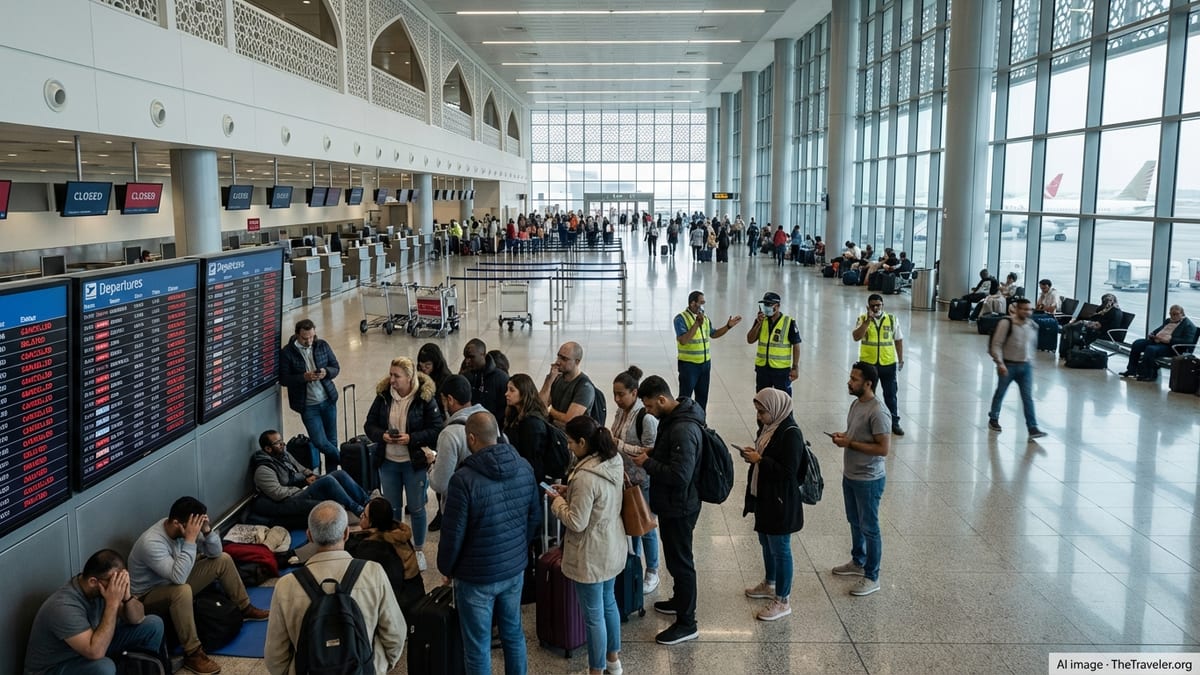
Philadelphia International Airport is grappling with some of its most severe delays in years as a fast-moving energy shock, driven by a US–Iran conflict and a near-lockdown of the Strait of Hormuz, sends oil prices toward 200 dollars a barrel and forces airlines worldwide to rip up schedules in real time.
Get the latest news straight to your inbox!
Global Energy Shock Hits Airline Timetables
Published market analysis shows that the effective shutdown of the Strait of Hormuz, a corridor that normally carries about one fifth of the world’s seaborne oil, has tightened supplies and driven benchmark crude prices sharply higher, with some trading sessions briefly testing levels near 200 dollars a barrel as risk premiums surge. Research from regional banks and energy consultancies indicates that traders are now pricing in a prolonged period of constrained Gulf exports, especially from producers without robust alternative routes.
The conflict that erupted in late February, following coordinated strikes on Iranian targets and a subsequent Iranian move to restrict shipping through Hormuz, has cascaded quickly from military confrontation to commercial disruption. Logistics advisories describe a collapse of vessel traffic through the chokepoint and a scramble to reroute tankers via longer, costlier paths. These shifts have amplified volatility across oil and jet fuel markets, with refiners and airlines exposed to unexpectedly high input costs and patchy physical supply.
Economic commentaries suggest that the present shock is distinct from previous oil crises because it is colliding with already-strained shipping networks. With segments of the Red Sea and Suez corridor still operating below pre-2024 capacity, diversions away from Hormuz are compounding travel times and freight rates. For aviation, this means more expensive fuel at the same time that long-haul routings in and out of the Gulf require significant detours to skirt high-risk airspace.
Financial institutions tracking the conflict warn that even if a partial reopening of Hormuz is achieved, the combination of damaged infrastructure, heightened insurance costs and lingering geopolitical tension is likely to keep energy prices elevated well into 2026, locking airlines into a more expensive operating environment just as peak summer travel demand approaches.
Philadelphia International Strains Under Cascading Delays
Publicly available airport dashboards and airline advisories show that Philadelphia International has emerged as one of several major US hubs experiencing outsized disruption as the energy shock filters into flight operations. While the airport is geographically distant from the Gulf, its role as a transatlantic and domestic connector makes it vulnerable to any disturbance in long-haul schedules and aircraft availability.
According to flight-tracking services, carriers serving Philadelphia have consolidated some Europe and Middle East bound services, citing higher fuel costs, extended routings to avoid contested airspace and uncertainty over refuelling options at intermediate hubs. These schedule changes, often announced within 24 to 48 hours of departure, are creating rolling knock-on effects that reverberate through domestic feeder flights, producing waves of delays through the day.
Aviation analysts note that airlines are prioritising aircraft and crews for routes that can still operate profitably under current fuel price assumptions. That calculus can leave secondary international gateways, including Philadelphia, exposed to last-minute downgrades in capacity or aircraft swaps. Passengers are encountering longer check-in lines, rebooking queues and instances where connecting itineraries unravel when an upstream transatlantic leg is cancelled or heavily delayed.
Industry data also suggests that some carriers are experimenting with more aggressive tankering strategies, loading additional fuel at US or European airports where supply is more secure in order to reduce dependence on higher-risk or higher-cost refuelling points. While this can offer cost and resilience benefits, it adds weight, marginally increases fuel burn, and may require payload restrictions that translate into seat caps or cargo offloads on flights touching Philadelphia.
Saudi Arabia Leans on Pipelines and Domestic Hubs
In the Gulf, Saudi Arabia is attempting to shield its aviation network from the worst of the disruption by using its pipeline infrastructure to rebalance crude flows away from Hormuz. Business media reports highlight that the kingdom’s East–West pipeline to the Red Sea port of Yanbu has been ramped to near full capacity, allowing more crude to bypass the contested strait and reach global markets, albeit at constrained volumes relative to pre-crisis exports.
Energy and economic briefings indicate that this pipeline pivot is central to Riyadh’s effort to prevent a total seizure of its export capacity, which would further tighten global oil supply and potentially push prices beyond recent spikes. By sustaining at least partial flows, Saudi Arabia can continue feeding domestic refineries and jet fuel production, which in turn supports the operation of its major airports, including Riyadh, Jeddah and the rapidly expanding Red Sea hubs.
Aviation-focused commentary from the region suggests that Saudi carriers are nonetheless heavily exposed to the airspace and security implications of the conflict. Rerouted long-haul flights that avoid overflying high-risk zones add flight time and fuel burn, even as carriers work to preserve connectivity between Europe, Asia and Africa via Saudi hubs. Network planners are reportedly trimming marginal routes and focusing capacity on core corridors where demand and yields can absorb higher costs.
Observers note that the crisis is testing Saudi Arabia’s broader strategy to position itself as a global aviation crossroads. Investment in alternative energy export routes is providing some insulation for jet fuel supply, but the country remains entangled in a regional security environment that can quickly alter both air and sea traffic patterns, with knock-on effects for travellers worldwide.
UAE Airports Balance Resilience and Vulnerability
The United Arab Emirates, home to some of the world’s busiest long-haul hubs, is navigating a more complex mix of strengths and vulnerabilities. Trade and energy commentary underscores that the country benefits from the Habshan–Fujairah pipeline, which connects onshore fields directly to the Gulf of Oman, outside the Strait of Hormuz. International energy agencies report that flows through this line have been running at or near stated capacity since the crisis began.
This pipeline capacity has allowed the UAE to preserve a meaningful share of its export volumes despite the effective closure of Hormuz, providing a measure of stability for domestic fuel markets and the country’s large aviation sector. At the same time, reports on recent attacks and fires near key oil and logistics facilities highlight how exposed the UAE remains to spillover from the conflict, with temporary shutdowns and heightened security postures affecting both shipping and air operations.
Regional aviation analysis indicates that Emirates, Etihad and other UAE-based carriers have undertaken significant schedule reshaping, including rerouting flights, lengthening flight paths and selectively consolidating services. Even with relatively secure jet fuel access, higher global oil prices and rising insurance and security costs are pressuring margins. Some long-haul itineraries now involve longer ground times and wider connection windows to accommodate the risk of regional delays, rippling outward to partner airports in Europe and North America.
For travellers, the net effect is a less predictable network. While major UAE airports remain operational and continue to function as transit hubs between continents, their role as shock absorbers in the global system means that any operational slowdown in Dubai or Abu Dhabi can quickly propagate to airports like Philadelphia that feed into, or receive traffic from, these Gulf super-connectors.
Aviation Adapts to a Prolonged Hormuz Lockdown
Across the industry, planning documents and expert commentary point to a growing assumption that the Strait of Hormuz disruption will not be resolved quickly. Maritime security assessments describe vessel traffic through the corridor as having collapsed by more than 90 percent from pre-conflict levels, while new naval escort operations are only beginning to re-establish limited commercial transits under tight protection.
For airlines and airports, this outlook is driving a shift from short-term crisis response to medium-term adaptation. Carriers are revisiting fuel hedging strategies, re-evaluating the economics of ultra-long-haul routes, and considering more frequent technical stops in lower-risk locations to spread fuel sourcing. Airport authorities in North America and Europe, including those at Philadelphia, are meanwhile preparing for continued irregular operations, with some publicly available operational updates warning of extended periods of schedule volatility.
Industry analysts argue that the 2026 energy shock is accelerating structural changes that were already underway. Moves to more fuel-efficient fleets, greater use of sustainable aviation fuel and diversified routing strategies are gaining urgency as the cost of reliance on a single maritime chokepoint becomes more apparent. Yet these transitions take years, not months, leaving the current travel season exposed to high prices and frequent schedule changes.
For now, passengers flying through Philadelphia, Saudi Arabia and the UAE are experiencing the frontline effects of these geopolitical and energy market shifts in the form of missed connections, longer journeys and higher fares. How quickly the sector can stabilise will depend not only on diplomatic efforts to ease the US–Iran confrontation, but also on how effectively energy exporters and aviation stakeholders can redesign networks to live with a more fragile Strait of Hormuz.