


More news on this day
A traveler expecting an roughly 11-hour journey to Europe instead faced a drawn-out, roughly 40-hour sequence of delays and missed connections, with published coverage describing Air Canada offering a food voucher valued at about 15 euros along the way.
Get the latest news straight to your inbox!
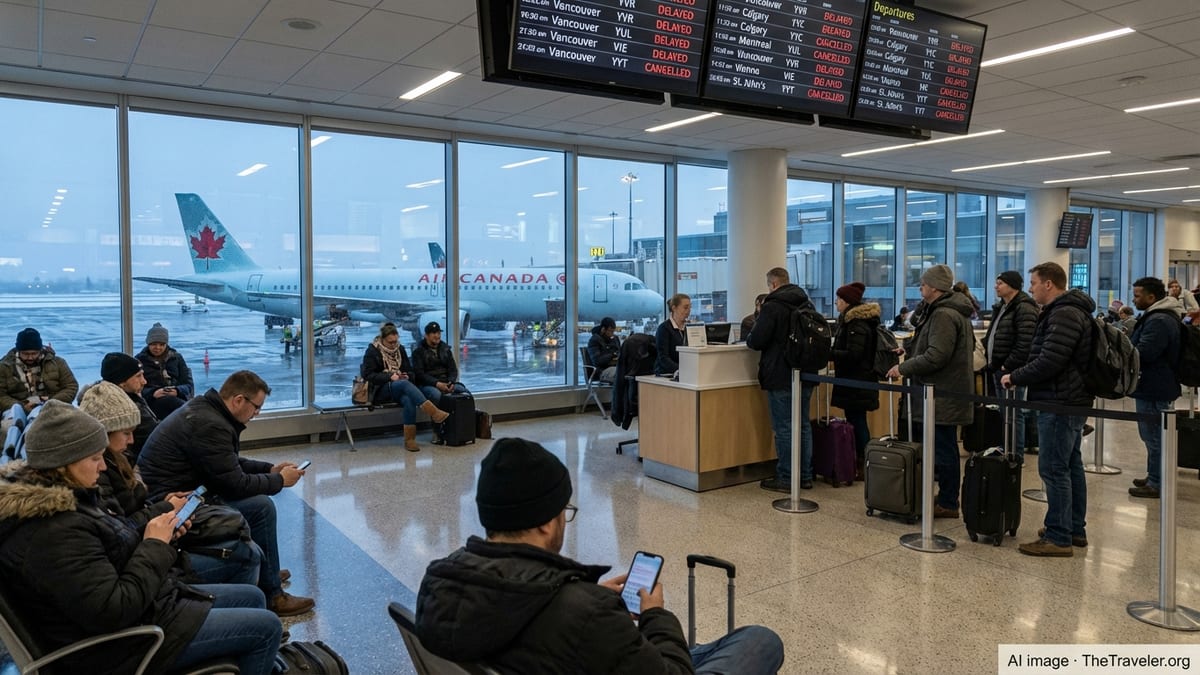
A short transatlantic plan turns into a multi-stop disruption
Published accounts of the trip describe a familiar summer-travel pattern: a long-haul itinerary that unravels after an initial delay ripples across later connections, turning what should be a same-day arrival into an overnight and then a second-day scramble. In this case, coverage characterized the experience as a gauntlet that stretched to roughly 40 hours before the traveler reached Europe.
While the precise details of the routing, flight numbers, and airports vary by account, the broad mechanics are consistent with how airline networks behave during irregular operations: once a passenger misses a connection, they may be routed onto the next available seats, sometimes via different hubs, and those seats can be scarce during peak travel periods. That can push arrivals deep into the next day even when the original itinerary was designed to be completed in a single travel window.
One detail that stood out in the coverage was the value of the assistance offered during the wait: a food voucher described as 15 euros. For passengers stuck airside in major international terminals, that amount can cover only a limited purchase, especially where prices skew higher than in the city outside the airport.
What rules say about meals, hotels, and rebooking on disrupted trips
In Canada, the Air Passenger Protection Regulations set minimum standards of treatment when a disruption is within an airline’s control or within its control but required for safety, including food and drink in reasonable quantities after a passenger has waited at the airport for two hours or more, along with access to means of communication. Publicly available guidance also notes that airlines may limit or refuse assistance if providing it would further delay the passenger, such as when boarding is imminent.
For overnight delays, the same Canadian framework can require hotel accommodation and transportation to and from that accommodation in certain circumstances, again depending on the reason for the disruption and where the carrier’s control is determined to sit. This is often where real-world frustration builds: the passenger experience is immediate, but eligibility can turn on post hoc classifications like “within the airline’s control,” “required for safety,” or outside the airline’s control.
For flights touching Europe, passenger-rights obligations can also intersect with European Union rules, which include requirements to provide care and assistance such as meals and refreshments when delays pass certain thresholds, as well as potential compensation in some situations. Determining which regime applies can be complicated on itineraries involving non-EU carriers, multiple segments, and connections, and it may depend on whether the disrupted flight departed from an EU airport or was operated by an EU carrier.
Separately from regulatory schemes, the Montreal Convention can matter for certain delay-related damages on international travel, though it operates differently from fixed compensation frameworks and typically requires documenting actual losses and navigating claim processes rather than receiving automatic, schedule-based payments.
Why a 15-euro voucher resonates with travelers right now
Meal vouchers are a standard tool airlines use to provide immediate, trackable assistance when disruptions occur. The problem, as passengers frequently point out across published accounts and public complaint channels, is that the value of a voucher can feel disconnected from airport pricing, especially in international terminals where a simple meal can run well beyond budget fast.
A 15-euro voucher, in practical terms at many large European hubs, may cover a snack and a drink, or a basic fast-casual item, but it may not cover a full meal depending on the outlet and country. It can also be less useful if the passenger is moved between terminals, must clear security again, or is rebooked onto a flight that departs from a different concourse where the voucher is not accepted at certain vendors.
Another friction point is timing. When delays stretch into multiple phases, a single voucher can feel like a token rather than a standard of care. Some airline policies and regulatory guidance emphasize “reasonable quantities” of food and drink over the course of a wait, but what is reasonable can look very different over four hours versus sixteen.
What passengers can document and do during extended delay chains
When a disruption stretches across multiple segments, documentation becomes the passenger’s leverage, both for insurance and for any later complaint or claim. Travelers can preserve boarding passes, baggage receipts, rebooking confirmations, and screenshots of app notifications showing scheduled versus revised departure and arrival times, especially when the itinerary changes more than once.
Receipts matter as well. Even when an airline offers vouchers, passengers may incur out-of-pocket expenses for food, local transport, accommodations, or necessities. Keeping itemized receipts and noting where and when the expense was incurred can help later, whether the request is framed as reimbursement, an insurance claim, or part of a passenger-rights process.
For Canada-related travel, publicly available resources from the Canadian Transportation Agency outline how complaint processes work and what standards of treatment and compensation may apply depending on the cause and length of a delay. For Europe-related travel, EU passenger-rights guidance similarly sets out what care is owed during waiting periods and what steps passengers can take to pursue claims where eligible.
Even when compensation is uncertain, passengers can still ask for clear written confirmation of the disruption reason and a breakdown of rebooking options. Clarity on whether the carrier is offering the “next available flight” on its own services or on a partner, versus a later option, can shape both outcomes and what a traveler can reasonably request while still at the airport.
A broader spotlight on customer care as airlines face disruption pressure
The Air Canada voucher detail has drawn attention not simply because of the number, but because it encapsulates a wider tension in modern air travel: passengers experience disruptions as a continuous ordeal, while policies and regulations often evaluate each segment or delay reason in discrete categories.
Publicly available information shows Canada’s passenger-rights framework has been under continued scrutiny and adjustment in recent years, including changes that affected refund provisions. In Europe, passenger-rights rules remain a major reference point for travelers seeking predictability during delays, even as the system’s scope and application can be complex on multi-country itineraries.
For travelers, the lesson from the reported 40-hour saga is that the most frustrating moments often hinge on basics: food, a place to sleep, reliable information, and a realistic path to the destination. When those basics are provided in a way that feels out of step with the real costs and real time involved, even a small voucher can become the detail that defines the entire trip.